Ganesh Puja Before a Wedding: Why Every Indian Wedding Starts Here
- Why Ganesha comes first
- When it is held
- What happens in the puja
- Gauri puja, and the pairing
- Where it sits in the wedding sequence
- Regional and community variation
- The samagri list, and why it defeats people
- Sankalp: the part nobody explains
- Timing it around everything else
- A note for destination weddings
- Practical notes
- Frequently Asked Questions
- Sources and further reading
Ganesh puja is the first ritual of an Indian wedding, performed days before the ceremony at both homes. Ganesha is the remover of obstacles and is worshipped before any undertaking, so nothing else in the wedding formally begins until this is done.
Why Ganesha comes first
In Hindu practice Ganesha is invoked at the start of any significant undertaking: a journey, a business, a new house, an examination, a wedding. He is Vighnaharta, the remover of obstacles, and also Vighnakarta, the one who places them, which is precisely why he is addressed first.
For a wedding this is not a formality. A wedding is the largest logistical, financial and emotional undertaking most families attempt, and the ritual acknowledges that plainly: before anything else is done, the family asks for the path to be cleared.
Practically, the Ganesh puja is what converts a set of plans into a wedding that has started. Many families date the beginning of the wedding from this puja rather than from the first guest event, and in traditional households certain restrictions begin here: travel is limited, mourning observances are set aside, and the household is understood to be in a ritual period.
When it is held
Timing varies more than the ritual itself.
- Several days to a fortnight before the wedding, at both the bride’s and the groom’s homes, separately. This is the most common pattern.
- On the morning of the first function, in compressed modern schedules, particularly for destination weddings where the family arrives only days ahead.
- Again on the mandap, immediately before the main ceremony, as the opening of the wedding rituals themselves. Most weddings do this even if a separate puja was held earlier.
The separate home puja is the one increasingly dropped from compressed schedules. Where the family cares about it, it is worth protecting: it is small, it is short, and it is the only ritual in the sequence that belongs purely to the household rather than to the event.
What happens in the puja
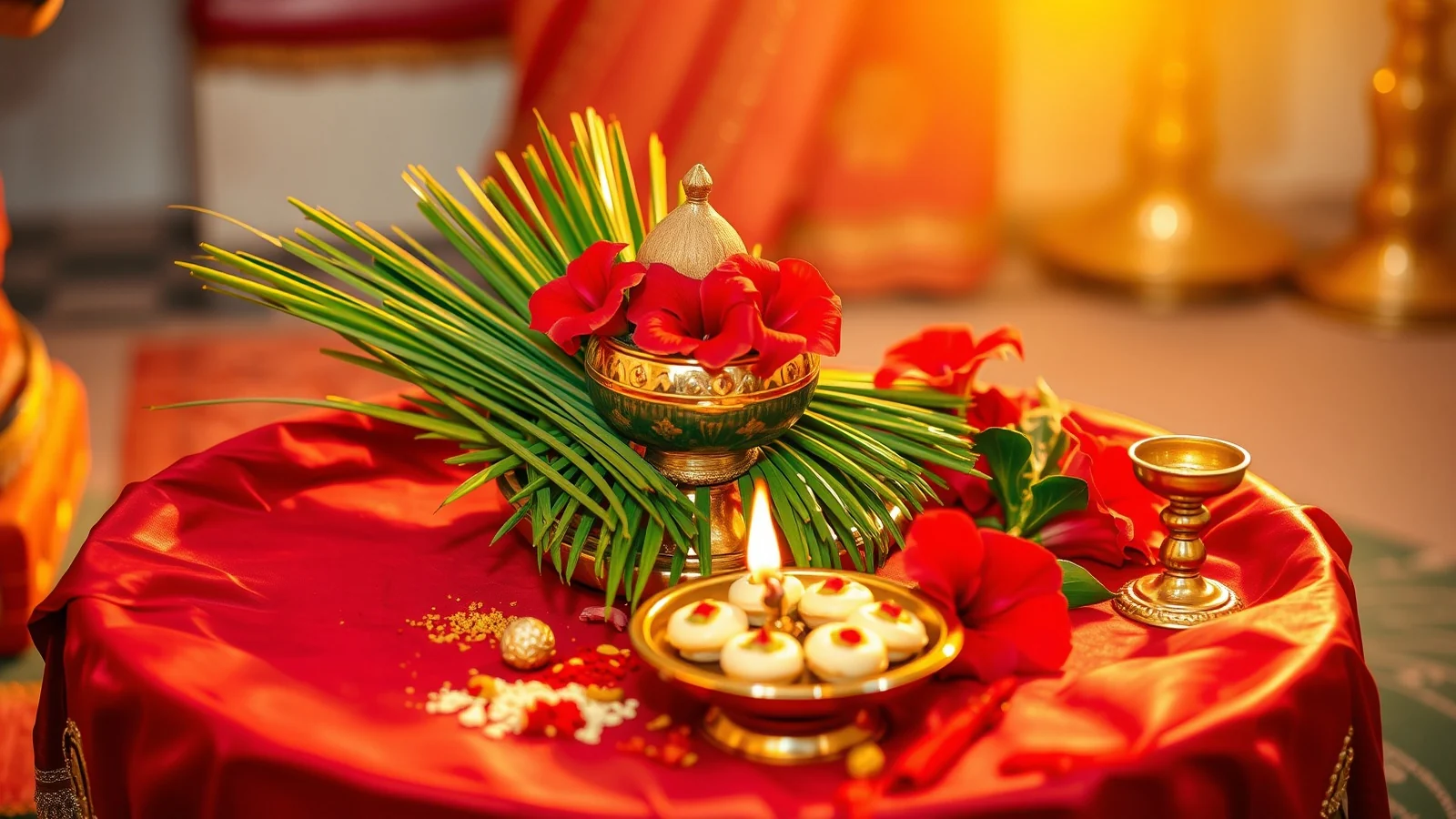
- Installation. An idol or image of Ganesha is placed on a decorated platform, often alongside a kalash, a brass pot of water topped with mango leaves and a coconut.
- Invocation. The priest performs pranapratishtha, inviting the deity to be present in the image for the duration.
- Offerings. Flowers, particularly red hibiscus, durva grass in bunches, sandalwood paste, kumkum, incense and a lit lamp.
- Modak or laddoo. The sweet associated with Ganesha above all others is offered, and distributed afterwards as prasad.
- Aarti. Lamps are circled and the family sings.
- Sankalp. The formal statement of intent, in which the family names the wedding that is about to take place and asks for it to proceed without obstacle.
Durva grass is the detail people miss. The bunches of trefoil grass offered to Ganesha are specific to him and are not used for other deities in the same way. Families who order flowers but forget durva find the priest asking for it, and it is not something a hotel florist stocks.
Gauri puja, and the pairing
In many traditions the Ganesh puja is performed alongside a Gauri puja, in which the bride worships Gauri, a form of Parvati, who is Ganesha’s mother.
The pairing is deliberate. Gauri is worshipped as the ideal wife and the bride’s prayer is for a long and happy married life, so the bride addresses the mother while the household addresses the son. In Maharashtrian and Gujarati practice this pairing is strongly marked; see Maharashtrian and Gujarati wedding traditions.
In some regions the bride performs the Gauri puja on the morning of the wedding, after haldi and before dressing, which makes it the last quiet moment she has before the day begins.
Where it sits in the wedding sequence
- Roka and sagai. The commitment and the engagement. See our roka guide and sagai guide.
- Ganesh puja. The ritual start, at both homes.
- Mehndi, sangeet and haldi. See the mehndi, sangeet and haldi guides.
- Baraat and milni. See the baraat.
- Mandap rituals. Ganesh puja repeated, then kanyadaan, gath bandhan, laja homa and the pheras.
- Vidaai and griha pravesh. See vidaai and griha pravesh.
The complete order is set out in our guide to Hindu wedding rituals.
Regional and community variation
- Maharashtrian. Ganesh worship is especially prominent, unsurprisingly given Ganesha’s standing in Maharashtra. See Maharashtrian wedding traditions.
- Gujarati. Ganesh sthapana is a distinct named event, often with the whole extended family present. See Gujarati wedding traditions.
- North Indian. Performed at both homes and repeated on the mandap. See Punjabi and Marwari traditions.
- South Indian. Vinayaka puja opens the ceremony, and in Telugu weddings it precedes the sequence running to jeelakarra bellam. See South Indian wedding traditions and Telugu wedding rituals.
- Jain. The opening worship differs, reflecting a different theology. See Jain wedding traditions.
Ganesh puja is not part of Sikh, Muslim, Christian or Parsi weddings. See the Anand Karaj, nikah, Christian and Parsi guides for those sequences.
The samagri list, and why it defeats people
A Ganesh puja requires a specific set of materials, the samagri, and the list is longer than families expect.
- Idol or image, and a decorated platform or chowki.
- Kalash, a brass or copper pot, with a coconut and mango leaves.
- Durva grass, in bunches, specific to Ganesha.
- Red flowers, hibiscus by preference, and a garland.
- Roli or kumkum, haldi, akshat, which is unbroken rice mixed with turmeric.
- Incense, camphor, cotton wicks, ghee and a lamp.
- Panchamrit, the mixture of milk, curd, ghee, honey and sugar.
- Modak or laddoo, betel leaves and nuts, fruit, and a coconut for the offering.
- Cloth, a red or yellow piece to drape the platform.
Most of this is available as a pre-packed puja kit, which solves ninety percent of the problem. What the kits do not include is fresh durva grass, fresh flowers and the coconut, which is exactly the list families end up chasing on the morning. Ask the priest for his own list a week ahead; every priest has one and none of them volunteer it unprompted.
Sankalp: the part nobody explains
The sankalp is the formal statement of intent, and it is the most substantive moment of the puja even though it looks like administrative recitation.
In it, the family states aloud who they are and what they are about to do. The recitation names the place, the date in the traditional calendar, the lineage of the family, the names of the people undertaking the ritual, and the purpose: the marriage of these two named people. It is, in effect, a declaration on the record.
Two practical points follow. The priest needs the names, gotra and lineage details in advance, the same information required for a South Indian lagna patrika. And it is worth asking him to explain what he is saying, because a family that understands the sankalp experiences the puja as a statement rather than as a preamble.
Timing it around everything else
The Ganesh puja is short, but it constrains what can happen around it.
- It comes first. No other wedding ritual should precede it. Families who schedule a mehndi or a cocktail evening before the puja are, in traditional terms, starting the wedding twice.
- Morning is conventional, and most priests prefer it.
- Both homes, separately. Not one joint event, in the traditional form.
- Fasting. In some families those performing the puja fast until it concludes, which affects how late it can reasonably run.
- The restrictions begin here. In traditional households the ritual period starts with this puja, which can affect travel and other commitments for the days that follow.
For the full order of events, see our complete guide to Hindu wedding rituals.
A note for destination weddings
Where the wedding is at a resort or palace rather than at home, the separate household puja usually cannot happen in the traditional form, and families improvise.
The two workable options are to hold it at home before travelling, which keeps the ritual where it belongs and means the family arrives at the venue with the wedding already begun, or to hold it in the accommodation on arrival with a travelling priest. The second is more common and works perfectly well, though it needs the samagri sourced locally or carried, and a room that permits a lit lamp.
Whichever route, tell the venue. A puja with camphor and incense in a modern hotel room will otherwise set off a smoke detector, which is a memorable but avoidable way to begin a wedding.
Practical notes
- Order durva grass explicitly. It is not a florist default and the puja is incomplete without it.
- Ask the priest for the samagri list a week ahead. The list of required items is long and specific, and assembling it the night before is how families end up sending someone out at six in the morning.
- Decide what happens to the idol. Traditional practice immerses it in water afterwards. Many families now use a clay idol for exactly this reason, and eco-friendly clay idols dissolve cleanly.
- Keep it small. This is a household ritual. Thirty people is plenty, and it works better as an intimate morning than as a function.
- Do not skip it to save an hour. It takes forty-five minutes. Of everything in a wedding schedule, this is the wrong place to find time.
- Confirm whether the Gauri puja is expected, and when. Families frequently assume different answers.
Planning a wedding that honours these traditions?
Team Velvet Knot plans weddings across every major Indian tradition, and we brief vendors on the rituals so nothing gets rushed, mistimed or quietly dropped from the running order. Tell us your dates and your community, and we will come back with an honest plan.
A related rite: read our full guide to kangna bandhana, the protective wrist thread.
The puja that follows: read our full guide to the Satyanarayan puja.
Frequently Asked Questions
Why is Ganesh puja performed before a wedding?
Ganesha is the remover of obstacles and is invoked at the start of any significant undertaking. A wedding is the largest undertaking most families attempt, and the ritual asks for the path to be cleared before anything else formally begins.
When is the Ganesh puja held?
Usually several days to a fortnight before the wedding, separately at the bride’s and the groom’s homes, and then repeated on the mandap immediately before the main ceremony. Compressed schedules sometimes drop the home puja, which is the one worth protecting.
What is offered in the puja?
Flowers, particularly red hibiscus, bunches of durva grass, sandalwood paste, kumkum, incense, a lit lamp, and modak or laddoo as the sweet associated with Ganesha. Durva grass is specific to him and is the item families most often forget to order.
What is the Gauri puja and how is it related?
Gauri is a form of Parvati, Ganesha’s mother, worshipped by the bride for a long and happy married life. The pairing is deliberate: the bride addresses the mother while the household addresses the son. It is strongly marked in Maharashtrian and Gujarati practice.
Do all Indian weddings include a Ganesh puja?
No. It is standard across Hindu weddings, with Vinayaka puja as the South Indian equivalent, and is especially prominent in Maharashtrian and Gujarati practice. It is not part of Sikh, Muslim, Christian, Parsi or Jain weddings, which open in their own ways.
What happens to the idol afterwards?
Traditional practice immerses it in water. Many families now use an unpainted clay idol specifically so it dissolves cleanly, which is both the traditional material and the environmentally sound choice.
Sources and further reading
Begin Your Engagement
Want a real number for your wedding?
Tell us your city, guest count and dates. Team Velvet Knot will come back within 24 hours with an itemised budget.