Baraat: The Indian Wedding Procession Explained
- What the Baraat actually is
- The Baraat ritual sequence
- Regional variations of the Baraat
- Modern Baraat trends
- Baraat planning and cost (2026)
- What the baraat costs
- Timing and roles
- What a live band costs
- Related wedding rituals
- Baraat formats compared by tradition
- The night-time noise limit, and why it decides your start time
- Frequently Asked Questions
- Related rituals on Velvet Knot
- Sources and further reading
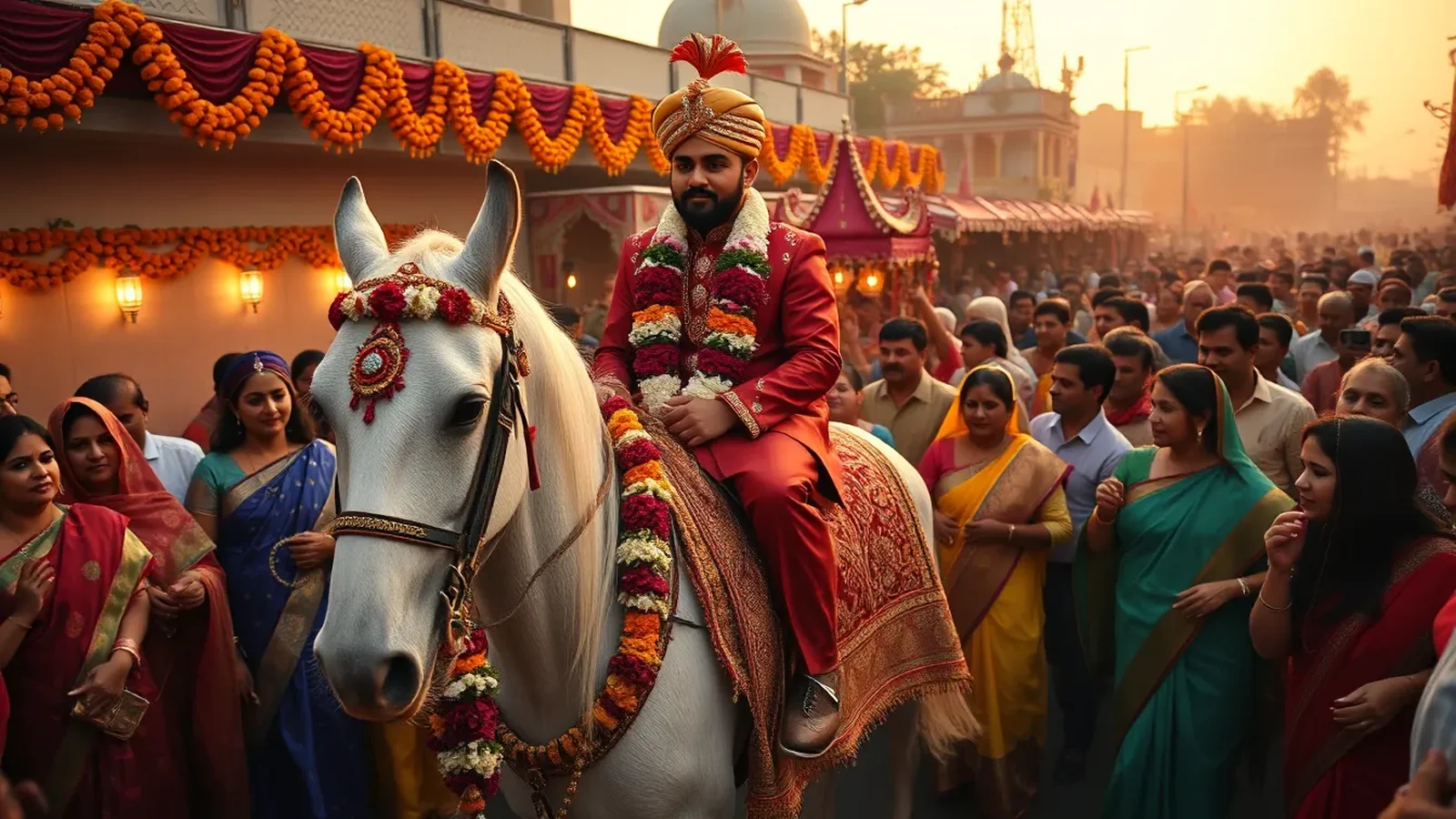
The Baraat is the groom’s wedding procession from his home or the staging area to the wedding venue, accompanied by his male family, friends, and live music (typically dhol players). The Baraat is one of the most visible and celebrated moments of any North Indian or Punjabi wedding: the groom arrives at the wedding mandap in style, often on a decorated horse (the ghori), accompanied by 50-300 dancing family members.
What the Baraat actually is
The Hindi-Punjabi word baraat refers to the wedding procession that escorts the groom to the wedding venue. The procession is led by dhol players, the groom typically rides a decorated horse (the ghori) or in modern weddings a vintage car or designer carriage, and the procession can run 30 minutes to 2 hours from the staging area to the venue depending on distance, scale, and music programming.
The Baraat is uniquely North Indian, Punjabi, Marwari, Bihari, and Rajasthani in its full form. South Indian, Bengali, and Maharashtrian weddings have a more restrained groom-arrival format that does not involve a procession with dhol and dance.
The Baraat ritual sequence
- Staging at the groom’s home or staging area. The groom is dressed in his sherwani and ceremonial accessories (turban, kalgi, sehra veil in some families). His sisters and female cousins perform the Ghodi Chadhna: a brief ritual where the groom is helped onto the horse, garlanded, and blessed.
- Music team setup. Dhol players (typically 4-12 musicians depending on scale) start playing. Some modern Baraats add a brass band or a DJ truck for amplified music.
- Procession start. The groom on the horse leads the procession. His father, brothers, paternal uncles, and male cousins walk alongside or just behind, dancing to the dhol. Distant relatives, friends, and the wider Baraat dance in the surrounding area.
- The walk. The Baraat walks slowly from the staging area to the wedding venue. The procession deliberately moves at dancing pace, not walking pace. Distance varies: traditional Baraats covered 1-3 km, modern Baraats often just 200-500 metres or even from the venue entrance to the mandap.
- Venue arrival. The bride’s family meets the Baraat at the venue entrance. The bride’s mother performs an aarti to welcome the groom. The Milni ceremony (formal exchange between male relatives of both sides) follows. The groom dismounts from the horse and is escorted to the mandap.
Regional variations of the Baraat
Punjabi Baraat (the most elaborate variant)
The classical large-scale Baraat. Dhol-heavy music, the groom on a decorated white horse or sometimes an elephant, 100-300 dancing family members, often a fireworks finale at the venue arrival. Punjabi Baraats can run 1-2 hours of pure procession. Music programming may include a live Punjabi singer for additional 30-60 minutes.
Marwari and Rajasthani Baraat
Distinctive for the Rajasthani folk music (Manganiyars or Langas rather than dhol-dominated Punjabi music), the groom in a traditional Rajasthani Pagdi turban with a sword (the katar) in some Rajput families, and a more dignified procession pace. Camels sometimes feature in destination Rajasthan Baraats.
Bihari and UP Baraat
Similar structure to Punjabi Baraat but with regional folk music (Bhojpuri songs, regional drum patterns) and often a slightly more compressed format. The groom on the horse, family dancing, dhol players.
Gujarati Baraat (called the Janh)
The Gujarati version is called Janh. Structurally similar but with Gujarati folk music and Dandiya dancing rather than Bhangra. The groom often arrives in a decorated car rather than a horse in urban Gujarati weddings.
Bengali, South Indian, Maharashtrian: no traditional Baraat
These regional traditions do not have a Baraat in the North Indian form. The groom arrives at the venue more quietly, often by car, and is welcomed at the entrance with an aarti and ritual reception. Some modern urban couples in these communities are adopting a Baraat-style entry as a cultural adaptation.
Modern Baraat trends
- Vintage car Baraats. A growing number of urban Punjabi and Marwari grooms are choosing vintage Mercedes, Rolls-Royce, or American classic cars instead of the traditional horse. The car arrives at the venue, the groom steps out, and the procession from the car to the mandap is danced rather than the traditional 1-2 km walk.
- Compressed Baraats. Many destination weddings compress the Baraat to a 200-400 metre procession within the venue itself (from the venue entrance to the mandap) rather than a long external procession.
- Helicopter and exotic arrivals. A few high-budget Punjabi grooms have arrived by helicopter in recent years. Costs Rs 3-15 lakh just for the arrival logistics.
- Dance choreography. Modern Baraats often include a pre-rehearsed family dance segment: the groom’s siblings and cousins performing a choreographed routine to a specific song. Choreographers cost Rs 50,000-3 lakh.
Baraat planning and cost (2026)
Standard Baraat budget
| Item | Cost range (Rs ) |
|---|---|
| Decorated horse (ghori) for 2-3 hours | 15,000 to 50,000 |
| Dhol players (6-12 musicians, 2-3 hours) | 25,000 to 1,50,000 |
| Brass band or DJ truck (optional) | 40,000 to 2,50,000 |
| Live Punjabi singer (optional, premium Baraats) | 3,00,000 to 15,00,000 |
| Fireworks at venue arrival (optional) | 30,000 to 2,00,000 |
| Choreographer for family dance segment | 50,000 to 3,00,000 |
| Police permission (for procession on public road) | 5,000 to 25,000 |
| Standard Punjabi Baraat total | 1,50,000 to 8,00,000 |
Logistics that need to be planned
- Police permission. Baraats on public roads require local police permission, especially in metro cities. Apply 2 weeks before the wedding date. Rs 5,000-25,000 for the permit plus any constable accompaniment.
- Route mapping. The procession route needs to be planned, with the bride’s venue informed of expected arrival time. Communication with the bride’s family during the procession (one designated coordinator on the groom’s side calling the bride’s side) prevents the “Baraat running late” coordination breakdown that is a common North Indian wedding issue.
- Horse handler experience. The horse handler needs to know the route and be comfortable with the music volume and crowd. Inexperienced horses can spook from fireworks or sudden crowd movements. Brief 48 hours ahead.
- Sherwani protection. The groom’s sherwani gets dust, sweat, and floral garland staining during a 1-hour Baraat. Have a designated change of accessories (turban, kalgi adjustment) at the venue arrival.
- Hydration. Particularly for summer Baraats: the groom and the procession family need water available throughout the route.
What the baraat costs
Timing and roles
What a live band costs
Related wedding rituals
- sehrabandi, the groom’s ceremony
- joota chupai, the shoe stealing ritual
- gath bandhan, the tying of the knot
- the Ganesh puja that opens a wedding
Baraat formats compared by tradition
The word baraat covers formats that look quite different from one another, and briefing
a band or a venue on the wrong one produces the wrong wedding. The table compares the main
regional forms. Every one of these varies by family, and urban weddings compress all of
them.
| Tradition | Local name | Music | How the groom arrives | Character |
|---|---|---|---|---|
| Punjabi | Baraat | Dhol-led, often a live singer | Decorated horse, sometimes an elephant, increasingly a vintage car | The largest format. Can run one to two hours with a hundred or more dancing |
| Marwari and Rajasthani | Baraat | Manganiyar or Langa folk musicians rather than dhol | Horse, with a pagdi and in some Rajput families a katar. Camels at destination weddings | More measured in pace and noticeably more formal |
| Bihari and UP | Baraat | Bhojpuri folk and regional drum patterns | Horse | Structurally similar to the Punjabi form, usually more compressed |
| Gujarati | Janh | Gujarati folk, with dandiya rather than bhangra | Decorated car in most urban weddings | Shorter, and folded into a day that already carries many functions |
| Bengali, South Indian, Maharashtrian | No traditional equivalent | Nadaswaram, sanai or conch depending on the tradition | Usually by car, received at the entrance | A welcome at the threshold rather than a procession. Some urban couples now add one |
The Milni that follows the arrival is worth naming separately on the run sheet whatever
the format, because it involves specific pairs of relatives from each side and stalls badly
if nobody has worked out in advance who is greeting whom.
The night-time noise limit, and why it decides your start time
Police permission for the route is covered above. The constraint families discover later,
usually mid-procession, is the statutory one on amplified sound. Under the Noise Pollution
(Regulation and Control) Rules, 2000, made under the Environment (Protection) Act, 1986, the
use of loudspeakers and public address systems is prohibited at night, between 10 pm and
6 am. State governments have a narrow power to relax this for a limited number of days in a
year for cultural or festive occasions, and how that is applied varies from state to state
and city to city.
For a baraat this is not a technicality. A procession that starts at nine leaves an hour
before the amplified music has to stop, and the arrival, the aarti and the Milni all sit
after that. Enforcement is real in the metros, and it usually arrives as a police
instruction to switch off rather than as a fine, in the middle of the procession, in front
of every guest.
Three things follow, and they should be settled while the timeline is still being drawn
rather than the week before.
- Work backwards from the limit, not forwards from the muhurat. Fix the
time the amplified music must stop, subtract the procession length honestly, and that is
your start time. Baraats overrun. Assume yours will. - Confirm the local position in writing. Ask the venue and the local
police station what applies on your date and in that specific area, since relaxations and
enforcement both vary. Hotels near residential blocks and hospitals are the strictest. - Have an unamplified fallback. Dhol and brass are acoustic instruments
and do not depend on a PA. Where the venue is genuinely restricted, a dhol-only procession
inside the grounds works and a DJ truck does not.
Frequently Asked Questions
What is the meaning of Baraat?
Baraat literally means “procession” or “group” in Hindi-Punjabi. In Indian wedding tradition, it refers specifically to the groom’s wedding procession from his home or staging area to the wedding venue, accompanied by his male family, friends, and live music. The groom typically rides a decorated horse or, in modern weddings, arrives in a vintage car.
Do all Indian weddings have a Baraat?
No. The Baraat in its full form is specific to North Indian, Punjabi, Marwari, Bihari, Rajasthani, and Gujarati Hindu and Sikh weddings. South Indian, Bengali, and traditional Maharashtrian weddings do not have a Baraat: the groom arrives more quietly at the venue and is welcomed with a ritual aarti.
Why does the groom ride a horse in the Baraat?
The horse (ghori) is a symbol of valour, royalty, and the groom’s status as the central figure of the wedding day. The tradition is rooted in older Indian wedding customs where the groom rode to the bride’s village to formally claim her in marriage. Modern weddings often replace the horse with a vintage car, but the symbolic meaning (the groom’s ceremonial arrival) remains.
How long does a Baraat usually last?
30 minutes to 2 hours. Traditional Baraats covering 1-2 km of public road took longer; modern Baraats compressed to within the venue typically run 30-45 minutes. The procession is deliberately slow to allow family dancing and photography.
Can the Baraat be skipped or compressed?
Yes. Many urban couples and NRI families compress the Baraat to a 200-400 metre procession within the venue itself, lasting 15-25 minutes. Some intimate weddings skip the formal Baraat entirely and have the groom arrive by car at the venue entrance with just immediate family.
What does a Baraat cost in 2026?
Rs 1.5-8 lakh for a standard mid-scale Punjabi or Marwari Baraat with horse, dhol players, and basic procession logistics. Premium Baraats with a live Punjabi singer, choreographed family dance segment, and fireworks can run Rs 10-50 lakh. Compressed venue-only Baraats run Rs 50,000-2 lakh.
Related rituals on Velvet Knot
The Baraat is one element of a wider North Indian wedding format. For related ceremonies see our Saptapadi, Jaimala, Sindoor Daan, and Mangal Phera guides. For community-specific Baraat traditions read our Punjabi wedding rituals and Marwari wedding traditions.
Sources and further reading
- Hindu Marriage Act, 1955: Government of India
- Hindu wedding overview: Encyclopaedia Britannica
Begin Your Engagement
Want a real number for your wedding?
Tell us your city, guest count and dates. Team Velvet Knot will come back within 24 hours with an itemised budget.