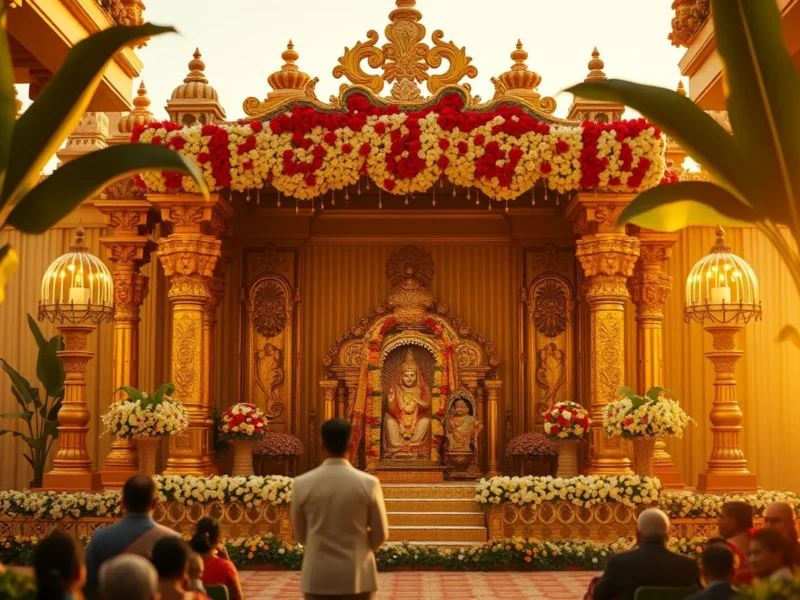
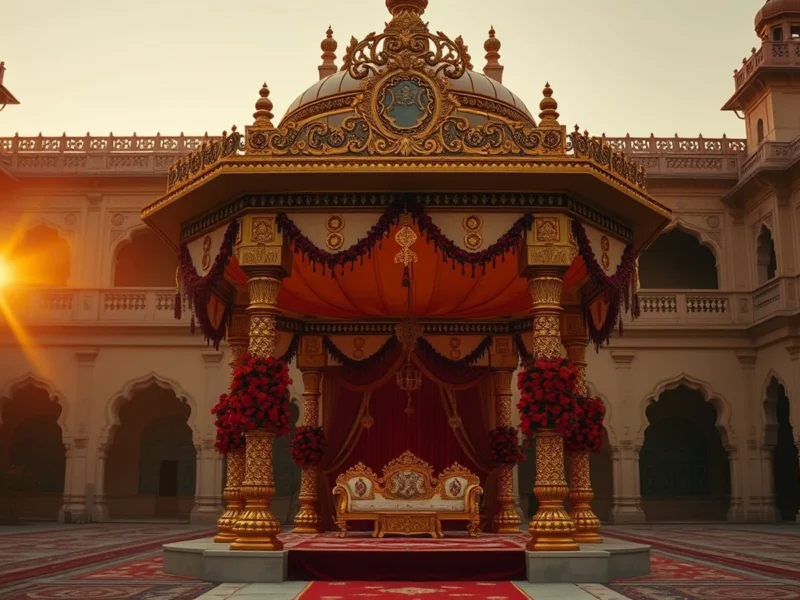
Mangal Phera: The Sacred Circumambulation in Hindu Marriage
- What the Mangal Phera is
- The Saat Phera (seven circles): the most common format
- The Chaar Phera (four circles): the Punjabi and Maharashtrian variant
- The Sikh Anand Karaj: four Laavan
- Regional variations of the Mangal Phera
- The relationship between Mangal Phera and Saptapadi
- The Vivaha Homa: the sacred fire
- Planning notes for the Mangal Phera
- Frequently Asked Questions
- Related rituals on Velvet Knot
- Sources and further reading
The Mangal Phera (Sanskrit: mangala = auspicious, phera = circle) is the rite in a Hindu wedding where the bride and groom walk together around the sacred fire (the Vivaha Homa). The number of circles varies by tradition, typically four in many South Indian and some Punjabi traditions, seven in most North Indian and Bengali traditions. Each circle is accompanied by a specific vow, and the completion of the Pheras marks the solemnisation of the marriage in Vedic Hindu tradition.
What the Mangal Phera is
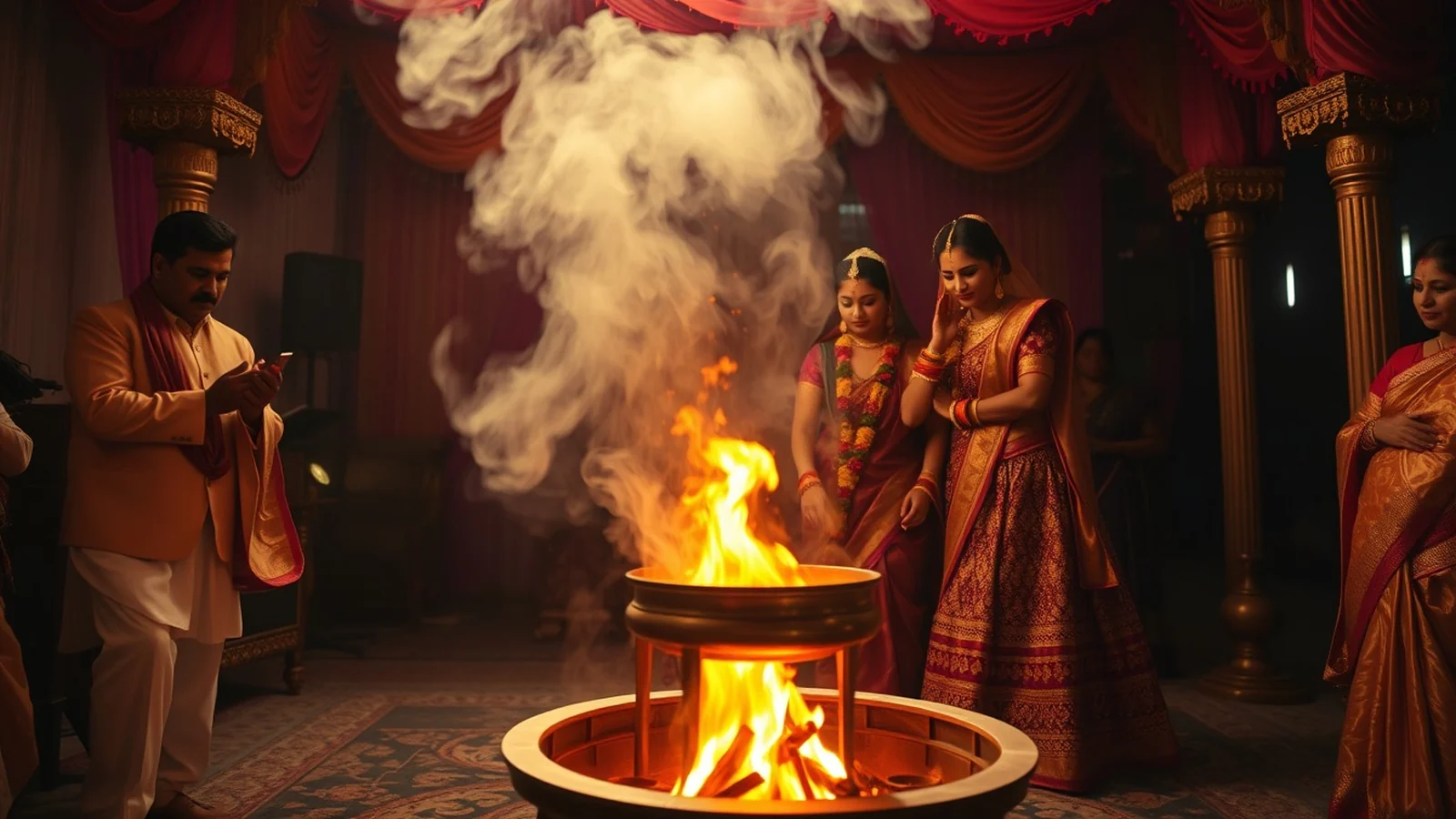
The Mangal Phera is a circumambulation rite: the bride and groom walking around the sacred wedding fire (the Agni or Vivaha Homa) in a clockwise direction. The fire is considered the divine witness to the marriage in Vedic Hindu thought, and the circumambulation formalises the union in the presence of the fire.
The number of circles depends on the tradition:
- Seven circles (Saat Phera, Saptapadi): the most widely-practiced format. Each circle is paired with a specific vow. The Saptapadi is the rite formally recognised under Section 7(2) of the Hindu Marriage Act, 1955.
- Four circles (Chaar Phera): practiced in some Punjabi, Maharashtrian, and Andhra Hindu traditions. Each circle corresponds to a Purushartha (one of the four life goals: Dharma, Artha, Kama, Moksha).
- Three circles: rare, in some Tamil Brahmin Iyengar sub-traditions.
The Saat Phera (seven circles): the most common format
In the Saat Phera tradition, the bride and groom walk seven times around the sacred fire, each circle paired with a specific vow:
- First circle: for nourishment. “Let us share food and provide for each other and our family.”
- Second circle: for strength. “Let us draw strength from each other to face life’s challenges.”
- Third circle: for prosperity. “Let us build wealth and resources together for the wellbeing of our household.”
- Fourth circle: for happiness. “Let us bring comfort and joy to each other through all seasons of life.”
- Fifth circle: for family. “Let us be blessed with virtuous offspring and the continuation of the family.”
- Sixth circle: for longevity. “Let us be granted good health and harmony across all the years to come.”
- Seventh circle: for lifelong friendship. “Let us be lifelong friends in this marriage and in all the lives that follow.”
The bride leads the groom for the first three circles in many North Indian traditions (signaling the bride’s importance and decision-making in the marriage). The groom leads for the remaining four. In some traditions the bride leads all seven, or the groom leads all seven; this is family-specific.
The Chaar Phera (four circles): the Punjabi and Maharashtrian variant
The Chaar Phera, practiced in many Punjabi Sikh weddings (the Anand Karaj follows this format, though as four Laavan rather than four pheras), some Punjabi Hindu families, and many Maharashtrian Hindu weddings, has four circles aligned with the four Purusharthas (the four life goals of Hindu philosophy):
- First circle: Dharma. The path of righteousness and ethical living.
- Second circle: Artha. The pursuit of material wellbeing and prosperity.
- Third circle: Kama. The fulfillment of love, desire, and shared joy.
- Fourth circle: Moksha. The pursuit of spiritual liberation, the highest goal.
The Sikh Anand Karaj: four Laavan
In Sikh weddings the equivalent rite is the Laavan: four hymns from the Guru Granth Sahib, recited by the Granthi while the couple circumambulates the holy book (not a fire). Each Laavan corresponds to a stage of spiritual progression toward union with the divine:
- First Laavan: the beginning of the spiritual journey, the recognition of dharma.
- Second Laavan: the longing and yearning for the divine.
- Third Laavan: the joy and ecstasy of spiritual love.
- Fourth Laavan: the union with the divine, the completion of the spiritual journey.
The Sikh Anand Karaj is governed by the Anand Marriage Act, 1909 (amended 2012). See our Sikh Anand Karaj guide for the full ceremony detail.
Regional variations of the Mangal Phera
Tamil Brahmin (Iyer and Iyengar)
Tamil Brahmin weddings have the Saat Phera with seven circles. The Iyer and Iyengar variants differ in the specific Sanskrit mantras recited during each circle. The ceremony is preceded by the Mangalyam Dharanam (tying of the Thali) in many sub-traditions.
Telugu
Telugu weddings have the Saat Phera with seven circles. Each circle is accompanied by mantras in Sanskrit with Telugu commentary by the family purohit. The bride leads the first three circles; the groom leads the last four.
Bengali
Bengali weddings have the Saat Phera, called the Anjali in some Bengali ritual descriptions. The seven circles are preceded by the Saat Paak (seven circles where the bride circles the groom alone, with her face covered, separate from the Phera).
Marwari and Rajasthani
Marwari weddings have the Saat Phera with seven circles around the sacred fire. The Marwari version includes specific verses honouring the family’s Kuldevi (family deity).
Maharashtrian
Maharashtrian Hindu weddings have either the Chaar Phera (four circles) or the Saat Phera depending on family tradition. The Maharashtrian Chaar Phera version is increasingly rare; most modern Maharashtrian weddings have shifted to seven circles.
The relationship between Mangal Phera and Saptapadi
In some traditions the terms are used interchangeably. In stricter Vedic Hindu thought, the Saptapadi (seven steps) is distinct from the Mangal Phera (seven circles):
- The Mangal Phera is the walking circumambulation around the fire.
- The Saptapadi is the seven discrete steps the bride and groom take at the conclusion of the circumambulation, with each step on a small rice mound while the priest recites a specific vow.
The Hindu Marriage Act, 1955, specifically recognises the Saptapadi (the seven steps) as the moment of marriage solemnisation when this rite is observed. The Mangal Phera as the circumambulation precedes the Saptapadi in some families’ wedding order. In many other families the two are combined or treated as a single rite.
For the full Saptapadi rite detail, see our Saptapadi: The Seven Vows of Hindu Marriage guide.
The Vivaha Homa: the sacred fire
The fire around which the Mangal Phera is performed is called the Vivaha Homa. It is lit by the family priest at the beginning of the wedding ceremony with specific Vedic mantras. The fire is sustained throughout the ceremony with offerings of ghee, sesame seeds, rice, and herbs. The fire is considered the divine witness to the marriage.
The Vivaha Homa is contained in a brass or copper Havan Kund (a small fire pit). The pit is filled with rice, sandalwood, and specific Vedic woods (sandalwood, mango, peepal). The fire is lit and kept burning throughout the wedding sequence, from the Kanyadaan through the Saptapadi.
Planning notes for the Mangal Phera
- Mandap design. The mandap (wedding canopy) must include a central space for the Havan Kund (the fire pit) and sufficient room for the bride, groom, family pandit, and the bride’s parents to be present during the Mangal Phera. The space around the fire should be 6-8 feet on each side to allow the circumambulation without disturbing other ritual elements.
- Fire safety. The Vivaha Homa is a real, lit fire, sometimes for 60-90 minutes continuously. The decor team must ensure adequate ventilation, fire extinguisher access, and flame-resistant draping around the mandap. Indoor weddings need a certified fire safety officer on site.
- Photography brief. The Mangal Phera is one of the most photographed moments of the wedding. Specific shots: the bride and groom walking together around the fire, the family pandit reciting mantras, the bride’s father pouring ghee into the fire, the seventh circle completion. Brief the photographer 24 hours ahead.
- Timing. The seven circles take 7-15 minutes depending on the elaborateness of the mantra recitation. South Indian families typically run the longest version (10-18 minutes including the elaborate Saptapadi follow-on).
- Outfit considerations. The bride’s lehenga or saree should be designed to allow walking around the fire without dragging into it. Heavily embroidered floor-length pallus need to be tucked or shortened for the Phera; the bride’s hair should be tied back to avoid contact with sparks.
What follows the seven steps: read our full guide to the Arundhati nakshatra darshan.
Frequently Asked Questions
What does Mangal Phera mean?
Mangal Phera literally means “auspicious circle” in Sanskrit-Hindi. It is the rite in a Hindu wedding where the bride and groom walk together around the sacred wedding fire (the Vivaha Homa) in a clockwise direction. Each circle is paired with a specific vow. The Mangal Phera, along with the Saptapadi (seven steps), is one of the central solemnising rites of a Hindu marriage.
Are Mangal Phera and Saptapadi the same?
The terms are often used interchangeably. Strictly: the Mangal Phera is the walking circumambulation around the fire (seven or four circles), and the Saptapadi is the seven discrete steps on rice mounds that follow. In many family traditions the two are combined into a single rite. The Hindu Marriage Act, 1955 specifically recognises the Saptapadi as the solemnisation moment.
Why are there seven circles in Mangal Phera?
Seven is a sacred number in Vedic Hindu thought, appearing in multiple contexts (the seven seas, the seven sages, the seven Saptarshi stars). Each of the seven circles in the Mangal Phera is paired with a specific vow covering food, strength, prosperity, happiness, family, longevity, and lifelong friendship. The complete set of seven encompasses all the major dimensions of married life.
Why do some Hindu weddings have four circles instead of seven?
The four-circle (Chaar Phera) variant practiced in some Punjabi and Maharashtrian Hindu traditions aligns each circle with one of the four Purusharthas: the four life goals of Hindu philosophy: Dharma, Artha, Kama, Moksha. Both the seven-circle and four-circle traditions are valid and reflect different sub-regional Hindu wedding practices.
Who leads the Mangal Phera: bride or groom?
Family tradition varies. In many North Indian Hindu weddings, the bride leads the groom for the first three circles (signaling her importance and choice in the marriage) and the groom leads for the remaining four. In other traditions the groom leads all seven, or the bride leads all seven. The family purohit confirms the specific format for that wedding.
What happens if a circle is missed or done out of order?
The priest restarts that section. The seven circles must be completed in order. In a well-coordinated wedding this is not an issue: the priest controls the pace and signals each circle’s start and completion. Mistakes are easily corrected by restarting.
Related rituals on Velvet Knot
The Mangal Phera is one rite in the Hindu wedding sequence. For the full sequence see our Hindu wedding rituals guide. For the related rites read our Saptapadi, Kanyadaan, Mangalsutra, and Sindoor Daan guides. For Sikh wedding ceremony see our Sikh Anand Karaj guide. To plan your wedding with Velvet Knot, request a quote.
Sources and further reading
- Hindu Marriage Act, 1955 (text on India Code): Government of India
- Anand Marriage Act, 1909: Government of India
- Saptapadi (seven steps of Hindu marriage): Encyclopaedia Britannica
- Hindu wedding overview: Encyclopaedia Britannica
Begin Your Engagement
Want a real number for your wedding?
Tell us your city, guest count and dates. Team Velvet Knot will come back within 24 hours with an itemised budget.