Kanyadaan: The Sacred Giving Away of the Bride in Hindu Weddings
- What Kanyadaan means
- The Kanyadaan ritual sequence
- Regional variations of Kanyadaan
- What happens when the father is absent or has passed
- The modern debate around Kanyadaan
- Planning notes for the Kanyadaan
- Related wedding traditions
- Related South Indian rituals
- Related wedding rituals
- Frequently Asked Questions
- Related rituals on Velvet Knot
- Sources and further reading
Kanyadaan (Sanskrit: कन्यादान) is one of the most important rites in a Hindu wedding, where the bride’s father (or her closest male guardian) formally gives her in marriage to the groom. The Sanskrit term literally means “the gift of a virgin daughter”: kanya meaning “young woman” and daan meaning “donation” or “offering”. In traditional Hindu thought, Kanyadaan is considered the highest form of dāna (charitable offering) a father can perform.
What Kanyadaan means
The Kanyadaan is a formal ritual in which the bride’s father, with his wife at his side, places his daughter’s right hand into the groom’s right hand and recites a sacred Sankalpa (a vow of intention) accompanied by a continuous stream of holy water being poured over the joined hands.
In the Vedic worldview that Hindu marriage ritual descends from, the Kanyadaan is the highest form of dāna a father can perform. The traditional Sanskrit verse goes: “Kanyadanam param dānam tatra dosho na vidyate”: “Kanyadaan is the supreme form of giving, in which no flaw can exist.” The ritual is considered to confer immense spiritual merit on the father.
The Kanyadaan ritual sequence
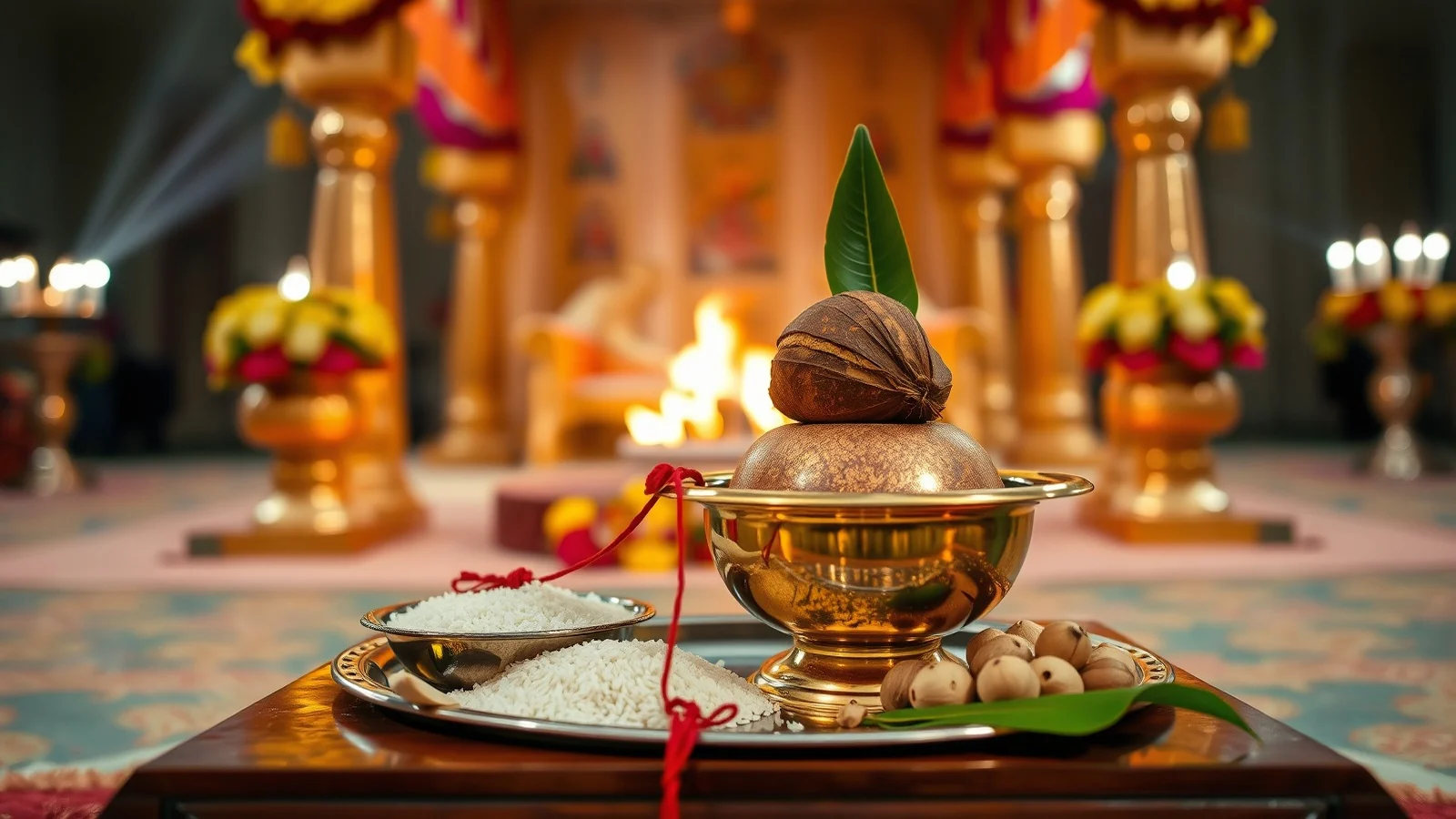
- Pre-Kanyadaan preparation. The bride is seated to the right of the groom. The bride’s father (and mother) take their positions facing the couple. A sacred copper pot of holy water is brought, along with sesame seeds, rice, and (in some traditions) a betel leaf. The family priest sits to the side ready to recite mantras.
- The hand-joining (Hastamelapa). The bride’s father takes his daughter’s right hand and places it in the groom’s right hand. The bride’s mother typically holds her husband’s hand from behind, signifying their shared participation. The priest recites the Hastamelapa Mantra blessing the union of the two hands.
- The Sankalpa vow. The bride’s father recites the formal Sankalpa: the vow of intention. The Sankalpa names the bride and groom, their gotras, the family lineages, and the specific marriage date. It explicitly states the father’s intention to give the bride to the groom.
- The water pouring (Argyam). While the Sankalpa is being recited, water is poured continuously over the joined hands of the couple from a copper vessel. The continuous flow of water symbolises the irreversibility of the gift. Sesame seeds and rice are added to the water in some traditions.
- The groom’s acceptance. The groom formally accepts the bride with the Vedic verse: “Kanyam Kanaka Sampannām Kanakāmbara bhūshitām (dadāmi Vishnu daivatyām) Pratīkshe pratīgrihyatām” (“I accept this daughter, adorned with gold and gold clothing, gifted to me with Vishnu as the divine witness”). The verse varies slightly by family tradition.
- Conclusion. The water stops flowing. The bride’s father formally relinquishes his guardianship. The hands are still joined; the priest now leads the couple into the next rite (typically the Pani Grahanam or the Saptapadi). The Kanyadaan is complete.
Regional variations of Kanyadaan
North Indian (Hindi-belt, Punjabi, Marwari, Bihari)
The Kanyadaan typically happens after the Jaimala (garland exchange) and before the Saptapadi. The bride’s father pours the water and recites the Sankalpa. In Punjabi families, the Kanyadaan is occasionally renamed as the Kanyadaan or simply the Dhol Diya (literally “giving with the hand”).
Tamil Brahmin (Iyer / Iyengar)
In Tamil Brahmin weddings, the Kanyadaan rite is called the Kanyadanam and is performed with great ritual elaboration. The bride sits on her father’s lap (a sub-rite called the Madhuparkam) before the formal hand-joining. The Sankalpa is recited in classical Sanskrit and is among the longest single recitations in a Tamil Brahmin wedding (3-5 minutes).
Telugu (Smartha / Vaishnava)
The Telugu version is called the Kanyadaanam. It includes a specific sub-rite where the bride is given a betel leaf and offers it to the groom, signifying her acceptance of the marriage. The Sankalpa is recited in Sanskrit with Telugu-language clarifications by the priest.
Maharashtrian
In Maharashtrian weddings, the Kanyadaan happens before the Antarpat (the cloth between bride and groom is removed). The bride’s father places her hand in the groom’s and recites the Sankalpa. The water pouring is typically done from a small kalash by the bride’s brother or maternal uncle in addition to the father.
Bengali
The Bengali version is called the Sampradan. It is structurally similar to Kanyadaan but with Bengali ritual elements: the bride’s father places her hand in the groom’s, water flows from a brass tumbler, and the priest recites the Sankalpa in Sanskrit. The Sampradan is preceded by the Bengali-specific Saat Paak (seven circles around the groom).
Sikh tradition
Sikh weddings (Anand Karaj) do not include a Kanyadaan rite. The Sikh Rehat Maryada specifically rejects the idea that a woman is “given” by her father, viewing it as inconsistent with Sikh egalitarian principles. Instead, the bride and groom walk together around the Guru Granth Sahib during the Four Laavan, with neither family “giving” the other.
Buddhist and Jain wedding traditions
Buddhist and Jain weddings have their own ritual structures and do not include the formal Vedic Kanyadaan. Some Jain families, particularly Digambar, incorporate a modified hand-joining rite but without the “giving” connotation.
What happens when the father is absent or has passed
Hindu wedding tradition addresses this scenario:
- If the father has passed away: The bride’s eldest brother typically performs the Kanyadaan in his role as her closest male guardian. In families without male siblings, the bride’s maternal uncle (Mama) or paternal uncle (Chacha) can perform the role.
- If the father is alive but absent: The same hierarchy applies. The eldest brother, then maternal uncle, then paternal uncle.
- If the bride has no male family available: In modern Hindu weddings, the bride’s mother can perform the Kanyadaan herself. Some priests will accept this; others may insist on identifying a male guardian. Family-specific tradition varies.
- If the bride is a widow remarrying: The Kanyadaan is typically not repeated (a woman is “given” only once in Vedic thought). A modified blessing ceremony substitutes.
The modern debate around Kanyadaan
The Kanyadaan has become one of the more debated Hindu wedding rituals in recent decades. The traditional framing (that the bride is being “given” by her father) has been challenged by feminist Hindu thinkers and increasingly by young couples planning modern Hindu weddings.
Three positions families take in 2026:
- Traditional preservation. Most Hindu families continue to perform the Kanyadaan exactly as the Vedic tradition prescribes. The Sankalpa is recited in Sanskrit, the water flows, the formal giving takes place. The view here is that the ritual carries thousands of years of spiritual meaning that cannot be lightly reframed.
- Reinterpretation within the traditional form. Some families perform the Kanyadaan but explicitly reframe the meaning during the ceremony. The priest or a family elder explains that the ritual is not about ownership transfer but about the couple’s mutual acceptance of family blessings. The Sankalpa is sometimes recited by both parents jointly.
- Modification or omission. A smaller but growing number of couples either omit the Kanyadaan entirely (replacing it with a mutual blessing ceremony from both sets of parents) or modify it so the bride’s parents bless the couple together without the formal “giving” language. Conservative families may resist this, but it is becoming visible in urban Indian and NRI Hindu weddings.
None of these positions is “right”. The Kanyadaan is a religious rite and the family’s interpretation of its meaning is the family’s decision. As wedding planners we brief the priest on the family’s preference well in advance and ensure the chosen format is performed with full ritual integrity.
Planning notes for the Kanyadaan
- Pandit briefing. Brief the family priest 1-2 weeks ahead on the family’s preferred Sankalpa form, the participants (father alone, both parents, alternative guardian), and any modifications the family wants. Senior priests will accommodate respectful modifications; junior priests may need explicit guidance.
- Materials needed. A copper kalash with holy water (typically Ganga jal if available, otherwise blessed water), sesame seeds, rice grains, a few betel leaves, and a small brass tumbler. The decor team sources these as part of the ritual materials package.
- Seating arrangement. The Kanyadaan requires the bride’s parents to face the couple at close proximity. The mandap design needs to accommodate this: typical mandaps have a low Kanyadaan platform in front of the main seating where the bride’s father sits during this rite.
- Photography brief. The Kanyadaan is the most emotionally charged moment of the wedding for the bride’s parents. Brief the photographer for close-up shots of the bride’s father’s face during the Sankalpa, the joined hands, and the parents’ expressions. This is often the most-shared family photograph of the wedding.
- Timing. The Kanyadaan typically takes 5-15 minutes depending on the elaborateness of the Sankalpa recitation. Tamil Brahmin and Telugu families typically run longer; North Indian and Bengali families typically shorter.
Related wedding traditions
Related South Indian rituals
Related wedding rituals
Also on Velvet Knot: the eight types of Hindu marriage.
Frequently Asked Questions
What is the meaning of Kanyadaan?
Kanyadaan literally means “the gift of a daughter” in Sanskrit. It is the formal Hindu wedding rite in which the bride’s father gives his daughter in marriage to the groom by joining their hands and reciting a Sankalpa (vow of intention) while sacred water is poured over their hands. In traditional Hindu thought it is considered the highest form of charitable giving (dāna) a father can perform.
Is Kanyadaan mandatory in a Hindu wedding?
In most North Indian, Tamil Brahmin, Telugu, Kannada, Maharashtrian, and Bengali Hindu wedding traditions, yes. The Kanyadaan is one of the central ritual elements. In Sikh, Buddhist, and Jain weddings the Kanyadaan does not occur. Some modern Hindu families opt to modify or omit it; this is increasingly accepted in urban and NRI Hindu weddings.
Who can perform the Kanyadaan if the bride’s father is not available?
In order of traditional precedence: the bride’s eldest brother, then her maternal uncle (Mama), then her paternal uncle (Chacha), then another close male guardian. In modern Hindu weddings, the bride’s mother increasingly performs the Kanyadaan herself when no male guardian is available; priest acceptance varies by tradition.
How long does the Kanyadaan ritual take?
5-15 minutes depending on the elaborateness of the Sankalpa recitation. Tamil Brahmin Iyer and Iyengar weddings typically run the longest (8-15 minutes); North Indian and Bengali weddings typically run 5-8 minutes. The exact timing is set by the family priest.
Can the Kanyadaan be modified for inter-faith weddings?
Yes, and modifications are common. Some inter-faith Hindu-Christian or Hindu-Sikh weddings omit the Kanyadaan in favour of a mutual parental blessing. Others perform a modified version with both sets of parents participating. The priest’s willingness to perform modifications varies; sourcing a priest comfortable with the family’s preferred format is part of the planning brief.
Is the Kanyadaan considered sexist in modern Hindu thought?
The debate is ongoing. Traditional interpretations frame the ritual as a sacred gift, not a transfer of ownership. Modern feminist Hindu thinkers have raised concerns about the “giving” framing in a contemporary context. Most Hindu families in 2026 continue to perform the Kanyadaan but with varying degrees of personal reinterpretation. The decision sits with each family and couple.
Related rituals on Velvet Knot
The Kanyadaan is one rite within a longer Hindu wedding sequence. For the full sequence see our Hindu wedding rituals guide. For related rites read our Saptapadi guide, Mangalsutra meaning guide, and Haldi ceremony guide. For community-specific Kanyadaan variations see our Tamil Brahmin, Telugu, Bengali, and Maharashtrian tradition guides. To plan your wedding with Velvet Knot, request a quote.
Sources and further reading
- Hindu Marriage Act, 1955 (text on India Code): Government of India
- Hindu wedding overview: Encyclopaedia Britannica
- Samskara (Hindu rite of passage): Encyclopaedia Britannica
Begin Your Engagement
Want a real number for your wedding?
Tell us your city, guest count and dates. Team Velvet Knot will come back within 24 hours with an itemised budget.