Jaimala vs Varmala: Meaning, Difference and How the Garland Exchange Works
- What the Jaimala means and why it matters
- Origin and the Swayamvar mythology
- Where the Jaimala falls in the ceremony
- The ritual sequence, step by step
- The playful lifting-the-groom tradition
- Regional names and variations
- Garland design, flowers and typical cost
- Grand entrances, decor, music and modern twists
- Etiquette, participants and the photography moments
- Planning checklist for a flawless garland exchange
- Related South Indian rituals
- Related wedding rituals
- The garland exchange across regions at a glance
- Garland budget at a glance
- A Jaimala run of show
- Frequently Asked Questions
- Sources and further reading
The Jaimala, also called Varmala, is the formal garland exchange between bride and groom in a Hindu wedding. Each places a flower garland around the other’s neck to signal mutual acceptance as life partners. It is usually the first wedding-day rite the assembled guests witness together.
What the Jaimala means and why it matters
The Jaimala, known in Sanskrit as the Varmala, is the moment a Hindu bride and groom formally choose each other in front of everyone who has gathered to bless them. The word breaks down simply: var means bridegroom, mala means garland, so varmala is literally the garland of the chosen one. The Hindi term jaimala carries the same idea, with jai evoking victory and celebration. When the bride lifts her garland over the groom’s head, and he does the same for her, the two families watching understand it as the first public ‘yes’ of the marriage.
Unlike the private, priest-led rites that follow at the mandap, the Jaimala is deliberately visible and shared. It is the rite designed for the crowd. That is why, at most Indian weddings, it is the first ceremony the full guest list actually sees, and why couples and planners invest so much thought into how it looks, sounds and photographs. The garland exchange sets the emotional tone for everything that comes after, from the Kanyadaan to the Saptapadi. For a broader map of where it sits, our Hindu wedding rituals guide lays out the full sequence.
Origin and the Swayamvar mythology
The garland exchange traces back to the ancient practice of Swayamvar, a Sanskrit word meaning ‘self-choice.’ In the Vedic and epic period, a princess of marriageable age would be presented with a gathering of eligible suitors, and she would signal her chosen husband by placing a garland around his neck. The act of garlanding was the decision itself. The most famous accounts appear in the Ramayana, where Sita garlands Rama, and in the Mahabharata, where Draupadi’s swayamvar and Damayanti’s choice of Nala are recounted in detail. In every version, the garland is the instrument of a woman’s own choice of partner.
That heritage is why the modern Jaimala still belongs, in spirit, to the bride. She garlands first in most regional customs, echoing the swayamvar tradition where the woman’s selection was decisive. Over centuries the free-choice swayamvar evolved into the family-arranged and love matches of today, but the symbolic core survived intact: two people accepting each other publicly through the exchange of flowers. Recognising that lineage helps couples treat the Jaimala as something more than a photo op, it is a living link to one of the oldest recorded ideas of consent in Indian marriage.
It is worth noting how gracefully the ritual has travelled through time. The palaces and royal courts of the epics gave way to village weddings, then to grand urban celebrations and today to destination and NRI ceremonies staged continents away from home. Through every shift, the garland remained the constant. Couples who understand this history often speak the meaning aloud during their own exchange, telling their guests that the flowers they are lifting carry thousands of years of the same simple promise: I choose you, in front of everyone we love.
Where the Jaimala falls in the ceremony
The Jaimala sits near the start of the wedding-day proceedings, after the groom’s arrival and before the couple settle in for the longer mandap rites. The typical order runs like this. The groom reaches the venue with his baraat and is received by the bride’s family, who perform a welcome aarti and apply tilak to his forehead. He is then led to the stage or mandap. The bride makes her entrance, usually escorted by her brothers or close male relatives, often shielded by a dupatta or saree pallu held aloft by her sisters and cousins.
Once the two are face to face, the garlands are exchanged. Only after this public acceptance do the families move into the sacred, priest-guided portion of the ceremony: the Kanyadaan, the Mangal Phera circling of the sacred fire, the Saptapadi seven vows, and finally the Mangalsutra tying and Sindoor Daan. In other words, the Jaimala is the threshold: the celebratory, camera-friendly opening act that gives way to the solemn heart of the wedding.
The ritual sequence, step by step
Though details vary by community, the garland exchange usually unfolds in a recognisable arc that a good planner will rehearse with both families in advance.
- Groom’s arrival and welcome. The groom is received at the mandap or stage by the bride’s mother, who performs aarti and applies tilak. He takes his place and waits.
- Bride’s entrance. The bride is walked in by her brothers or male relatives, frequently under a canopy of flowers or a held veil, sometimes to a live sehra or a chosen entrance song.
- The first garland. The bride approaches, and in many North Indian families her cousins may lift the groom to make him harder to reach. She stretches up and settles her garland over his neck to cheers.
- The second garland. The groom garlands the bride in return. Her female cousins may lift her for balance and for a matching burst of laughter.
- A third exchange, in some traditions. Several Tamil Brahmin, Telugu and Bengali families exchange the garland three times, treating the repetition as an added blessing rather than a game.
- Celebration and photography. Confetti, applause, dhol or a curated track, and a flurry of camera shutters. The couple then take their seated position for the rites to come.
The playful lifting-the-groom tradition
Nothing defines a North Indian Jaimala quite like the moment the groom is hoisted onto the shoulders of his brothers, cousins and friends just as the bride steps forward to garland him. The intent is pure mischief: make it comically difficult for her to reach, force a few near-misses, and let the two sides of the family trade good-natured competition. The bride’s side often responds by lifting her in turn, so both partners end up airborne and laughing while the flowers finally change hands. It is one of the warmest icebreakers in the entire wedding, the point where two families stop being formal and start being one.
The tradition is beloved but genuinely worth choreographing. Sherwanis and heavy lehengas are not built for acrobatics, and a poorly coordinated lift can tear fabric, unbalance the couple, or ruin the photo angle. Experienced planners brief the lifting group a day ahead: who lifts, how high, which direction to face the cameras, and a clear signal to lower gently. Done well, the lift is the single most joyful frame of the day. Done carelessly, it is a wardrobe emergency and a bruised knee, so the fun is best backed by a few minutes of quiet rehearsal.
Regional names and variations
The garland exchange is near-universal across Hindu India, but its personality shifts dramatically by region.
North Indian (Punjabi, Marwari, Bihari, UP). The most theatrical version, complete with the lifting, dhol or DJ, and extended choreography. It commonly runs eight to fifteen minutes and is photographed exhaustively. Marwari and Gujarati families often add their own flourishes, with the Gujarati exchange typically calmer and folded into the wider mandap sequence, and the Marwari version leaning into music and celebration.
South Indian (Tamil, Telugu, Kannada, Malayali). More restrained and ritually formal. The groom is not lifted, the mood is dignified, and in many Tamil Brahmin homes the garland is exchanged three times. These versions are short, roughly three to five minutes, with the emphasis firmly on formal acceptance. Mango leaves and jasmine frequently feature in the garlands themselves.
Bengali (Mala Badal). The Bengali equivalent, literally ‘garland change,’ follows the Subho Drishti first glance and the Saat Paak seven circles. The couple exchange garlands three times, blessed by the women’s conch-shell blowing and ululation. It is quiet yet deeply emotional.
Maharashtrian. Here the garland exchange follows the Antarpat, the cloth held between the couple, and the Manglashtak shlokas. It is measured and reverent rather than playful.
Want a real number for your wedding? Send us your dates and guest count and we will come back with an itemised estimate for your wedding, not a range copied off a price list.
Garland design, flowers and typical cost
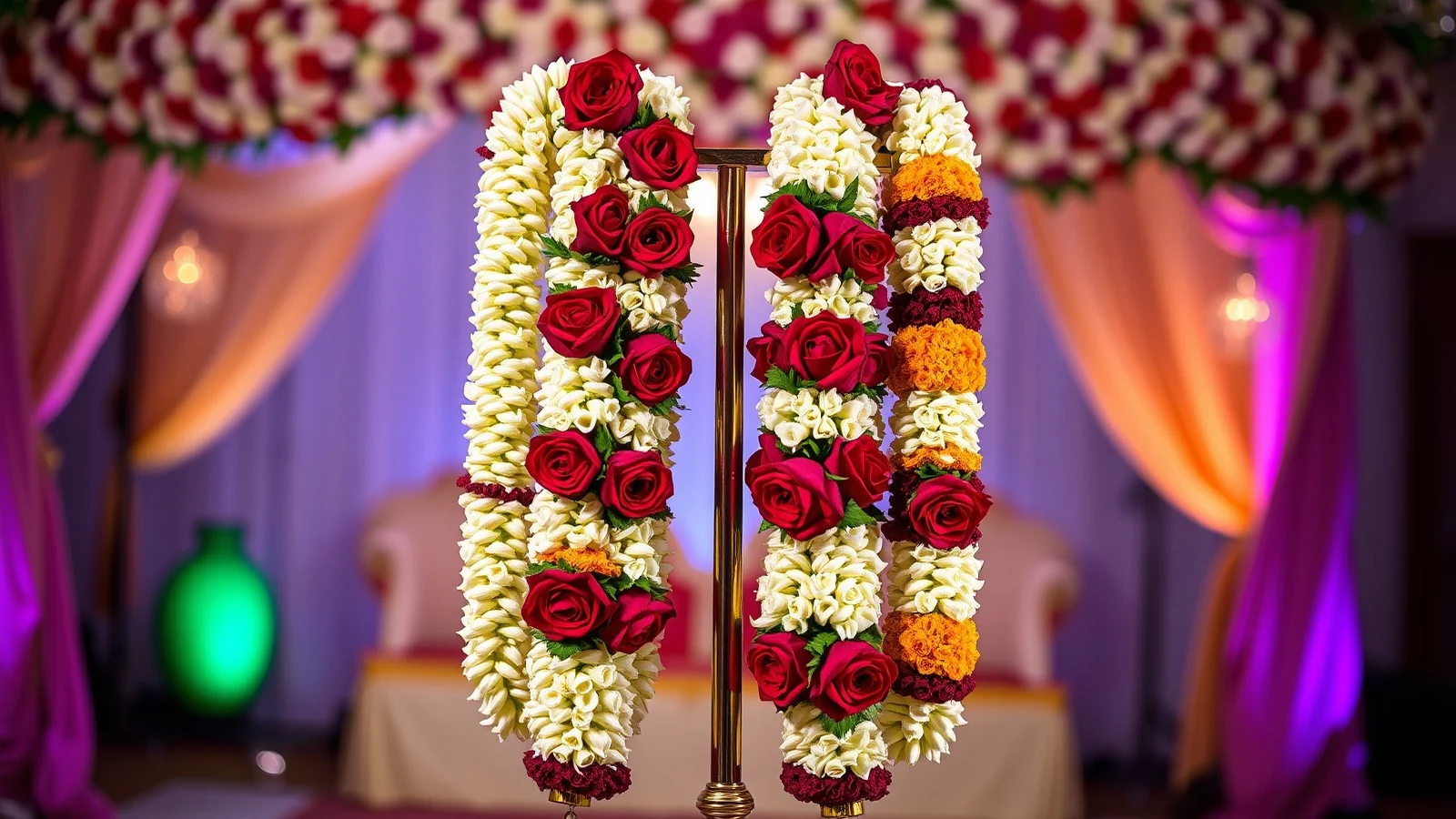
The flowers a couple choose carry their own quiet symbolism. Traditional Jaimala garlands are built around a handful of blooms:
- Marigold (genda). The most common choice, its bright orange and yellow associated with auspiciousness and Lord Vishnu.
- Rose (gulab). Red or pink, standing for love and purity, and the backbone of most designer garlands.
- Jasmine (mogra or mallika). Fragrant white blossom evoking divine femininity, a staple of South Indian garlands.
- Chrysanthemum (sevanti). Adds volume and a note of longevity.
- Mango leaves. Woven through the strand in many Tamil Brahmin and Telugu garlands for extra auspiciousness.
Modern designer Jaimalas layer in orchids, lilies and imported peonies or hydrangeas alongside the traditional flowers. Cost scales with ambition. A basic marigold-and-rose garland runs about Rs 2,000 to Rs 5,000 each. A mid-tier designer garland with orchids or imported stems lands around Rs 5,000 to Rs 15,000 each. Premium, fully imported designer Jaimalas can reach Rs 15,000 to Rs 50,000 per garland. Most couples order two garlands plus one or two spares, so budget for the full set rather than a single piece.
Grand entrances, decor, music and modern twists
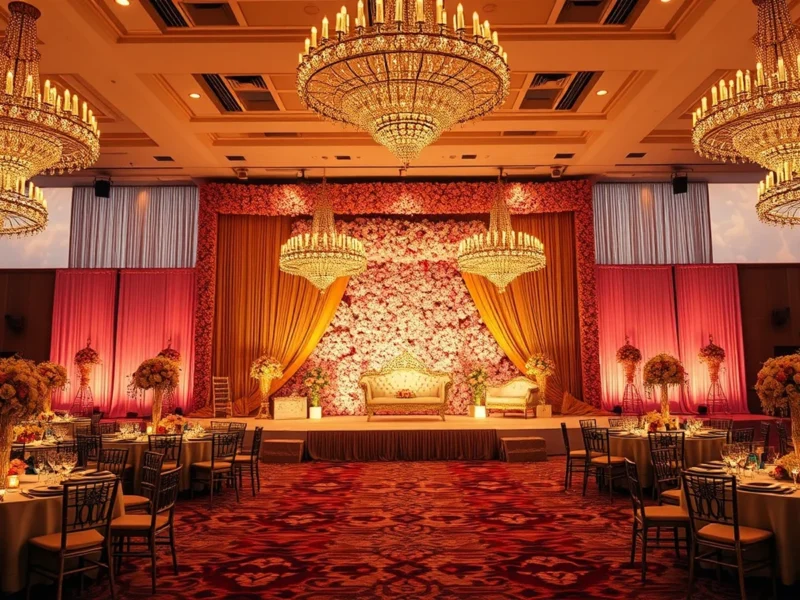
Because the Jaimala is the first act the whole gathering witnesses, couples increasingly build a mini-production around it. Popular staging ideas include a raised floral stage flanked by pillars of marigold and rose, a cold-spark or dry-ice entrance for the bride, cascading floral chandeliers overhead, and a backdrop that reads clearly in both daylight and evening light. The garlands themselves are often colour-matched to the couple’s outfits, so the flowers photograph as part of the styling rather than against it.
Music and timing make or break the moment. Many couples now choreograph a slow-walk entrance to a chosen song, pause the track for the actual exchange so the crowd’s cheer carries, then hit an upbeat number as the garlands land. Golden hour, roughly the hour before sunset, is a favourite slot for outdoor Jaimalas because the light flatters both the flowers and the faces. Destination and NRI weddings add their own twists: garland exchanges on palace steps, on a beach at dusk, or beside a lit courtyard, sometimes with a live band or a curated fusion playlist. The rite stays the same; the setting is where couples make it unmistakably theirs.
Etiquette, participants and the photography moments
The Jaimala belongs to the couple, but a small cast supports it. The bride’s brothers or cousins escort and often lift her; the groom’s friends and brothers handle his lift; the mothers manage the welcome and aarti; and the priest waits to begin the rites once the garlands are exchanged. Etiquette is gentle here. The playful resistance is meant to stay affectionate, never rough, and both sides should agree in advance how far the lifting goes so nobody is caught off guard or embarrassed.
A few planning habits protect the moment. Brief the florist forty-eight hours ahead with neck-circumference dimensions, because heavily floral garlands can weigh one to two kilograms and must sit without crushing a saree pallu or a sherwani collar. Run a flower patch test if either partner has known allergies to jasmine or lily. Keep one or two spare garlands with a designated runner nearby, since strands do tear or get stepped on. And above all, brief the photographer for the specific beats that define this rite: the bride approaching, the unveiling if there is one, the first garland placement, the second, the family’s reaction, and the seated couple immediately after. Those six frames are among the most treasured of the entire wedding, so they are worth naming out loud before the ceremony begins.
Planning checklist for a flawless garland exchange
A Jaimala looks effortless only when the details behind it are handled early. Over dozens of weddings, our planners have settled on a short, repeatable checklist that keeps the moment joyful and stress-free for the couple and both families.
- Confirm the format a week ahead. Decide with both sides whether there will be lifting, how many exchanges, and roughly how long the segment should run, so the schedule and the DJ or band are aligned.
- Match garlands to outfits. Share the bride’s and groom’s outfit colours with the florist so the flowers complement rather than clash, and confirm garland weight and length against neck measurements.
- Rehearse the lift. If the groom or bride is being hoisted, run one quiet practice a day before, agreeing on height, direction and a gentle lower-down signal to protect the outfits.
- Cue the music deliberately. Plan an entrance track, a pause for the actual exchange, and an upbeat release once the garlands land, so the crowd energy peaks at the right second.
- Stage the light. For outdoor weddings, schedule the Jaimala near golden hour where possible, and add warm uplighting on the stage for evening exchanges.
- Keep spares and a runner ready. Position one or two backup garlands with a designated person nearby in case a strand tears or falls.
- Brief the photographer and videographer by beat. Name the exact frames you want captured rather than assuming they will be caught in the rush.
Handled this way, the garland exchange becomes the confident, celebratory opening it is meant to be, setting a warm tone for every rite that follows at the mandap.
Planning a luxury wedding?
Speak to our team for a tailored shortlist and cost plan.
Related South Indian rituals
Related wedding rituals
The garland exchange across regions at a glance
| Region | Local name | Where it falls | Character |
|---|---|---|---|
| North Indian (Punjabi, Marwari, Bihari, UP) | Jaimala or Varmala | After the groom’s welcome, before the mandap rites | Theatrical, with lifting, dhol or DJ; commonly eight to fifteen minutes |
| Gujarati | The garland exchange | Folded into the wider mandap sequence | Calmer than the North Indian version |
| South Indian (Tamil, Telugu, Kannada, Malayali) | Maalai maatral in Tamil | Within the formal wedding rites | Restrained, about three to five minutes, and exchanged three times in many Tamil Brahmin homes |
| Bengali | Mala Badal | After the Subho Drishti and the Saat Paak | Three exchanges, with conch shells and ululation |
| Maharashtrian | The garland exchange | After the Antarpat and the Manglashtak | Measured and reverent rather than playful |
Garland budget at a glance
Most couples order two garlands and one or two spares, so the set costs more than the per-garland price suggests. The figures below use the ranges above and assume two garlands plus two spares.
| Tier | Typical flowers | Per garland | Set of four |
|---|---|---|---|
| Basic | Marigold and rose | Rs 2,000 to Rs 5,000 | Rs 8,000 to Rs 20,000 |
| Mid-tier designer | Rose with orchids or imported stems | Rs 5,000 to Rs 15,000 | Rs 20,000 to Rs 60,000 |
| Premium | Fully imported flowers | Rs 15,000 to Rs 50,000 | Rs 60,000 to Rs 2 lakh |
A Jaimala run of show
Because the exchange lasts minutes and is photographed from every angle, it rewards a short written cue sheet shared with the families, the photographers and whoever runs the music.
| Moment | Who leads | Cue for the team |
|---|---|---|
| Groom’s welcome | The bride’s mother, with aarti and tilak | Photographers in place at the stage before the groom arrives |
| Bride’s entrance | Her brothers or close male relatives, often under a held veil | Entrance song starts; the path to the stage is clear |
| First garland | The bride, with the groom’s side ready for a lift | Music pauses so the cheer carries |
| Second garland | The groom, with the bride’s side ready to lift her | Lifting groups briefed a day ahead on height and direction |
| Third exchange, where custom asks for it | The couple | The priest or an elder signals it, so the room waits |
| Celebration | Everyone | Upbeat track as the garlands land, then portraits before the mandap rites |
Also on Velvet Knot: the milni ceremony guide.
Frequently Asked Questions
What is the difference between Jaimala and Varmala?
They are the same ritual under two names. Varmala is the Sanskrit term and Jaimala is the Hindi term, and both refer to the formal garland exchange between bride and groom in a Hindu wedding.
Is the Jaimala mandatory in a Hindu wedding?
In most North Indian and South Indian Hindu traditions it is a standard, near-universal rite. Sikh, Buddhist and Jain weddings do not include a formal Jaimala, though some couples add a similar ceremonial garland exchange as a cultural touch.
Why does the groom get lifted during the Jaimala?
It is a playful North Indian, especially Punjabi, custom. The groom’s male cousins and friends lift him high so the bride has to reach up to garland him. It is family fun rather than a ritual requirement, and the bride is often lifted in return for balance.
How long does the Jaimala ceremony take?
Anywhere from three to fifteen minutes. A quiet South Indian exchange takes about three to five minutes, while a Punjabi Jaimala with lifting and full photography can run ten to fifteen minutes.
What do Jaimala garlands cost in India?
A basic marigold-and-rose garland costs roughly Rs 2,000 to Rs 5,000 each. Mid-tier designer garlands with orchids or imported flowers run Rs 5,000 to Rs 15,000 each, and premium designer garlands can reach Rs 15,000 to Rs 50,000 each. Most couples order two plus one or two spares.
Who garlands whom first in the Jaimala?
In most regional customs the bride garlands the groom first, echoing the ancient Swayamvar tradition in which a woman signalled her chosen partner by placing a garland around his neck. The groom then garlands her in return, and some communities repeat the exchange three times.
What is the garland exchange called in a Bengali wedding?
It is the Mala Badal, literally the garland change. It follows the Subho Drishti and the Saat Paak, and the couple exchange garlands three times to the sound of conch shells and ululation.
Sources and further reading
More wedding rituals explained: the Hindu wedding rituals guide, Kanyadaan and Sindoor Daan.
Begin Your Engagement
Want a real number for your wedding?
Tell us your city, guest count and dates. Team Velvet Knot will come back within 24 hours with an itemised budget.