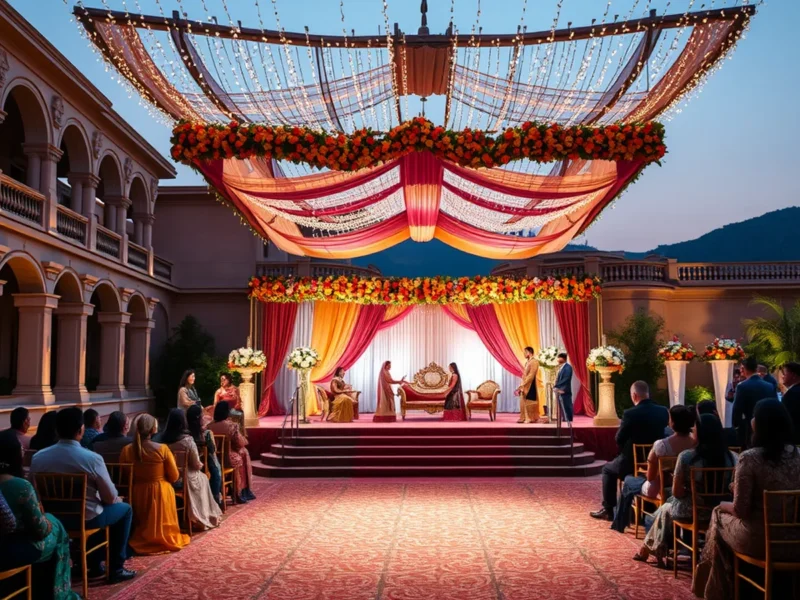
Tilak Ceremony: Meaning, Ritual Sequence, and Planning Guide
- What the Tilak ceremony is
- Regional variants of the Tilak
- The Tilak ritual sequence
- Who attends the Tilak
- Tilak vs Roka vs Sagai vs Engagement
- What to gift at the Tilak
- Sample Tilak budget (2026)
- What tilak and roka cost
- Related pre-wedding rituals
- Regional forms of the Tilak compared
- What goes on the Sagun thali
- Tilak ceremony in English, and what the word actually refers to
- Frequently Asked Questions
- Related ceremonies on Velvet Knot
- Sources and further reading
The Tilak ceremony is a pre-wedding ritual in Hindu and Sikh wedding traditions where the bride’s family formally visits the groom’s home (or hosts him at theirs) to anoint him with a tilak (a vermillion mark on his forehead) and present him with gifts, sweets, and a ceremonial offering. In Marwari and many North Indian Hindu communities, the Tilak is one of the first formal pre-wedding ceremonies after the Roka, and it functions as the family’s public commitment to the alliance.
What the Tilak ceremony is
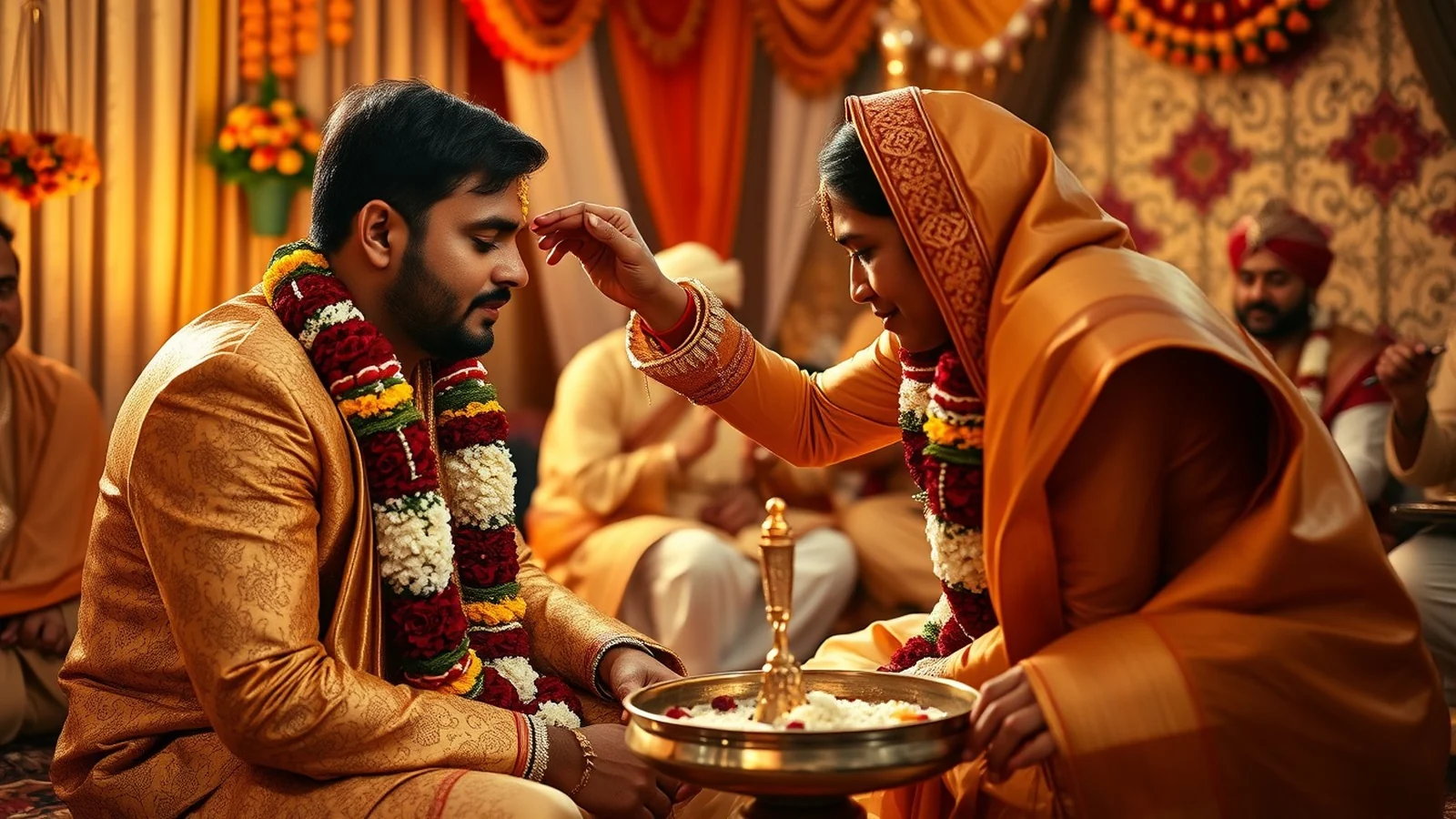
The Tilak ceremony (sometimes spelled Teeka) is a structured pre-wedding visit in Hindu wedding tradition. The bride’s male family members (her father, brothers, paternal uncles) travel to the groom’s home and apply a tilak (a small mark of vermillion mixed with rice) on his forehead. The application is followed by the presentation of gifts, sweets, dry fruits, and a ceremonial cash offering (Shagun).
The Tilak serves several functions:
- Formally confirming the alliance after the Roka
- Publicly committing both families to the wedding
- Introducing the bride’s family to the groom’s extended family
- Symbolically blessing the groom for the upcoming marriage
The Tilak typically happens 2-6 months before the wedding, after the Roka and before the formal engagement (Sagai or Mangni). In many Marwari families, the Tilak and the Sagai are separate ceremonies; in many modern Punjabi families, the Tilak is folded into a combined pre-wedding event.
Regional variants of the Tilak
Marwari Tilak
The most ritually elaborate version. The bride’s father, brothers, and paternal uncles travel to the groom’s home, often with a large family procession. They bring a formal Sagun thali containing gifts, a ceremonial dagger (in some Rajput-Marwari traditions), sweets, dry fruits, and the Shagun cash. The pandit conducts a short Ganesh puja, the tilak is applied, and a meal hosted by the groom’s family follows. The ceremony typically runs 3-4 hours.
Punjabi Tilak (also called Chunni Chadhai when combined with a separate sub-rite)
The Punjabi Tilak is structurally similar to the Marwari version but often less ritually elaborate. The bride’s male relatives visit the groom’s home, apply the tilak, and present sweets and gifts. In many Punjabi families this is followed by or combined with the Chunni Chadhai (the chunni-placing ceremony) where the bride’s family symbolically dresses the bride in her wedding outfit on a separate occasion.
Bihari and Eastern UP Tilak
Called the Tilak or sometimes the Chhekka. Similar to the Roka in function in some families; a separate ceremony following the Roka in others. The bride’s father applies the tilak, the families exchange gifts, and a meal is hosted.
Sikh Sagaai-Tilak combined ceremony
Sikh families typically combine the Tilak with the engagement (Sagaai) into a single combined ceremony. The bride’s family visits the groom’s home (or a Gurudwara), an Ardas is recited, the tilak is applied (often by the bride’s father or brother), the ring is exchanged, and gifts are presented.
Planning the wedding these rituals belong to?
Velvet Knot plans luxury Indian weddings end to end, from every ceremony and its decor to the venue, vendors and guest hospitality. Share your dates for a tailored plan.
The Tilak ritual sequence
- Arrival and welcome. The bride’s family arrives at the groom’s home (or the chosen venue). The groom’s family receives them with sweets, garlands, and a welcome aarti. Music often plays during arrival (Shehnai for Marwari, dhol for Punjabi).
- Ganesh puja. A short Vedic puja invoking Lord Ganesha (the remover of obstacles) is performed by the family pandit. This formally inaugurates the ceremony.
- Tilak application. The bride’s father (or eldest male relative) applies the tilak on the groom’s forehead. The tilak is typically a mixture of vermillion and rice, applied with the right thumb. In some traditions a coconut is placed in the groom’s hands at this moment.
- Sagun presentation. The bride’s family presents the formal Sagun: sweets, dry fruits, a tray of fruits, gold ornaments (typically a ring or a chain), a Shagun cash amount, and traditional clothes for the groom. The groom’s family receives and acknowledges each item.
- Aashirvad (blessings). The groom’s parents and elders bless the bride’s family members. Family photographs follow.
- Meal. The ceremony concludes with a meal hosted by the groom’s family. Typically a sit-down meal for 30-100 guests, running 2-3 hours.
Who attends the Tilak
The Tilak is a male-led ceremony in traditional practice (women from the bride’s side often do not travel to the groom’s home for the Tilak). Standard attendees:
- Bride’s father, brothers, paternal uncles
- Bride’s maternal uncle (Mama), typically attends as a key family representative
- 2-4 close male family friends of the bride’s father
- The family pandit
- Groom’s immediate family (parents, siblings)
- Groom’s close extended family (uncles, aunts, first cousins)
- 3-5 close family friends of the groom’s parents
Modern Tilak ceremonies are increasingly mixed-gender, with the bride’s mother, sisters, and female cousins attending alongside the male relatives. The bride herself does not traditionally attend the Tilak (since the ceremony happens at the groom’s home), though modern urban families increasingly include her.
Tilak vs Roka vs Sagai vs Engagement
The pre-wedding ceremony terminology is confusing because regional traditions overlap. Here is the typical sequence in a traditional Marwari or Punjabi wedding:
- Roka (3-9 months before wedding): the alliance is formally locked. Held at the bride’s home.
- Tilak (2-6 months before wedding): the bride’s family visits the groom’s home, applies the tilak, presents gifts.
- Sagai / Mangni (1-4 months before wedding): the formal engagement. The ring is exchanged. Often a larger event (100-300 guests).
- Sangeet, Mehndi, Wedding: the main wedding sequence.
Modern families increasingly combine the Roka, Tilak, and Sagai into one or two events for logistics simplicity. The Tilak as a standalone ceremony is most likely to be retained by Marwari and traditional North Indian families.
What to gift at the Tilak
The bride’s family typically presents:
- A traditional outfit for the groom (sherwani, kurta-pyjama, or Western suit)
- A gold ring or chain
- A wristwatch (high-quality, often a designer brand)
- A box of premium sweets and dry fruits
- A coconut, a fruit thali, and ritual items
- A Shagun cash amount (typically ending in 1 to Rs 2,101, Rs 5,101, Rs 11,001, scaled to family means)
The groom’s family reciprocates with sweets, dry fruits, and sometimes a smaller gift package for the bride’s family members. The exchange is not equal (the bride’s family traditionally gives more) but the reciprocation is part of the ceremonial format.
Sample Tilak budget (2026)
| Item | Cost range (Rs ) |
|---|---|
| Venue (groom’s home, mostly free) | 0 to 1,00,000 |
| Catering (50-80 guests, sit-down meal) | 1,00,000 to 3,00,000 |
| Decor + flowers | 50,000 to 2,00,000 |
| Photography + video (3 hours) | 30,000 to 1,20,000 |
| Music (Shehnai or dhol) | 10,000 to 50,000 |
| Pandit + ritual material | 5,000 to 20,000 |
| Sagun gifts (clothes, ring, watch, sweets) | 50,000 to 5,00,000 |
| Shagun cash | 2,101 to 51,000+ |
| Total (bride’s family side) | 2,47,000 to 12,40,000 |
What tilak and roka cost
Related pre-wedding rituals
- sehrabandi, the groom’s ceremony
- the mehndi ceremony explained
- the sagai engagement ceremony
- the Ganesh puja that opens a wedding
More community traditions: read our full guide to Kayastha wedding traditions.
Regional forms of the Tilak compared
The variants are described individually above. Side by side, the differences are easier
to hold, and they matter because the same word describes ceremonies of quite different
scale. Families combine, split and rename these freely, so confirm what your own families
intend rather than assuming.
| Tradition | Also called | Who applies the tilak | Where it happens | Scale |
|---|---|---|---|---|
| Marwari and Rajasthani | Tilak | The bride’s father, brothers and paternal uncles | The groom’s home | The most elaborate form, often with a large family party travelling |
| Punjabi | Tilak, often alongside the Chunni Chadhai | The bride’s male relatives | The groom’s home | Similar in shape, usually less ritually elaborate |
| Bihari and eastern UP | Tilak or Chhekka | The bride’s father | The groom’s home, with a meal hosted | Sometimes the same event as the Roka, sometimes separate |
| Sikh | Usually merged with the Sagaai | The bride’s father or brother | The groom’s home or a gurdwara | One combined ceremony, opened with an Ardas |
The one structural point common to all of them is direction of travel: the bride’s family
goes to the groom’s. That is the opposite of most later wedding functions and it catches
out-of-town families out, so it is worth confirming early who is hosting and who is
travelling.
What goes on the Sagun thali
The thali the bride’s family carries is the practical heart of the ceremony and the part
most often assembled at the last minute. Contents vary by community and by family, and the
family elders are the authority. As a general shape, expect the following, and expect your
own family to add to it.
- The tilak itself. Roli or kumkum, rice for the akshat pressed onto the
mark, and a small container for each. - Sweets. Traditional mithai rather than a cake, in an odd-numbered count
in many families. - Dry fruit and a whole coconut. Standard across most northern
communities. - Clothing and a shagun envelope. The clothing is for the groom and often
for his immediate family; the cash amount conventionally ends in one. - Community-specific items. Some Rajput and Marwari families include a
ceremonial dagger. This is a family tradition and not a general requirement, and it needs
thinking about if the ceremony is being held anywhere with security screening.
Two practical notes. The thali is photographed, usually close up and usually before it is
presented, so it wants assembling properly rather than in the car. And if the two families
are in different cities, the perishable items are better bought at the destination than
carried, which means someone on the ground needs a list several days ahead.
Tilak ceremony in English, and what the word actually refers to
The commonest confusion about this ceremony is that the word does not name the event at all.
A tilak is the mark itself, the vermillion applied to the forehead, and the ceremony takes its
name from the act of applying it. That is why you will see the same gathering called a tilak in
one family and something else entirely in another: they are naming the event after its central
gesture.
| The term | What it refers to | How it is used at a wedding |
|---|---|---|
| Tilak | The mark applied to the forehead | The bride’s family applies it to the groom, which is the act that gives the ceremony its name |
| Tilak ceremony | The visit built around that act | The bride’s father, brothers and male relatives call on the groom with gifts and sweets |
| Betrothal | The nearest English word | It carries the right sense of a promise between families, but no ring and no exchange of vows |
| Engagement | The word most often used in English | Inexact here, because in the classical form the bride is not present and nothing is exchanged between the couple |
If you are explaining the day to guests who do not speak Hindi, betrothal is the honest
translation and engagement is the convenient one. What matters practically is that a tilak is a
commitment between two families rather than a couple’s announcement, which is why the guest list,
the seating and the gifts are all organised around the elders rather than around the couple. Our
roka guide and the comparison in this page’s own table cover
how it differs from the rites that sit either side of it.
Frequently Asked Questions
What does Tilak ceremony mean?
The Tilak ceremony is a pre-wedding ritual in Hindu and Sikh wedding traditions where the bride’s family formally visits the groom (typically at his home) and applies a tilak (a vermillion mark) on his forehead. The application is accompanied by the presentation of gifts, sweets, and a ceremonial cash offering. The Tilak formally confirms the alliance and publicly commits both families to the wedding.
How is the Tilak different from the Roka?
The Roka is held at the bride’s home and involves both families meeting to formally lock the alliance. The Tilak is held at the groom’s home and involves the bride’s male family members visiting the groom to anoint him with a tilak and present gifts. The Roka focuses on the bride; the Tilak focuses on the groom. Many modern families combine the two into a single event.
How long before the wedding is the Tilak held?
Typically 2-6 months before the wedding. Some traditional Marwari families hold the Tilak 6-12 months in advance; modern urban families typically run it 2-4 months ahead. The exact timing is influenced by the family purohit’s muhurta consultation.
Does the bride attend the Tilak ceremony?
Traditionally, no: the Tilak is a male-led ceremony held at the groom’s home, and the bride did not attend. In modern urban Hindu families, the bride increasingly does attend, particularly when the Tilak is being combined with the Sagai (engagement). This is family-specific and not a strict requirement.
What is the appropriate Shagun amount for a Tilak?
Symbolic amounts ending in 1 are traditional: Rs 2,101, Rs 5,101, Rs 11,001, Rs 25,001, Rs 51,001. The exact amount scales to the family’s means. The intention is symbolic blessing rather than financial transaction. Wealthier families often give larger amounts (Rs 1 lakh+) but the ending-in-1 convention is widely respected.
Can the Tilak be skipped in a modern Hindu wedding?
Yes. Modern urban Hindu families increasingly skip a standalone Tilak ceremony and fold its functions into the Roka or the Sagai. The Tilak as a discrete event is most retained by Marwari, traditional Rajasthani, and some Bihari families. Punjabi families often retain a smaller version. South Indian and Bengali families typically do not have a Tilak rite in the North Indian format.
What is the tilak ceremony called in English?
There is no exact English word. It is usually described as the groom’s blessing or engagement ceremony, in which the bride’s family formally accepts the groom by applying a tilak to his forehead. In Hindi it is also called tilak samaroh.
What is the tilak ceremony in English?
There is no exact English equivalent. Betrothal is the closest, because the ceremony is a formal promise between two families rather than between the couple. It is often called an engagement in English, which is convenient but inexact: in the classical form the bride is not present, no rings are exchanged, and the central act is the bride’s family applying a tilak, a vermillion mark, to the groom’s forehead. The ceremony is named after that mark.
What is a tilak ceremony?
A pre-wedding ritual in Hindu and Sikh traditions in which the bride’s family formally visits the groom, applies a tilak to his forehead and presents gifts, sweets and a ceremonial offering. It is the moment the match is publicly fixed between the two families. In Marwari and many North Indian communities it is the men of the bride’s family who attend.
Related ceremonies on Velvet Knot
The Tilak is one rite in the pre-wedding sequence. For the related ceremonies see our Roka ceremony guide, Haldi ceremony guide, and the broader Hindu wedding rituals guide. For community-specific Tilak variations read our Marwari and Punjabi wedding tradition guides. To plan your wedding with Velvet Knot, request a quote.
Sources and further reading
- Hindu Marriage Act, 1955 (text on India Code): Government of India
- Hindu wedding overview: Encyclopaedia Britannica
Begin Your Engagement
Want a real number for your wedding?
Tell us your city, guest count and dates. Team Velvet Knot will come back within 24 hours with an itemised budget.