Wedding Traditions · Indian Weddings
South Indian Wedding Planner
Premium planning with cultural depth. We invest time in your specific community customs, not just the aesthetic.
Velvet Knot is a South Indian wedding planner coordinating Tamil, Telugu, Malayalam, and Kannada ceremonies, each built around an auspicious Muhurtham often held at 4 to 6am. We know that Telugu weddings feature Talambralu and Jeelakarra Bellam while Tamil Brahmin ones include Kasi Yatra and Oonjal. South Indian wedding planning is priced as a flat fee quoted for your wedding.
A South Indian wedding planner coordinates the diverse and ritual-rich ceremonies of Tamil, Telugu, Malayalam, and Kannada traditions, each with distinct customs, timing requirements, and ceremonial elements that demand genuine cultural expertise. South Indian weddings are typically morning affairs centred around an auspicious Muhurtham, with ceremonies lasting 1-3 hours in an elaborate mandap. Velvet Knot plans South Indian weddings across all four traditions with attention to community-specific variations.
The differences between traditions are significant, a Tamil Brahmin wedding includes Kasi Yatra and Oonjal, a Telugu wedding features Talambralu and Jeelakarra Bellam, and a Kerala Hindu wedding has its own distinct Thali ceremony. An experienced planner knows these distinctions.
Plan Your South Indian Wedding in These Cities
Velvet Knot’s south indian wedding wedding specialists work across India’s major wedding markets. Explore our city-specific planning teams:
- South Indian Wedding Planning in Hyderabad
- South Indian Wedding Planning in Bangalore
- South Indian Wedding Planning in Chennai
- South Indian Wedding Planning in Kerala
For couples planning a destination wedding or luxury celebration, we coordinate at heritage venues across all our service cities. Request a personalised quote.
What Distinguishes a South Indian Wedding
South Indian weddings, Telugu, Tamil, Kannada, Malayalee, share core ceremonial elements but differ significantly in timeline, music, food, and ritual specifics. The wedding muhurtham is often early morning (4-6am), which fundamentally shapes how the day is structured. Many couples flying in for South Indian weddings underestimate this, pre-wedding ceremonies start the night before and run until dawn.
Tradition-Specific Ceremonies
- Telugu, Pellikuthuru, Pellikoduku, Snathakam, Kashi Yatra, Madhuparkam, Talambralu
- Tamil Brahmin, Nichayathartham, Janavasam, Kashi Yatra, Mangalyadharanam, Saptapadi, Pradhana Homam
- Kannada, Naandi, Devakaarya, Dhare Heralu, Saptapadi
- Malayalee, varies significantly by community (Nair, Christian, Mappila Muslim, Brahmin); each has distinct ritual sequences
Where We Add Operational Value
The early-morning muhurtham, the ritual material requirements (specific flowers, leaves, oils, lamps), and the timing precision required for South Indian ceremonies need a planner who has run multiple weddings in this format. Our founder spent eight years across Telugu, Tamil, and Kannada ceremonies before founding Velvet Knot. We know which pandit will respect your specific lineage, which caterer can produce authentic regional cuisine without compromise, and how to coordinate priests, musicians, and design teams for early-morning starts.
Cities
South Indian wedding planning across Hyderabad, Bangalore, Chennai, and Kerala. Packages are quoted per wedding. Request a consultation.
Inside South Indian Wedding Planning: Four Traditions, One Region, Very Different Weddings
South Indian is shorthand for at least four distinct wedding traditions: Tamil Brahmin (and within that, Iyer and Iyengar are different), Telugu (Andhra and Telangana have variation), Kannada, and Malayali (and within that, Christian Malayali and Hindu Malayali are very different weddings). Treating them as one is the surest way to misbrief vendors and offend elders. We map the family’s specific community in the first brief and staff the wedding accordingly.
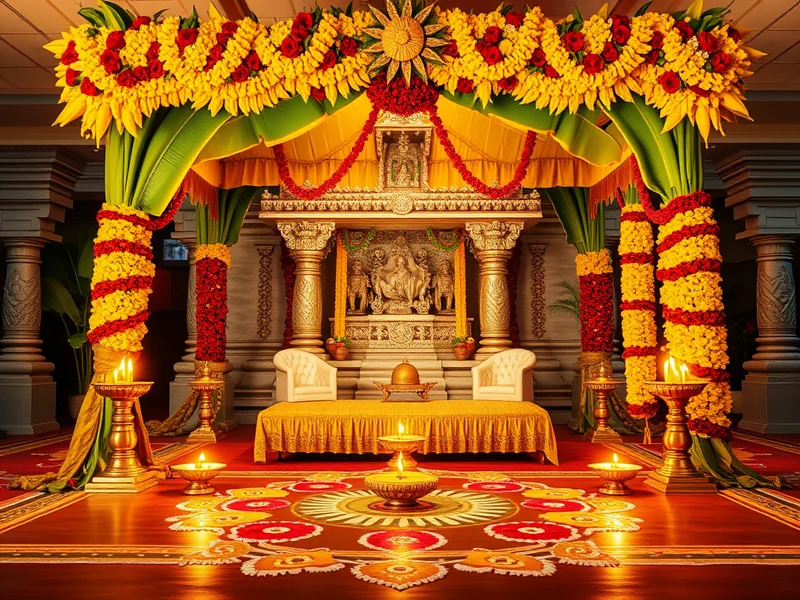
What is shared across most South Indian Hindu weddings: a mandapam, not a mandap. Banana trees as the structural corner element. A kolam (rice flour design) at the entrance. The nilavilakku (brass lamp) lit at the start. Jasmine garlands, in volume. Pre-dawn or early-morning muhurtams. A multi-event lead-up (Nichayathartham or Pellikuturulu engagement, Mehendi where adopted, the wedding itself, and a reception). What is not shared: the Saptapadi sequence (Tamil Brahmin Iyengar runs it differently to Iyer), the mangalsutra tying convention, who blesses whom in which order at the end of the ceremony.
Logistical reality: pre-dawn muhurtams (often 5-7 AM) mean vendor crews on site by 2 AM, catering staff arriving overnight, and venue lighting briefed for low-light photography. We coordinate with venues that are practiced with South Indian timing windows and brief photographers on the specific moments that South Indian families want captured (the kanyadaanam, the mangalyam dharanam, the saptapadi steps, the Sumangali blessings). For destination South Indian weddings (Bangalore, Chennai, Coimbatore, Madurai, Trivandrum, Kochi) we handle the venue, vendor, and logistics layer end to end.
Four regional calendars, not one
South Indian is a convenient label for four quite different wedding traditions, and the first thing it hides is that they do not share a calendar. Families fix the date from a regional panchangam, weighting nakshatra and lagna heavily, and each region rules out different months.
Tamil families avoid Aadi and Maargazhi. Telugu and Kannada families avoid Ashada and shunya masam. Malayali families avoid Karkidakam. Our muhurtham guide sets out how the calculation is made and which windows remain.
The second thing the label hides is the hour. South Indian muhurthams frequently fall very early in the morning, well before dawn, which is a scheduling fact rather than a preference. A venue that cannot open at three in the morning, or that has another event checking out that day, is not a candidate no matter what the sales team says.
The third is duration. These are multi day weddings, commonly running across two to three days with family resident at or near the venue throughout. That turns the room block into a major line item and it means the venue is effectively yours for longer than a single evening booking would suggest.
The ritual sequence runs on its own clock
The ceremony order is fixed, long and specific, and it is what a planner has to build the run sheet from. A Telugu wedding moves through Nischitartham, Snathakam, Kashi Yatra, Mangala Snanam, the Ganesh and Gauri Puja, Kanyadaanam, then the Jeelakarra Bellam, Madhuparkam, Mangalsutra Dharana, Talambralu and Saptapadi.
A Tamil Brahmin wedding runs a parallel but distinct sequence: Nischayathartham, Pallikai Thellichal, Naandi, Kashi Yatra, Maalai Maatral, Oonjal, Kanyadaanam and the Mangalya Dharanam, in which the thali is tied in three knots.
Two of those deserve particular attention when you are planning. The Jeelakarra Bellam, in which the couple place a paste of cumin and jaggery on each other’s heads, has to happen at the exact auspicious moment, and it is the point at which the marriage is considered done. That is the single instant the entire day is built around, and it is not moveable by five minutes for the convenience of a photographer or a caterer.
Plan the light, not just the timing
The Nalangu sits at the other end of the register, a light hearted Tamil ceremony of sandalwood, turmeric and games in front of both families, designed to break the ice between two people who may barely know each other. It is the warmest part of the wedding and it is regularly under lit and under photographed because it is treated as an interval rather than an event.
The wider point is that a pre dawn ceremony and a daytime celebration need completely different lighting plans, and both need planning in advance. A team set up for an evening reception will produce flat, disappointing coverage of a ceremony that happens in the dark, and no amount of editing recovers it. Ask any photographer you shortlist to show you work from a muhurtham at the hour yours will actually fall.
Where South Indian weddings go wrong
The recurring failures come from applying a North Indian template to a format that shares almost none of its assumptions.
The venue cannot open early enough. Muhurthams frequently fall before dawn. A property that checks the previous event out at midnight and starts housekeeping at seven is not able to host a three in the morning ceremony, whatever the sales team agrees to verbally.
The photographer has never shot in the dark. A pre dawn ceremony needs a lighting plan built for it. A team accustomed to evening receptions produces flat, disappointing coverage of the most important twenty minutes of the wedding, and it cannot be fixed afterwards. Ask to see work from a muhurtham at the hour yours will fall.
The room block is sized for one night. These are two and three day weddings with family resident throughout. The accommodation requirement is much larger than the ceremony guest count suggests, and it is usually the second biggest line in the budget.
The regional calendar was assumed rather than checked. Tamil, Telugu, Kannada and Malayali families rule out different months, and a date that is fine for one side may be excluded for the other. In a wedding joining two South Indian regions, both panchangams have to be consulted before anything is booked.
The exact moment is treated as approximate. The Jeelakarra Bellam happens at a precise auspicious instant and it is the point at which the marriage is considered complete. It does not move for a caterer who is running late or a photographer who wants to reposition. Everything else in the morning has to be built to arrive at that moment on time.
Handled properly, a South Indian wedding is one of the calmest formats to run, precisely because the sequence is so well defined. The difficulty is entirely in the preparation.
Frequently Asked Questions
Which South Indian community do you specialise in?
All four major ones: Tamil (Iyer, Iyengar, and non-Brahmin Tamil traditions), Telugu (Andhra and Telangana variations), Kannada, and Malayali (Hindu and Christian). We staff every wedding with at least one planner who has run weddings in that specific community before, and we brief vendors on community-specific expectations.
Why do South Indian weddings have such early muhurtams?
Muhurtam timing is set by the family’s purohit based on the bride and groom’s birth charts and the prevailing planetary positions for the wedding date. Many auspicious windows fall in the pre-dawn or early-morning hours (typically 4 AM to 8 AM). Less commonly they fall in the evening. The timing is fixed before the venue is booked, not the other way around.
Do you arrange the purohit and the mandapam decor?
Yes to both. We work with regionally-specific purohits (a Tamil Brahmin Iyengar purohit, a Telugu Smartha purohit, a Kannadiga Madhva purohit, a Namboothiri for Malayali Brahmin weddings) and brief our design teams on community-specific mandapam structures. The banana tree placement, the kolam style, the jasmine volume, the brass lamp positioning, all of it varies.
Can you plan a South Indian wedding outside South India?
Routinely. We have planned Tamil Brahmin weddings in Delhi, Telugu weddings in Goa, Kannadiga weddings in Udaipur, and Malayali weddings in Bangalore. The constraint is sourcing the right purohit, the right kitchen, and the right ritual material in the destination city. We have a vetted vendor network for all four major South Indian communities across most metros and destination venues.
What does full-service South Indian wedding planning cost?
Velvet Knot’s Signature South Indian wedding planning carries a flat planning fee, quoted for your wedding. Total wedding budgets in our 2026 portfolio range from Rs 20 lakh for a 150-guest Tamil Brahmin wedding in Bangalore to Rs 2.5 crore for a 500-guest multi-day Telugu wedding at a heritage venue.
How South Indian wedding planning connects across Velvet Knot
South Indian weddings concentrate in Hyderabad, Chennai, Bangalore, Kochi, and Mysore, with Kerala as our coastal destination market. For ritual depth see our South Indian wedding traditions, Tamil Brahmin wedding rituals, and Telugu wedding rituals guides.
Sources and further reading
Cultural Heritage
Understanding the Traditions
South Indian wedding traditions are among the oldest continuously practiced marriage customs in the world. Each of the four major traditions, Tamil, Telugu, Malayalam, and Kannada, has distinct ritual sequences, Thali/Mangalsutra designs, ceremony structures, and cultural expressions. What unites them is the centrality of Muhurtham (auspicious timing based on Panchangam), the morning ceremony schedule, the elaborate mandap setup, and the banana leaf sadya/bhojanam feast. South Indian weddings tend to be more ritually focused and less spectacle-driven than North Indian celebrations, though modern celebrations increasingly blend both approaches.
Ceremonial Detail
Key Rituals & Ceremonies
Tamil: Oonjal (swing ceremony), Kasi Yatra (groom pretends to leave for Kasi), Mangalya Dharanam (tying the Thali), Saptapadi. Telugu: Jeelakarra Bellam (cumin-jaggery paste on heads), Talambralu (rice shower), Mangalsutra Dharana, Saptapadi. Malayalam: Thalikettu (tying the Minnu), Pudamuri (cloth exchange), Sadya feast. Kannada: Dhare (water pouring ritual), Mangalsutra tying, and specific community variations. Pre-wedding events include Nichayathartham (engagement), Nalangu/Pasupu Kumkuma (haldi equivalent), and Sangeeth (gaining popularity). All traditions emphasise Kanyadaan and sacred fire rituals.
Our Approach
How we plan your South Indian Wedding
Every ceremony is unique. Here is how we ensure ritual accuracy, cultural depth, and operational excellence.
Cultural Consultation
We sit with your family to understand specific customs, rituals, and regional variations important to you.
Ceremony Flow Design
We map out every ceremony, from pre-wedding rituals to the final reception, ensuring nothing is missed.
Venue & Vendor Matching
We source venues and vendors experienced in your specific wedding traditions and ceremony requirements.
Decor & Ambiance
Custom decor that reflects the cultural significance and aesthetic traditions of your ceremony style.
Ritual Coordination
Our team coordinates with priests, musicians, and specialists to ensure every ritual is performed correctly.
Day-of Management
Seamless execution of every event so your family can be fully present in every meaningful moment.
Curated Venues
Popular Venues
ITC Grand Chola
Chennai
Five-Star HotelTaj Falaknuma Palace
Hyderabad
Heritage PalaceKumarakom Lake Resort
Kerala
Backwater ResortITC Gardenia
Bangalore
Five-Star HotelThe Leela Palace Chennai
Chennai
Luxury HotelPan-India Reach
Plan your South Indian Wedding anywhere in India
We coordinate south indian weddings across India's most beautiful destinations.
Common Questions
Frequently Asked Questions
What are the main ceremonies in a South Indian wedding?
How many days does a South Indian wedding last?
How does a Tamil Brahmin wedding differ from other South Indian traditions?
What food and attire define a South Indian wedding?
What guest counts are typical for a South Indian wedding?
What does a South Indian wedding planner cost with Velvet Knot?
How does Velvet Knot plan a South Indian wedding?
Which cities is South Indian wedding planning most in demand?
Begin Your Engagement
Plan your South Indian Wedding Planner
Share a few details and we will respond within 24 hours with a scheduling link for a 30-minute consultation.