Nalangu Function: Meaning in English and the Games of a Tamil Wedding
- What nalangu is
- The games
- What it is actually for
- The turmeric and sandalwood
- Regional equivalents
- The nalangu songs
- Regional variations on the games
- Running nalangu at a hotel
- Practical notes
- Related South Indian rituals
- Nalangu at a glance
- Setting up the games
- Planning a nalangu that works
- Nalangu in English, and why there is no single word for it
- Frequently Asked Questions
- Sources and further reading
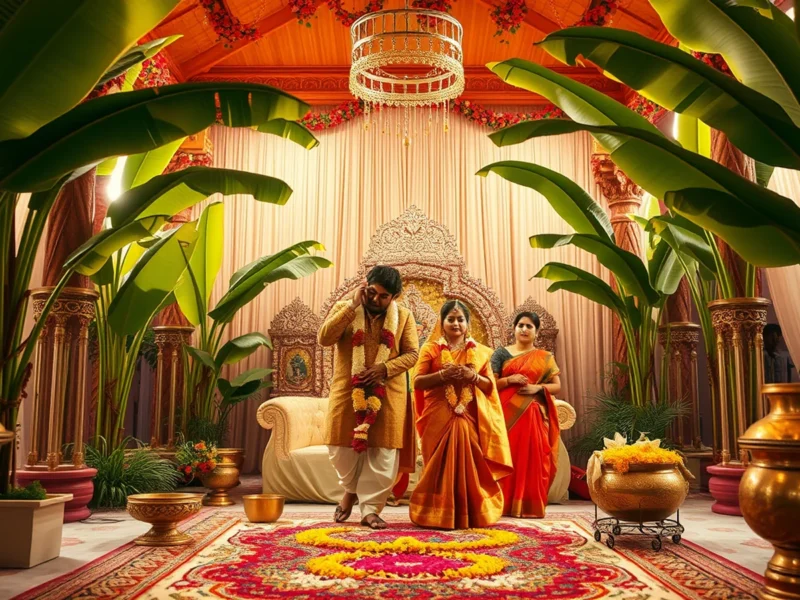
Nalangu is the light-hearted Tamil ceremony where the couple apply sandalwood and turmeric to each other’s feet and then play a series of games in front of both families. Its purpose is to break the ice between two people who may barely know each other.
What nalangu is
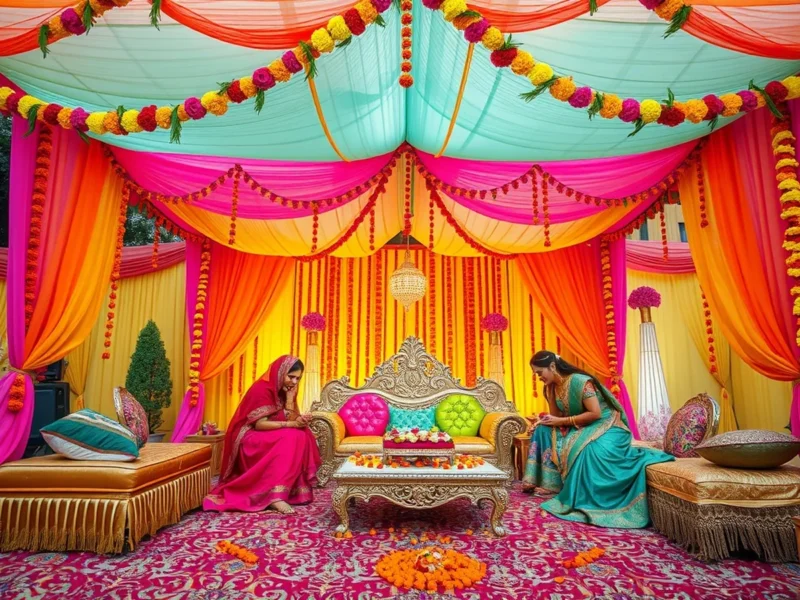
Nalangu is the deliberately unserious part of a Tamil wedding. After hours of Sanskrit chanting, fire rituals and formal obligations, the couple are seated facing each other and made to play games while both families watch, comment and interfere.
It is held either on the evening before the wedding or on the evening of the wedding day itself, depending on family custom and on how the muhurtham falls. Some families hold two, one at each house.
The ceremony opens with the application of maanjal and chandanam, turmeric and sandalwood paste, to the couple’s feet, along with kumkum. Traditional nalangu paatu songs are sung throughout by the women of the family, often teasing both the bride and the groom. Then the games begin.
The games
The specific games vary by family, but a core set recurs across most Tamil weddings.
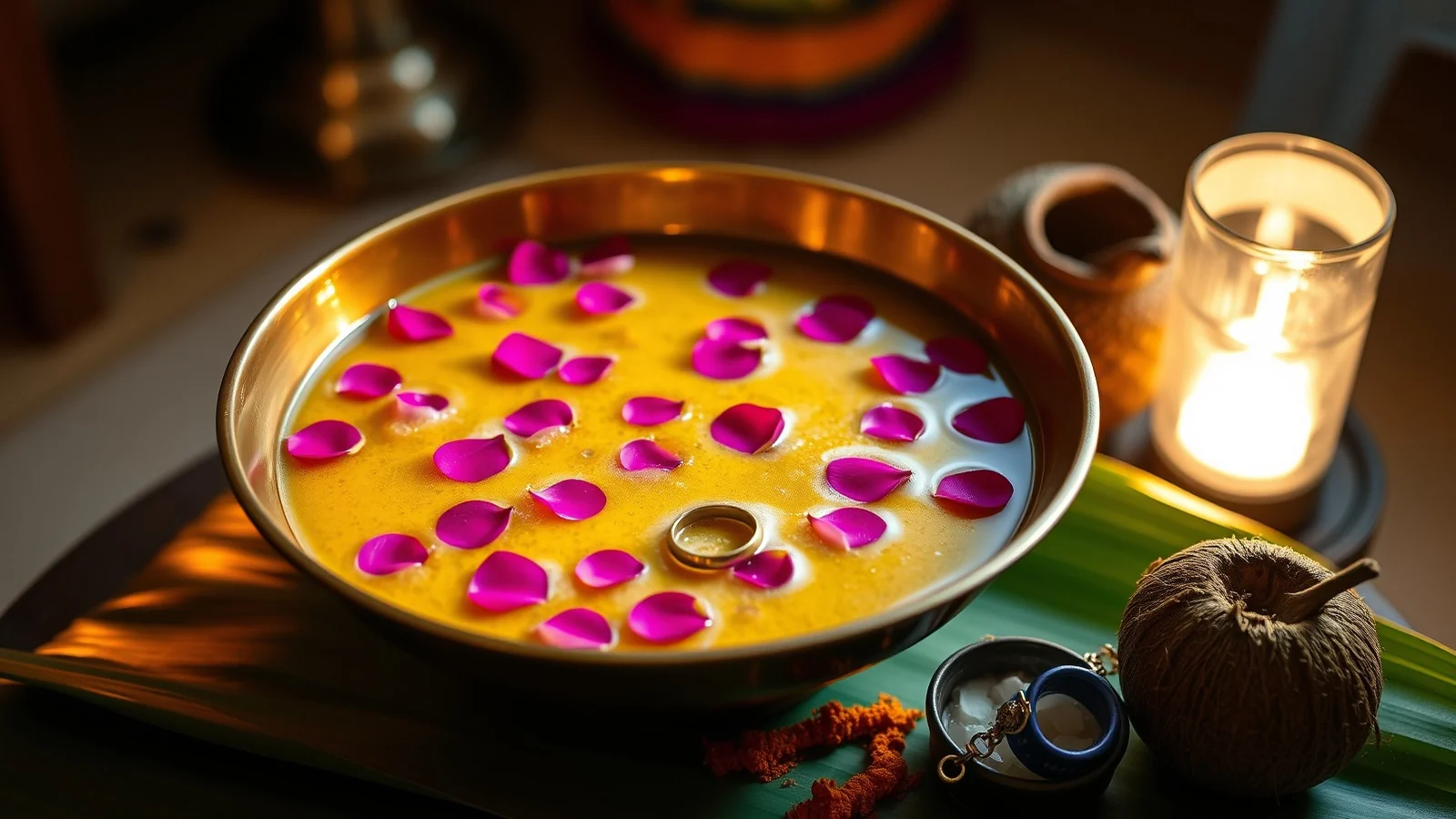
- The ring in the pot. A ring, or sometimes a coin, is dropped into a wide vessel of milky water clouded with turmeric. Both reach in at once and try to find it. Best of three is common, and the winner is said to have the upper hand in the marriage. It is the single most widespread game and appears in North Indian weddings too.
- Rolling the coconut. The couple roll a coconut back and forth to each other across the floor. Simple, and surprisingly effective at making two nervous people laugh.
- Breaking the papad. Each breaks a papad over the other’s head. Undignified, universally enjoyed, and guaranteed to be filmed.
- The garland exchange. A lighter repeat of the formal maalai maatral, often with the couple’s cousins making it deliberately difficult.
- Blowing out the lamp, or tug of war with a flower string. Smaller regional variations, played where family custom includes them.
Throughout, the cousins on both sides are expected to cheat on behalf of their own side. This is understood and is part of the design.
What it is actually for
The ceremony has a clear social function, and it is worth stating plainly because it explains why nalangu has survived so robustly while more solemn rituals have thinned out.
It introduces two people to each other. In a traditional arranged marriage the couple might have met a handful of times under supervision. The wedding rituals themselves offer no opportunity to interact naturally: they sit, they are instructed, they perform. Nalangu is the first occasion on which they do something together, in public, that is not scripted by a priest.
It introduces the two families. The cousins on both sides compete, tease and cheat on behalf of their own. Families that have spent the day being formally polite to each other end the evening arguing about whether someone saw the ring before they reached for it.
It releases the pressure. A South Indian wedding day begins before dawn with mangala snanam and runs on a fixed muhurat with no slack in it. Nalangu is the only part of the sequence with no timing pressure and no religious obligation attached, and it functions as the exhale.
The turmeric and sandalwood
The application of turmeric and sandalwood paste that opens the ceremony is not incidental, and it connects nalangu to the wider ritual use of both substances.
Turmeric runs through the entire South Indian wedding, from the haldi and the pre-dawn ritual bath to the yellow thread on which the thaali is strung. It is understood as purifying and auspicious, and it has genuine antiseptic properties that underpin its traditional use on skin.
Sandalwood is cooling and fragrant, and is applied at points of transition and blessing across Hindu ritual. Applying both to the feet is a gesture of honour: in Indian practice, touching or anointing the feet is an act of respect, and here the couple perform it for each other. Before the games begin, in other words, they each formally honour the other. It is easy to miss under the noise that follows.
Regional equivalents
- Tamil. Nalangu proper, with the full song tradition. See Tamil Brahmin wedding rituals.
- Telugu. Closely equivalent post-wedding games are played, and the ring-finding game is near universal. See Telugu wedding rituals.
- Kannada. Similar games ceremonies are held, with regional variation in the songs. See Kannada wedding traditions.
- Malayali. The Kerala structure differs, though family games at the reception fill a similar role. See Malayali wedding traditions.
- North Indian. The equivalents are spread across several customs: the ring-in-the-pot game is played at the groom’s home after griha pravesh, and the licensed teasing between families is concentrated in joota chupai.
In inter-community weddings, nalangu is usually the easiest ritual to explain to the other side, because its purpose is self-evident within about ninety seconds of the first game starting.
The nalangu songs
Nalangu paatu is the song tradition that accompanies the ceremony, and it is considerably cheekier than most wedding music.
The songs are teasing by design. They mock the groom, tease the bride, comment on the families, and in their older forms could be quite pointed about the in-laws. In many families the women of the bride’s side and the groom’s side sing competing verses at each other, which is the closest thing a South Indian wedding has to a rap battle and is enjoyed accordingly.
This is a deliberate licence. The rest of the wedding is formal, hierarchical and full of deference. Nalangu is the release valve, and the songs are where the things nobody could say politely get said musically, in front of everyone, with no consequences.
Like the oonjal songs, the repertoire is thinning generation by generation. Families who still have singers should record them. Families who do not can and increasingly do use recordings, and while it is not the same, it is far better than a games ceremony conducted in silence with a Bluetooth speaker playing film songs.
Planning the wedding these ceremonies belong to? We plan weddings across India and can take the schedule, the logistics and the coordination off your family entirely.
Regional variations on the games
The core games are widespread, but the details differ by region and by family, and the variations are worth knowing if two families are combining traditions.
- The ring in the pot. Near universal. The vessel is filled with water clouded by turmeric or milk, sometimes with flower petals. Some families use a ring, others a coin or a small silver object. Best of three or best of five, and the loser is teased for the rest of the evening.
- Rolling the coconut. Common in Tamil practice. In some families it is rolled, in others tossed, and in a few it must be caught with both hands while seated.
- Breaking the papad. Widespread and universally enjoyed. Some families use appalam, some use a sweet, and a few substitute a garland of flowers for anyone worried about dignity.
- Feeding each other. Sweets or milk, often with the cousins interfering. Simple and reliably charming.
- The flower fight. In some families the couple throw flowers or petals at each other, which is chaotic, photogenic and entirely harmless.
- Guessing games. Questions about each other, with the family judging the answers. This is the variant most likely to reveal that the couple do not yet know each other well, which is exactly what the ceremony is for.
Running nalangu at a hotel
Nalangu evolved as a home ritual, performed in a hall or courtyard with forty relatives. Most weddings now happen in hotels, and the translation needs thought or the ceremony flattens.
- Get a small room, not the ballroom. This is the single most important decision. Nalangu in a room built for six hundred people, with the couple on a distant stage, stops being a family game and becomes a performance. A side hall or a suite works far better.
- Sit on the floor if you can. The ceremony is traditionally performed seated on the floor, and hotels default to chairs on a raised platform. Floor seating with cushions changes the whole feel of it.
- Warn housekeeping. There will be turmeric water, broken papad and flowers on the floor. Telling the venue in advance costs nothing and avoids an awkward conversation.
- Protect the clothes. Turmeric permanently stains silk. Most brides change into a simpler saree, and this should be decided in advance rather than negotiated while holding a bowl of turmeric water.
- Control the guest list. Thirty to fifty family members. The temptation to invite everyone staying at the hotel should be resisted.
- Kill the stage lighting. Warm, even, low light. Nalangu photographs best when it looks like a family evening, which is what it is.
Practical notes
- Hold it when people still have energy. Nalangu scheduled at midnight after a dawn muhurtham is a ceremony nobody enjoys. The evening before the wedding often works better.
- Keep the audience small. It works at thirty to fifty family members. At four hundred it becomes a stage performance and the couple stop being natural.
- Protect the clothing. Turmeric stains silk permanently. Most brides change into a simpler saree for nalangu, and it is worth deciding this in advance rather than at the moment the paste appears.
- Brief the singers. Nalangu paatu is a genuine repertoire, and like oonjal songs it is thinning with each generation. Identify who knows them early.
- Let the photographer get close. This is a candid, low-light, fast-moving ceremony, and it produces the most natural images of the entire wedding.
For where nalangu sits in the full sequence, see our guide to South Indian wedding traditions and to the oonjal ceremony.
Planning a wedding that honours these traditions?
Team Velvet Knot plans weddings across every major Indian tradition, and we brief vendors on the rituals so nothing gets rushed, mistimed or quietly dropped from the running order. Tell us your dates and your community, and we will come back with an honest plan.
Related South Indian rituals
Nalangu at a glance
| Item | Detail |
|---|---|
| What it is | The light-hearted Tamil games ceremony between the couple |
| When | The evening before the wedding or the evening of the wedding day, and in some families once at each house |
| How it opens | Maanjal and chandanam, turmeric and sandalwood paste, applied to the couple’s feet with kumkum |
| Music | Nalangu paatu, sung by the women of both families |
| Core games | The ring in the pot, rolling the coconut, breaking the papad and a repeat of the garland exchange |
| Purpose | To introduce the couple and the two families to each other, and to release the pressure of the day |
| Religious obligation | None, which is why it can run without watching the clock |
Setting up the games
| Game | What you need | Planning note |
|---|---|---|
| The ring in the pot | A wide vessel, milky water clouded with turmeric, and a ring or coin | Best of three is common, so keep a towel within reach for the couple’s hands |
| Rolling the coconut | A coconut and a clear stretch of floor | Seat the couple far enough apart that the roll is a real one |
| Breaking the papad | Plenty of papads | Keep spares, because the first ones often fail to break cleanly and everyone wants a second take |
| The garland exchange | A second pair of light garlands | Brief the cousins that the difficulty is meant to stay playful |
| The lamp or the flower string | A small lamp, or a string of flowers for a tug of war | Played only where family custom includes it, so ask the elders first |
Planning a nalangu that works
The ceremony succeeds when it feels unplanned, which takes some planning. A few things make the difference:
- Seating. Low seats with the couple facing each other, and the elders close enough to watch and comment.
- Light. The games happen in the evening, and the best moments are faces reacting, so give the photographers usable light rather than only decorative lamps.
- The songs. If anyone in the family still sings nalangu paatu, ask them in advance and record them. A recording is a fallback, not the goal.
- The slot. Leave room for it after a long ritual day. It has no muhurat to keep, and rushing it defeats its purpose.
- The props. Assign one person to the vessel, the paste, the papads and the spares, so nothing is hunted for while the families wait.
Nalangu in English, and why there is no single word for it
People searching for nalangu in English are usually trying to explain the evening to a
relative who does not speak Tamil, and the honest answer is that English has no word for it,
because English weddings have no equivalent occasion. The nearest description is the games
evening: the part of a Tamil wedding designed to make two people who may barely know each other
laugh in front of their families.
| If you need to say it in English | How accurate it is |
|---|---|
| The games ceremony, or the games evening | The most useful description, because the games are what guests will actually see |
| An ice-breaking ceremony | Accurate about the purpose, which is exactly what the rite is for |
| A turmeric and sandalwood ritual | Describes the opening act, where the couple apply the paste to each other, but misses the point of the evening |
| A bridal shower or a reception game | Wrong. Both families are present, the couple are the participants rather than the audience, and it sits inside the wedding sequence |
Two practical notes follow from that. First, if you are briefing a photographer or an
emcee who is not Tamil, describe it as the games rather than as a ritual, or they will plan for
something solemn and miss the entire evening. Second, when you write it on an invitation in
English, the function is usually listed by name with a short line under it, because guests who
know it do not need the translation and guests who do not will not recognise any English label
you choose.
Frequently Asked Questions
What is the nalangu ceremony?
Nalangu is the light-hearted Tamil wedding ceremony in which the couple apply turmeric and sandalwood paste to each other’s feet and then play a series of games in front of both families, accompanied by traditional nalangu paatu songs.
What games are played at nalangu?
The core set is finding a ring dropped into a pot of turmeric-clouded water, rolling a coconut back and forth, breaking a papad over each other’s head, and a light repeat of the garland exchange. Cousins on both sides are expected to cheat for their own side, and that is part of the design.
When is nalangu held?
Either on the evening before the wedding or on the evening of the wedding day, depending on family custom and how the muhurtham falls. Some families hold two, one at each house. Holding it while people still have energy makes a considerable difference.
What is the point of the nalangu games?
They introduce two people who may barely know each other, in public and without a script, which no other part of the wedding allows. They also break the ice between the two families, and they release the pressure of a day that runs on a fixed muhurat from before dawn.
Why is turmeric and sandalwood applied to the feet?
Turmeric is purifying and auspicious and runs through the whole South Indian wedding, and sandalwood is cooling and used at moments of blessing. Applying either to the feet is an act of honour in Indian practice, so before the games start the couple each formally honour the other.
Does the winner of the ring game really rule the marriage?
No. It is a joke that every family repeats and nobody believes, and it exists to give the couple something to compete over on a day when everything else is prescribed. Best of three is the usual format, and the cheating is generally shameless on both sides.
What do you need to prepare for a nalangu ceremony?
Turmeric and sandalwood paste with kumkum, a wide vessel of milky turmeric water with a ring or coin, a coconut, plenty of papads, a spare pair of light garlands, low seating for the couple and good light for photographs. A singer for the nalangu paatu, or a recording, completes it.
What is the nalangu function called in English?
There is no single English word for it. It is usually described as the Tamil wedding games ceremony: a light-hearted function where the couple apply sandalwood and turmeric to each other’s feet and then play games in front of both families.
What is the nalangu function in English?
English has no equivalent, so the useful translation is the games ceremony or the games evening. Nalangu is the light-hearted Tamil function in which the couple apply sandalwood and turmeric to each other and then play a series of games in front of both families. Its purpose is to break the ice between two people who may barely know each other, so describing it as an ice-breaking ceremony is accurate about the intent.
What does nalangu mean?
It names the function rather than translating into a single idea. In practice nalangu refers to the sandalwood and turmeric applied between the couple and to the games that follow it, held in front of both families as part of a Tamil wedding.
Sources and further reading
Begin Your Engagement
Want a real number for your wedding?
Tell us your city, guest count and dates. Team Velvet Knot will come back within 24 hours with an itemised budget.