South Indian Wedding Traditions: Tamil, Telugu, Malayalam & Kannada Guide
- Tamil Wedding Traditions (Tamil Nadu)
- Telugu Wedding Traditions (Andhra Pradesh & Telangana)
- Malayalam/Kerala Wedding Traditions
- Kannada Wedding Traditions (Karnataka)
- Common Elements Across All South Indian Weddings
- Temple Weddings vs Hall Weddings in South India
- The South Indian Wedding Menu: A Feast Like No Other
- South Indian Wedding Costs: A Comparative Overview (2026)
- Explore South Indian community traditions
- Setting the muhurtham
- What a Mysore wedding costs
- Related South Indian rituals
- Frequently Asked Questions
- Plan Your South Indian Wedding with Velvet Knot
- Sources and further reading
A South Indian wedding centres on the tying of the thali (mangalsutra), the exchange of garlands, and the saptapadi or seven steps, with distinct customs across Tamil Nadu, Andhra Pradesh and Telangana, Kerala, and Karnataka. Attire, cuisine, and ritual order differ beautifully across Tamil, Telugu, Malayalam, and Kannada traditions while the spiritual core stays shared.
Planning a South Indian wedding? Free download: the ritual-by-ritual planning timeline
Every ritual on this page in order, with when it happens, what the family arranges and when to book it, on one printable page. Share a few details about your wedding in the form at the end of this page and the download link appears as soon as you send it.
A South Indian wedding is a vibrant celebration of culture, devotion, and family, with distinct rituals across Tamil Nadu, Andhra Pradesh/Telangana, Kerala, and Karnataka. The core ceremony revolves around the tying of the thali (mangalsutra), the exchange of garlands, and the saptapadi (seven steps), but the execution, attire, cuisine, and customs differ beautifully across Tamil, Telugu, Malayalam, and Kannada traditions. South Indian weddings are attended by an estimated 35 to 40 million families each year across the four major states, making this one of the most significant cultural markets in India’s INR 10 lakh crore wedding industry (CAIT, 2025). This guide covers every major ritual, regional variation, temple vs hall wedding considerations, and the legendary South Indian wedding feast.
Tamil Wedding Traditions (Tamil Nadu)
Pre-Wedding Rituals
Tamil weddings begin with the Nischayathartham (engagement), where both families formalise the match and exchange rings, sarees, and dhotis. This is followed by the Paalikai Thellichal, a fertility ritual where nine types of grains are soaked in mud pots and kept at the entrance of the wedding venue. The sprouting of these grains symbolises prosperity. The Nalangu ceremony is a playful pre-wedding game night where the bride and groom compete in fun tasks like finding a ring in a bowl of turmeric water. Professional Nalangu event setups in Chennai now cost INR 50,000 to INR 3,00,000.

Muhurtham: The Auspicious Wedding Hour
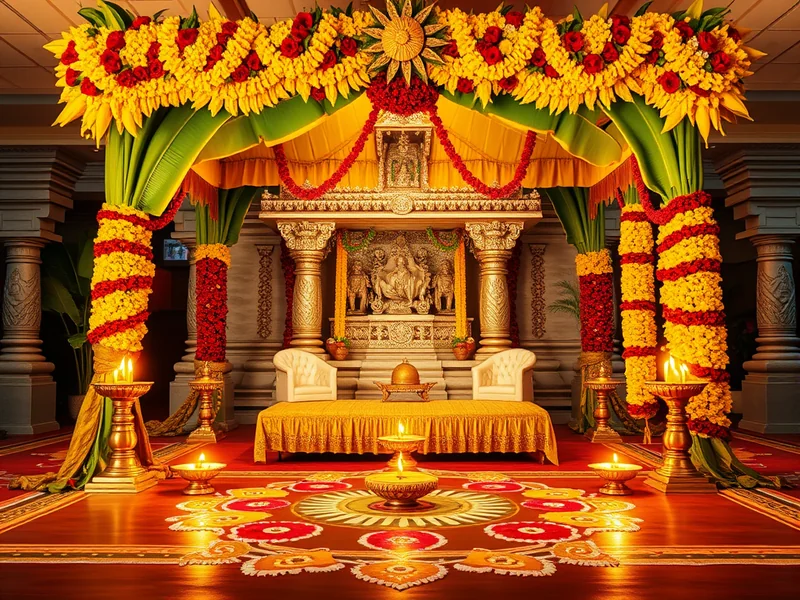
The Muhurtham is the most sacred moment of a Tamil wedding, calculated by the family priest based on the couple’s horoscopes. Tamil weddings are almost always held in the morning, typically between 6:00 AM and 12:00 PM. The ceremony takes place on a decorated stage or mandapam. The Kanyadaanam (giving away the bride) is performed by the bride’s father, followed by the Thali tying, where the groom ties the sacred thali around the bride’s neck with three knots while the nadaswaram (traditional wind instrument) plays and mangala vaadyam (auspicious drums) sound. The three knots are tied: the first by the groom, the second and third by the groom’s sister. This is the moment that legally and spiritually seals the marriage.
Saptapadi and Post-Ceremony
After the thali tying, the couple performs the Saptapadi (seven steps around the sacred fire). The groom holds the bride’s right toe as she steps on seven small heaps of rice or betel leaves, each step representing a vow. This is followed by the Ammi Mithithal, where the bride places her foot on a grinding stone, symbolising her steadfastness. The groom then places silver toe rings (metti) on the bride’s feet, another important symbol of marriage in Tamil culture. The ceremony concludes with Arundhati Darshan, where the couple looks at the star Arundhati (a symbol of marital fidelity) in the sky, though in morning weddings this is often symbolic.
Telugu Wedding Traditions (Andhra Pradesh & Telangana)
Pre-Wedding Rituals
Telugu weddings are known for their elaborate pre-wedding ceremonies. The Pellikuthuru and Pellikoduku ceremonies involve the ceremonial bathing of the bride and groom at their respective homes with turmeric and oil, accompanied by singing and celebration. The Snathakam is a unique Telugu ritual where the groom pretends to renounce worldly life and set off on a pilgrimage to Varanasi, but the bride’s father intervenes, persuading him to stay and marry his daughter. This is a humorous and theatrical tradition that often has guests laughing. The groom is given new clothes, an umbrella, a walking stick, and sandals to play the part.
Jeelakarra Bellam (Cumin and Jaggery)
The Jeelakarra Bellam ceremony is the highlight of a Telugu wedding. A paste of cumin seeds (jeelakarra) and jaggery (bellam) is placed on the bride’s and groom’s heads. The mixture of cumin (which is bitter) and jaggery (which is sweet) symbolises the couple’s commitment to staying together through the bitter and sweet moments of life. The bride and groom simultaneously place this paste on each other’s head, and this ritual is considered the moment the marriage is officially solemnised. It is equivalent to the thali tying in Tamil weddings.
Talambralu (Showering Rice)
Immediately after Jeelakarra Bellam, the couple showers each other with Talambralu, rice mixed with turmeric. This playful ritual, where bride and groom try to pour rice on each other’s head, is one of the most photographed moments of a Telugu wedding. It symbolises prosperity and the couple’s wish for abundance. Telugu weddings are also known for the Mangalsutra Dharana (thali tying) and the Saptapadi around the sacred fire.
Planning a South Indian wedding?
Velvet Knot plans luxury South Indian weddings end to end, from the sacred rituals and mandap to the venue, catering and guest hospitality. Share your dates and city for a tailored plan.
Malayalam/Kerala Wedding Traditions
Nair and Namboothiri Weddings
Kerala Hindu weddings vary by community. Nair weddings are known for their simplicity and elegance. The Kanyadaanam is the central ritual, performed at the Muhurtham time, usually in the morning at a temple or wedding hall. The bride’s father gives her hand to the groom while Vedic mantras are chanted. The groom ties the Thali (Minnu), a gold ornament shaped like a banyan leaf, around the bride’s neck. This is followed by the Pudamuri, where the groom presents the bride with a wedding saree (the Pudava, a white or cream saree with a gold border, called Kasavu in Kerala). The bride changes into this saree, symbolising her acceptance of the groom and his family.
Syrian Christian Influence and Simplicity
Kerala Hindu weddings are notably more restrained compared to their North Indian counterparts. The ceremonies are typically completed within two to three hours. Guest lists are large (500 to 2,000 guests is common), but the events themselves are straightforward. The Sadya (traditional Kerala feast served on a banana leaf) is the centrepiece of the celebration. A full Kerala Sadya includes 24 to 28 dishes, from avial and olan to payasam and banana chips. Professional Sadya caterers in Kerala charge INR 500 to INR 1,500 per leaf in 2026, making Kerala weddings comparatively economical.
Kannada Wedding Traditions (Karnataka)
Pre-Wedding: Nandi and Nischay Tamulam
Kannada weddings begin with the Nandi puja, a prayer to the family deity seeking blessings for the wedding. The Nischay Tamulam is the formal engagement ceremony where betel leaves, nuts, fruits, coconuts, and turmeric are exchanged between the two families. This is followed by the Devara Puje, where both families perform puja at their respective homes. In Lingayat weddings, the groom’s family sends an Otti (auspicious bundle containing saree, blouse piece, turmeric, kumkum, and coconuts) to the bride.
Dhare: The Sacred Water-Pouring Ceremony
The Dhare ceremony is the most significant ritual in a Kannada Hindu wedding. The bride’s father pours sacred water over the joined hands of the bride and groom while Vedic mantras are chanted, formally giving his daughter in marriage. This is the Kannada equivalent of Kanyadaanam and is considered the binding moment of the marriage. The Mangalsutra Dharane (tying of the mangalsutra) follows, accompanied by the playing of the shehnai and nadaswaram. The mangalsutra in Kannada weddings is often a simple black-beaded chain with two gold cups (known as Karimani Sara).
Saptapadi and Post-Wedding
The couple then takes Saptapadi (seven steps) around the sacred fire. After the pheras, the Arundhati Nakshatra Darshana and Dhruva Darshana rituals are performed, where the couple gazes at the stars symbolising constancy and devotion. Kannada weddings often include the Oonjal (swing ceremony), where the newlyweds sit on a decorated swing while married women sing folk songs. This ritual is believed to strengthen the bond between the couple.
Common Elements Across All South Indian Weddings
Despite regional variations, several elements unite South Indian weddings:
- Morning Muhurtham: Almost all South Indian weddings are held in the morning, with the auspicious time typically falling between 7:00 AM and 11:30 AM.
- Thali/Mangalsutra: The tying of the thali is the central act of marriage across all four traditions, though the design and material of the thali differ.
- Vedic Mantras: All ceremonies are conducted with Sanskrit mantras chanted by a priest, rooted in Vedic tradition.
- Silk Sarees: The bride wears a silk saree, most commonly a Kanjeevaram (Tamil Nadu), Pochampally or Uppada (Andhra/Telangana), Kasavu (Kerala), or Mysore silk (Karnataka).
- Banana Leaf Meals: The wedding feast is traditionally served on banana leaves, with regional variations in the menu.
- Nadaswaram and Thavil: Traditional instrumental music featuring the nadaswaram (wind instrument) and thavil (drum) is played during the ceremony in all four traditions.
- Gold Jewellery: South Indian brides are known for their elaborate gold jewellery, including temple jewellery sets, jimikki kammal (earrings), oddiyanam (waist belt), and nethichutti (forehead ornament). India’s southern states account for roughly 40% of the nation’s gold consumption, according to the World Gold Council.
Temple Weddings vs Hall Weddings in South India
| Factor | Temple Wedding | Hall/Convention Centre Wedding |
|---|---|---|
| Cost | INR 25,000-2,00,000 (temple fees) | INR 2,00,000-20,00,000 (venue rental) |
| Capacity | 50-500 guests (varies by temple) | 200-5,000+ guests |
| Ambience | Traditional, spiritual, historic | Customisable, modern, flexible |
| Decor Restrictions | Limited; must follow temple rules | Full creative freedom |
| Timing | Strict muhurtham adherence | Flexible scheduling |
| Catering | Usually vegetarian; temple may provide | Full choice; non-veg possible |
| Photography | May be restricted in sanctum | No restrictions |
| Popular Temples | Tirupati, Guruvayur, our cultural consultant Temple, Srirangam | N/A |
According to data from popular temple wedding offices, the Tirumala Tirupati Devasthanam (TTD) in Andhra Pradesh hosts over 25,000 weddings annually, making it one of the busiest wedding venues in India. Guruvayur Temple in Kerala books out months in advance, with some families waiting over a year for preferred dates. Temple wedding costs are modest (INR 1,000 to INR 50,000 for the temple booking itself), but travel, accommodation, and post-wedding celebrations at nearby halls add to the total budget.
The South Indian Wedding Menu: A Feast Like No Other
South Indian wedding meals are legendary for their variety, flavour, and presentation. Here is what a typical banana leaf feast looks like across the four traditions:
| State | Signature Dishes | Meal Style | Avg. Cost Per Plate (2026) |
|---|---|---|---|
| Tamil Nadu | Sambar, rasam, kootu, poriyal, payasam, vadai, curd rice | Banana leaf, vegetarian (Brahmin) or with non-veg (Chettinad) | INR 600-1,800 |
| Andhra/Telangana | Pulihora, pappu, avakaya, biryani (non-Brahmin), pesarattu, bobbatlu | Banana leaf; often includes non-veg for non-Brahmin weddings | INR 700-2,500 |
| Kerala | Sadya: avial, olan, thoran, sambar, rasam, pachadi, ada pradhaman | Banana leaf Sadya; 24-28 dishes | INR 500-1,500 |
| Karnataka | Bisi bele bath, holige/obbattu, chitranna, kosambari, payasa | Banana leaf; vegetarian in most Brahmin weddings | INR 500-1,500 |
Non-Brahmin South Indian weddings, particularly in Andhra Pradesh and Tamil Nadu (Chettinad community), often include elaborate non-vegetarian spreads featuring mutton biryani, chicken curry, prawn fry, and fish preparations. According to catering industry estimates, South Indian wedding catering is 20 to 40% more economical than equivalent North Indian wedding catering, primarily because banana leaf service eliminates the cost of crockery and the focus is on homestyle cooking at scale.
South Indian Wedding Costs: A Comparative Overview (2026)
| Category | Budget Wedding | Mid-Range Wedding | Premium Wedding |
|---|---|---|---|
| Venue | INR 50,000-2,00,000 | INR 2,00,000-8,00,000 | INR 8,00,000-30,00,000 |
| Catering (500 guests) | INR 2,50,000-5,00,000 | INR 5,00,000-12,00,000 | INR 12,00,000-25,00,000 |
| Bridal Saree & Jewellery | INR 1,00,000-3,00,000 | INR 3,00,000-10,00,000 | INR 10,00,000-50,00,000+ |
| Decor | INR 50,000-2,00,000 | INR 2,00,000-8,00,000 | INR 8,00,000-25,00,000 |
| Photography | INR 50,000-1,50,000 | INR 1,50,000-5,00,000 | INR 5,00,000-15,00,000 |
| Total Estimate | INR 5,00,000-15,00,000 | INR 15,00,000-50,00,000 | INR 50,00,000-2,00,00,000+ |
Explore South Indian community traditions
- Kannada wedding traditions
- Malayali wedding traditions
- Kodava (Coorgi) wedding traditions
- Konkani wedding traditions
Setting the muhurtham
What a Mysore wedding costs
Related South Indian rituals
- the Kashi Yatra ritual
- the oonjal swing ceremony
- the nalangu games ceremony
- mangala snanam, the dawn ritual bath
- the jeelakarra bellam ritual
- talambralu, the rice shower
- nischitartham, the South Indian engagement
Traditions in this region: read our full guide to Chettiar and Nagarathar wedding traditions.
Traditions in this region: read our full guide to Kerala Syrian Christian wedding traditions.
Temple weddings on Velvet Knot: which temples actually host weddings.
Also on Velvet Knot: Nadar wedding rituals.
Frequently Asked Questions
How long does a South Indian wedding ceremony last?
The core South Indian wedding ceremony, from the start of the Muhurtham rituals to the completion of Saptapadi, typically lasts 1.5 to 3 hours. The entire event, including reception of guests, the meal, and post-ceremony rituals, usually wraps up by early afternoon. Unlike many North Indian weddings that extend into the late night, South Indian weddings are predominantly morning affairs.
What is the most important ritual in a South Indian wedding?
The tying of the Thali (Mangalsutra) is universally considered the most important ritual across all South Indian wedding traditions. It is the definitive act that marks the couple as married. In Tamil weddings, it is called Thali Kattu; in Telugu, Mangalsutra Dharana; in Malayalam, Thalikettu; and in Kannada, Mangalsutra Dharane. The specific design and style of the thali vary by community and region.
Can non-vegetarian food be served at a South Indian wedding?
Yes. While Brahmin community weddings are strictly vegetarian, many other South Indian communities serve non-vegetarian food at weddings. Chettinad (Tamil Nadu) weddings feature elaborate non-veg menus, as do Reddy and Naidu (Andhra Pradesh) weddings, Nair (Kerala) weddings, and Vokkaliga/Lingayat (Karnataka) weddings. However, if the wedding is held at a temple or temple-affiliated hall, only vegetarian food is permitted.
What should guests wear to a South Indian wedding?
Silk sarees are the preferred attire for women attending a South Indian wedding. Kanjeevaram silk sarees are considered the gold standard. Men typically wear a veshti (white dhoti) with a shirt or kurta, or a formal silk dhoti and angavastram (shawl). In urban settings, men may also wear suits or formal kurta-pajama. Bright and auspicious colours like red, yellow, green, and gold are encouraged. White is acceptable in Kerala weddings but may be avoided in Tamil and Telugu weddings where it can be associated with mourning.
How do I book a temple wedding at Tirupati or Guruvayur?
For Tirumala Tirupati, you can book online through the TTD website (ttdevasthanams.ap.gov.in) or visit the TTD office. Bookings open 90 days in advance, and popular dates fill up within hours. The basic Kalyanam package costs around INR 3,500 to INR 15,000 depending on the hall chosen. For Guruvayur Temple, bookings are made through the Guruvayur Devaswom website (guruvayurdevaswom.nic.in), and the waiting period can be several months. Fees range from INR 2,500 to INR 25,000. A wedding planner experienced in temple weddings can handle the logistics, permits, and coordination on your behalf.
What is the best season for a South Indian wedding?
The peak wedding season in South India runs from November to February when the weather is pleasant across all four states. The Tamil month of Thai (mid-January to mid-February) is considered highly auspicious for Tamil weddings. In Kerala, the Meenam-Medam period (March-April) is also popular. The monsoon months (June to September) are generally avoided in Kerala and coastal Karnataka, while inland Andhra Pradesh and Telangana have year-round wedding activity. Always consult a priest for auspicious dates (muhurtham) well in advance.
Plan Your South Indian Wedding with Velvet Knot
Planning a South Indian wedding? Get a free, personalised quote from Velvet Knot’s expert team. Whether you want a grand Kanjeevaram-draped celebration in Chennai, a temple wedding at Tirupati, an elegant Sadya reception in Kochi, or a regal affair in Bangalore, our planners understand every regional tradition and ensure flawless execution. Get your free quote today.
Sources and further reading
Velvet Knot believes in showing our work. The references below are the authoritative sources we consult when planning weddings in this category.
- Hindu Marriage Act, 1955: Government of India
- Dravidian peoples, Britannica: Britannica
Begin Your Engagement
Want a real number for your wedding?
Tell us your city, guest count and dates. Team Velvet Knot will come back within 24 hours with an itemised budget.