Nischitartham: The South Indian Engagement and the Lagna Patrika
- What nischitartham is
- The lagna patrika
- Fixing the muhurtam
- What else happens
- Regional differences
- Gotra, and why it is checked
- Horoscope matching and what it covers
- Planning notes for families abroad
- What the ceremony has become
- Practical notes
- Frequently Asked Questions
- Sources and further reading
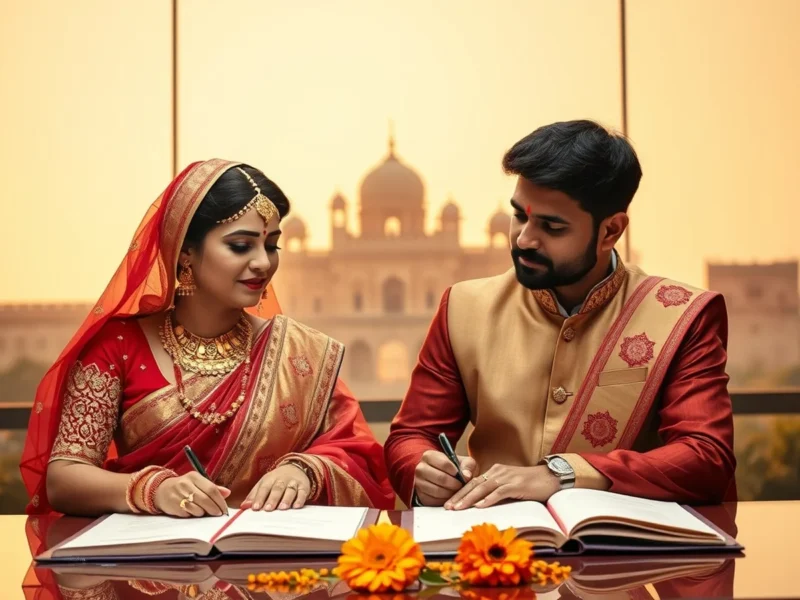
Nischitartham is the South Indian engagement, at which the two families formally agree the marriage and the priest fixes the wedding muhurtam. Its defining element is the lagna patrika, a written record of the agreement read aloud in front of both families.
What nischitartham is
Nischita means decided or fixed. Nischitartham is the ceremony at which a South Indian marriage stops being a discussion and becomes an agreement, and at which the wedding date is set.
It is the Telugu name. The Tamil equivalent is nichayathartham, and Kannada families use their own variants. In every version the essential business is the same: the two families meet formally, horoscopes are confirmed as compatible, the priest calculates the auspicious hour for the wedding, and the agreement is written down and read out.
That last element is what makes it different from a North Indian engagement. A sagai centres on the exchange of rings. Nischitartham centres on a document.
The lagna patrika
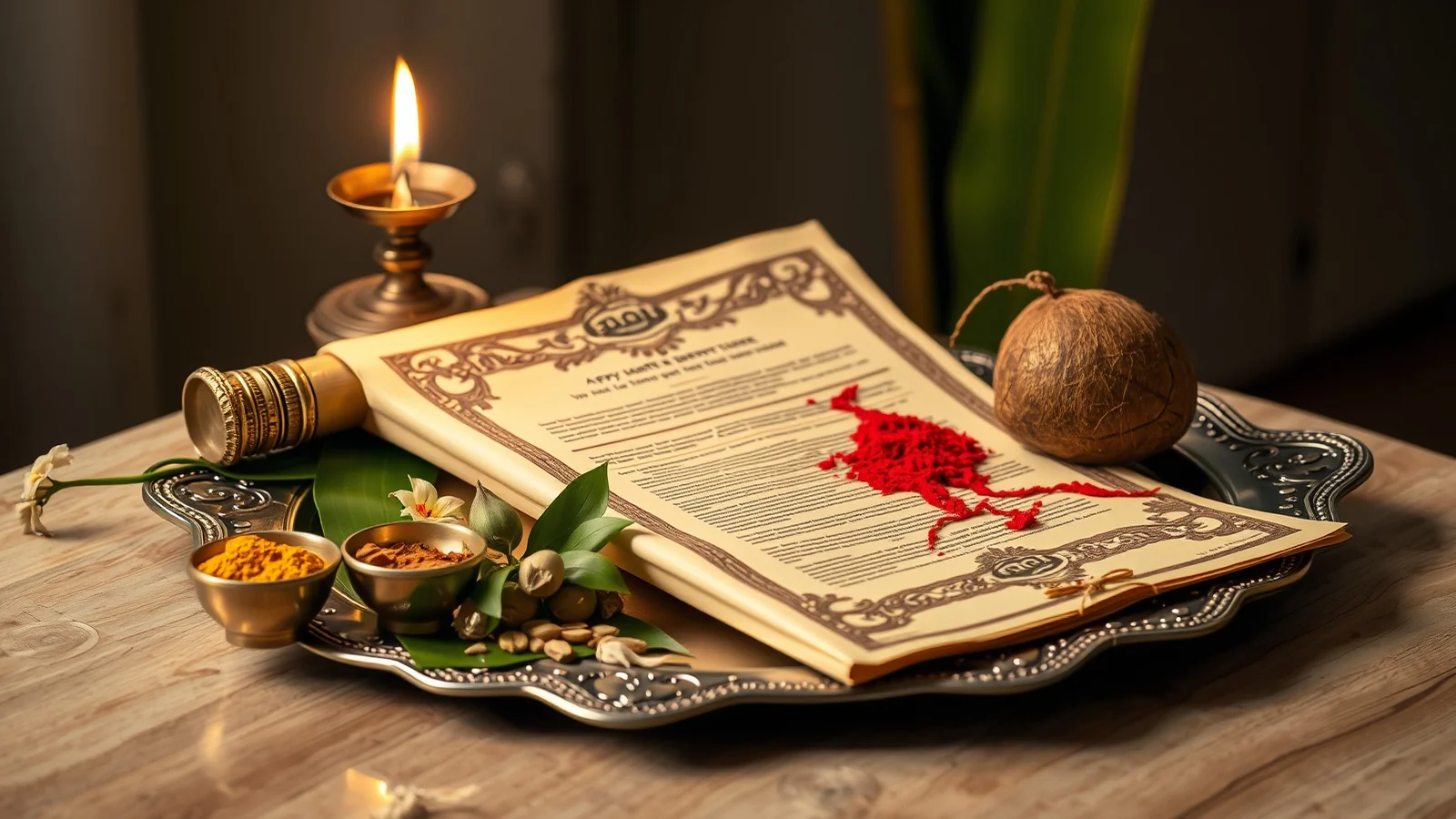
The lagna patrika, also called the lagna patrikai or lagna patrike, is the written record of the marriage agreement. It is prepared by the priest, usually on a decorated sheet or a traditional palm-leaf-style paper, and it states the essentials in formal terms.
- The names of the bride and groom, with their gotras and the names of their parents and grandparents.
- The lineage details that establish the two families are not of the same gotra, since marriage within a gotra is traditionally prohibited.
- The agreed date and the muhurtam, the precise auspicious time, for the wedding.
- The venue.
- In traditional versions, the undertakings each family gives.
Two copies are prepared. The priest reads the document aloud in front of both families, and each family keeps a copy. In many households the reading is the emotional centre of the event, because it is the moment the wedding acquires a date that everyone must now work to.
Fixing the muhurtam
The muhurtam is calculated from the birth details of the bride and groom against the panchangam, the traditional almanac. The priest identifies windows that are auspicious for both, avoiding inauspicious periods, and the families choose from what is offered.
This is the single most consequential decision made at nischitartham, and it is worth understanding why. South Indian weddings are frequently solemnised very early in the morning, and the entire day is constructed backwards from that fixed instant: the mangala snanam ritual bath, dressing, the Kashi Yatra, the oonjal, and in Telugu weddings the jeelakarra bellam at the muhurtam itself.
Because the time cannot move, everything else must. Families who book a venue before fixing the muhurtam frequently discover the two are incompatible, and it is the venue that has to give way.
What else happens
- Pasupu and kumkum. Turmeric and vermilion are exchanged between the women of the two families, a standard marker of auspiciousness.
- Tamboolam. Trays of betel leaves, areca nuts, fruit, coconut, flowers and sweets are exchanged. The number of trays is often specified by custom and counting them is taken seriously.
- Gifts of clothing. Each family presents the other’s children with new clothes, commonly a silk saree for the bride and a dhoti or suit for the groom.
- Jewellery. Frequently presented to the bride by the groom’s family at this point.
- Rings. Increasingly common as a modern addition, borrowed from North Indian and Western practice rather than traditional to the ceremony.
- A meal. Almost always, and often a substantial one.
The exchange of tamboolam is the element most often underestimated by families organising from abroad. The trays are specific, the contents are specific, and someone who knows the custom needs to assemble them.
Regional differences
- Telugu. Nischitartham, with the lagna patrika read aloud and pasupu-kumkum exchanged. Often held at the bride’s home or a function hall. See Telugu wedding rituals.
- Tamil. Nichayathartham, with the lagna patrikai read and a strong emphasis on the tamboolam trays. See Tamil Brahmin wedding rituals.
- Kannada. An equivalent ceremony with local naming and its own tray conventions. See Kannada wedding traditions.
- Malayali. The Kerala engagement is structured differently and the lagna patrika is not always central. See Malayali wedding traditions.
- North Indian. The nearest equivalents are the roka and the sagai, which mark commitment and engagement but do not typically produce a written agreement or fix the muhurtam in the same binding way.
In an inter-community wedding this asymmetry causes real confusion. A North Indian family may treat the engagement as a party and the date as provisional; a South Indian family has just signed and read out a document. Establish which understanding is operating before anyone books flights.
Gotra, and why it is checked
The lagna patrika records the gotra of both families, and this is not a formality.
A gotra is a patrilineal lineage, traditionally traced to one of a set of ancient sages. Marriage between two people of the same gotra is prohibited in orthodox practice, on the reasoning that they descend from a common ancestor. The rule is called sagotra prohibition, and it is why the engagement document records three generations of names on each side.
In practice most families check this before the match is agreed rather than at the nischitartham, so the recording at the ceremony confirms rather than discovers. Where a same-gotra situation does emerge, families handle it in different ways and priests differ on how strictly it applies, particularly for communities where gotra is not traditionally tracked.
The practical consequence for anyone organising a wedding is simple: somebody has to gather accurate names for parents and grandparents on both sides, spelled correctly, before the priest prepares the document. This is more work than it sounds, especially where grandparents have died and no one is certain of the spelling.
Planning the wedding these ceremonies belong to? We plan weddings across India and can take the schedule, the logistics and the coordination off your family entirely.
Horoscope matching and what it covers
Before the date is fixed, the horoscopes are usually compared. Families outside the tradition often assume this is a single yes or no; it is more granular than that.
The comparison, kundali milan or porutham in Tamil practice, scores compatibility across a set of categories covering temperament, longevity, prosperity, progeny and the like. A threshold score is generally treated as acceptable. Specific configurations, notably mangal dosha or the equivalent, are checked for and, where present, are often addressed through prescribed remedies rather than treated as disqualifying.
How much weight a family gives this varies enormously, from decisive to a formality performed to satisfy grandparents. What matters practically is that the two families understand each other’s position before the nischitartham, because discovering at the ceremony that one side considers the match astrologically settled and the other considers it still open is a genuinely difficult moment.
Planning notes for families abroad
Nischitartham is the ceremony that causes NRI families the most trouble, because it has to happen in person and it has to happen before the wedding can be planned.
- The muhurtam cannot be fixed remotely in most families. The priest, the horoscopes and both families need to be in the same place, which usually means an additional trip.
- Video-link versions exist and have become more common, with the lagna patrika read over a call and copies couriered. Older relatives may or may not accept this.
- Build it into the trip plan. If the family is making one visit before the wedding, this is what it is for.
- Get the tamboolam assembled locally. The trays cannot practically be brought from abroad, and a relative in India needs to take it on.
Our NRI short trip planning guide covers sequencing this alongside the other rituals that need the family present.
What the ceremony has become
Within a generation, nischitartham has moved from a meeting to an event, and the two understandings now coexist uncomfortably in the same families.
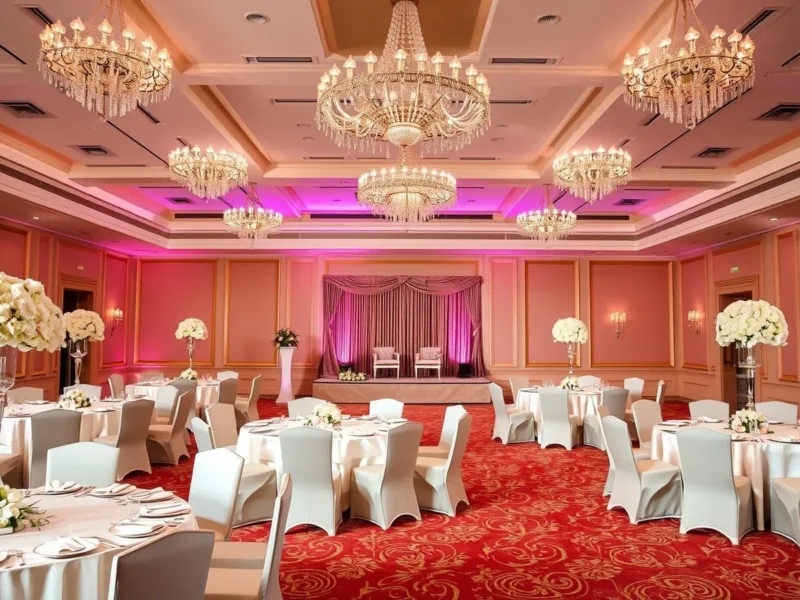
The older form was small: elders, the priest, the immediate families, a document, a meal. The current form frequently involves a banquet hall, a few hundred guests, decor, a photographer and an outfit budget. Neither is wrong, but the cost and effort of the second version means some families now treat the engagement as the first of two weddings rather than as the preliminary to one.
The practical consequence is worth naming: where one family is planning a function and the other is expecting a house ceremony, the mismatch is discovered late and is awkward to correct. Settle the scale in the same conversation that settles the date.
Practical notes
- Fix the muhurtam before the venue. Not after. This is the single most common and most expensive sequencing error in South Indian weddings.
- Get the gotra details right. The lagna patrika records lineage for three generations. Somebody needs to gather grandparents’ names in advance, and it is not a five-minute job.
- Ask the priest for the tamboolam list. Contents and tray counts vary by family and region, and there is no generic version.
- Keep the document. The lagna patrika is a family record. Many households frame it. At minimum, photograph it before it is folded away.
- Photograph the reading. It is the substantive moment, and it is easy to treat as an administrative pause between the gifts and the meal.
- Agree the guest count early. Nischitartham has expanded in recent years from a family meeting into a full function, and the two understandings of its scale cause friction.
For the full South Indian sequence, see our guide to South Indian wedding traditions.
Planning a wedding that honours these traditions?
Team Velvet Knot plans weddings across every major Indian tradition, and we brief vendors on the rituals so nothing gets rushed, mistimed or quietly dropped from the running order. Tell us your dates and your community, and we will come back with an honest plan.
Frequently Asked Questions
What is nischitartham?
Nischitartham is the South Indian engagement ceremony at which the two families formally agree the marriage and the priest fixes the wedding muhurtam. Nischita means decided. The Tamil equivalent is nichayathartham.
What is a lagna patrika?
It is the written record of the marriage agreement, prepared by the priest and read aloud before both families. It states the names, gotras and lineage of the bride and groom, their parents and grandparents, and the agreed date, muhurtam and venue. Two copies are made, one for each family.
How is the wedding date decided?
The priest calculates it from the birth details of both against the panchangam, identifying windows auspicious for both and avoiding inauspicious periods. The families choose from the options offered. Once fixed, the muhurtam cannot move, and the whole wedding day is built backwards from it.
What is tamboolam?
Trays of betel leaves, areca nuts, fruit, coconut, flowers and sweets exchanged between the two families. The number of trays and their contents are often specified by custom, and counting them is taken seriously. Ask the priest for the list rather than assuming.
Is nischitartham the same as a North Indian engagement?
No. A sagai centres on the exchange of rings; nischitartham centres on a document and on fixing a binding muhurtam. In inter-community weddings this causes real confusion, because one family may treat the date as provisional while the other has just had it formally recorded.
Should we book the venue before the engagement?
No. Fix the muhurtam first. South Indian weddings are often solemnised very early in the morning and the time cannot be moved, so a venue booked in advance frequently turns out to be incompatible. It is the most common and most expensive sequencing error families make.
What is nischitartham in English?
Nischitartham means engagement. It is the South Indian ceremony at which the two families formally agree the marriage and the wedding date is fixed.
Sources and further reading
Begin Your Engagement
Want a real number for your wedding?
Tell us your city, guest count and dates. Team Velvet Knot will come back within 24 hours with an itemised budget.