Jeelakarra Bellam: The Cumin and Jaggery Ritual at the Heart of a Telugu Wedding
- What jeelakarra bellam is
- The curtain, and why it matters
- What the cumin and jaggery mean
- How the ritual is performed
- Where it sits in the Telugu wedding
- Regional variation
- What the priest is actually saying
- Common variations between families
- If you are attending as a guest
- Practical notes
- Jeelakarra bellam at a glance
- Planning around the muhurtam
- Jeelakarra bellam meaning, word by word
- Frequently Asked Questions
- Sources and further reading
In jeelakarra bellam, the Telugu couple place a paste of cumin and jaggery on each other’s heads at the exact auspicious moment. The bitter and the sweet together stand for a bond that holds through both, and it is the point at which the marriage is considered made.
What jeelakarra bellam is
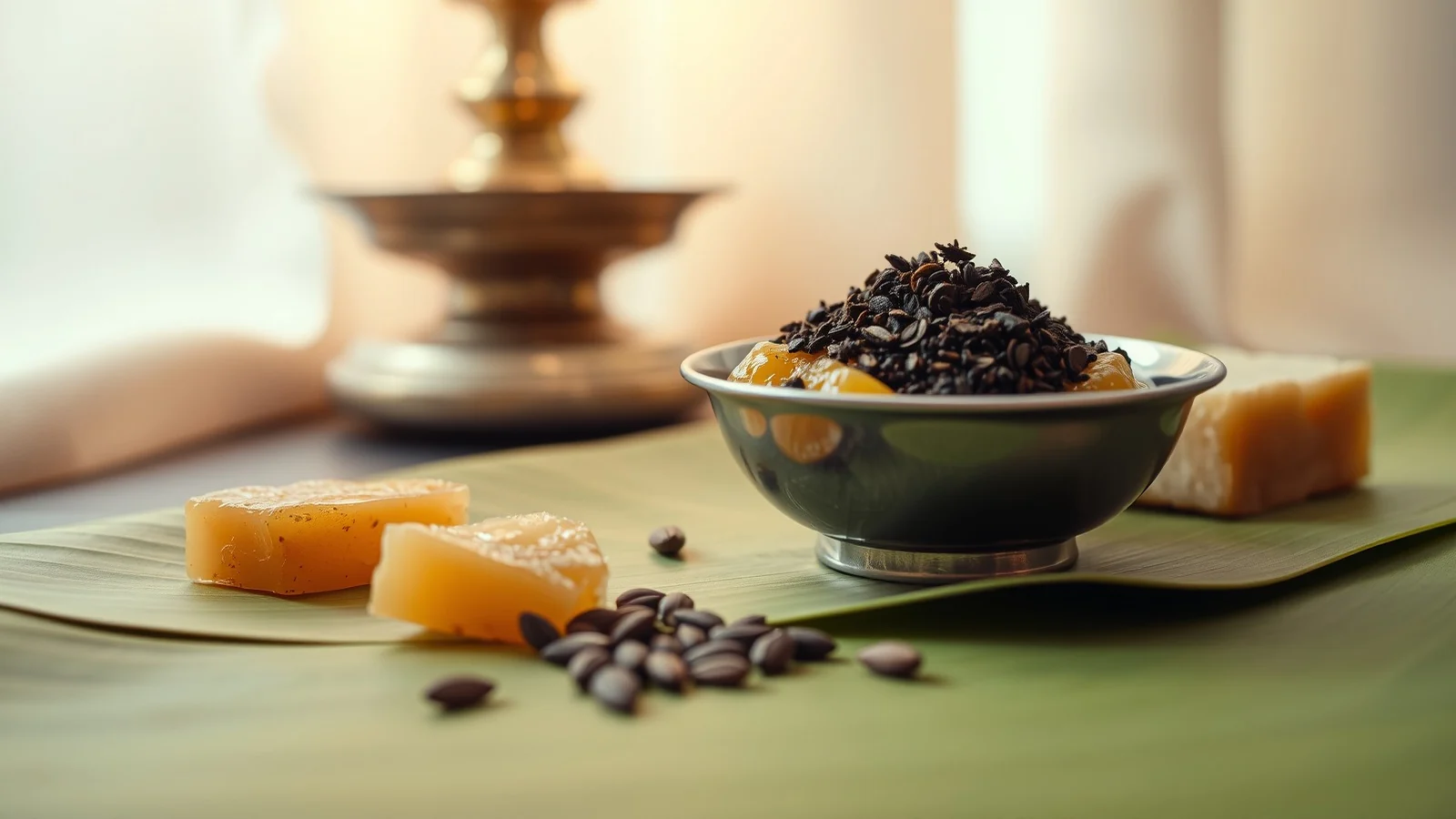
Jeelakarra is cumin and bellam is jaggery. The ritual takes its name from the two ingredients, ground together into a coarse paste, that the bride and groom place on each other’s heads at the appointed hour.
It is the single most distinctive moment in a Telugu wedding, and among the most important. In many families it is treated as the moment the marriage takes effect, more than the tying of the mangalsutra that follows. The paste is applied at the precise muhurtam calculated by the priest, which is why Telugu weddings so often fall at inconvenient hours of the morning.
Until that moment the couple are separated by a curtain, and they cannot see each other. The curtain comes down, they place the paste, and the wedding proceeds. Everything before it is preparation, including the mangala snanam at dawn and the Kashi Yatra. Everything after it belongs to a married couple.
The curtain, and why it matters
The tera, sometimes called the antarpat, is a plain cloth curtain held up between the bride and groom by two people, usually their maternal uncles. It is not decorative. It does real ritual work.
The couple are seated facing each other with the curtain between them. Neither can see the other. The priest chants, and the assembled family waits. At the exact muhurtam the curtain is lowered, and the first thing the couple do on seeing each other is reach up and place the paste on each other’s heads.
The reading is direct. The curtain represents the separateness of two lives; its removal at the auspicious instant is the joining. In marriages where the couple genuinely had not met, that first look carried enormous weight, and even now, when the couple have known each other for years, the moment the tera drops is the one the photographers are briefed on above all others.
Some families keep a small opening in the curtain, some use a plain white cloth, others a decorated one. What is consistent is the timing: the curtain does not come down early, and it does not come down late.
What the cumin and jaggery mean
The pairing is the point, and it is unusually plain-spoken for a wedding ritual.
Jaggery is intensely sweet. Cumin is bitter. Ground together, neither cancels the other; you taste both. A marriage will contain both, and the couple are taking them together, at the same moment, from the same hand. It is one of the few Hindu wedding rituals that states openly that the marriage will contain difficulty.
The paste holds together. Cumin and jaggery combine into a mixture that does not readily separate, and this is widely cited as the second layer of meaning: a bond that resists being pulled apart.
The placement is deliberate. The paste goes on the crown of the head, the spot understood in traditional practice as the seat of consciousness. Placing it there, rather than feeding it, makes the gesture about the union of two minds rather than about taste.
There is also a practical reading offered in many families: cumin aids digestion and jaggery gives energy, and a couple who have been fasting since before dawn are about to need both. Like the turmeric in haldi and the henna in mehndi, the folk medicine and the symbolism sit comfortably together.
How the ritual is performed
- The paste is prepared in advance, cumin seeds and jaggery pounded together, usually by the women of the family. It is coarse rather than smooth.
- The couple are seated facing each other on the mandap, the bride traditionally to the groom’s left when they later sit side by side.
- The tera is raised between them by two relatives, commonly the maternal uncles.
- The priest chants the relevant mantras and counts down to the muhurtam.
- The curtain drops at the exact moment.
- Both reach up simultaneously and place the paste on the other’s head, and hold it there for the duration of the chanting.
- The mangalsutra follows immediately, along with the tying of the three knots. See our guide to the mangalsutra.
The simultaneity matters. Neither goes first. In a ritual sequence where the bride is given and the groom receives, this is a moment of exact symmetry, and families who understand that tend to stage it carefully rather than letting one person move ahead of the other.
Where it sits in the Telugu wedding
The full sequence, and the reason the day starts so early.
- Nischitartham. The formal engagement, at which the date is fixed. See our nischitartham guide.
- Pellikuthuru and pellikoduku. The bride and groom formally declared as such at their own homes.
- Mangala snanam. The pre-dawn ritual bath. See the mangala snanam guide.
- Kashi Yatra. The groom’s staged departure. See the Kashi Yatra guide.
- Maalai maatral and oonjal. Garland exchange and the swing. See the garland exchange and the oonjal ceremony.
- Kanyadaanam. The giving of the bride. See kanyadaan.
- Jeelakarra bellam. At the muhurtam.
- Mangalsutra and talambralu. The thread is tied, then the rice shower. See the talambralu guide.
- Saptapadi. The seven steps. See saptapadi.
The whole day is built backwards from the jeelakarra bellam muhurtam. Move that and everything else moves with it, which is why the priest is consulted before the venue.
Regional variation
- Telugu. Jeelakarra bellam in its fullest form, treated as the defining moment of the wedding. See Telugu wedding rituals.
- Kannada. A closely equivalent ritual is performed, with the curtain and the jeera-bella paste, under regional names. See Kannada wedding traditions.
- Tamil. The antarpat curtain appears, but the cumin and jaggery element is not standard; the muhurtam centres on the tying of the thaali. See Tamil Brahmin wedding rituals.
- Malayali. The Kerala sequence differs substantially and this ritual is not part of it. See Malayali wedding traditions.
- North Indian. No equivalent. The binding moment is distributed across the pheras and the saptapadi rather than concentrated in one instant. See our complete guide to Hindu wedding rituals.
In an inter-community wedding this difference is worth explaining early. A North Indian family may not understand why the entire schedule is immovable, and the answer is that this ritual has a time, not a slot.
Planning the wedding these ceremonies belong to? We plan weddings across India and can take the schedule, the logistics and the coordination off your family entirely.
What the priest is actually saying
The chanting over the jeelakarra bellam is not generic. The mantras invoke the couple’s union in terms that are worth knowing, because guests who understand them experience a very different ceremony from those who do not.
The recitation addresses the pair as partners in dharma, the obligations of the household, and asks that they be of one mind. The phrase most often quoted from this portion translates roughly as a wish that their hearts be joined, that their minds be joined, and that they live together in harmony. It is repeated while the paste is held in place, which is why the couple hold the position longer than feels natural.
Many priests will explain the verses to the family beforehand if asked, and a growing number narrate them briefly in Telugu or English during the ceremony so that guests follow along. Families organising a wedding for a mixed or largely non-Telugu-speaking guest list should ask for this specifically. It costs nothing and transforms the twenty minutes around the muhurtam from an opaque ritual into something the room can follow.
Common variations between families
The core is fixed but the details are not, and families disagree about them more than they expect.
- Who holds the curtain. Maternal uncles is the common convention, but some families use the couple’s siblings or the priest’s assistants.
- Whether the paste is also fed. Some households have the couple place a small amount in each other’s mouths afterwards, so that the bitter and sweet are literally tasted. Others consider this incorrect and keep it strictly on the head.
- The consistency. A coarse crumbly mixture in some families, a smooth paste bound with a little ghee or honey in others.
- How long it stays. A few seconds in some traditions, the whole recitation in others, which can be several minutes with arms raised.
- Whether the curtain returns. A minority of families raise it again briefly afterwards before the mangalsutra.
None of these are worth arguing about, and all of them get argued about. Ask the priest which version the family follows a week ahead, and tell both sides the answer.
If you are attending as a guest
This is the moment to be in your seat, and it is the one most often missed by guests who have stepped out for coffee.
The muhurtam is announced in advance and the priest will usually give a warning several minutes ahead. Guests unfamiliar with Telugu weddings frequently assume the ceremony builds to a climax at the end, as a church wedding does, and are surprised to find the decisive moment arrives early in a long sequence and lasts under a minute.
Two practical courtesies. Do not stand in the aisle between the mandap and the seating during the curtain drop; the photographers have one chance at it. And do not applaud immediately, since the mangalsutra follows straight away and the chanting continues. The room takes its cue from the family, and the noise properly belongs a minute later, at the talambralu.
Practical notes
- Confirm the muhurtam before booking anything. Not the venue, not the caterer, not the flights. Everything else is negotiable and this is not.
- Brief the photographers on the curtain drop. It happens once, it takes two seconds, and it cannot be repeated. Two cameras, one on each face, is the standard brief.
- Prepare the paste fresh. Made too far ahead it dries out and will not stay on the head.
- Warn the couple that it is messy. Jaggery in the hair, immediately before the most photographed hours of the day. Hair and makeup should know it is coming.
- Nominate the curtain holders in advance. Traditionally the maternal uncles. It is a small honour and being overlooked is noticed.
- Do not schedule a late function the night before. A muhurtam at five in the morning means the family is up at one. This is the most common scheduling failure in Telugu weddings.
For the wider South Indian sequence, see our guide to South Indian wedding traditions.
Planning a wedding that honours these traditions?
Team Velvet Knot plans weddings across every major Indian tradition, and we brief vendors on the rituals so nothing gets rushed, mistimed or quietly dropped from the running order. Tell us your dates and your community, and we will come back with an honest plan.
Jeelakarra bellam at a glance
| Item | Detail |
|---|---|
| Ingredients | Cumin and jaggery, pounded together into a coarse paste |
| Who applies it | The bride and groom, to each other, at the same moment |
| Where | The crown of the head |
| When | At the exact muhurtam the priest has calculated |
| The curtain | The tera, held between the couple by two relatives, commonly the maternal uncles |
| What follows | The mangalsutra with its three knots, then the talambralu |
| Meaning | The bitter and the sweet taken together, and a bond that does not separate |
Planning around the muhurtam
A Telugu wedding day is built backwards from one instant, and every vendor needs to know it.
| Planning point | Why it matters | What to do |
|---|---|---|
| Fix the muhurtam first | Every other timing depends on it | Consult the priest before confirming the venue and the date |
| Count back the morning | The day starts with the mangala snanam before dawn | Set hair, makeup and dressing times from the muhurtam, not from a normal start |
| Brief the photographers | The curtain drop is the frame families want most | Place a camera on each side of the tera and agree the cue |
| Prepare the paste | It must be ready and within reach at the moment | Give one person responsibility for the bowl |
| Rehearse the simultaneity | Neither partner is meant to move first | Walk the couple through the gesture before the day |
| Get the guests in early | An early muhurtam means an early arrival | Plan transport and a light breakfast so guests are seated before the chanting |
In an inter-community wedding, share this plan with the other family early. A family used to a wedding whose binding moment is spread across the pheras may not see why the schedule cannot move, and a short explanation of the muhurtam saves a tense morning.
Jeelakarra bellam meaning, word by word
The name is simply the two ingredients, which is why it sounds like a recipe rather than a
rite. In Telugu, jeelakarra is cumin and bellam is jaggery. The compound names the paste the
couple place on each other’s heads, and the rite is named after the paste.
| Telugu | What it is | What it carries in the rite |
|---|---|---|
| Jeelakarra | Cumin seed | The bitter half: the parts of a life together that are not sweet |
| Bellam | Jaggery, unrefined cane sugar | The sweet half |
| Jeelakarra bellam | The paste made of the two | Placed on each other’s heads at the muhurtam, standing for a bond that holds through both |
What people mean when they search for it in marriage
The phrase turns up attached to the word marriage more often than on its own, and that is
because the rite is not decorative. It is performed at the exact auspicious moment, and in most
Telugu families it is the point at which the marriage is considered made, rather than the garland
exchange or the reception that follows. If you are planning the timeline, that single fact
governs everything: the muhurtam decides when this happens, and the rest of the day is arranged
around it rather than the other way round.
It is also why the paste is prepared fresh and kept ready rather than made on the spot. There
is no room in the sequence to start grinding cumin while the priest waits.
Frequently Asked Questions
What is jeelakarra bellam?
It is the Telugu wedding ritual in which the bride and groom place a paste of cumin, jeelakarra, and jaggery, bellam, on each other’s heads at the exact auspicious moment. In many families it is regarded as the point at which the marriage takes effect.
Why cumin and jaggery specifically?
Because one is bitter and one is sweet, and ground together neither cancels the other. A marriage contains both, and the couple take them at the same moment from the same hand. The paste also holds together rather than separating, which is read as an unbreakable bond.
What is the curtain used for?
The tera, or antarpat, is held between the couple so they cannot see each other, and is lowered at the precise muhurtam. It represents two separate lives, and its removal at the auspicious instant is the joining. The first thing the couple do on seeing each other is place the paste.
Where is the paste placed?
On the crown of the head, understood in traditional practice as the seat of consciousness, rather than fed to each other. That placement makes the ritual about the union of two minds rather than about taste. Both reach up at the same time; neither goes first.
Is jeelakarra bellam performed in all South Indian weddings?
No. It is central in Telugu weddings and has a close Kannada equivalent. Tamil weddings use the antarpat curtain but not the cumin and jaggery, and the Kerala sequence does not include it at all. North Indian weddings have no equivalent.
Why can the wedding time not be moved?
Because the ritual is performed at a specific calculated muhurtam rather than at a convenient point in the schedule. The rest of the day is built backwards from it, which is why Telugu families fix the muhurtam with the priest before booking the venue.
Why do Telugu weddings happen so early in the morning?
Because the day is built around the jeelakarra bellam muhurtam that the priest calculates, and it often falls in the early hours. The mangala snanam and the other rites have to be completed before it, so the family’s day starts before dawn.
What does jeelakarra bellam mean in English?
Jeelakarra means cumin and bellam means jaggery in Telugu, so the name means cumin and jaggery. The paste of the two is placed on each other’s heads by the couple at the muhurtham.
What is the meaning of jeelakarra bellam?
The words are the ingredients. In Telugu, jeelakarra is cumin and bellam is jaggery, and the rite is named after the paste made from the two. The couple place it on each other’s heads, the bitter and the sweet together standing for a bond that holds through both. It is performed at the exact auspicious moment and is the point at which most Telugu families consider the marriage made.
Sources and further reading
Begin Your Engagement
Want a real number for your wedding?
Tell us your city, guest count and dates. Team Velvet Knot will come back within 24 hours with an itemised budget.