Mehndi Ceremony: Meaning, Rituals, Regional Styles and What Actually Happens
- What the mehndi ceremony actually is
- Why henna, and what the tradition is said to mean
- The hidden name, and the games attached to it
- How the ceremony runs, hour by hour
- Regional variation across India
- Getting a good stain: what actually works
- The one safety warning that matters: black henna
- Designs, motifs and what they mean
- What bridal mehndi costs, and what drives the price
- Aftercare, hour by hour
- Practical planning notes
- Related pre-wedding rituals
- Frequently Asked Questions
- Sources and further reading
The mehndi ceremony is the henna function held one to two days before an Indian wedding, where the bride’s hands and feet are decorated in intricate patterns. It is part ritual, part celebration, and in most families the most relaxed event of the entire wedding.
What the mehndi ceremony actually is
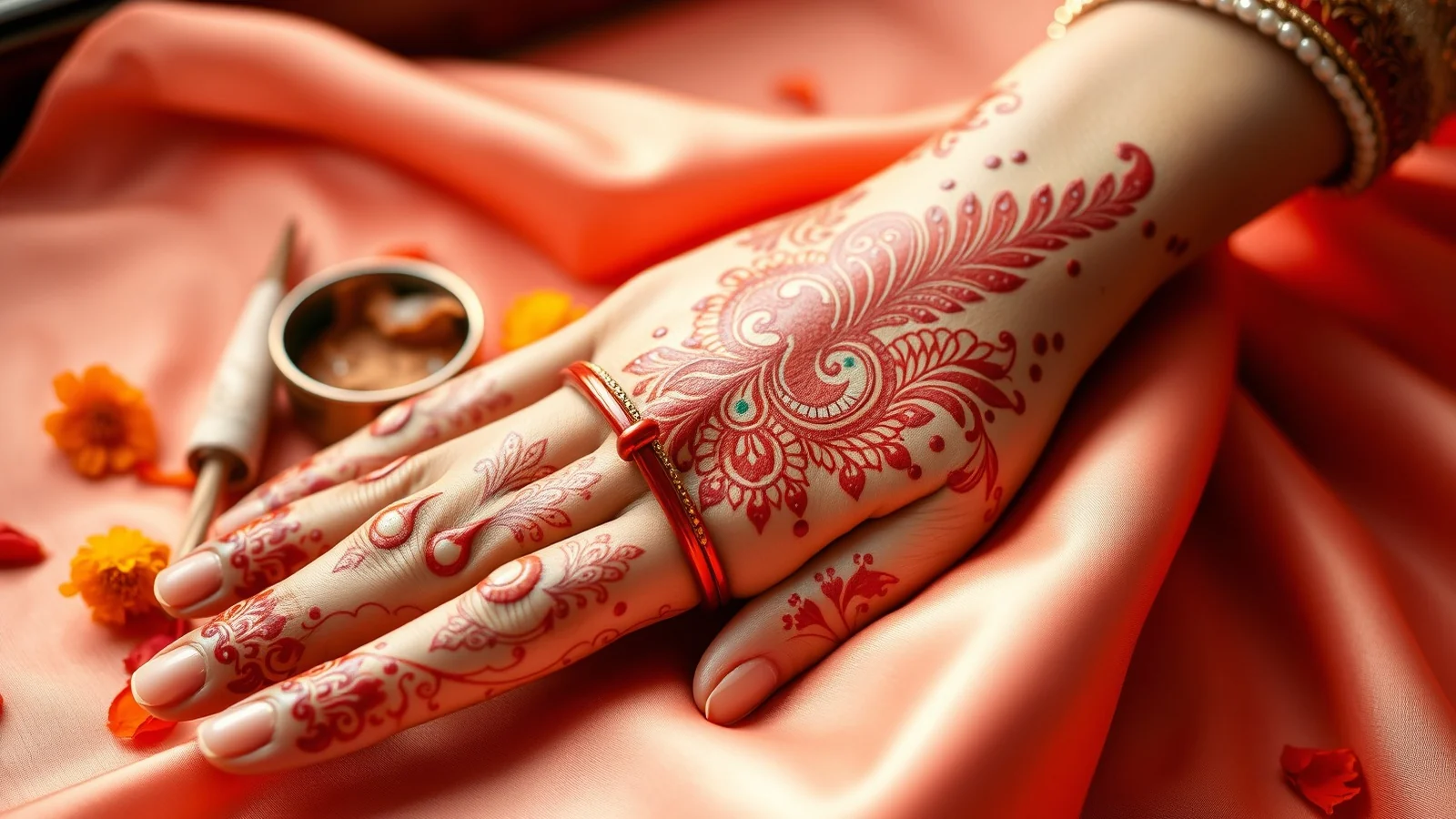
Mehndi is henna, the paste made from the dried and powdered leaves of Lawsonia inermis, a shrub cultivated across Rajasthan, Gujarat and Madhya Pradesh. Applied to skin, it leaves a reddish-brown stain that deepens over roughly 48 hours and fades over one to three weeks.
The mehndi ceremony is the function built around that application. The bride sits while an artist works on her hands, forearms, feet and shins. Around her, the women of both families are decorated too, food is served, and in most modern weddings the music starts and does not stop. It is usually held one or two days before the wedding, and in a large number of families it is now merged with the sangeet into a single evening.
Unlike the saptapadi or the kanyadaan, mehndi carries no scriptural requirement. No Vedic text prescribes it. It is a folk custom, absorbed into wedding practice over centuries and now near universal across Hindu, Muslim, Sikh and many Christian Indian weddings.
Why henna, and what the tradition is said to mean
Three explanations circulate, and they are worth separating by how much weight they carry.
The practical one is the most defensible. Henna has a genuine cooling effect on skin and has long been used in hot climates to relieve heat. Wedding weeks are stressful and physically punishing, and applying a cooling paste to the extremities the night before is a sensible piece of folk medicine. Traditional practice also credits it with soothing headaches and calming nerves.
The auspicious one is cultural. Red and its shades signal prosperity and fertility across Indian ritual, which is why the same colour recurs in the sindoor, the bridal outfit and the mangalsutra thread. Henna belongs to that palette.
The one to present as folklore is the darkness belief. Many families hold that the darker the bride’s stain develops, the deeper her husband’s love will be, or the better her relationship with her mother-in-law. Stain depth is in fact governed by skin temperature, how long the paste stays on, body chemistry and paste quality. Enjoy the belief; do not let anyone read a marriage forecast into it.
The hidden name, and the games attached to it
The best known convention is that the groom’s name, or his initials, is concealed somewhere in the bridal design. The groom is expected to find it, traditionally on the wedding night, and in practice at the reception with an audience.
The custom does real work. It gives a shy couple a first shared task, it gives the groom’s family something to participate in, and it produces the photographs everyone wants. Artists usually hide the letters in the shading of a petal, a peacock’s plumage or the border of a paisley.
A second convention holds that a bride with mehndi on her hands should not do housework until the colour fades, which historically bought a new bride a genuine grace period in her marital home. It is a small custom with more social intelligence in it than it first appears.
How the ceremony runs, hour by hour
A bridal set is not a quick job. Full hands, forearms, feet and shins in intricate work takes four to eight hours, depending on density and the artist’s speed. Most weddings therefore start the bride’s application in the early afternoon, well before guests arrive.
- Early afternoon. The bride’s application begins, usually in a quiet room with one or two family members.
- Late afternoon. Guests arrive. Two to four additional artists work through the female guests, doing simpler designs that take ten to thirty minutes each.
- Evening. Food, music and dancing. The bride cannot use her hands, so she is fed by family, which is itself part of the fun.
- Night. The paste is left on as long as the bride can bear, ideally six to eight hours.
Plan the guest artists properly. One artist for eighty women guarantees a queue and a quietly annoyed extended family. The working ratio is roughly one artist per twenty-five to thirty guests who actually want mehndi. Costs and booking lead times are covered in our guide to mehndi artist charges in India.
Regional variation across India
The ceremony is not uniform, and assuming it is causes avoidable friction in inter-community weddings.
- Rajasthani and Marwari. The most elaborate tradition. Full arm coverage past the elbow, dense figurative work with baraat scenes, portraits and architectural motifs. See Marwari wedding traditions.
- Punjabi. Held alongside or close to the chooda ceremony, and typically merged with a large, music-heavy function. Coverage is generous but often less figurative than Rajasthani work.
- Gujarati. Strong geometric and floral patterns, with the mehndi function frequently combined with garba. See Gujarati wedding traditions.
- Muslim. Mehndi is a major standalone event, often hosted by the bride’s family with its own dress code, and remains one of the most significant pre-wedding functions. See Muslim wedding traditions.
- South Indian. Historically far more restrained. Tamil practice used maruthani on fingertips, palms and the soles of the feet rather than full-arm patterns, and Kerala and Karnataka traditions were similarly minimal. Full-arm bridal mehndi in South Indian weddings is a recent, largely North-influenced import, and older relatives may expect the simpler form. See South Indian wedding traditions.
Getting a good stain: what actually works
Most of the folklore around stain depth is wrong, but a few things genuinely matter.
- Leave it on. Time on skin is the single biggest factor. Six to eight hours is the target. Overnight is better.
- Keep warm. Henna stains better on warm skin. Clove smoke or simply staying out of air conditioning helps.
- Do not wash it off. Scrape the dried paste away, then avoid water on the area for the next twelve hours. Water at the wrong moment is the most common cause of a disappointing stain.
- Oil, do not soap. Mustard, coconut or eucalyptus oil after scraping protects the developing stain.
- Apply a lemon and sugar sealant sparingly. It holds the paste in contact with skin, but overdoing it makes the design bleed.
Colour peaks around 48 hours after application, not immediately. A stain that looks pale the morning after is usually normal. Time the application so that peak colour lands on the wedding day, which in practice means the mehndi function two days before, not the night before.
The one safety warning that matters: black henna
Natural henna is never black. It is orange-brown when fresh and matures to a deep reddish brown. Any paste sold as instant, jet-black henna, or promising a stain within an hour, almost certainly contains para-phenylenediamine, a synthetic hair dye chemical known as PPD.
PPD applied directly to skin is a well-documented cause of severe allergic contact dermatitis. Reactions include chemical burns, blistering, permanent scarring in the shape of the pattern, and lifelong sensitisation to related compounds, which can rule out ordinary hair dye for the rest of a person’s life. Reactions frequently appear days after application, once the wedding is over.
Health authorities in several countries have issued consumer warnings about black henna specifically. The practical rule for a wedding is simple and non-negotiable: insist on natural henna paste, ask your artist what is in it, and refuse anything marketed on the promise of a black stain or an unusually fast result. This is the only part of the mehndi ceremony where getting it wrong causes lasting harm.
Designs, motifs and what they mean
Bridal mehndi is not decorative noise. Most of the recurring motifs carry meaning, and knowing them lets a bride brief her artist rather than accept a default template.
- The peacock. The most common single motif in Indian bridal work, associated with beauty and, in some readings, with longing and devotion.
- The lotus. Purity and the unfolding of a new life stage, and one of the oldest symbols in Indian art.
- The paisley or mango motif. Fertility and good fortune, and the shape that most often fills the large spaces on the forearm.
- The baraat scene. A figurative panel showing the groom’s procession, the palanquin or the couple themselves, usually placed on the back of the hand or the centre of the palm. This is the Rajasthani signature.
- The dulha and dulhan portraits. Faces of the bride and groom, technically the hardest element and the one that separates a good artist from an average one.
- The jaali or net. Fine lattice fill used to connect larger motifs and to cover the forearm without leaving it heavy.
Two structural conventions are worth knowing. The palms are traditionally the densest area, because the hands are what a bride shows when she is blessed and when she is photographed. And the design is usually built to be continuous from the fingertips to a defined stopping point on the forearm, rather than as isolated patches, which is why a bride should decide her sleeve length before the artist starts rather than after.
What bridal mehndi costs, and what drives the price
Pricing is driven by four things: the reputation of the artist, the coverage area, the density of the work, and the season.
A full bridal set covering both hands to the elbow and both feet to the shin, in dense figurative work, sits at the top of the range. Palms-and-fingertips-only work sits far below it. The single biggest cost jump is not from adding area but from adding portraits and figurative panels, which take an artist significantly longer and require a genuinely different skill level.
Peak wedding season pricing in India is real and material. The same artist commanding one figure in July will quote considerably more for a November or December Saturday, and the best artists are booked out on those dates months in advance. Guest artists are usually charged separately, either per head or as a flat hourly rate for a stated number of artists, and this is the line families most often forget to agree in writing.
Detailed 2026 ranges are set out in our guide to mehndi artist charges in India, and the function as a whole is priced alongside the other pre-wedding events in our haldi ceremony cost guide and sangeet night cost guide.
Aftercare, hour by hour
The forty-eight hours after application decide the result, and almost all of the disappointment brides report traces to something in this window.
- Hours 0 to 6. Paste on, undisturbed. Keep warm. Do not let it be knocked or smudged, which in practice means the bride does very little and is looked after by someone else.
- Hours 6 to 8. Optional lemon and sugar sealant, applied lightly with a cotton ball. Overdoing this makes the design bleed and blur, so once is enough.
- Hour 8 onwards, ideally overnight. Leave the dried paste on as long as tolerable. Wrapping the hands in tissue or a soft cloth prevents flaking onto bedding.
- Removal. Scrape the dried paste off. Do not wash it off. This is the single most common mistake and it costs several shades of colour.
- The next 12 hours. No water on the area. Apply mustard, coconut or eucalyptus oil, and reapply after any unavoidable contact with water.
- Hours 24 to 48. The stain darkens on its own. It will look disappointingly orange at first. This is normal and is not a sign of bad henna.
Practical consequences follow that families rarely anticipate. The bride cannot wash her own hair, handle food, or use a phone comfortably for most of a day. If the mehndi function is the night before the wedding, the salon appointment the next morning has to work around hands that are still oiled. Building this into the schedule is far easier than discovering it at seven in the morning on the wedding day.
Practical planning notes
A few things that repeatedly go wrong on real weddings.
- Book the bridal artist early. Established artists are reserved months ahead for peak season dates. This is one of the first vendors to lock, not one of the last.
- Do a patch test. Two days ahead, on a small area. It costs nothing and rules out the worst outcome.
- Schedule around the drying time. The bride cannot eat unaided, use a phone or change clothes for hours. Build that into the day rather than discovering it.
- Photograph the design when the paste is dry and again at peak colour. The two look entirely different, and most families want both.
- Agree the outfit in advance. Sleeves need to clear the forearms. See mehndi outfit ideas and haldi and mehndi decoration ideas.
Where mehndi sits in the wider sequence, and how it connects to the haldi ceremony and the functions that follow, is set out in our complete guide to Hindu wedding rituals.
Planning a wedding that honours these traditions?
Team Velvet Knot plans weddings across every major Indian tradition, and we brief vendors on the rituals so nothing gets rushed, mistimed or quietly dropped from the running order. Tell us your dates and your community, and we will come back with an honest plan.
Related pre-wedding rituals
Frequently Asked Questions
When is the mehndi ceremony held?
Usually one to two days before the wedding. Two days ahead is technically better, because henna stain peaks roughly 48 hours after application, so the colour is at its deepest on the wedding day itself. Many families now combine mehndi with the sangeet into a single evening function.
How long does bridal mehndi take?
Four to eight hours for a full bridal set covering hands, forearms, feet and shins. Guest designs take ten to thirty minutes each. Budget one artist for every twenty-five to thirty guests who want mehndi, or you will have a queue all evening.
Does a darker mehndi stain really mean a stronger marriage?
No. It is a much-loved folk belief, not a fact. Stain depth is determined by how long the paste stays on, skin temperature, individual body chemistry and the quality of the paste. Enjoy the tradition, but nobody should read anything into a lighter stain.
Is black henna safe?
No. Natural henna is never black. Black henna almost always contains PPD, a hair dye chemical that causes severe allergic contact dermatitis, chemical burns and permanent scarring when applied to skin, often with reactions appearing days later. Insist on natural henna and refuse any paste sold on a promise of a black stain or a one-hour result.
Do South Indian weddings have a mehndi ceremony?
Traditionally in a much simpler form. Tamil practice applied maruthani to the fingertips, palms and soles rather than full-arm patterns, and Kerala and Karnataka customs were similarly restrained. Elaborate full-arm bridal mehndi in South Indian weddings is a recent North Indian influence, so it is worth checking what the older generation expects.
Can the groom have mehndi too?
Yes, and in many communities he does. Groom’s mehndi is typically a small token design on the palm or the back of one hand rather than extensive work. In some Rajasthani and Muslim traditions it is an established part of the groom’s pre-wedding ritual rather than an optional extra.
What is mehndi?
Mehndi is the Hindi and Urdu word for henna, the paste made from the dried leaves of the henna plant, Lawsonia inermis, which stains the skin a reddish brown. At an Indian wedding it also names the ceremony, usually held a day or two before the wedding, when the bride’s hands and feet are decorated with intricate designs while family and friends celebrate.
What is the difference between mehndi and henna?
There is no difference in the substance: mehndi is simply the South Asian name for henna. The distinction is in use. Henna is the plant and the dye, while mehndi refers both to the dye and to the art and the pre-wedding ceremony built around it. Avoid black henna, which contains a chemical that can cause serious skin reactions.
Sources and further reading
Begin Your Engagement
Want a real number for your wedding?
Tell us your city, guest count and dates. Team Velvet Knot will come back within 24 hours with an itemised budget.