Chooda and Kalire: The Punjabi Bride’s Bangle Ceremony Explained
- What the chooda is
- The ceremony: who does what
- Kalire: the umbrellas, and the game attached to them
- How long the chooda is worn
- Where the chooda sits in the wedding sequence
- Choosing and buying the chooda
- What has changed, and what has not
- Photographing the ceremony
- Practical notes for planning the ceremony
- Related pre-wedding rituals
- Frequently Asked Questions
- Sources and further reading
The chooda ceremony is the Punjabi ritual in which the bride’s maternal uncle gifts her a set of red and ivory bangles on the morning of her wedding. Kalire, the golden umbrella-shaped ornaments, are then tied to them by her sisters and friends.
What the chooda is
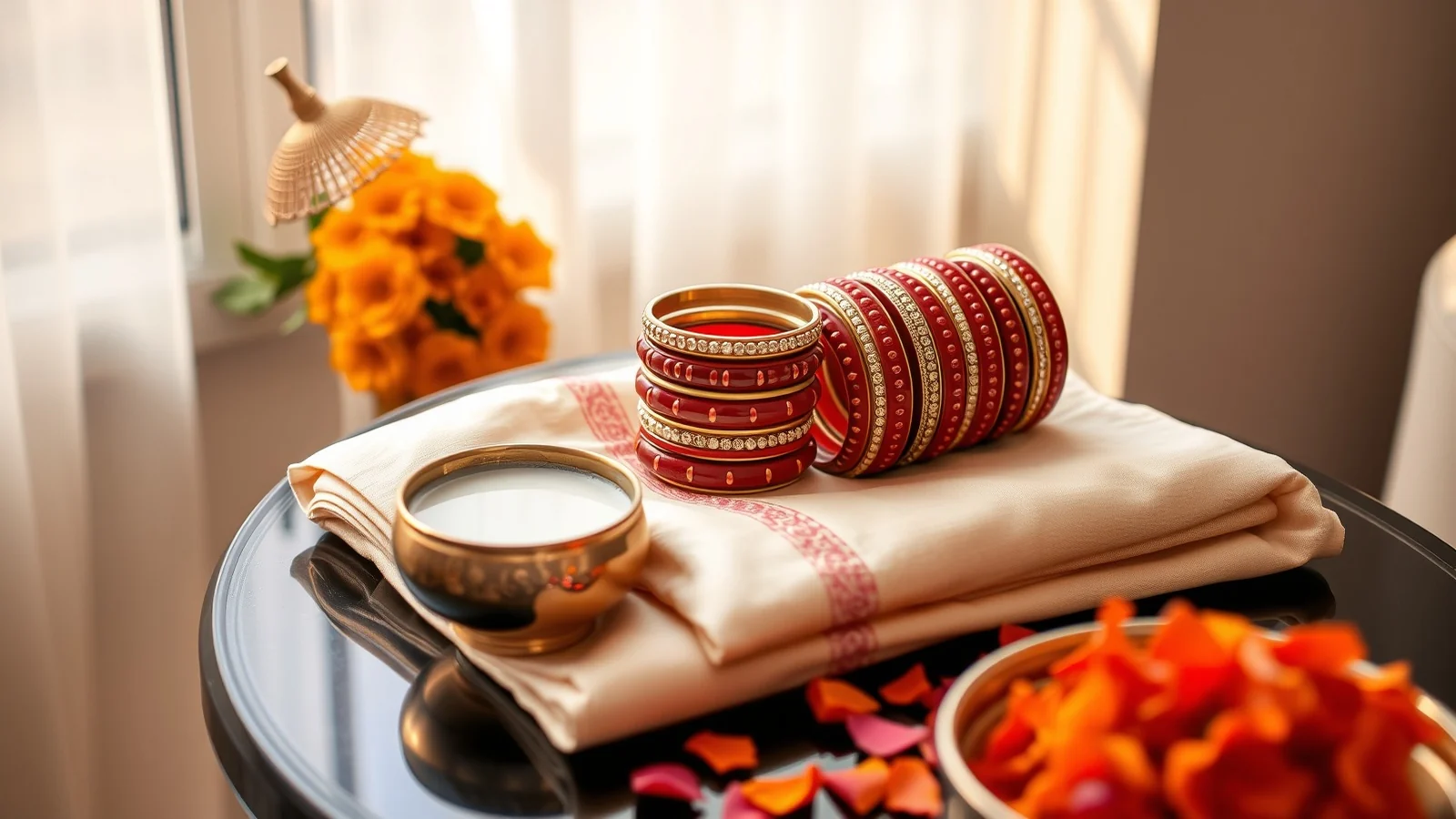
The chooda is a set of bangles in red and ivory or white, worn by a Punjabi bride from her wedding morning. Traditionally they were ivory; today they are almost always acrylic, resin or plastic, and the colour pairing rather than the material carries the meaning.
The number varies by family. Twenty-one is the most commonly cited set, but sets of seven, eleven, fifty-one and a hundred and one all appear. There is no single correct number, and a family that insists otherwise is describing its own custom rather than a rule.
Red is the colour of marriage and auspiciousness across North Indian ritual, and appears again in the bride’s outfit and in the sindoor applied during the wedding itself. The white or ivory is generally read as purity, and the pairing as the balance of the two. The chooda is worn on both wrists, and it is deliberately conspicuous: it announces a new bride to anyone who sees her.
The ceremony: who does what
The chooda is not bought by the bride or her parents. It is gifted by her mama, her mother’s brother, and his wife, the mami. This is the defining feature of the ritual and the reason it matters so much within the family: it is the maternal side’s formal contribution to the wedding.
The ceremony takes place on the morning of the wedding, or occasionally the evening before, at the bride’s home. A small puja is usually performed first. The bangles are then dipped in kachi lassi, a mixture of milk and water, sometimes with rose petals, which is understood as purifying them.
The mama and mami slide the bangles onto the bride’s wrists. Throughout, the bride traditionally keeps her eyes closed or looks away, and is not supposed to see the chooda on her own wrists until the wedding ceremony. Once they are on, the bangles are covered with a white cloth or dupatta and stay covered until the ceremony begins. Female relatives sing traditional songs as the bangles go on, and the moment is one of the emotional peaks of the wedding morning, second only to the vidaai.
Kalire: the umbrellas, and the game attached to them
Once the chooda is on, the bride’s sisters, cousins and closest friends tie kalire to it. These are the ornate, umbrella-shaped golden ornaments that hang from the bangles and are impossible to miss in wedding photographs.
The origin is practical and rather touching. Kalire were traditionally made of dried coconut and dry fruits, tied to the bride’s wrists so that she carried food with her on the long journey to her marital home, in an era when that journey could take a day or more and a new bride might be reluctant to ask for anything. The decorative gold version is a modern descendant of a food parcel.
Attached to them is the best-known game in a Punjabi wedding. The bride shakes her kalire over the heads of her unmarried friends and sisters. Whoever a piece falls on is said to be next to marry. It works exactly like a bouquet toss, and it is treated with the same mixture of enthusiasm and mock terror. Some kalire are deliberately made to shed easily so that the game actually works.
How long the chooda is worn
This is where practice varies most, and where families most often disagree.
- Forty days. The most commonly quoted traditional period, and still the most widely followed compromise.
- Twenty-one days. A shortened observance, common where the bride returns to work.
- One year. The strictest traditional form, still followed in some families.
- Until the first significant family event. Some households time removal to a specific occasion rather than a fixed count of days.
Removal is itself a small ceremony. The chooda is traditionally taken off by the bride’s mother-in-law or by her husband’s sister, often with a puja, and the bangles are then either kept, given to an unmarried woman in the family, or immersed in flowing water. Working brides frequently negotiate a middle path: full chooda for the first weeks, then a reduced set of a few bangles on each wrist. There is no religious prohibition on this, and it is now common.
A practical note that nobody mentions in advance: a full chooda makes typing, driving and sleeping genuinely awkward for the first week. Brides who plan to return to work quickly should discuss the duration with both families before the wedding, not after.
Where the chooda sits in the wedding sequence
The chooda belongs to the compressed, emotionally intense sequence of the wedding morning, after the pre-wedding functions and immediately before the ceremony itself.
- Roka and engagement. The formal commitment, covered in our roka ceremony guide.
- Mehndi. Henna application, one to two days before. See the mehndi ceremony guide.
- Sangeet. The music night. See sangeet planning.
- Haldi. Turmeric application on the wedding morning. See the haldi ceremony guide.
- Chooda and kalire. Immediately after haldi, before the bride dresses.
- Baraat and milni. The groom’s procession arrives. See the baraat.
In a Sikh wedding the chooda is equally common, though the ceremony that follows is the Anand Karaj rather than a Vedic ceremony with pheras. See our Anand Karaj guide for that sequence. The chooda is a Punjabi cultural custom rather than a religious requirement, which is why it crosses both traditions comfortably.
Choosing and buying the chooda
The chooda is bought by the maternal uncle’s family, which means the people buying it are frequently not the people who will have to wear it for forty days. A few practical points prevent the most common problems.
- Material. Traditional ivory is no longer used, and the trade in it is illegal in India under wildlife protection law. Modern sets are acrylic, resin or plastic. Better quality sets are heavier, have a deeper red, and do not scratch into a milky finish within a week.
- Sizing. Chooda is sized by the width of the hand at its widest point, not the wrist. It has to pass over the knuckles to go on and to come off. Most sellers size by pressing the hand into a cone gauge, and it is worth doing this in person rather than guessing.
- Weight. A full set of a hundred and one bangles on each wrist is genuinely heavy over a full day. Brides who want the visual density of a large set sometimes use a mixed approach, with a heavier set for the ceremony and photographs and a lighter one for the days that follow.
- Finish. Matte, glossy, mirror-worked and kundan-studded sets are all available. Studded sets photograph beautifully and catch on every fabric in the bride’s wardrobe.
Buy at least two weeks ahead, and have the bride try the set on privately before the ceremony. Discovering on the wedding morning that the bangles do not pass the knuckles is a genuinely stressful way to start the day, and it happens more often than anyone admits.
What has changed, and what has not
The chooda is one of the more resilient Punjabi customs, but the practice around it has shifted noticeably in the last two decades.
The duration has compressed. A full year was once standard. Forty days is now the common observance, and twenty-one days is widespread among brides who return quickly to work. Very few families now treat the longer periods as obligatory, and almost none treat a shortened period as a religious failing.
The reduced set has become normal. Wearing two or four bangles on each wrist after an initial full-chooda period is now common enough to be unremarkable. It preserves the visible marker of a new bride while making ordinary life possible.
The ceremony has grown. What was once a small, quick family ritual is now frequently a photographed event with its own decor, its own outfit and its own timing in the schedule. This is the opposite direction to the duration, and it reflects a broader pattern: rituals that photograph well have expanded, and obligations that constrain daily life have contracted.
What has not changed is who gives it. The mama and mami remain the givers in effectively every family that observes the custom. It is the one element nobody has been willing to modernise, because it is the part that carries the meaning.
Photographing the ceremony
Chooda is an indoor ritual, usually in a bedroom or a small hall, in mixed light, with fifteen people crowded around a seated bride whose eyes are closed. It is one of the harder things to shoot at a wedding and one of the most valuable to get right.
- Clear a working space. The photographer needs a metre of room on at least one side of the bride. Somebody has to enforce this, and it will not be the photographer.
- Position for the mama’s hands. The defining image is the uncle sliding the bangles on, and it needs a clear line to the wrists, not to the back of six relatives’ heads.
- Shoot the milk dipping. The kachi lassi bowl with the bangles in it is the most visually distinctive moment in the ritual and the one most often missed because it happens before people are ready.
- Capture the kalire toss. This is fast, unpredictable and involves several people moving at once. It benefits from a second shooter or at minimum from a warning.
- Do not stage the reveal. The moment the bride first sees the chooda on her own wrists is real and brief, and asking her to do it again for the camera never looks the same.
For the wider sequence and how it connects to the rest of the wedding morning, see our guide to Punjabi wedding traditions and the haldi ceremony that precedes it.
Practical notes for planning the ceremony
Things that go wrong, and how to avoid them.
- Confirm sizing weeks ahead. Chooda is not adjustable. Bangles that are too tight cannot be worn for forty days, and bangles that are too loose slide over the hands. Get the bride’s wrist measured properly.
- Schedule it after haldi, not before. Turmeric paste and a fresh chooda are a poor combination, and the sequence exists for a reason.
- Allow forty-five minutes to an hour. Families routinely allocate fifteen. With a puja, the milk dipping, the singing and the photographs, it always runs longer.
- Tell the photographer it is happening. It is a small indoor ritual that is easy to miss, and it produces some of the best images of the day.
- Order spare kalire. They are designed to fall off. Several will.
For the full sequence of a Punjabi wedding and how these functions relate to one another, see our guide to Punjabi wedding traditions.
Planning a wedding that honours these traditions?
Team Velvet Knot plans weddings across every major Indian tradition, and we brief vendors on the rituals so nothing gets rushed, mistimed or quietly dropped from the running order. Tell us your dates and your community, and we will come back with an honest plan.
Related pre-wedding rituals
The rite before this one: read our full guide to the mayian and vatna ceremony.
Frequently Asked Questions
Who gives the chooda to the bride?
Her maternal uncle, the mama, along with his wife, the mami. This is the defining feature of the ritual. The chooda is not bought by the bride or her parents, and it represents the maternal family’s formal contribution to the wedding.
How many bangles are in a chooda set?
Twenty-one is the most commonly cited number, but sets of seven, eleven, fifty-one and a hundred and one all exist. There is no single correct count, and the number is a matter of family custom rather than rule.
How long does a bride wear her chooda?
Forty days is the most widely followed period. Some families observe twenty-one days, others a full year. Removal is usually done by the mother-in-law or the husband’s sister, with the bangles then kept, passed to an unmarried woman, or immersed in flowing water.
What are kalire and why does the bride shake them?
Kalire are the umbrella-shaped golden ornaments tied to the chooda by the bride’s sisters and friends. She shakes them over the heads of unmarried women, and whoever one falls on is said to marry next. Originally they were made of dried coconut and dry fruits so the bride carried food on the journey to her marital home.
Can a working bride wear a shorter chooda?
Yes, and many do. A common compromise is the full set for the first two to three weeks, then a reduced set of a few bangles on each wrist. There is no religious prohibition. The point to settle is family expectation, and it is far easier to agree before the wedding than after.
Is the chooda ceremony only for Hindu weddings?
No. It is a Punjabi cultural custom rather than a religious rite, and it is performed in Sikh weddings just as commonly as Hindu ones. The ceremony that follows differs, the Anand Karaj rather than a Vedic ceremony, but the chooda ritual itself is essentially identical.
Sources and further reading
Begin Your Engagement
Want a real number for your wedding?
Tell us your city, guest count and dates. Team Velvet Knot will come back within 24 hours with an itemised budget.