Mayian and Vatna Ceremony: The Punjabi Turmeric Ritual Explained by Planners
- What the mayian ceremony actually is
- Vatna: what is in the paste and why
- How mayian differs from a pan-Indian haldi
- Who applies the vatna, and in what order
- The red phulkari held overhead by four women
- Gana bandhna: the sacred thread on the wrist
- Why the bride and groom cannot leave the house
- Chooda, kalire and what follows for the bride
- Suhag and ghorian: the songs the women sing
- Jaggo night and the same-evening sequence
- Sikh and Hindu Punjabi families: what differs
- Timing, venue and how planners actually run it
- Mayian and vatna: which word means what
- Frequently Asked Questions
- Sources and further reading
Mayian is the Punjabi pre-wedding rite held at both the bride’s and the groom’s homes, usually one or two days before the wedding. Its central act is vatna, a paste of turmeric, mustard oil and gram flour rubbed on by married female relatives while four women hold a red dupatta overhead and sing suhag or ghorian.
What the mayian ceremony actually is
Mayian is a household rite, not a party format. In Punjabi families it marks the moment the bride or groom is formally set apart from ordinary life and placed under the family’s protection until the wedding. The word is spelled mayian, maiyan or maiya depending on the family and the region, and all three refer to the same sequence of seating, anointing and singing.
The ceremony happens twice and separately. The bride’s family holds theirs at her home, the groom’s family holds theirs at his, and neither side attends the other. This matters for planning because it means two setups, two photography calls and two catering counts on the same afternoon if both households are in the same city.
Structurally the rite has three parts that always appear together: the seating of the honouree on a low stool under a red cloth, the application of vatna by married women of the family, and the tying of the gana thread. Everything else, including the scale of the decor and the length of the singing, is family preference layered on top.
Vatna: what is in the paste and why
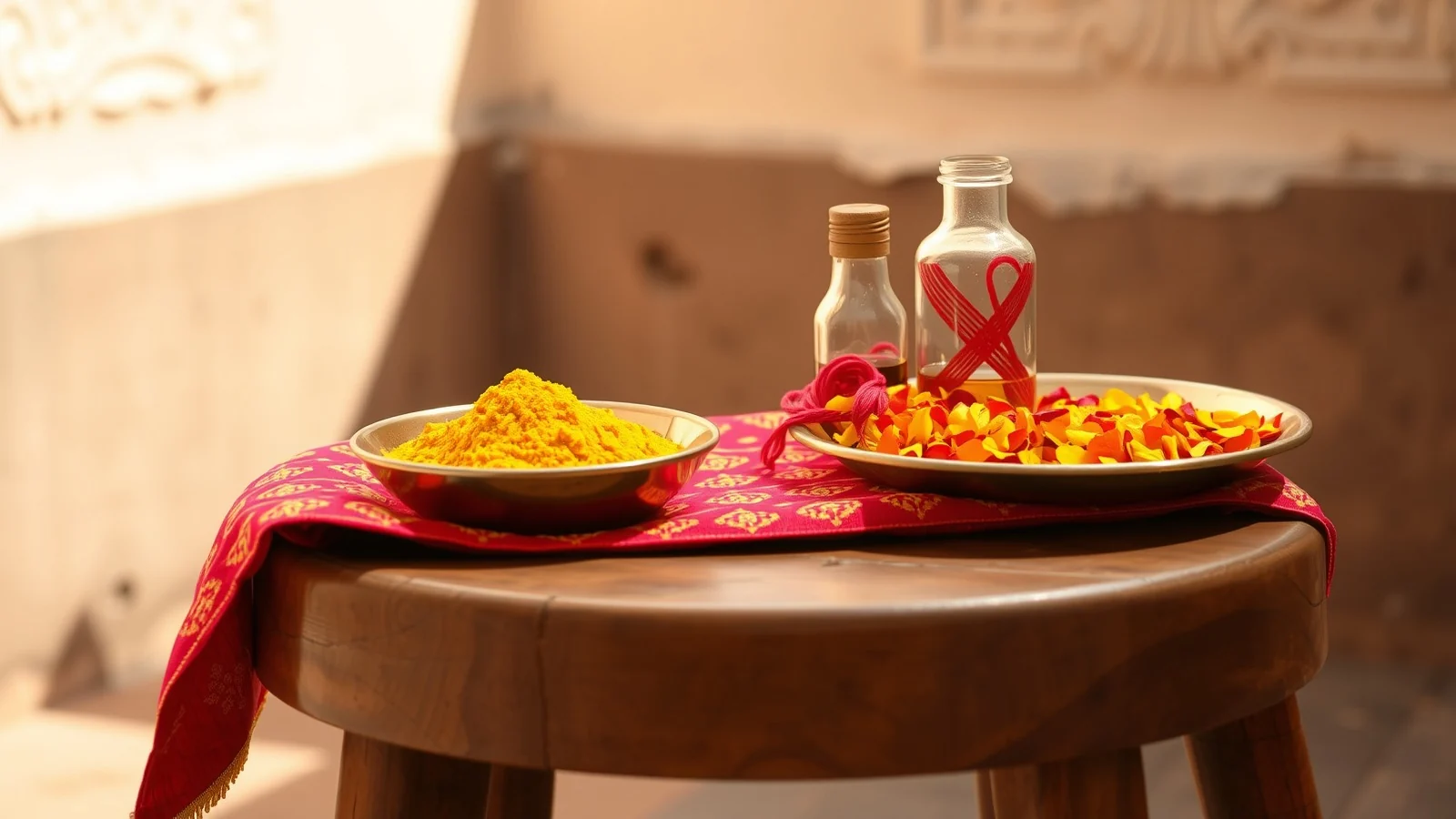
Vatna is the paste itself, not the event. The traditional mix is haldi (turmeric), sarson ka tel (mustard oil) and besan (gram flour), sometimes loosened with rosewater, milk, malai or curd. Older Punjabi households grind it fresh in the kitchen that morning rather than buying a ready blend, and the smell of raw mustard oil is part of what people remember.
Each ingredient earns its place. Turmeric is antiseptic and gives the skin the golden cast families associate with a blessed body. Gram flour acts as a gentle abrasive that lifts dead skin. Mustard oil binds the mixture and softens it so it does not crack on the arms. Rosewater or cream is added when the skin is dry or sensitive, which is common in a Delhi or Chandigarh winter wedding.
The ritual logic runs deeper than skincare. Turmeric in Punjabi belief carries auspiciousness and wards off nazar, the evil eye, at a point when the family considers the bride or groom especially vulnerable. Read a fuller account of the plant’s traditional use in the Britannica entry linked at the end of this guide.
How mayian differs from a pan-Indian haldi
This is the distinction most guides blur. A generic haldi ceremony as it is staged today is a turmeric application, often co-ed, often at a resort lawn, often with guests smearing each other for photographs. Mayian is narrower and older. Only married women of the family apply the vatna, the honouree stays seated and passive, and guests do not smear one another.
The second difference is the canopy. A haldi rarely involves a cloth held overhead. In mayian the red phulkari or dupatta is structural, not decorative, and the ceremony is not considered done without it. The third difference is the gana thread and the confinement rule that follows, neither of which belongs to a standard haldi at all.
The fourth difference is musical. A haldi playlist is usually film music. Mayian carries suhag and ghorian, two specific Punjabi song forms sung live by the women present. If a family asks us for a haldi and describes a red dupatta and their nani singing, they are describing mayian, and the run sheet should be built accordingly. See our wider Punjabi wedding traditions guide for where it sits in the full sequence.
Who applies the vatna, and in what order
Order is the part families care about most. The bride or groom is seated on a patra, a low wooden stool, usually facing east. The eldest married woman of the family goes first, most often the paternal aunt (bhua) or the maternal aunt (masi), followed by other married female relatives in rough order of seniority. Unmarried girls and widowed relatives traditionally do not apply, though many modern families have relaxed this.
Application moves from the feet upward: feet, knees, hands, arms, shoulders, then the face last. The direction is deliberate. It reads as raising the person from the ground toward blessing rather than pushing anything downward. Each woman takes a small quantity on a leaf, a bunch of durva grass or her fingers, touches the seven points, and gives way to the next.
In practice a large family means forty women and a queue. The fix is to brief three or four senior relatives to go first with real quantity, then let the rest apply a token touch. Without that brief the vatna runs out or the bride sits for ninety minutes, and the light you booked for photographs is gone.
The red phulkari held overhead by four women
Four married women hold a red dupatta or phulkari flat above the seated bride or groom for the whole of the vatna. Each takes one corner. In many families the four are chosen to represent both sides of the parental line, and being asked is treated as an honour rather than a chore.
The canopy has a protective reading. It shields the honouree from the sky and from any gaze during a moment when they are considered exposed, and it visually marks the space beneath it as a temporary sacred enclosure. The phulkari itself, the hand embroidered floral shawl of Punjab, is often an heirloom brought out of a trunk for exactly this purpose.
Practically, four holders is the right number because arms tire. We rotate holders quietly every ten to fifteen minutes and always keep a spare red dupatta on hand, because the vatna will get on the cloth. If the family shawl is a genuine heirloom, use a plain red dupatta for the ceremony and the phulkari only for the photographs.
Gana bandhna: the sacred thread on the wrist
Gana is a red or saffron thread, sometimes with a small iron ring, a cowrie shell or a supari knotted into it, tied around the right wrist of the groom and the left wrist of the bride. In most families a maternal uncle or the officiating elder ties it, and it is put on around the same time as the mayian rather than at a separate event.
Its function is protective and binding. The thread marks the wearer as consecrated to the wedding, and it is not removed casually. Many families untie it only after the wedding is complete, often during a post-wedding game where bride and groom untie each other’s gana, which is played for laughs but has a real closing meaning.
Composition varies genuinely by family and by caste custom, so ask rather than assume. Some households use plain moli thread, others add turmeric-dyed cotton. If the family cannot recall, the priest or granthi who is running the wedding will usually supply the correct version.
Why the bride and groom cannot leave the house
After mayian, the bride and groom traditionally stay inside the home until the wedding. No shopping, no salon run, no stepping out to meet friends. In stricter households they are not left alone at all, and a sibling or cousin sleeps in the room. This is one of the few rules that older relatives will actually enforce.
The reasoning is a mix of protection and status. Once anointed and wearing the gana, the person is considered to be in a consecrated, vulnerable state, susceptible to nazar and to accident. There is also an older practical layer: the vatna and the rest were meant to leave the skin visibly glowing, and exposure to sun, dust and travel would undo it.
Plan around it rather than fighting it. Everything requiring the bride to leave the house, including trials, jewellery collection and any outdoor portrait session, has to finish before mayian begins. Families who ignore this end up negotiating with a grandmother at eight in the morning on wedding day, and the grandmother usually wins.
Chooda, kalire and what follows for the bride
For a Punjabi bride, mayian leads directly into chooda. The chooda ceremony, in which the maternal uncle and aunt present the set of red and ivory bangles, is usually held the morning of the wedding or immediately after mayian the previous day. The bride is not supposed to see the bangles until they are on her wrists, so they are covered with a cloth until the moment.
Kalire, the gold umbrella-shaped ornaments, are tied to the chooda by sisters and friends afterwards. Our chooda and kalire guide covers the sequence and the milk-dipping detail properly. What matters here is scheduling: chooda and mayian are separate rites and should not be collapsed into one hour just because both involve the same relatives.
On the groom’s side the parallel is sehrabandi, the tying of the floral veil to his turban before the baraat departs. Sehrabandi is a wedding-day rite, so the groom’s mayian sits a day or more ahead of it, and the two should never be scheduled back to back.
Planning the wedding these ceremonies belong to? We plan weddings across India and can take the schedule, the logistics and the coordination off your family entirely.
Suhag and ghorian: the songs the women sing
Suhag and ghorian are two distinct Punjabi folk song forms, not a single playlist. Suhag are sung at the bride’s home. They are voiced from the bride’s perspective or her mother’s, often addressed to her father, asking for a good husband and a good home, and they carry an undertow of impending separation.
Ghorian are sung at the groom’s home. The name comes from ghori, the mare he will ride to the wedding, and the songs praise the groom, his lineage and his sisters, and are often sung as the family gathers around him. The two forms are not interchangeable, and singing ghorian at the bride’s mayian would strike older guests as a mistake.
Both are traditionally unaccompanied or backed only by a dholki, with the women clapping. Recorded music kills the effect. If nobody in the family still knows the repertoire, and increasingly nobody does, hire a small group of folk singers rather than defaulting to a Bollywood playlist. Budgeting for that sits inside the wider wedding planning cost conversation.
Jaggo night and the same-evening sequence
Jaggo very often follows mayian on the same evening. The maternal aunt carries a decorated brass or copper pot on her head, studded with lit oil lamps or candles, while the family dances through the house or the street with a stick hung with bells. Jaggo means wake up, and the original point was to rouse the neighbourhood and announce the wedding.
The two rites sit together naturally: mayian is quiet, seated and inward, and jaggo is loud, moving and outward, so the evening travels from stillness to celebration. In a joint sequence the vatna finishes in the late afternoon, the honouree bathes, and jaggo begins after dark.
Two things go wrong. First, open flames plus dupattas plus dancing is a real fire risk, so battery candles are worth arguing for in indoor venues. Second, if mayian runs late, jaggo pushes past eleven and any apartment complex or hotel sound cutoff becomes a problem. Build a hard finish time into the mayian block.
Sikh and Hindu Punjabi families: what differs
Mayian is a cultural Punjabi rite rather than a religious one, so both Sikh and Hindu Punjabi families keep it. The difference shows in the framing around it. Hindu Punjabi households usually attach more explicit puja elements, a priest, a small havan or a Ganesh invocation before the vatna begins.
Observant Sikh families typically keep the mayian free of idol worship and priestly ritual, treating it as folk custom performed by the family alone, sometimes preceded or followed by an Akhand Path or Sukhmani Sahib path at home. Some strict households decline elements they read as Hindu ritual accretion, including certain gana practices, while keeping the vatna and the songs. Our Anand Karaj guide covers where the religious line is normally drawn.
Ask each family directly instead of assuming from surname or gurdwara membership. Practice varies household to household, and the fastest way to cause offence is to arrange a priest for a family that did not want one, or to skip one for a family that expected it.
Timing, venue and how planners actually run it
Mayian typically falls one or two days before the wedding, in daylight, most often late morning to mid afternoon. Where a family holds mehndi separately, mayian usually precedes it, and our mehndi ceremony guide explains why henna should go on after the vatna has been washed off rather than before.
Home is the traditional venue and still the best one, because the rite reads as a household act. When the house is too small, a hotel suite or a lawn works, but recreate the domestic frame: a low stool on the floor rather than a stage, family seated close, no MC. The moment a compere picks up a microphone, mayian becomes a haldi.
Practicalities that repeat on every event: turmeric permanently stains marble, silk and grout, so lay a cotton dhurrie under the seating area and keep the honouree in old white or yellow cotton, never in something they want to keep. Skin-test the paste two days ahead for anyone with sensitive skin. Brief the photographer to shoot from just outside the four dupatta holders, since shooting from directly overhead is impossible and shooting from the front gives you nothing but four arms.
Planning a wedding that honours these traditions?
Team Velvet Knot plans weddings across every major Indian tradition, and we brief vendors on the rituals so nothing gets rushed, mistimed or quietly dropped from the running order. Tell us your dates and your community, and we will come back with an honest plan.
Mayian and vatna: which word means what
These two are searched for separately and constantly mistaken for each other, including by
families planning them. They are not alternatives. One is the occasion and the other is the thing
that happens at it.
| Word | What it names | So you would say |
|---|---|---|
| Mayian | The Punjabi pre-wedding occasion itself, held at both homes one or two days before the wedding | We are holding the mayian on Thursday |
| Vatna | The paste of turmeric, mustard oil and gram flour, and the act of applying it | The vatna is applied by married female relatives |
| Maiyan, maiya | Alternative transliterations of mayian | The same occasion |
| Batna | An alternative form of vatna used in some families | The same paste |
So a vatna ceremony and a mayian are, in most Punjabi families, the same afternoon described
from two different angles. If a vendor quotes you for one and a relative talks about the other,
check before you assume two functions have been planned.
The distinction becomes practical when you are booking. A decorator needs to know about the
red phulkari held overhead by four women and the seating for the application; a caterer needs to
know it is an at-home function for the family rather than a hosted event; and a photographer
needs to know that the paste, not a stage, is where the pictures are. Our
haldi ceremony guide covers the pan-Indian version, which
this page’s own comparison explains is not quite the same thing.
Frequently Asked Questions
Is mayian the same as haldi?
No. Haldi as commonly staged today is a broader, often co-ed turmeric application. Mayian is a specific Punjabi rite in which only married female relatives apply vatna to a seated honouree beneath a red dupatta held by four women, followed by the gana thread and a rule against leaving the house. The turmeric is shared, the structure and meaning are not.
How many days before the wedding is mayian held?
Most families hold it one or two days before the wedding, in daylight. Where the celebration runs longer, it can fall three days out. It should sit before mehndi, and it must sit before anything that requires the bride or groom to leave the house, because the confinement rule begins the moment mayian ends.
Who is allowed to apply the vatna?
Traditionally married women of the family, beginning with the eldest, most often a paternal or maternal aunt. Unmarried girls and widowed relatives were customarily excluded, though many families today no longer observe that. Men are not part of the application in the traditional form, even at the groom’s mayian.
What is the gana thread and when is it removed?
Gana is a red or saffron thread tied to the groom’s right wrist and the bride’s left, sometimes knotted with a small iron ring, cowrie shell or supari. It marks the wearer as consecrated for the wedding. Most families remove it only after the wedding, often during a post-wedding game where the couple untie each other’s thread.
Do the bride and groom really have to stay indoors afterwards?
In traditional households, yes, and older relatives enforce it. The person is considered protected but vulnerable once anointed and wearing the gana, so they stay home until the wedding. Diaspora and urban families often relax it to mean no travel and no solo outings. Either way, finish trials, shopping and outdoor portraits before mayian.
Can vatna damage the skin or clothes?
Turmeric stains fabric, marble and grout permanently and can irritate sensitive skin, especially with raw mustard oil. Skin-test the paste two days ahead, add malai or rosewater for dry skin, dress the honouree in old cotton, and lay a washable dhurrie under the seating. Wash off with besan and water rather than scrubbing with soap.
What is the difference between mayian and vatna?
Mayian is the occasion and vatna is what happens at it. Mayian is the Punjabi pre-wedding rite held at both the bride’s and the groom’s homes a day or two before the wedding. Vatna is the paste of turmeric, mustard oil and gram flour that married female relatives rub on, and the act of applying it. A vatna ceremony and a mayian are usually the same afternoon.
Sources and further reading
Begin Your Engagement
Want a real number for your wedding?
Tell us your city, guest count and dates. Team Velvet Knot will come back within 24 hours with an itemised budget.