Sehrabandi: The Groom’s Ceremony Before the Baraat Leaves
- What sehrabandi is
- Who ties the sehra, and in what order
- What the sehra is understood to mean
- Ghodi chadhna and the departure
- Regional and community variation
- The groom’s dress: safa, sehra, kalgi and the rest
- The songs, and who sings them
- When the groom is not wearing a turban
- Practical planning notes
- Related wedding rituals
- Sehrabandi step by step, with timings
- Choosing a sehra: flowers, beads or pearls
- Sehrabandi meaning, and the three spellings you will see
- Frequently Asked Questions
- Sources and further reading
Sehrabandi is the ceremony at the groom’s home in which a veil of flowers or beads, the sehra, is tied to his turban just before the baraat departs. It is the groom’s equivalent of the bride’s chooda ceremony, and it marks the moment he leaves as a bridegroom.
What sehrabandi is
The sehra is a curtain of flowers, beads or strings of pearls attached to the front of the groom’s turban, hanging down to cover his face. Bandi means tying. Sehrabandi is therefore simply the ceremony of tying the sehra, performed at the groom’s home in the last hour before the wedding procession sets off.
It is the counterpart to what is happening at the bride’s house at roughly the same time, where the chooda is being put on her wrists. Both rituals do the same job: they mark the transition from an ordinary member of the family into a bride or a bridegroom, and both are performed by the family that is about to lose that person to another household.
Sehrabandi is most strongly associated with Punjabi, Rajasthani, Haryanvi and broader Hindi-belt Hindu weddings, and it is equally established in North Indian Muslim weddings, where the sehra is tied before the groom’s party leaves for the nikah.
Who ties the sehra, and in what order
The sequence is more structured than most guests realise, and getting it wrong causes genuine offence.
- The turban comes first. The groom’s safa or pagdi is tied by a family elder, often a maternal uncle or a professional turban tier engaged for the day.
- The father or eldest male elder ties the sehra. This is the central act. In many families the officiating priest hands the sehra to the father, who fixes it to the turban.
- The sisters and bhabhis participate. The groom’s sister-in-law traditionally applies surma, kohl, to his eyes, and sisters may tie a smaller decorative element or receive a gift, the neg, in return.
- Aarti and tilak. The mother performs aarti and applies a tilak. See our tilak ceremony guide for the related pre-wedding ritual of the same name.
Money or sweets are usually passed over the groom’s head and given away to ward off the evil eye. In many families the groom’s mother does not accompany the baraat at all, which makes this her farewell, and it is often more emotional than anyone expects.
What the sehra is understood to mean
Two explanations are given, and both are worth knowing.
Protection. The most commonly stated purpose is shielding the groom from the evil eye on the journey to the wedding venue. A groom in full wedding dress, at the head of a procession, is conspicuous, and the covering is understood to deflect attention and ill intent.
Concealment until the right moment. The sehra hides the groom’s face until the couple meet, which historically mattered in marriages where the two had not seen each other. The face is revealed at the milni, when the two families formally greet one another, or at the jaimala, when the garlands are exchanged. That reveal is the point of the whole device, and it is why grooms are asked to keep the sehra down even when it is inconvenient.
A practical consequence follows: a groom in a full flower sehra cannot see much, cannot eat, and will be uncomfortably warm. Plan for a family member to guide him, and expect the sehra to be lifted for photographs long before it is formally removed.
Ghodi chadhna and the departure
Sehrabandi flows directly into ghodi chadhna, the mounting of the mare, which is the formal start of the baraat.
The groom’s sisters and cousins feed the mare gram or grass, a small ritual called ghodi puja, and are given money in return. The groom is helped onto the horse, sometimes with a young nephew seated in front of him as sarbala or saha, a companion who traditionally shared the journey and, in older custom, shared any danger on the road.
Songs specific to this moment, the ghodi songs, are sung by the women of the family. Then the procession begins. From this point the wedding belongs to the road, the band and the dancing, and the quiet part of the groom’s day is over.
Regional and community variation
- Punjabi. Sehra of flowers or beaded strings, tied over a bright safa, with heavy participation from sisters and bhabhis. See Punjabi wedding traditions.
- Rajasthani and Marwari. Elaborate safa tying is itself a major element, and the sehra is frequently of pearls or beads rather than fresh flowers. See Marwari wedding traditions.
- Muslim. Sehrabandi is well established before the groom’s party leaves for the nikah, and the sehra is often of flowers or gold thread. See Muslim wedding traditions and our nikah ceremony guide.
- South Indian. There is no direct equivalent. The groom’s preparation follows a different structure entirely, built around ritual bathing and the Kashi Yatra. See South Indian wedding traditions.
In inter-community weddings this asymmetry is worth raising early. A North Indian family will expect a sehrabandi and a baraat; a South Indian family may have planned neither, and may have scheduled the muhurtham at an hour that leaves no room for a procession.
The groom’s dress: safa, sehra, kalgi and the rest
Sehrabandi is the moment the groom’s outfit is completed, and the individual elements have names and conventions that families are expected to know.
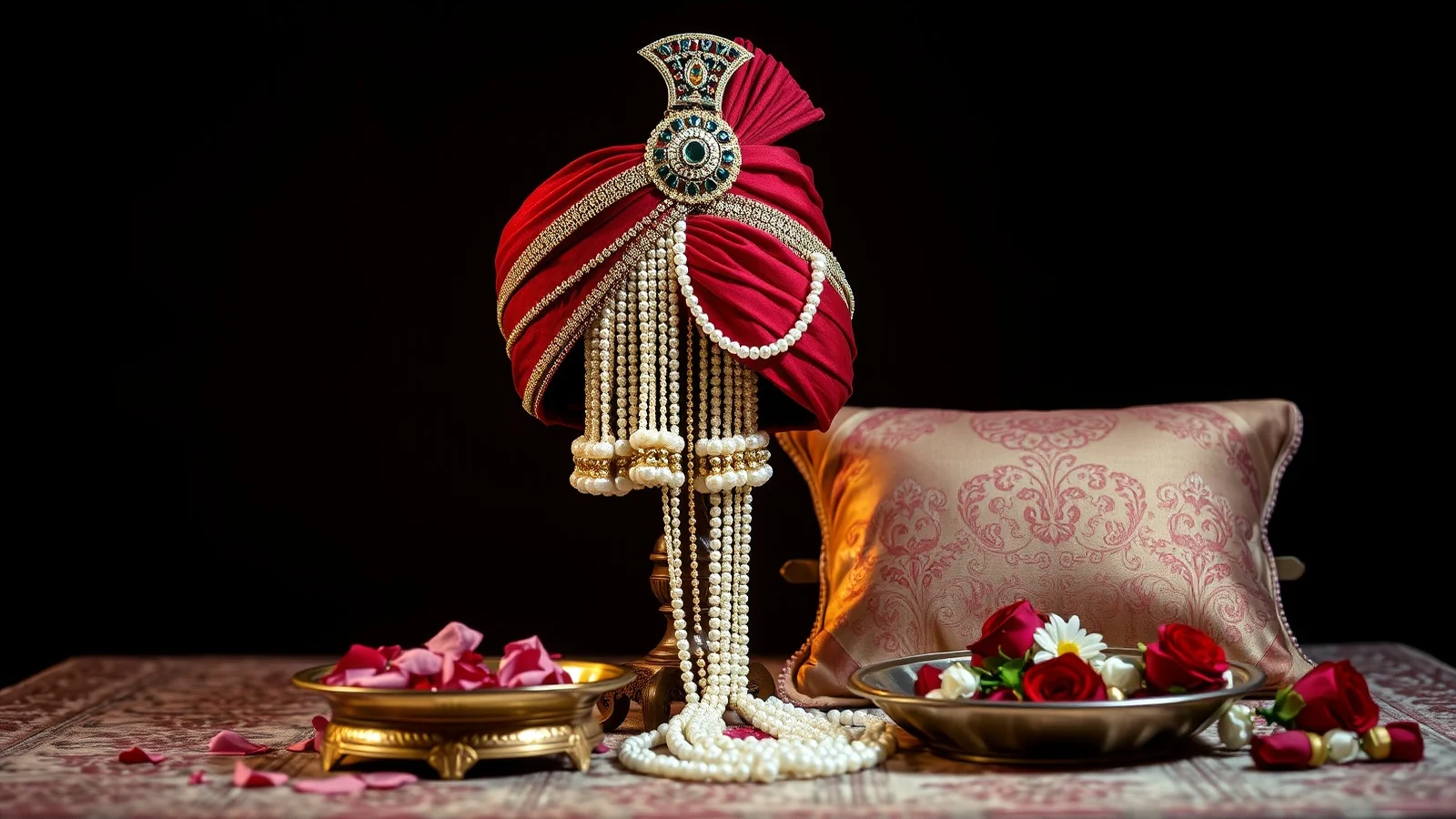
- The safa or pagdi. The turban. Colour is usually coordinated with the outfit, with reds, golds, ivories and pastel pinks dominant in Punjabi and Rajasthani weddings. A well-tied safa takes fifteen to twenty minutes and genuine skill.
- The kalgi. The brooch or plume fixed to the front of the turban, traditionally a feather or a jewelled ornament. It is fitted before the sehra.
- The sehra. The veil itself, of fresh flowers, beads, pearls or gold thread, tied over the turban so that it falls across the face.
- The sarpech. A jewelled turban ornament, worn in more formal or heritage-styled weddings, often alongside the kalgi.
- The kamarbandh and talwar. A waist sash and, in Rajput and many Punjabi weddings, a ceremonial sword carried by the groom.
- The mojri or jutti. Traditional footwear, and the item that will shortly be stolen during joota chupai.
Order matters: turban, then kalgi and sarpech, then sehra last. Attempting to fit ornaments after the sehra is tied means undoing it, which in a fresh flower sehra means damaging it.
Planning the wedding these ceremonies belong to? We plan weddings across India and can take the schedule, the logistics and the coordination off your family entirely.
The songs, and who sings them
Sehrabandi has its own musical repertoire, and it is one of the parts of the wedding most at risk of quietly disappearing.
The ghodi songs are sung as the groom prepares and mounts the mare, addressed both to him and to the horse, and they are traditionally sung by the women of the groom’s family rather than by hired musicians. They are affectionate, frequently teasing, and often specifically about a mother watching her son leave.
Sehra as a poetic form is a separate and older tradition. In Urdu poetry a sehra is a verse composed for a bridegroom and recited at his wedding, and in many North Indian families, both Hindu and Muslim, a relative would compose one for the occasion. Some families still do, and a well-written sehra read aloud at the tying is more memorable than anything a DJ will produce that evening.
If the singers in a family are ageing or scattered, this is worth planning around. Recording an aunt singing the ghodi songs a few weeks before the wedding, and playing it at the ceremony, is far better than silence, and families who do it rarely regret it.
When the groom is not wearing a turban
A growing number of grooms wear a suit, a bandhgala or a sherwani without a safa, particularly in metro weddings and in second or destination weddings. The question of what happens to sehrabandi then comes up constantly, and it has a straightforward answer.
The ceremony is about the family preparing and blessing the groom before he leaves. The turban is the traditional vehicle for that, not the point of it. Families in this position generally do one of three things.
- Keep the safa for the ceremony only. The groom wears the turban and sehra for sehrabandi and the baraat, then removes both on arrival. This is the most common solution and it preserves the ritual intact.
- Substitute a lighter element. A flower garland placed by the father, or a stole tied across the shoulders, carries the same gesture without the turban.
- Keep the blessing, drop the veil. Aarti, tilak, surma and the giving of neg all happen exactly as they would, without a sehra at all.
What matters is that the father or eldest elder performs the central act and that the family gets its farewell. No priest will object to any of these, and no tradition is compromised by them. Where families do run into difficulty is when the ritual is dropped entirely without discussion, and the groom’s mother realises afterwards that she never got her moment.
Practical planning notes
- Fresh flower sehras wilt. In peak summer a marigold or rose sehra has a working life of a couple of hours. For a long procession or a hot afternoon, beaded or pearl sehras hold up far better.
- Book the turban tier. A well-tied safa takes skill and around fifteen to twenty minutes, and most families also want matching turbans for eight to ten male relatives.
- Allow forty-five minutes. Sehrabandi, aarti, ghodi puja and photographs consistently overrun the fifteen minutes families allocate, and the baraat then arrives late for a fixed muhurat.
- Check the ceiling height and the horse. A groom on a mare in a full sehra needs clearance at the gate, and the animal needs a handler who has done weddings before.
- Confirm who is staying behind. If the groom’s mother traditionally does not join the baraat, the photographer needs to capture the farewell before departure, not after.
For how sehrabandi fits into the wider order of a Hindu wedding day, see our complete guide to Hindu wedding rituals.
Planning a wedding that honours these traditions?
Team Velvet Knot plans weddings across every major Indian tradition, and we brief vendors on the rituals so nothing gets rushed, mistimed or quietly dropped from the running order. Tell us your dates and your community, and we will come back with an honest plan.
Related wedding rituals
More community traditions: read our full guide to Rajput wedding traditions.
Sehrabandi step by step, with timings
Most families underestimate this ceremony because each step is short. Laid end to end, with photographs, it takes most of an hour, and the baraat cannot leave until it is done.
| Step | Who | Allow |
|---|---|---|
| Tie the safa or pagdi | A maternal uncle, an elder or a professional turban tier | 15 to 20 minutes |
| Fit the kalgi and sarpech | The turban tier or an elder | 5 minutes |
| Tie the sehra | The father or the eldest male elder, often after the priest hands it over | 5 minutes |
| Apply surma | The groom’s sister-in-law | 5 minutes, with the exchange of neg |
| Aarti and tilak | The groom’s mother | 5 to 10 minutes |
| Pass money or sweets over his head | Elders | A few minutes |
| Ghodi puja and mounting the mare | Sisters and cousins, then the groom with the sarbala | 10 minutes |
| Family photographs | Photographer | 10 minutes, often more |
Choosing a sehra: flowers, beads or pearls
| Sehra | Suits | Watch for |
|---|---|---|
| Fresh flowers such as marigold or rose | Evening baraats and cooler months | Wilts within a couple of hours in heat, and weighs more than it looks |
| Beads | Long processions and daytime heat | Can catch on the kalgi if fitted in the wrong order |
| Pearls | Rajasthani and heritage styling | Needs a secure fixing to a well-tied safa |
| Gold thread | Muslim weddings and formal evening looks | Can be warm and heavy under lights |
| No sehra, blessing only | Grooms without a turban | Agree it with the family in advance |
Sehrabandi in the day’s running order
Sehrabandi is the last event at the groom’s home and the first domino of the wedding day. If it starts late, the baraat leaves late and arrives against a muhurat that will not move. Work backwards from the time the baraat has to reach the venue: allow the travel time, then the length of the procession, then a full hour for sehrabandi and the ghodi puja. For a Punjabi wedding the milni follows on arrival, so the bride’s family needs to know when to be at the gate. Our baraat guide covers the procession itself, and our Punjabi wedding traditions page covers the milni.
Sehrabandi meaning, and the three spellings you will see
The word is a compound of the two things that happen: the sehra, and the tying of it. The
sehra is the veil of flowers or beads that hangs over the groom’s face, and the ceremony is the
moment it is fastened to his turban, just before the baraat leaves.
| What you will see written | Why | Same rite? |
|---|---|---|
| Sehrabandi | Written as one word, the usual form | Yes |
| Sehra bandi | Written as two, which is why search results split between them | Yes |
| Sehra bandhi | A transliteration closer to the spoken form in some families | Yes |
| Sehra | The object itself, the floral veil, not the ceremony | No, this is the thing being tied |
There is one more source of confusion worth knowing. In some North Indian and Urdu-speaking
families, sehra also names a genre of verse sung or recited in the groom’s honour, so a relative
who says they are writing the sehra is not talking about flowers at all. If you are coordinating
a programme, ask which of the two is meant before you allocate ten minutes to it.
For planning purposes, the useful point is that sehrabandi is the last thing that happens at
the groom’s home. Everything else, the dressing, the safa, the photographs with his family, has
to be finished before it, because the baraat departs immediately afterwards.
Frequently Asked Questions
What does sehrabandi mean?
It means the tying of the sehra. The sehra is the veil of flowers, beads or pearls attached to the groom’s turban so that it covers his face, and sehrabandi is the ceremony of fixing it in place at his home just before the baraat departs.
Who ties the groom’s sehra?
Traditionally the groom’s father or the eldest male elder of the family, often after the priest hands it over. The turban itself is usually tied first by a maternal uncle or a professional turban tier, and sisters and sisters-in-law take part with surma, aarti and the exchange of neg.
Why does the sehra cover the groom’s face?
Two reasons are given. It is understood to protect him from the evil eye during the procession, and it conceals his face until the couple formally meet, either at the milni or at the exchange of garlands. That reveal is the purpose of the device.
Is sehrabandi part of Muslim weddings too?
Yes. Sehrabandi is well established in North Indian Muslim weddings, performed before the groom’s party leaves for the nikah. The sehra is often made of flowers or gold thread, and the ritual structure closely parallels the Hindu version.
Do South Indian weddings have sehrabandi?
No, there is no direct equivalent. South Indian groom’s rituals are built around ritual bathing and the Kashi Yatra rather than a veiled turban and a mounted procession. This is worth raising early in inter-community weddings, since one family may be expecting a baraat that the other has not planned for.
How long does the sehrabandi ceremony take?
Allow forty-five minutes to an hour once aarti, the ghodi puja and photographs are included. Families routinely budget fifteen minutes for it, which is the single most common reason a baraat leaves late and arrives against a fixed muhurat.
In what order are the groom’s turban, kalgi and sehra put on?
The safa or pagdi is tied first, then the kalgi and any sarpech are fixed to it, and the sehra is tied last. Fitting ornaments after the sehra means undoing it, which can damage a fresh flower sehra.
What is the meaning of sehrabandi?
It names the tying of the sehra. The sehra is the veil of flowers or beads that hangs over the groom’s face, and sehrabandi is the ceremony at his home in which it is fastened to his turban just before the baraat leaves. You will see it written as sehrabandi, sehra bandi or sehra bandhi, and all three refer to the same rite.
Sources and further reading
Begin Your Engagement
Want a real number for your wedding?
Tell us your city, guest count and dates. Team Velvet Knot will come back within 24 hours with an itemised budget.