Gath Bandhan: The Knot That Ties an Indian Wedding Together
- What gath bandhan is
- Who ties it
- What goes inside the knot
- Why the couple stay tied through the pheras
- Regional names and variations
- Which end is tied, and why it is not arbitrary
- Who leads the pheras, and what the knot makes visible
- When the knot comes off
- What families get wrong
- Practical notes
- Gathbandhan meaning, and the other gathbandhan
- Frequently Asked Questions
- Sources and further reading
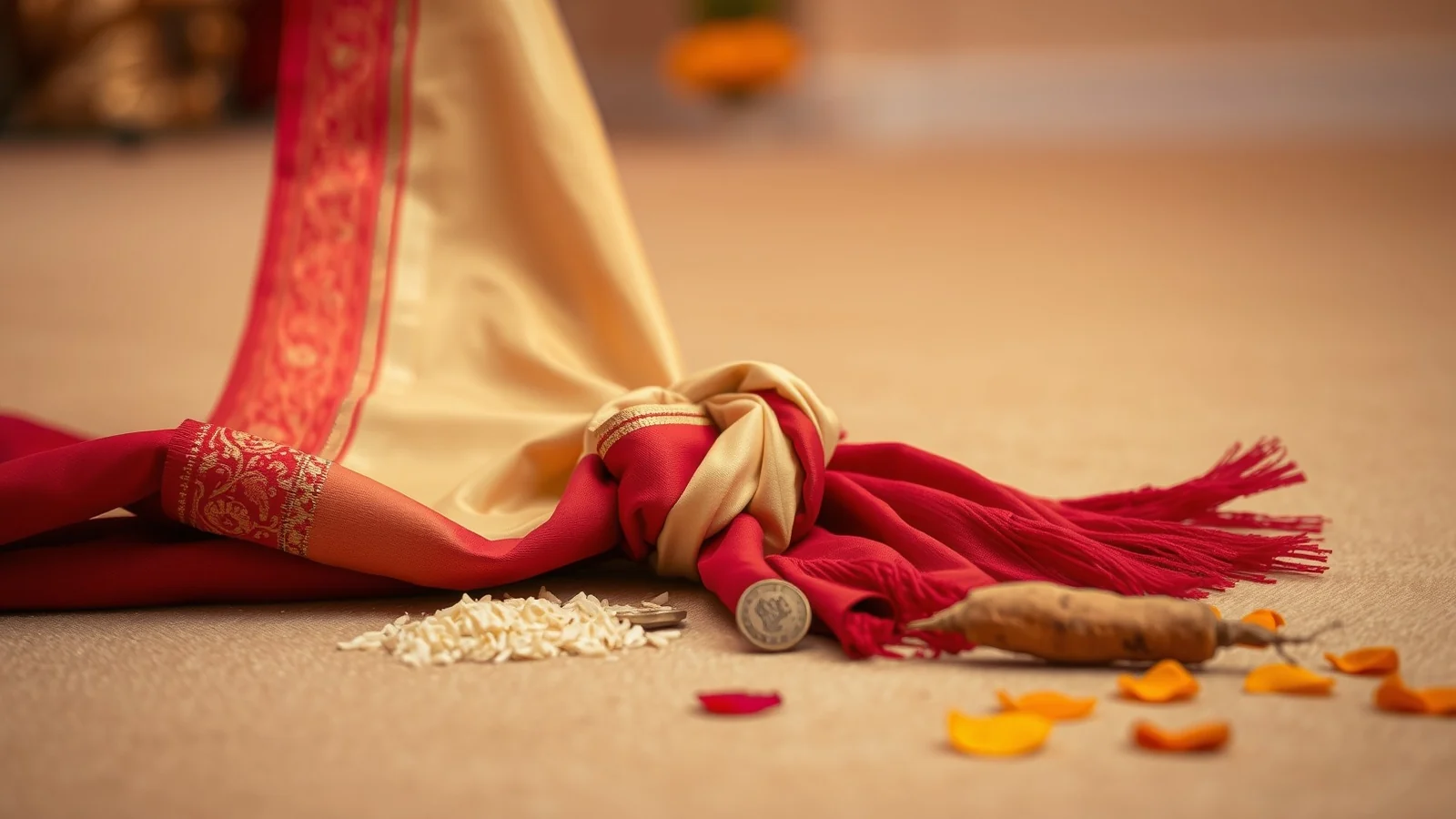
Gath bandhan is the ritual in which the groom’s stole is knotted to the bride’s dupatta or saree before the pheras, with rice, coins and turmeric tied inside. The couple then circle the fire joined, which is the literal origin of tying the knot.
What gath bandhan is
Gath means knot and bandhan means binding. The ritual joins the couple physically: one end of the groom’s stole, the patka or dupatta worn over his shoulder, is knotted to the end of the bride’s dupatta or the pallu of her saree.
It is performed on the mandap immediately before the pheras, the circling of the sacred fire, and the couple remain tied for the whole of that circling. In many families the knot is not untied until the ceremony is complete, and in some it stays on through the reception.
The English idiom about tying the knot has its own separate history, but the correspondence is exact: this is a wedding in which a knot is literally tied and the couple are literally bound. It is performed across North Indian Hindu weddings, in Gujarati and Marathi practice, and with local variations across much of the country.
Who ties it
This is where families differ, and where it is worth checking before the day.
- The bride’s sister, most commonly. In a large number of North Indian families the knot is tied by the bride’s sister or a close female cousin, which gives her a defined role at the centre of the ceremony.
- The groom’s sister, in other families, particularly in Punjabi practice, where the bhabhi or sister of the groom performs it.
- The bride’s mother or brother, in some regional traditions.
- The priest, where no family convention applies.
Whoever ties it usually receives a gift, the neg, from the other side. As with the joota chupai, this is a small negotiated transaction that gives the younger relatives on both sides something to do and something to argue about.
What goes inside the knot
The knot is not empty. Small items are tied into it, and each is a standard prosperity symbol.
- Rice, a few grains, for sustenance and abundance, the same symbolism as the vessel at griha pravesh.
- Coins, usually an odd number, for wealth. Amounts ending in one are preferred, since the extra unit marks the sum as a blessing rather than a transaction.
- Turmeric, a whole root or a pinch of powder, for auspiciousness and purity.
- Betel nut or supari, for fertility and as a standard ritual offering.
- Durva grass, in some families, for resilience and long life.
- Flowers, commonly a few petals.
The contents vary by family and there is no fixed list. What is consistent is that the knot carries something rather than nothing, and that the items are all associated with prosperity and continuity rather than with the couple personally.
Why the couple stay tied through the pheras
The pheras are the circling of the sacred fire, and in most North Indian traditions there are four; in the Vedic form there are seven steps, the saptapadi, which some families treat as the same thing and others as distinct. Our guide to the difference between pheras and saptapadi sets that out.
Being tied while circling does two things. It makes the couple move as one, physically: they cannot walk at different speeds or in different directions without pulling on each other, which is a lesson delivered by the body rather than by a priest. And it makes the vows joint. Each phera carries an undertaking, and both are bound to it at the moment it is spoken.
There is also a widely repeated convention about who leads. In most traditions the bride leads the first three or four rounds and the groom the remainder, or the reverse, depending on region. The knot means the leader is pulling the other, visibly, which is the point.
Regional names and variations
- North Indian Hindu. Gath bandhan or gathbandhan, tied before the pheras. See our complete guide to Hindu wedding rituals.
- Punjabi. Widely performed, often with the groom’s sister tying it, alongside chunni chadhana earlier in the sequence. See Punjabi wedding traditions.
- Gujarati. Performed as part of the mandap rituals, with the knot tied by the bride’s sister. See Gujarati wedding traditions.
- Marathi. An equivalent binding is observed within a differently ordered sequence. See Maharashtrian wedding traditions.
- Marwari and Rajasthani. Well established, often with heavier ceremonial dress making the knot more visible. See Marwari wedding traditions.
- South Indian. There is no direct equivalent. The binding function is carried by the tying of the thaali or mangalsutra and, in Telugu practice, by the jeelakarra bellam. See South Indian wedding traditions.
Which end is tied, and why it is not arbitrary
The knot joins the groom’s stole to the bride’s dupatta or the pallu of her saree, and the specific ends used carry meaning in most traditions.
The groom’s patka is worn over one shoulder and hangs down at the front. The bride’s dupatta or pallu is drawn over her head and shoulder. The two loose ends are brought together and knotted, which puts the join at roughly waist height between them and leaves enough slack to walk.
In traditions where the couple sit side by side for the fire rituals, the knot naturally sits between them and does not need adjusting. Where they stand and circle, the length matters a great deal: too short and they cannot negotiate the turn around the fire without one dragging the other, too long and the fabric trails near the flame. Priests who do this often will set the length themselves.
A detail worth knowing is that in most traditions the knot is tied so that it can be undone rather than cut. Cutting the gath bandhan is considered inauspicious, and a knot pulled too tight to release has genuinely required scissors at more than one wedding.
Planning the wedding these ceremonies belong to? We plan weddings across India and can take the schedule, the logistics and the coordination off your family entirely.
Who leads the pheras, and what the knot makes visible
Convention differs by region on who walks in front, and the knot is what makes the convention legible to everyone watching.
In many North Indian traditions the bride leads the first three pheras and the groom the fourth, or the bride leads the earlier rounds and the groom the later ones. In others the order is reversed. The usual explanation offered is that the bride leads while the vows concern the household and its sustenance, and the groom leads for the vow concerning the couple’s shared future, though families give different accounts.
Whatever the local rule, the knot means the person in front is pulling the person behind. That is deliberately visible. A ritual that simply had two people walking in turn would say much less than one where the physical connection is on display, and it is the difference between a stated intention and a demonstrated one.
For how the pheras relate to the seven steps, see our comparison of pheras and saptapadi.
When the knot comes off
Untying is handled in three broad ways, and families should decide which before the day.
- At the end of the mandap rituals. The priest or a relative unties it once the ceremony concludes, and it is treated as unremarkable.
- After the reception. The couple stay tied through the photographs and the receiving line, which is visually striking and practically awkward.
- At the groom’s home. Untying becomes its own small ritual on arrival, often performed by the groom’s mother or sister alongside griha pravesh, and in some families the knotted cloth is then kept.
Many families keep the fabric afterwards, and some keep the contents of the knot with it. It is one of the few physical objects from the ceremony that is both meaningful and easy to store, which is worth mentioning to a couple who would otherwise let it be sent to the dry cleaner.
What families get wrong
Three failures recur, and all are avoidable in the week before the wedding.
The fabric. A bridal dupatta with heavy zari and stonework does not knot; it bunches, slips and can tear at the border. Brides who discover this on the mandap end up having the knot tied around a fold, which looks wrong in every photograph. Carrying a lighter second dupatta solves it entirely.
The length. Tied short, the couple cannot circle the fire without one dragging the other. Tied long, the fabric trails near the flame while laja homa is being offered, which is a genuine hazard rather than a theoretical one.
The claim. Both sisters expecting to tie it, discovered in front of everyone. This is the most common of the three and the easiest to prevent with one phone call.
Practical notes
- Check the fabric can take a knot. A heavily embroidered dupatta with zari work does not knot cleanly and can tear. Many brides carry a lighter secondary dupatta specifically for this.
- Agree who ties it, in advance. The bride’s sister and the groom’s sister both expecting to do it, in front of everyone, is an avoidable and surprisingly common problem.
- Tie it loosely enough to walk. The couple have to circle a fire four or seven times, negotiate a step, and sit down again. A tight knot at short length makes that genuinely difficult.
- Prepare the knot contents beforehand. Rice, coins, turmeric and supari in a small pouch, ready to hand. Hunting for a coin mid-ceremony is a real occurrence.
- Decide when it comes off. Some families untie it at the end of the ceremony, some keep it through the reception, and some treat untying as its own small ritual at the groom’s home.
- Brief the photographer on the hands. The tying itself is a close, quick, low-hand-height action and is easy to miss entirely.
Planning a wedding that honours these traditions?
Team Velvet Knot plans weddings across every major Indian tradition, and we brief vendors on the rituals so nothing gets rushed, mistimed or quietly dropped from the running order. Tell us your dates and your community, and we will come back with an honest plan.
A related rite: read our full guide to kangna bandhana, the protective wrist thread.
Gathbandhan meaning, and the other gathbandhan
The word does exactly what the rite does. Gath is a knot and bandhan is a binding or a tie, so
gathbandhan is the tying of the knot, and in this case the knot is literal: the groom’s stole is
fastened to the bride’s dupatta or saree before the pheras, with rice, coins and turmeric tied
inside it.
| Part of the word | Sense | In the rite |
|---|---|---|
| Gath | A knot | The physical knot joining the two garments |
| Bandhan | A binding, a tie, a bond | The bond the knot stands for, which is why the couple stay joined through the circuits of the fire |
| Gathbandhan | The tying of the knot | The rite itself, performed just before the pheras |
If your search results look strange, this is why: in Indian news and politics, gathbandhan
means a coalition or an alliance between parties, and it is used constantly in that sense. The
word is the same and the idea is the same, two things tied together, but the results are about
elections rather than weddings. Adding the word ceremony or ritual to the search separates
them.
The English phrase tying the knot is not a coincidence either, though the expression has its
own history in several cultures. Here the knot is not a metaphor. Somebody ties it, in front of
you, and it stays tied until it is formally taken off.
Frequently Asked Questions
What is gath bandhan?
Gath means knot and bandhan means binding. It is the ritual of knotting the groom’s stole to the bride’s dupatta or saree pallu before the pheras, so the couple circle the sacred fire physically joined.
Who ties the knot?
Most commonly the bride’s sister or a close female cousin, though in Punjabi and some other traditions the groom’s sister does it. Whoever ties it usually receives a gift, the neg, from the other side. It is worth agreeing in advance, since both sisters expecting to do it is a common flashpoint.
What is placed inside the knot?
Typically rice for sustenance, coins for wealth in an odd number, turmeric for auspiciousness, betel nut for fertility, and sometimes durva grass and flower petals. The exact contents vary by family; what matters is that the knot carries something rather than nothing.
Why do the couple stay tied during the pheras?
So they move as one. Tied together, they cannot walk at different speeds or directions without pulling on each other, which delivers the lesson physically rather than verbally. It also makes each vow joint at the moment it is spoken.
Is gath bandhan the origin of tying the knot?
The English idiom has its own separate history, so this is not its origin. But the correspondence is exact: a knot is literally tied and the couple are literally bound, which is why the phrase resonates so strongly with Indian weddings.
Do South Indian weddings have gath bandhan?
No direct equivalent. The binding function is carried instead by the tying of the thaali or mangalsutra and, in Telugu weddings, by the jeelakarra bellam ritual at the muhurtam.
What is the meaning of gathbandhan?
Gath means a knot and bandhan means a binding or bond, so gathbandhan is the tying of the knot. In a Hindu wedding it is the rite in which the groom’s stole is knotted to the bride’s dupatta or saree before the pheras, with rice, coins and turmeric tied inside. The same word is used in Indian politics to mean a coalition, which is why search results for it mix weddings and elections.
Sources and further reading
Begin Your Engagement
Want a real number for your wedding?
Tell us your city, guest count and dates. Team Velvet Knot will come back within 24 hours with an itemised budget.