Kangna Bandhana Explained: The Protective Wedding Thread, Its Knots and the Untying Game
- What the kangna actually is
- The objects knotted into the thread and what each is understood to do
- The protective logic behind the tying
- Who ties the kangna, and on which wrist
- Where it falls in the ritual sequence
- Why the thread is never removed midway
- Kangna kholna: the untying game
- Regional names and North Indian variation
- Gujarat, Maharashtra and the western practice
- The South Indian parallel: kaapu and kankanam
- What happens to the thread after the wedding
- Planning notes for the family
- Notes for photographers and film crews
- Frequently Asked Questions
- Sources and further reading
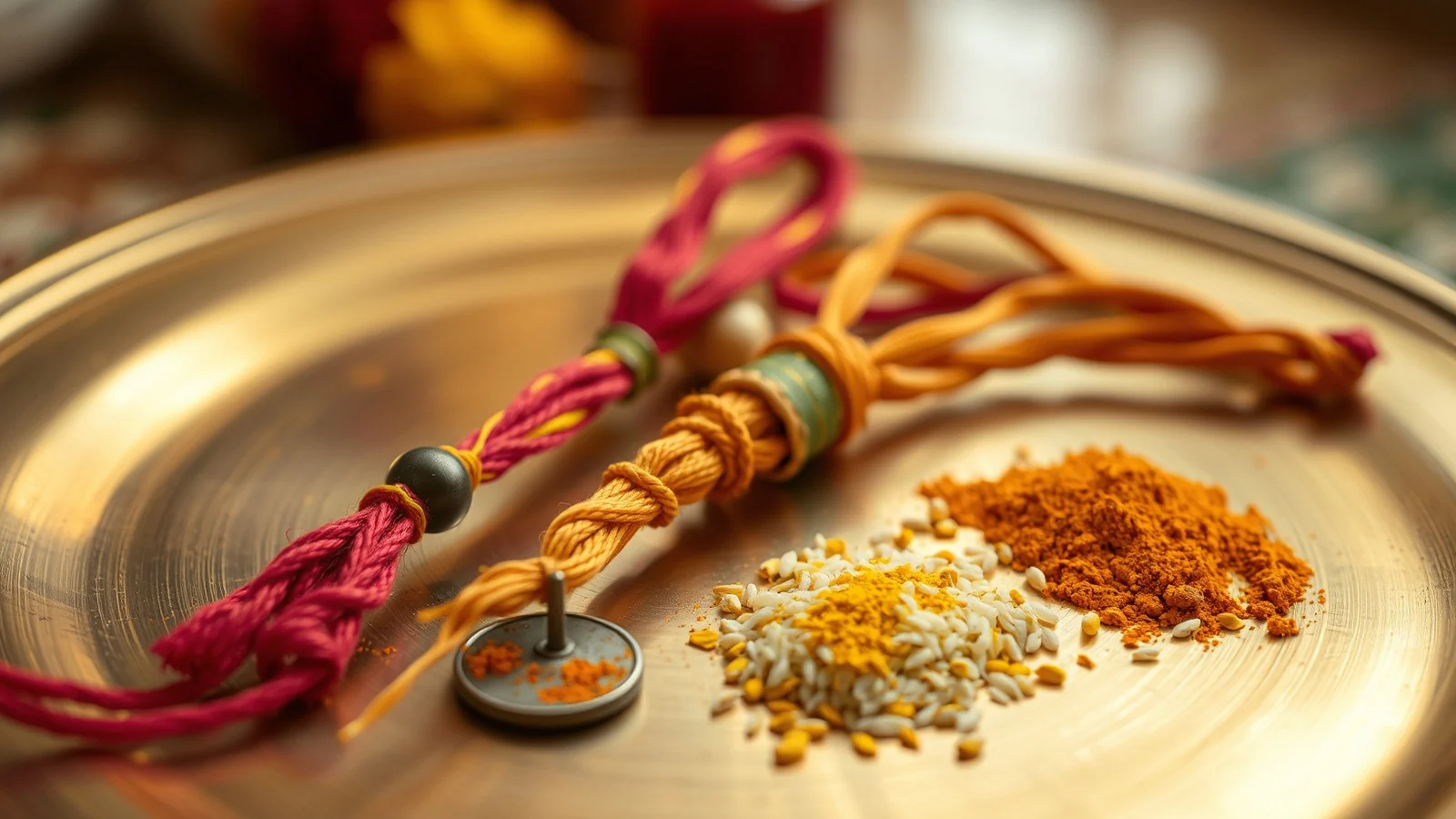
Kangna bandhana is the tying of a consecrated red and yellow thread around the wrist of the bride and the groom shortly before the main wedding rites begin. Small objects are knotted into it, usually an iron ring, a betel nut, a cowrie shell and a coin. The thread is worn without interruption until the rites are complete.
What the kangna actually is
Strip away the ceremony and the kangna is a piece of string. It is the mauli or kalava that any household priest carries by the reel, spun cotton dyed red and yellow, sometimes with a third strand of white. What turns that string into a kangna is what happens to it: it is smeared with turmeric, passed over the sacred fire or held during the invocation, and then small objects are knotted into it before it goes onto a wrist. The word bandhana simply means tying. Kautuka, the older Sanskrit term, refers to the thread itself.
You will not find a single fixed list of what belongs on a kangna. What is genuinely common across regions is a metal ring, something from the areca and betel family, and a coin. Beyond that, families follow their own priest, their own grandmother, or whatever was done at the last wedding in the house. If your priest tells you his version differs from what you read online, he is not wrong. This is domestic ritual, transmitted household to household, and it varies more than the textbook accounts of Hindu wedding rituals suggest.
The objects knotted into the thread and what each is understood to do
The iron ring carries the most weight. Iron is the classic apotropaic metal in Indian household practice, the same logic that puts an iron nail under a pillow or an iron bangle on a new mother. It is understood to repel whatever is understood to be repelled: the evil eye, wandering influences, the general bad luck that gathers around anything valuable and unfinished. Some priests use a small iron ring, others a bent length of iron wire. In wealthier households you will sometimes see a silver ring substituted, which is aesthetically nicer and ritually beside the point.
The betel nut, the supari or areca nut, is the standard stand-in for auspicious presence in almost every Hindu domestic rite. It is what a family uses to represent a deity, to seal an invitation, to make a promise binding. Knotted into the kangna it marks the thread as consecrated rather than ordinary. The cowrie shell, where it appears, is an old symbol of fertility and of wealth, since cowries were currency across large parts of the subcontinent for centuries. The coin makes the same point in modern terms, prosperity carried on the body.
Many families add a small twist of cloth holding mustard seed and turmeric, occasionally with a grain of rice or a piece of dried turmeric root. Mustard is a standard protective grain, scattered at thresholds and burned to clear a space. Turmeric is the auspicious substance that has already coated both bodies during the haldi ceremony and, in Telugu households, during mangala snanam. Reading the kangna object by object, it is a portable version of every protection the household has already applied.
The protective logic behind the tying
The kangna exists because a wedding creates a gap. From the moment the rites begin, the bride and groom are no longer what they were and not yet what they will become. Ritual grammar across many traditions treats that in-between state as exposed, and Hindu practice is explicit about it. The couple are said to be vulnerable through the interval between the opening invocation and the completion of the vows, and the thread is the guard placed over that interval. It is not a good luck charm worn casually. It is fastened for a defined window and then it comes off.
Read alongside the other binding rituals of the day, the pattern is clear. Gath bandhan ties the couple to each other. The kangna ties protection to each individual. One is about union, the other about safety, and they are not interchangeable, though guests routinely confuse the two when they see knots and red thread on the same stage.
Who ties the kangna, and on which wrist
In most households the priest ties it, but he is rarely alone. The common arrangement is that the priest prepares the thread, chants over it, and then either ties it himself or hands it to an elder to tie while he continues. On the groom’s side that elder is often his sister or his bhabhi. On the bride’s side it is frequently her maternal uncle, the mama, who has a defined ceremonial role through much of the day and who will feature again around kanyadaan in many communities.
The usual convention is the right wrist for the groom and the left wrist for the bride, following the broader ritual habit that places the man to the right and the woman to the left. Plenty of families reverse it or tie the bride’s on the right so it sits with her chooda. If the priest states a side, follow the priest. There is no benefit in arguing convention with the person conducting the rite, and no family has ever remembered afterwards which wrist it was on.
Where it falls in the ritual sequence
The kangna goes on early, after the invocation and before the main rites. The standard order is that the assembly is settled, the Ganesh puja is performed to clear obstacles, the family deities and ancestors are acknowledged, and only then are the threads tied. The reasoning is simple. The protection has to be in place before the vulnerable stretch opens, not partway through it. A kangna tied after the fire is lit has missed its own purpose.
In many North Indian weddings the tying happens at the groom’s house or his lodging in the morning, hours before he leaves with the baraat, sometimes alongside sehrabandi. The bride’s is tied at her home or in her room at the venue, in a small gathering of women. In other households both are tied at the mandap in front of everyone. Neither is more correct. Ask your priest which he intends, because the two versions have completely different implications for your morning schedule.
Why the thread is never removed midway
The one rule almost every household agrees on is continuity. The kangna stays on. It is not taken off for the outfit change, not slipped off for a jewellery shot, not removed because it clashes with the lehenga. A protection tied for an interval is understood to fail if it is interrupted, and older relatives take this seriously enough that a bride who removes hers will hear about it. If it has to be shifted, it is shifted, never opened.
Tell the beauty and styling team explicitly, at the trial and again on the morning, that the thread on the wrist does not come off for any reason. It costs one sentence. We have seen the alternative play out, and the reaction is out of all proportion to the object, which is exactly what you would expect of something people believe is holding a risk at bay.
Kangna kholna: the untying game
The solemn tying gets a comic ending. Once the rites are complete, usually after the couple reach the groom’s home and the griha pravesh is done, the family stages the kangna kholna or kangan khelna. The couple sit facing each other and each has to untie the other’s thread using one hand, without teeth, without help, while a room full of relatives offers advice and actively obstructs. Sisters and cousins tighten the knots in advance, which is understood as part of the game rather than cheating.
A widespread variant replaces the untying with a fishing game. A wide vessel is filled with water clouded by milk or turmeric, a ring and sometimes coins are dropped in, and the couple compete to find the ring by hand. Best of three is the usual format. Whoever wins is declared, with great ceremony and no evidence, to be the one who will rule the household. In several communities the untied threads themselves are dropped into the water for the round.
The tonal shift is the point. The day has been formal, expensive and closely watched, and the first thing the new family does together is play a slightly ridiculous game in which the bride is expected to win. It sits with the other teasing rituals of the wedding, notably joota chupai and, on the following morning, muh dikhai. If the couple are exhausted, this is the moment they usually stop performing and start laughing.
Regional names and North Indian variation
The same rite carries different names across the map. Kangna bandhana, kangan bandhan, kankan bandhan, kautuka bandhan and kangana dharan all describe the tying of the protective thread. The variation is regional and linguistic rather than doctrinal. In Hindi speaking north India kangan and kangna dominate. In more Sanskritised usage, and in priestly manuals, you will hear kautuka. Families sometimes use two names in one sentence without noticing.
In Punjabi households the thread is often tied at the same sitting as other pre-departure rites and the untying game afterwards is loud and heavily contested. In Marwari and Rajasthani practice the object list tends to be fuller, with the iron ring, supari, cowrie and coin all present, and the priest narrating each as he ties. Bihari and eastern Uttar Pradesh families often keep the tying small and domestic, with only close women present.
Gujarat, Maharashtra and the western practice
In Gujarati weddings the thread commonly appears as kankan or kangan bandhan and is tied during the ganesh sthapana and mandap muhurat stage, well before the couple meet at the mandap. The Gujarati sequence is dense with preparatory rites at both homes, so the thread often goes on during a mandap muhurat that the wider guest list never sees. Photographers who arrive with the baraat will simply miss it.
Maharashtrian practice is similar in structure, with kankan bandhne performed during the preparatory puja and the same emphasis on the thread staying on until the post-wedding rites. Maharashtrian families are often particular about the turmeric coated thread and about who is permitted to tie it. In many Sindhi households the equivalent is folded into the pre-wedding puja sequence at each home.
The South Indian parallel: kaapu and kankanam
South Indian weddings have their own version and it is arguably more prominent. The kaapu, also called kankanam or kankana dharanam, is a turmeric coated thread with a piece of turmeric root or a small metal ring knotted in, tied to the wrist of the bride and groom during the preparatory rites. In Tamil Brahmin weddings the kappu kattal is a named, scheduled item and the priest treats it with the same seriousness as the fire rites.
In Telugu weddings the kankanam is tied after the preliminary pujas and stays on through jeelakarra bellam, the talambralu rice showering and the rest of the muhurtham. Kannada and Malayali families use closely related forms with local variation in what is knotted in. Across South Indian wedding traditions the removal is a defined post-wedding item, often on the third day, rather than a party game.
If your wedding is a mixed one, and in Hyderabad a great many are, expect both families to want their version. Two threads on two wrists is a perfectly workable answer and we have run it many times. What causes friction is one side quietly dropping their rite to save time. Raise it at the ritual briefing, agree the order with both priests, and build the extra fifteen minutes into the muhurtham schedule.
What happens to the thread after the wedding
Nothing is thrown in a bin. Once untied, the kangna and its objects are treated as consecrated material. The most common practice is immersion in flowing water, a river or a tank, along with other ritual remains. Families who cannot manage that will place it at the base of a tulsi plant, a peepal or a banana tree in the garden. Some priests take the threads away with the rest of the puja materials as a matter of course.
A fair number of families keep them instead. The iron ring or the coin gets put away in the puja room or in the bride’s jewellery box and stays there for decades. Cowrie shells from a kangna turn up in old family boxes surprisingly often. There is no rule against keeping it, and no rule requiring it. Ask the elders on both sides what they intend, because the two households frequently assume opposite things.
Planning notes for the family
Assign the kangna to a named person, or it will be improvised. The thread, the iron ring, the supari, the cowrie and the coin are trivially cheap, well under Rs 500 for everything, and are usually included in the priest’s samagri kit. That is exactly why nobody checks. Confirm with the priest a week out whether he is bringing the objects or expects the family to supply them, and confirm the coin denomination if your family has a preference for an older coin.
Put the tying on the schedule with a real time against it. It is short, but it sits inside the preparatory puja block, and that block routinely runs late because the bride is still in makeup. On a strict muhurtham, a delayed kangna compresses everything downstream. Families running the North Indian sequence should also decide in advance whether the tying happens at home or at the venue, because that decision changes travel timing for a dozen people.
Notes for photographers and film crews
This is the most reliably missed moment of the day. The tying happens in a small room, early, with poor light, often at both homes simultaneously, and it lasts under ten minutes. Crews scheduled to arrive with the baraat or at the mandap will not be there. If the family wants it covered, it needs a named shooter, an arrival time tied to the priest’s schedule rather than the printed one, and a light on standby.
The untying game is the opposite problem. It is chaotic, it is at night, and it is genuinely funny, so shoot it loose and shoot video. Get the vessel from above for the ring hunt, get the couple’s faces rather than their hands, and keep rolling after the winner is declared because the argument that follows is usually the best footage of the evening. Anyone budgeting coverage should factor this in when reviewing wedding planning costs.
Planning a wedding that honours these traditions?
Team Velvet Knot plans weddings across every major Indian tradition, and we brief vendors on the rituals so nothing gets rushed, mistimed or quietly dropped from the running order. Tell us your dates and your community, and we will come back with an honest plan.
Frequently Asked Questions
What is kangna bandhana in a Hindu wedding?
Kangna bandhana is the tying of a consecrated cotton thread, usually the red and yellow mauli or kalava, around the wrist of the bride and the groom before the main wedding rites begin. Small objects are knotted into it, most commonly an iron ring, a betel nut, a cowrie shell and a coin. It is understood as protection worn through the interval between the start of the rites and their completion, and it is not removed until afterwards.
On which wrist is the kangna tied?
The usual convention is the right wrist for the groom and the left wrist for the bride, following the general ritual placement of the man to the right and the woman to the left. Practice varies, and some families tie the bride’s on the right so it sits with her other bangles. If your priest specifies a side, follow him. Fix the placement with the jewellery and makeup team in advance so it does not compete with heavy bangle stacks.
Why is an iron ring tied into the thread?
Iron is the standard protective metal in Indian household practice, used in many contexts to ward off the evil eye and unwanted influence. Knotting an iron ring into the kangna carries that protection onto the body of the person wearing it. Some families substitute silver or a plain metal ring, and some priests use a bent piece of iron wire rather than a finished ring. The material matters more than the shape in traditional reasoning.
Can the kangna be removed during the wedding?
No. Continuity is the one point almost every household agrees on. The thread stays on through outfit changes, portrait sessions and meals, and is only removed at the kangna kholna afterwards, or on a set day later in South Indian practice. The common failure is a makeup artist or jewellery stylist pulling it off during a change without asking. Brief them directly, at the trial and again on the wedding morning.
What is the kangna kholna or kangan khelna game?
It is the playful untying that closes the rite, usually held at the groom’s home after the couple arrive. The couple untie each other’s threads one handed while relatives obstruct them, or they compete to fish a ring out of a vessel of water clouded with milk or turmeric. Best of three is the usual format, and the winner is jokingly declared the one who will run the household. It is deliberately light after a formal day.
Is the kangna the same as the South Indian kaapu or kankanam?
They are parallel forms of the same idea rather than the same rite. The kaapu or kankanam is a turmeric coated thread, usually with turmeric root or a metal ring knotted in, tied during the preparatory rites in Tamil, Telugu, Kannada and Malayali weddings. The protective logic and the timing are closely comparable. The main differences are the objects used and the removal, which in the South is often a scheduled post-wedding item rather than a game.
Sources and further reading
Begin Your Engagement
Want a real number for your wedding?
Tell us your city, guest count and dates. Team Velvet Knot will come back within 24 hours with an itemised budget.