Malayali Wedding Traditions: The Kerala Hindu Wedding Explained
- A Wedding Measured in Minutes, Not Hours
- Nishchayam: The Formal Engagement
- The Muhurtham: An Auspicious Morning
- The Kalyana Mandapam and the Arrival
- Dakshina: Seeking the Blessings of Elders
- Pudavakoda and the Tying of the Minnu
- Kanyadaanam, Panigrahanam, and the Question of Fire
- The Namboodiri Veli and Community Variations
- The Bride’s Look: Kasavu, Jasmine, and Temple Gold
- The Sadya: A Feast on a Banana Leaf
- Grihapravesham and the Modern Kerala Wedding
- How the muhurtham is fixed
- Related South Indian rituals
- Frequently Asked Questions
- Sources and further reading
Malayali wedding traditions centre on a brief, elegant morning Muhurtham. The Nair Kalyanam is famously simple: the groom ties a leaf-shaped Thaali in seconds, elders are honoured, and the celebration ends in a Sadya feast served on a banana leaf.
Planning a Malayali wedding? Free download: the ritual-by-ritual planning timeline
Every ritual on this page in order, with when it happens, what the family arranges and when to book it, on one printable page. Share a few details about your wedding in the form at the end of this page and the download link appears as soon as you send it.
A Wedding Measured in Minutes, Not Hours
Few Indian weddings are as quietly striking as the Kerala Hindu wedding. Where many North Indian and even neighbouring South Indian ceremonies stretch across days of fire rituals and elaborate rites, the classic Malayali wedding, and especially the Nair Kalyanam, is famous for its brevity and grace. The central act, the tying of the sacred thread around the bride’s neck, can be over in less than a minute. Yet nothing about it feels rushed. It feels distilled: every gesture carries weight, every ritual has been pared down to its meaning.
This elegance is deeply Malayali. Kerala’s matrilineal past, its temple culture, and the understated aesthetic of cream-and-gold silk all shape a wedding that prizes dignity over spectacle. The bride glows in a Kasavu set mundu rather than a heavily embellished lehenga, jasmine is coiled through her hair, and the mandapam is lit by the soft gold of an auspicious morning. To understand Malayali wedding traditions is to understand how a community turned simplicity into a form of luxury. This guide walks through the Kerala Hindu wedding step by step, notes how customs shift across the Nair, Namboodiri Brahmin, and Ezhava communities, and shows how modern Kochi and Trivandrum couples keep the old grammar alive. For the wider regional picture, see our South Indian wedding traditions overview, and for the pan-Hindu ritual framework, the Hindu wedding rituals guide.
Nishchayam: The Formal Engagement
The journey begins with the Nishchayam, the formal engagement that seals the alliance between two families. Traditionally held at the bride’s home or a temple hall, it is where the elders of both sides meet, exchange trays of fruit, flowers, and sweets, and publicly commit to the union. The two families agree on the Muhurtham, the auspicious date and time for the wedding, usually fixed after consulting an astrologer who studies the couple’s birth stars (nakshatras) and the Malayalam almanac (panchangam).
At the Nishchayam the families often exchange the lagna patrika or a written declaration of intent, and gifts pass between the households. It is a warm, relatively small gathering compared to the wedding itself, but it is binding in spirit. In many families the bride and groom exchange rings here, a modern touch layered onto an old custom. The Nishchayam sets the emotional tone that runs through every Malayali wedding: this is a joining of families, honoured through the blessing of elders rather than through extravagance.
The Muhurtham: An Auspicious Morning
The heart of the Kerala Hindu wedding is the Muhurtham, the precise, astrologically chosen window during which the marriage must be solemnised. Unlike the late-night wedding hours common in North India, Malayali Muhurthams almost always fall in the morning, often between dawn and noon, when the day is considered purest. Auspicious months such as those around the Malayalam calendar’s favourable periods are preferred, while certain months and the inauspicious period of Karkidakam are usually avoided.
Because the Muhurtham is a fixed sliver of time, the entire ceremony is engineered around it. Guests arrive early, the bride and groom are dressed and ready, and the crucial rites are timed so that the tying of the Thaali lands exactly within the auspicious minutes. This is a large reason Malayali weddings feel so brisk and composed. There is no room for delay when the stars have named the hour. The discipline of the Muhurtham is itself a kind of reverence, a belief that a marriage begun at the right moment begins well.
The Kalyana Mandapam and the Arrival
The wedding unfolds in the Kalyana Mandapam, a decorated pavilion or stage set within a temple, an auditorium, or an increasingly popular resort venue. It is adorned with fresh flowers, banana stems (representing fertility and prosperity), coconut fronds, and the traditional brass lamp, the nilavilakku, whose lit flame invites auspiciousness into the space. Kerala’s love of natural, temple-inspired decor means the mandapam often favours marigold, jasmine, and greenery over heavy artificial ornamentation.
The groom typically arrives first and is received warmly, sometimes to the sound of the chenda melam or the nadaswaram, and takes his place on the mandapam. The bride is then escorted in by her maternal uncle or a senior relative, a nod to Kerala’s matrilineal heritage in which the mother’s family held great importance. As she steps up to join the groom, the assembly rises in anticipation of the Muhurtham. The staging is graceful and unhurried in feel, even though the clock is quietly counting down to the sacred minute.
Dakshina: Seeking the Blessings of Elders
Before the couple can be married, they seek blessings through Dakshina, a beautiful rite in which the bride and groom bow before their parents, grandparents, and other respected elders and offer them betel leaves, areca nut, and a small token or coin. In return the elders place their hands on the couple’s heads and bless the union. This gesture threads through Malayali weddings as an expression of humility and gratitude, an acknowledgement that the marriage rests on the goodwill of the whole family line.
Dakshina embodies a value at the core of Kerala culture: respect for those who came before. It is not a grand ritual, but it is a deeply felt one, and it often moves families to tears. By honouring their elders first, the couple signals that they enter marriage not as isolated individuals but as the newest link in a long chain of families joined over generations.
Pudavakoda and the Tying of the Minnu
Now come the two acts that define the Nair wedding. The first is the Pudavakoda, also called Pudava Koda, the giving of the wedding cloth. The groom presents the bride with a new mundu or saree, the pudava, a gesture symbolising his pledge to provide for and cherish her. In older Nair custom this exchange of cloth was itself the essence of marriage, a remarkably minimal rite reflecting the community’s historically relaxed matrilineal marriage forms.
The second and most sacred act is the tying of the Thaali, known in Kerala as the Minnu. Unlike the ornate gold chains of other regions, the Minnu is a small, leaf-shaped gold pendant (its shape echoing a peepal or tulsi leaf) strung not on a chain but on a thread traditionally spun from pure cotton, sometimes yellowed with turmeric, and in some communities woven from strands taken from the bride’s own garment or a mangalya thread. The groom ties it around the bride’s neck in a matter of seconds while the assembly showers the couple with rice and flowers and the nadaswaram swells. This small pendant is Kerala’s version of the mangalsutra, and once tied, the couple are married. Its plainness is the point: no elaborate jewel is needed to bind two lives, only a leaf of gold and a thread offered with intent.
Kanyadaanam, Panigrahanam, and the Question of Fire
In many Malayali weddings, particularly those following fuller Brahminical rites, the tying of the Minnu is accompanied by Kanyadaanam and Panigrahanam. In the Kanyadaanam the bride’s father gives his daughter’s hand to the groom, entrusting her to him as a sacred offering. You can read the deeper meaning of this rite in our guide to Kanyadaan. In the Panigrahanam the groom accepts by holding the bride’s right hand, formally taking her as his partner.
Here Kerala reveals an important internal variation. The classic Nair Kalyanam in its simplest form has historically involved little or no elaborate fire ritual: the pudava and the Minnu were enough, and there was no long homam or lengthy circling of a sacred fire. This is strikingly different from the fire-centred ceremonies of Tamil or Telugu Brahmins. Families who do include the fire perform the saptapadi, the seven steps or vows taken together before Agni, the fire god, as witness. Where present, these vows carry the same significance they hold in weddings across the country. Whether a couple takes seven steps around fire or simply exchanges cloth and thread depends on community and family tradition, and both are authentically Malayali.
The Namboodiri Veli and Community Variations
Kerala is not one single wedding but a family of related traditions. Among the Namboodiri Brahmins, the priestly community, the wedding is called the Veli and is far more elaborately Vedic than the Nair Kalyanam. The Namboodiri Veli traditionally spanned several days and included extensive fire rituals, mantras, and rites such as the couple gazing at the pole star Arundhati, reflecting the community’s orthodox Brahminical role. It stands at the more ritual-heavy end of the Kerala spectrum.
The Ezhava community, historically associated with the reformist teachings of Sree Narayana Guru, often keeps weddings deliberately simple and free of expensive priestly ceremony, sometimes solemnised with a garland exchange and the tying of the thaali in the presence of family. Christian and Muslim Malayali weddings follow their own distinct customs entirely; for the former see our Christian wedding traditions guide. Across all these Hindu variations, though, a shared Malayali grace persists: the morning timing, the Kasavu and jasmine, the honouring of elders, and the Sadya that follows.
The Bride’s Look: Kasavu, Jasmine, and Temple Gold
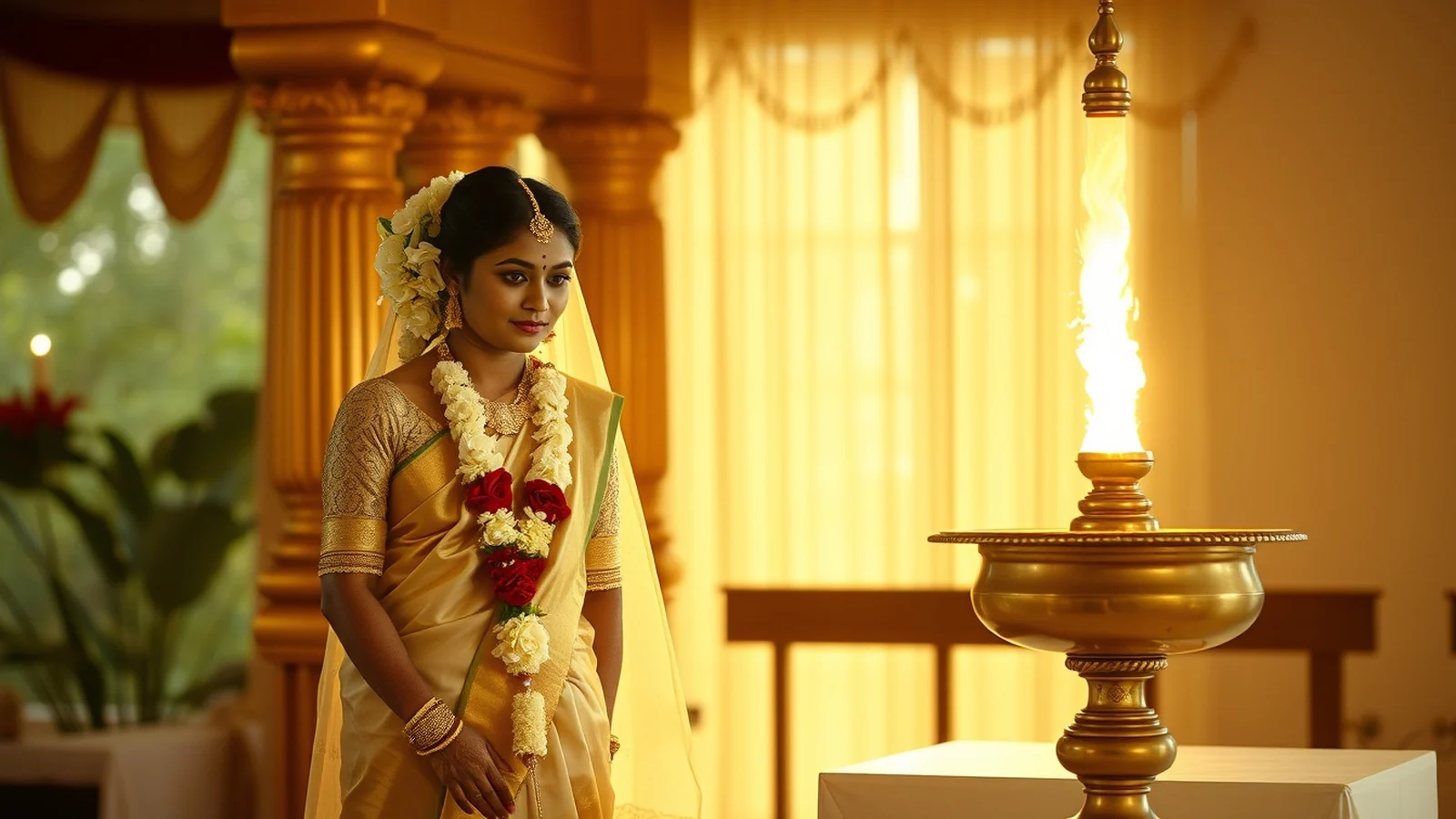
The Malayali bride is one of the most recognisable in India precisely because she is so restrained. She wears the Kasavu, the cream or ivory set mundu (a two-piece drape) or Kasavu saree bordered in real or imitation gold zari. This cream-and-gold palette is the signature of Kerala and reads as pure, auspicious, and effortlessly elegant. Where other regions favour deep reds and heavy embroidery, Kerala’s bride lets the natural sheen of the silk and the glint of the gold border do the work.
Her hair is dressed with a thick garland of fresh jasmine (mulla), fragrant and white against the gold. She wears temple jewellery, antique-style gold pieces such as the palakka mala, the mango-motif manga mala, layered kasu malas of coins, and jhumkas, jewellery whose motifs are drawn from Kerala’s temples and traditions. Some brides carry the ashtamangalyam, a tray of eight auspicious items. The overall effect is regal but never loud, a look that has made the Kasavu bride a lasting emblem of understated South Indian elegance.
The Sadya: A Feast on a Banana Leaf
If the ceremony is brief, the celebration is generous, and it reaches its peak at the Sadya, the grand vegetarian banana-leaf feast that follows the wedding. Guests sit in long rows and a fresh green banana leaf is placed before each person, positioned with the tapering end to the left. Then, dish by dish, a procession of servers ladles out an astonishing spread, each item in its precise position on the leaf.
A wedding Sadya can run to two dozen dishes or more. Staples include steaming rice with parippu (lentil curry) and ghee, tangy sambar, the coconut-and-yoghurt avial, the mild white gourd curry olan, the crunchy thoran of stir-fried vegetables, sour kaalan, tart pachadi and kichadi, crisp banana chips and the sweet-spicy sharkara varatti, pickles, pappadam, and buttermilk. The meal ends, gloriously, with payasam, the Kerala dessert of rice, jaggery, or vermicelli cooked in coconut milk or milk, sometimes served in two or three varieties. Eating the Sadya with the right hand off the leaf is part of the ritual pleasure. It is Kerala’s edible expression of abundance and hospitality, the warm counterweight to the ceremony’s brevity.
Grihapravesham and the Modern Kerala Wedding
After the wedding and feast comes the Grihapravesham, the bride’s ceremonial first entry into the groom’s home. She is welcomed at the threshold, often lighting the household lamp and stepping in with her right foot first, symbolising the prosperity and light she brings to her new family. In some traditions a rice-filled measure (para) is nudged over the doorway with her foot, an omen of plenty. This gentle homecoming replaces the tearful send-off, the Vidaai, that dominates weddings in many other regions.
Today, in Kochi, Trivandrum, and among the global Malayali diaspora, weddings blend this heritage with contemporary style. Couples marry in restored heritage venues and backwater resorts, hire photographers to capture the Minnu moment, and stage a reception in the evening where the bride may switch to a designer saree. Yet the core holds firm: the morning Muhurtham, the leaf-shaped Minnu tied in seconds, the Kasavu and jasmine, and the Sadya on a banana leaf. For couples comparing customs across the south, our Tamil Brahmin and Telugu wedding rituals guides sit alongside this one. Whatever the venue, the Malayali wedding endures as proof that the most elegant celebrations are often the ones that say the most with the least.
Planning a wedding rooted in your traditions?
Tell us your community, dates and vision. Team Velvet Knot will honour every ritual and put together a tailored plan and an honest budget.
How the muhurtham is fixed
Related South Indian rituals
Traditions in this community: read our full guide to Kerala Syrian Christian wedding traditions.
Temple weddings on Velvet Knot: a Guruvayur temple wedding.
Also on Velvet Knot: Ezhava wedding traditions.
Frequently Asked Questions
What is a Nair wedding called and why is it so short?
The Nair Hindu wedding is called the Kalyanam. It is famously brief because in its traditional form the marriage is completed by two simple acts: the Pudavakoda (the groom giving the bride a wedding cloth) and the tying of the Minnu, the leaf-shaped thaali, which takes only seconds. Historically there was little or no long fire ritual, so the essential ceremony can be over within the auspicious Muhurtham minute.
What is the Minnu in a Malayali wedding?
The Minnu is Kerala’s version of the mangalsutra. It is a small, leaf-shaped gold pendant, its form echoing a peepal or tulsi leaf, strung on a thread rather than a chain (traditionally cotton, sometimes turmeric-dyed). The groom ties it around the bride’s neck to solemnise the marriage. Its deliberate plainness reflects the understated elegance of Malayali wedding traditions.
Why do Kerala weddings happen in the morning?
Malayali weddings are timed to the Muhurtham, an astrologically chosen auspicious window that, in Kerala tradition, almost always falls in the morning between dawn and noon, when the day is considered purest. The whole ceremony is engineered so the Minnu is tied within these exact minutes, which is why Kerala weddings feel so composed and brisk.
What is the difference between a Nair and a Namboodiri wedding?
The Nair Kalyanam is simple, centred on the pudava and Minnu with minimal fire ritual. The Namboodiri Veli, belonging to Kerala’s Brahmin priestly community, is far more elaborately Vedic, traditionally spanning several days with extensive fire rituals and mantras. Both are Kerala Hindu weddings, but they sit at opposite ends of the ritual spectrum.
What does a Malayali bride wear?
The Malayali bride wears the Kasavu, a cream or ivory set mundu or saree bordered in gold zari, the signature cream-and-gold look of Kerala. She dresses her hair with fresh jasmine and wears antique-style temple jewellery such as the palakka mala, manga mala, and layered coin necklaces. The overall effect is regal yet understated.
What is a Kerala wedding Sadya?
The Sadya is the grand vegetarian feast served after a Kerala wedding on a fresh banana leaf. It can include two dozen or more dishes, among them rice with parippu, sambar, avial, olan, thoran, pickles, and pappadam, ending with payasam, the coconut-milk or jaggery dessert. It is the celebratory heart of Malayali hospitality.
Sources and further reading
Begin Your Engagement
Want a real number for your wedding?
Tell us your city, guest count and dates. Team Velvet Knot will come back within 24 hours with an itemised budget.