Christian Wedding Traditions in India: Ceremony, Customs & Planning Guide
- What an Indian Christian wedding looks like
- Pre-wedding customs
- The church ceremony in sequence
- The reception
- Attire and cuisine
- What a wedding planner coordinates
- Related community traditions
- Related wedding rituals
- The five traditions compared
- Why the church, not the venue, sets your date
- Frequently Asked Questions
- Denominational variation in Indian Christian weddings
- Indian Christian wedding documentation
- Sources and further reading
An Indian Christian wedding centres on a church ceremony with the exchange of vows and rings, often within a nuptial Mass. Pre-wedding customs like the engagement and the Roce anointing, the bride’s white gown, and a celebratory reception complete the day. Customs vary across Goan, Mangalorean, Keralite and other communities.
What an Indian Christian wedding looks like
Christian weddings in India blend the universal Christian marriage liturgy with the regional culture of the community. A Goan Catholic wedding, a Mangalorean wedding, a Syrian Christian wedding from Kerala and a Protestant wedding each carry their own customs, food and music. What stays constant is the heart of the day: a church ceremony where the couple exchange vows and rings before God, a priest or pastor, and their families.
This guide explains the typical sequence, the meaning of each custom, and how the day is planned, while noting where regional practice differs.
Pre-wedding customs
Engagement
The engagement formally announces the couple’s intention to marry. Families gather, the couple exchange rings, and the wedding date is fixed. In many communities the priest blesses the couple at this stage.
Banns of marriage
In Catholic and several Protestant churches, the banns are announced in church on three consecutive Sundays before the wedding. This public notice invites anyone with an objection to the marriage to come forward, and is part of the church’s preparation alongside pre-marital counselling.
Roce ceremony
In Goan and Mangalorean Catholic communities, the Roce is held on the eve of the wedding. The bride and groom, at their own homes, are anointed by family with roce, a paste of coconut milk and oil. It is a cleansing and blessing ritual, the last as unmarried individuals, and parallels the Haldi of Hindu weddings. Other communities hold a simple prayer service or a haldi-style function instead.
Bridal shower and Sangeet
Many families now also host a bridal shower and a musical evening, reflecting a wider Indian wedding culture while keeping the ceremony itself rooted in church tradition.
The church ceremony in sequence
| Stage | What happens |
|---|---|
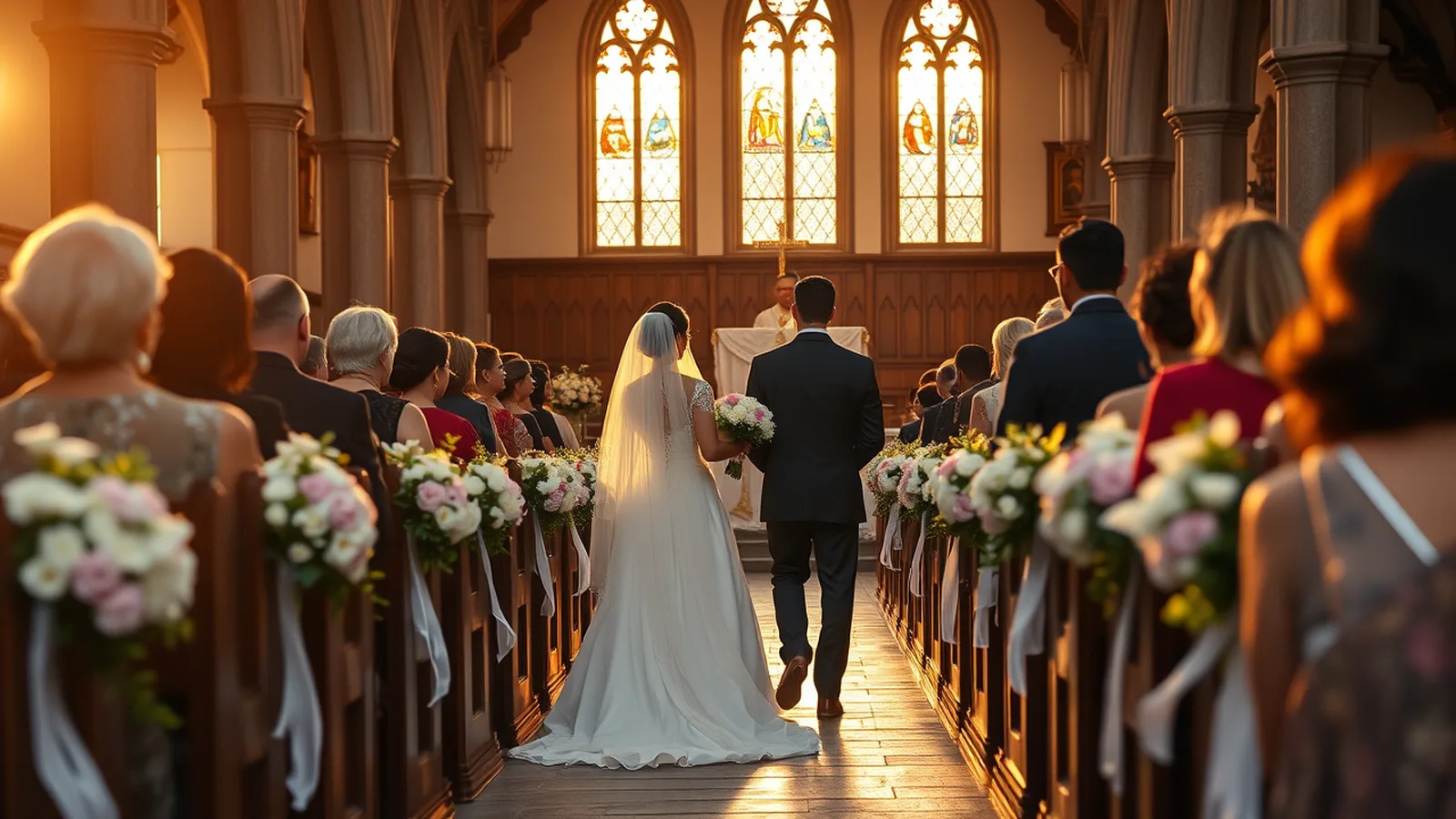
| Procession | The groom waits at the altar; the bride enters, escorted by her father, to music. |
| Welcome and readings | The priest or pastor welcomes the gathering; readings from the Bible and hymns follow. |
| Homily | A short sermon on the meaning of Christian marriage. |
| Exchange of vows | The couple declare their consent and promise to love, honour and cherish each other. |
| Exchange of rings | Rings are blessed and exchanged as a sign of fidelity. |
| Nuptial Mass | In Catholic weddings, the ceremony continues with the Eucharist; some communities also tie a Minnu or thali. |
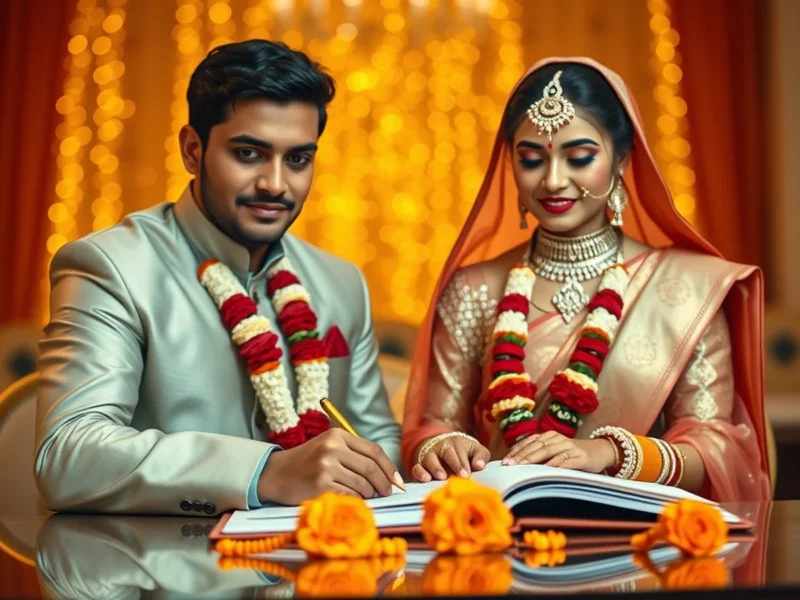
| Signing of the register | The couple, witnesses and clergy sign the marriage register. |
| Recessional | The couple is announced as married and exits the church to applause. |
Among Syrian Christians in Kerala, the groom ties a Minnu, a small leaf-shaped gold pendant marked with a cross, around the bride’s neck, and drapes her with the Manthrakodi saree, customs that show how local culture shapes the universal ceremony.
The reception
After the church ceremony the families and guests move to a banquet hall for the reception. There is a wedding feast, the cutting of the cake, the first dance, toasts to the couple, and music and dancing. Goan receptions are famous for their live bands, while a Keralite Christian reception leans on a sadya-style feast served alongside meat dishes.
Attire and cuisine
The bride traditionally wears a white gown with a veil, white being the symbol of purity, though Keralite Christian brides often wear a white-and-gold Kerala saree. The groom wears a formal suit or tuxedo. Cuisine varies sharply by region: Goan weddings serve pork sorpotel, vindaloo and bebinca; Mangalorean tables feature sanna and chicken curry; Kerala weddings offer appam, stew and beef preparations.
What a wedding planner coordinates
A Christian wedding has a fixed church schedule that everything else must fit around: booking the church and clergy, coordinating the choir and music, the floral decor of the altar and aisle, transport between church and venue, and the reception programme. A planner also manages the documentation and the regional customs particular to your community. If you are planning a Christian wedding, Velvet Knot coordinates the full day as a pan-India premium planner that plans every major tradition. Explore our services or request a quote to begin.
Related community traditions
Related wedding rituals
Traditions in this community: read our full guide to Kerala Syrian Christian wedding traditions.
The five traditions compared
The denominational detail is set out above. This table puts the five side by side,
because the practical differences between them decide the wedding date more than any other
single factor. Requirements vary by diocese and by parish, so treat the last column as what
to ask about rather than as a universal rule.
| Tradition | Ceremony form | Typical length | Distinctive rite | What to confirm with the parish |
|---|---|---|---|---|
| Roman Catholic | Sacrament of Matrimony within a nuptial Mass | The longest of the five | The Mass itself, with the Eucharist | Pre-Cana dates, banns on three Sundays, the parish NOC if marrying away from home |
| Goan Catholic | Nuptial Mass with a Konkani cultural layer | As Catholic, plus the day before | The Roce anointing at each family’s home | The residency requirement and the pre-marital course for couples marrying into Goa from outside |
| Syrian Christian (Kerala) | An older and more elaborate liturgy | Longer than a Latin Catholic rite | The Minnu Kettu and the Manthrakodi | Which church and which liturgical family, since practice differs between them |
| Protestant (CSI, CNI, Baptist, Methodist, Pentecostal) | A wedding service of vows, readings and blessing | The shortest of the five | The exchange of vows and rings, usually without a Eucharist | The denomination’s own pre-marital requirement, which varies widely |
| North-East Indian Christian (Mizo, Naga, Khasi) | Protestant service with regional customs | Varies by community | Community rites carried alongside the church service | Which customs the family expects around the service, and who leads them |
Why the church, not the venue, sets your date
This is the one thing that most surprises families planning a Christian wedding after
attending Hindu ones. In a Hindu wedding the muhurat comes from the priest and the venue is
booked around it. In a Christian wedding the constraint is the church diary, and it is
tighter than most couples expect.
The reasons stack up. Parishes have a limited number of slots, and popular churches in
Goa, Mumbai, Bengaluru and Kerala fill their peak season well ahead. Sundays are usually
unavailable or restricted because of regular services. The liturgical calendar matters:
parishes commonly discourage or restrict weddings during Lent and Advent, and the dates of
Lent move each year with Easter. Where a Mass is involved, the celebrant has to be
available too, and a family priest travelling in is a separate booking again.
The workable order is therefore: talk to the parish first, hold a church date, and only
then look at reception venues. Couples who reverse this routinely find the hall booked and
the church unavailable, and the hall is the easier of the two to change.
Two further timing points are worth building into the plan from the start. Pre-marital
preparation is a course with fixed dates, not a form, and the banns need three consecutive
Sundays before the wedding, which sets a hard floor on how soon the wedding can happen. Where the two partners belong to different parishes or one is not of the same denomination,
the paperwork moves between offices and takes longer again, so it should be started at the
same time as the venue search rather than after it.
Frequently Asked Questions
What is the Roce ceremony?
The Roce is a pre-wedding anointing ceremony in Goan and Mangalorean Catholic communities. The bride and groom are anointed with a paste of coconut milk and oil on the eve of the wedding, marking their last day as single individuals.
What are the banns of marriage?
The banns are a public announcement of an intended marriage, read out in church on three Sundays before the wedding, allowing anyone with a valid objection to raise it. They are part of Catholic and many Protestant wedding preparations.
Do all Indian Christian weddings include a Mass?
No. A nuptial Mass with the Eucharist is part of Catholic weddings. Protestant weddings follow a service of vows, readings and blessings without a Mass, though the exchange of vows and rings is common to both.
What is a Minnu?
The Minnu is a small leaf-shaped gold pendant marked with a cross, tied around the bride’s neck by the groom in Syrian Christian weddings in Kerala. It is the regional equivalent of a thali.
What does a Christian bride wear in India?
Most Indian Christian brides wear a white gown with a veil, symbolising purity. Keralite Christian brides commonly wear a white-and-gold Kerala saree instead.
How long does the church ceremony last?
A church ceremony usually takes one to one and a half hours. A Catholic ceremony with a full nuptial Mass runs longer than a Protestant service of vows and blessings.
Denominational variation in Indian Christian weddings
“Christian wedding” in India covers at least five quite distinct traditions, each with its own ceremony structure, documentation requirements, and pre-wedding obligations. Treating them as the same will misbrief vendors and offend family elders. The major variations:
Roman Catholic (most Goan, many South Indian, Mumbai Christian)
A Catholic wedding is a Sacrament of Matrimony performed within a Wedding Mass. Pre-Cana counselling (6-12 weeks of structured pre-marital sessions) is mandatory. The Banns of Marriage (a public announcement of the intended wedding read at three successive Sunday Masses) is required by Canon Law. The wedding itself runs 60-90 minutes and includes the Liturgy of the Word, the Rite of Marriage, the Liturgy of the Eucharist, and the Nuptial Blessing. Both partners must be baptised; if one is not Catholic, a Mixed-Marriage Dispensation from the bishop is required. We coordinate the documentation chain with the parish priest from the eight-month mark.
Syrian Christian (Saint Thomas Christians of Kerala)
One of the oldest Christian traditions in the world, claiming descent from the apostle Thomas in 52 CE. The Syrian Christian wedding is more elaborate than a Latin Catholic wedding, with traditions like the Minnu Kettu (tying of the sacred thread or pendant similar to a Hindu mangalsutra), the Manthrakodi (gifting of the sari), and a multi-day reception format. Syrian Catholic, Syrian Orthodox, Marthoma, and Knanaya sub-traditions each have their own ceremony order and post-ceremony practices.
Protestant (various denominations across India)
Protestant weddings cover Church of South India (CSI), Church of North India (CNI), Baptist, Methodist, Pentecostal, and several smaller denominations. The service is typically a shorter Wedding Service (no Eucharist in most denominations) of 30-45 minutes. Pre-marital counselling is encouraged but rarely as structured as Catholic Pre-Cana. The Banns of Marriage are not required.
Goan Catholic with cultural Indian elements
Goan Catholic weddings often layer a Konkani cultural ceremony called the Roce (a turmeric-based pre-wedding ceremony similar to a Haldi) before the Wedding Mass. The Roce is held the day before the wedding at each family’s home. A formal Sangeet-style musical evening often follows. Goan Catholic weddings are increasingly multi-event productions across a long weekend.
North-East Indian Christian (Mizo, Naga, Khasi)
Mizoram, Nagaland, Meghalaya, and parts of Assam have predominantly Christian populations with their own ritual traditions blending Protestant theology with regional cultural practice. Tribal wedding customs (the Nyat Senna in Naga weddings, the formal Khasi engagement ceremony) sit alongside the church service. Outside-planner unfamiliarity with these traditions is high.
Indian Christian wedding documentation
The Indian Christian Marriage Act, 1872, governs Christian weddings in India. Documentation typically required at the parish (varies by denomination and diocese):
- Baptismal certificates of both partners (recent, typically within 6 months)
- Confirmation certificates
- No-Objection Certificate from the home parish (if marrying in a different parish)
- Pre-Cana certificate (Catholic only)
- Birth certificates and photo ID
- For destination Catholic weddings in Goa: a one-week Pre-Marital Course conducted in Goa is typically required for non-resident couples
For interfaith Catholic-non-Catholic weddings, the Mixed-Marriage Dispensation is requested by the parish priest from the diocesan office. This takes typically 4-8 weeks. We brief families on the full document chain during the planning kick-off so nothing surprises at the four-month mark.
Sources and further reading
Velvet Knot believes in showing our work. The references below are the authoritative sources we consult when planning weddings in this category.
- Indian Christian Marriage Act, 1872: Government of India
- Catholic Church in India, Britannica: Britannica
- Saint Thomas Christians (Syrian Christians of Kerala), Britannica: Britannica
Wedding paperwork: Christian marriage registration.
Begin Your Engagement
Want a real number for your wedding?
Tell us your city, guest count and dates. Team Velvet Knot will come back within 24 hours with an itemised budget.