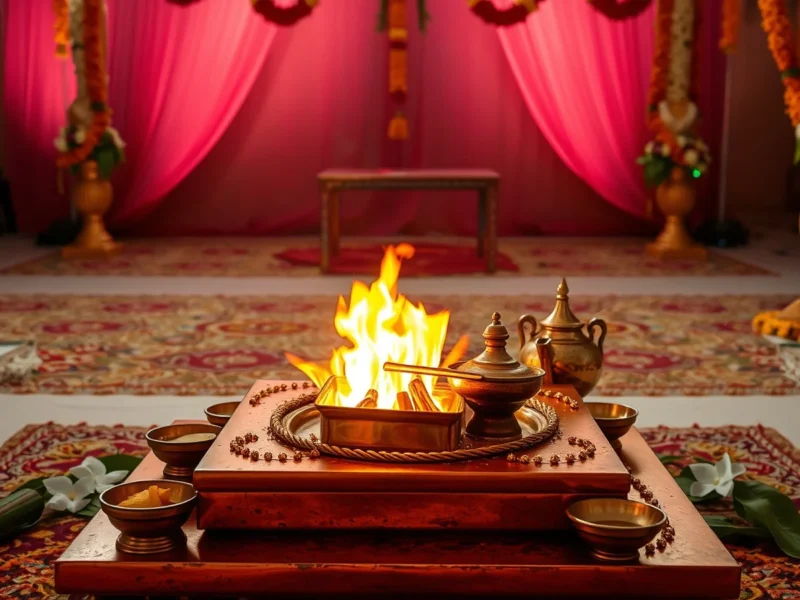
Gaye Holud: The Bengali Turmeric Ceremony, the Tattva and How It Is Planned
- What gaye holud is
- Where gaye holud sits in a Bengali wedding
- The married women: the eyo
- The tattva: what the groom’s family sends
- Gaye holud in Bangladesh
- How the turmeric paste is made
- Stains, clothes and where to hold it
- Decor and photography
- Food on the holud morning
- Gaye holud at a destination wedding
- Combining gaye holud with another community’s haldi
- Gaye holud for the groom’s family: the part often forgotten
- What to settle beforehand
- Frequently Asked Questions
- Sources and further reading
Gaye holud is the Bengali turmeric ceremony, held on the morning of a Hindu Bengali wedding. The groom is anointed first at his home. The rest of his turmeric is then sent to the bride’s house with the tattva: gifts that usually include a saree, sweets and a decorated rui fish. The bride is anointed with it while conches blow. In Bangladesh, the holud is a separate festive evening a day or two before.
Planning a Bengali wedding? Free download: the ritual-by-ritual planning timeline
Every ritual of a Bengali wedding in order, with when it happens, what the family arranges and when to book it, on one printable page. Share a few details about your wedding in the form at the end of this page and the download link appears as soon as you send it.
What gaye holud is
Gaye holud means “turmeric on the body”, and at its simplest that is what it is: married women of the family anoint the bride and the groom with a paste of turmeric before the wedding. Turmeric is auspicious, it is believed to purify and protect, and it gives the skin a glow for the wedding. Almost every Indian community has some version of a haldi ceremony.
What makes the Bengali gaye holud distinctive is the order and the exchange. The groom’s family goes first. Turmeric is applied to the groom at his home, and the same turmeric, now touched by him, is carried to the bride’s house as part of the tattva, a procession of gifts. The bride is anointed with it. The turmeric links the two bodies before the wedding, which is the point of the ritual.
Our general haldi ceremony guide covers the pan-Indian version. This guide covers what is specifically Bengali about it, and what is different again in Bangladesh.
Where gaye holud sits in a Bengali wedding
In a Hindu Bengali wedding, gaye holud is held on the morning of the wedding day itself, not days before as in many other communities. The sequence on that morning usually runs like this.
| Time | Ritual | What happens |
|---|---|---|
| Before sunrise | Dodhi mongol | The bride (and the groom at his home) eats curd and chira, flattened rice, with married women. It is the last meal before a fast that lasts until after the wedding. |
| Early morning | Groom’s gaye holud | Married women of the groom’s family anoint him with turmeric. |
| Morning | The tattva travels | The groom’s family sends the turmeric with gifts to the bride’s house. |
| Late morning | Bride’s gaye holud | The bride is anointed with the groom’s turmeric while conches are blown and the women ululate. |
| After | Bath and rest | The bride bathes and rests before dressing for the evening wedding. |
Many families also put the shankha and pola, the white conch-shell bangle and the red coral bangle, on the bride during the wedding morning, and the order of these small rituals varies a good deal from family to family. Ask the elders and the priest rather than following any list, including this one.
The married women: the eyo
Gaye holud belongs to the married women of the family, the eyo, whose husbands are living. They grind the turmeric, apply it, blow the conch and lead the ululation, the ulu, which is the high trilling sound that marks every auspicious moment in a Bengali wedding. In most families they also fast for the morning along with the bride.
Many families invite an odd number of married women to take part. The bride’s mother often does not apply the turmeric herself, because she has her own role later in the day, but she supervises.
The tattva: what the groom’s family sends
The tattva is the most visible part of gaye holud. A line of relatives or helpers carries a series of decorated trays from the groom’s house to the bride’s. Each tray carries a gift, and each gift is arranged with real care, often shaped into a figure or wrapped in coloured cellophane and ribbons. The trays are displayed at the bride’s house and photographed.
What goes in a tattva varies by family, but these are the usual contents.
- The turmeric itself, the reason for the procession.
- A saree for the bride, often a red-bordered saree she will wear for the holud or a later ritual.
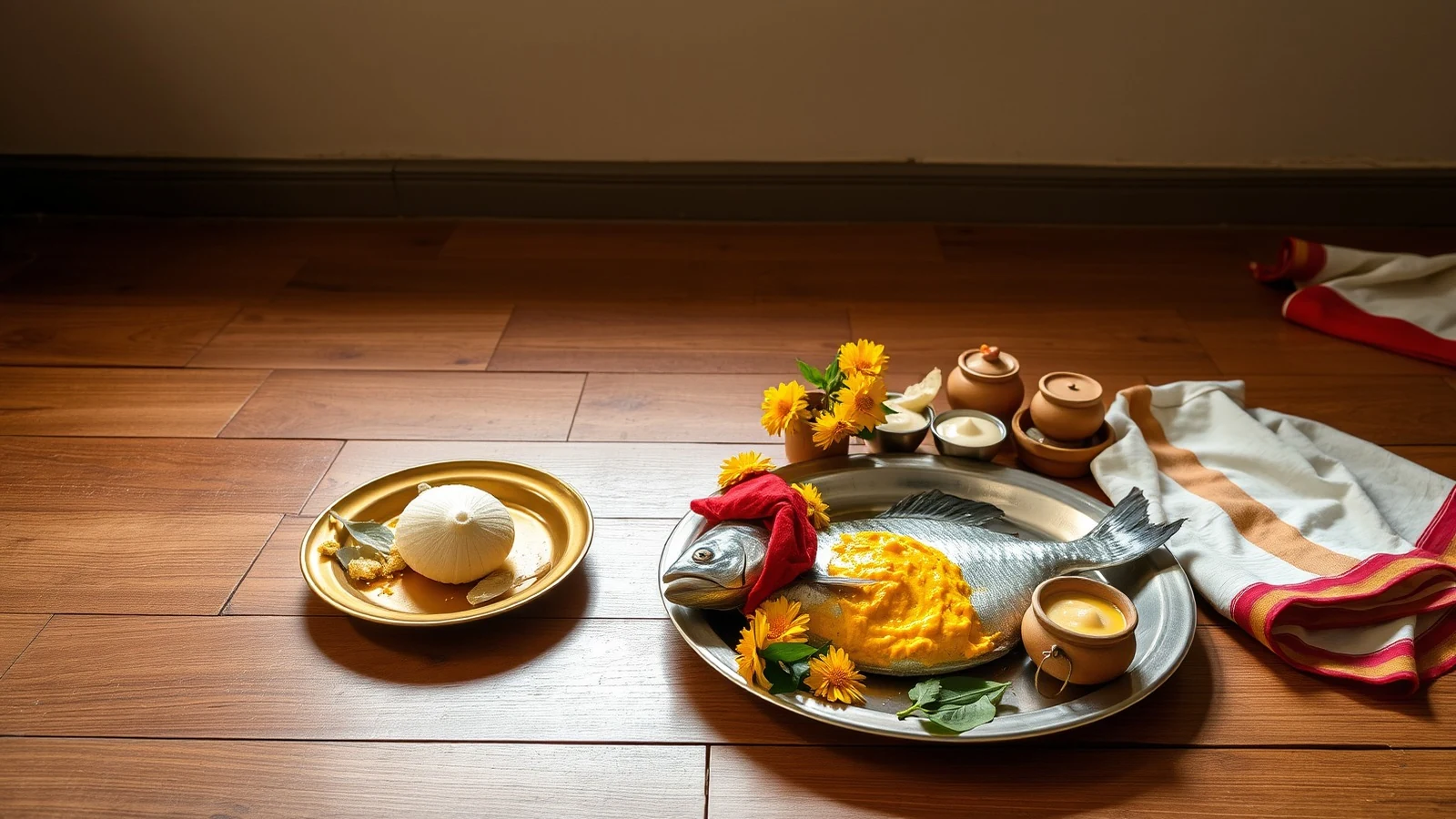
- A rui fish, decorated as a bride, with a small saree, sindoor and ornaments. The fish is a symbol of fertility and plenty in Bengali culture, and the dressed fish is one of the most photographed objects of a Bengali wedding.
- Sweets, usually Bengali sweets such as sandesh and rosogolla, in large quantities.
- Curd, in a clay pot.
- Cosmetics and toiletries: alta, the red dye for the feet, sindoor, a mirror, oil, soap and perfume.
- Betel leaves and nuts, and fruit.
The bride’s family sends a tattva back to the groom’s house, either the same day or later, with gifts for the groom. The return tattva often includes clothes, a watch or cufflinks, and the same sweets and fish.
Gaye holud in Bangladesh
In Bangladesh, the holud has grown into one of the biggest events of the wedding, celebrated by Muslim and Hindu families alike. It is usually held a day or two before the wedding, as a separate evening for the bride and for the groom, or as a joint event. The bride sits on a decorated stage in a yellow or orange saree with flower jewellery, and guests come up one by one to touch turmeric to her face and feed her sweets. There are songs, dancing and a full dinner, and the decor runs to marigolds, yellow fabric and lamps.
For a Bangladeshi or cross-border Bengali wedding held in India, that evening event is the one most families mean by “holud”, and it needs a stage, a photographer, music and catering just like a sangeet. Clarify which version the families expect before you plan anything.
How the turmeric paste is made
Traditionally, raw turmeric is ground on a stone slab, the sil, by the married women of the family, and mixed with mustard oil and sometimes a little curd. Some families keep the sil and grind the turmeric at home as part of the ritual; others buy ready ground turmeric and mix it on the day. Either way, the paste is thick, stains everything and takes some scrubbing to wash off.
If the bride has sensitive skin, test a little of the paste on her arm a week before the wedding. Mustard oil and raw turmeric can irritate some skin types, and a rash on the wedding morning is the last thing anyone wants. Her makeup artist will also want to know when the holud ends and the bath is done.
Stains, clothes and where to hold it
Turmeric stains fabric, marble, grout and upholstery, and it is very hard to remove. That is why most families hold the holud at home, in a courtyard or on a terrace, where a little yellow on the floor does not matter.
At a hotel or banquet hall, the venue will usually want it held on a lawn or a terrace with a sheet on the floor, and some venues charge a cleaning fee or ask for a deposit. Ask before you book. Dress everyone taking part in clothes they do not mind ruining. The bride usually wears an old or inexpensive yellow or red-bordered saree for the holud and changes after her bath.
Decor and photography
Gaye holud decor is simple and yellow: marigolds, mango leaves, a low seat for the bride, a brass plate for the turmeric and the conches. The tattva trays themselves are the main decor, and they are usually laid out on a table or on the floor near the bride. Many families now hire a decorator to make the trays, especially the dressed fish.
The photographs that matter are the arrival of the tattva, the trays laid out, the first touch of turmeric and the bride laughing as the women smear it on her face. Morning light is ideal, so the timing works in the photographer’s favour. Brief them to arrive before the tattva and to stay until the bride goes for her bath.
Food on the holud morning
The bride, the groom and often the married women are fasting on the wedding day, so the holud is not a meal for them. For everyone else, families usually serve a light breakfast of luchi, aloo, sweets and tea. The real feast is in the evening after the wedding. In Bangladesh, where the holud is an evening event, there is a full dinner, often with biryani, kebabs and sweets.
Gaye holud at a destination wedding
A destination wedding compresses the week, and the gaye holud often moves from the wedding morning to the previous day, or is combined with other rituals. That is a practical change and most families accept it. What usually survives is the order: the groom first, his turmeric sent to the bride, and the tattva trays.
When both families are staying at the same resort, the tattva becomes a procession across the resort, which can be lovely. Agree with the resort where the trays will be set out, where the holud will be held, and how the cleaning will be handled. Our Bengali wedding traditions guide covers how the morning fits into the rest of the day, and the Kolkata wedding planning page covers the city’s venues.
Combining gaye holud with another community’s haldi
In a wedding between a Bengali family and a family from another community, two haldi traditions meet. The Bengali one usually wants the groom first and the turmeric carried across; a Punjabi family will have its own mayian and vatna; a South Indian family may have a mangala snanam. They are not in conflict, but they need sequencing. The simplest answer is to let each family hold its own ritual for its own child, and to carry the Bengali tattva between them, which the other family usually enjoys.
Gaye holud for the groom’s family: the part often forgotten
Because the bride’s holud is the one most guests see, the groom’s side is easy to under-plan. His holud happens first and earlier, often before seven in the morning, at his family home or at a separate venue, and it sets the timing for everything at the bride’s house. If the groom’s turmeric leaves late, the bride’s holud starts late, her bath is late, and her makeup artist is waiting.
Give the groom’s side its own small plan: who grinds or mixes the turmeric, which married women are present, who carries the tattva and at what time it leaves. When the two families are in different cities and the groom’s family travels on the wedding day, some families anoint the groom the evening before and send the turmeric with a relative who travels ahead. Agree that in advance with the priest so that nobody is surprised on the morning.
What to settle beforehand
- Which version of the holud: the morning ritual, the Bangladeshi evening event, or both.
- Who sends the tattva, how many trays, and who makes them.
- Whether the groom’s turmeric will physically travel to the bride, or whether both are anointed at the same venue.
- Where the holud is held, and whether the venue charges for cleaning.
- The fast: when the bride last eats and who brings her water.
- The photographer’s arrival time.
Frequently Asked Questions
What is gaye holud?
Gaye holud is the Bengali turmeric ceremony before a wedding. Married women anoint the groom with turmeric first, and the same turmeric is sent with gifts to anoint the bride.
When is gaye holud held?
In a Hindu Bengali wedding it is held on the morning of the wedding day. In Bangladesh it is usually a separate evening event one or two days before the wedding.
What is the tattva in a Bengali wedding?
The tattva is the set of decorated gift trays exchanged between the families. The groom’s tattva usually includes the turmeric, a saree, sweets, curd, cosmetics and a rui fish dressed as a bride.
Why is a fish sent at gaye holud?
The fish is a symbol of fertility and plenty in Bengali culture. A rui fish dressed as a bride is a traditional part of the groom’s tattva.
Is gaye holud the same as haldi?
It is the Bengali form of the haldi ceremony. The distinctive features are that the groom goes first and his turmeric is sent to the bride with the tattva.
What does the bride wear for gaye holud?
Usually a yellow saree or a red-bordered white saree that she does not mind staining. In Bangladesh brides wear a yellow or orange saree with flower jewellery.
Sources and further reading
Planning a Bengali wedding with a gaye holud morning and an evening ceremony? Tell us your dates and guest count and we will send a tailored plan and quote.
Begin Your Engagement
Want a real number for your wedding?
Tell us your city, guest count and dates. Team Velvet Knot will come back within 24 hours with an itemised budget.