Wedding Planner in Dubai for Indian Weddings: The Honest 2026 Guide
- Why Indian families pick Dubai
- The 4-night Indian wedding in Dubai: a realistic itinerary
- The hidden logistics nobody on the SERP writes about
- Real costs in INR and AED
- What goes wrong without an experienced planner
- Why an India-based planner beats a Dubai-resident planner
- Frequently Asked Questions
- Planning your Dubai Indian wedding with Velvet Knot
- Sources and further reading
An Indian wedding in Dubai usually runs as a four-night format, since international guests cannot easily extend stays: Mehndi, Sangeet, ceremony, and reception. Dubai sits about four hours from most Indian metros and seven from London, splitting the flight burden well. A comparable wedding in London or New York costs 60 to 100 percent more than Dubai.
If you have searched for an Indian wedding planner in Dubai, you have already seen the same pattern. Every result is a Dubai-resident operator quoting in AED, walking you through venue glossies, and quietly avoiding the parts that actually decide whether your wedding works: how Indian documents get attested in the UAE, where the pandit is actually coming from, how the alcohol permit gets issued, and what the bill really looks like when you convert it back to rupees.
This guide does the opposite. We plan Indian weddings in Dubai from Hyderabad. The pandit, the decorator, the photographer, the choreographer, most of the family-all India-based. The venue, the catering compliance, the licensing, the on-ground crew-Dubai-based. The bridge between the two is what families pay us for.
 sangeet night at a Dubai luxury hotel ballroom” decoding=”async” width=”1200″ height=”675″ src=”data:image/svg+xml;base64,PHN2ZyB3aWR0aD0iMSIgaGVpZ2h0PSIxIiB4bWxucz0iaHR0cDovL3d3dy53My5vcmcvMjAwMC9zdmciPjwvc3ZnPg==” class=”lazyload” style=”–smush-placeholder-width: 1200px; –smush-placeholder-aspect-ratio: 1200/675;” />
Why Indian families pick Dubai
Dubai sits roughly four hours from most Indian metros and seven hours from London. For an Indian family with relatives split across India, the UK, and North America, no single destination splits the flight burden better. Add year-round event-grade weather between October and April, hotel infrastructure built for 300-pax events, a visa regime that issues 30-day tourist e-visas in under 72 hours, and a hospitality culture that already understands Indian weddings (Atlantis The Palm alone runs dozens a year), and the math works.
Cost-wise, a comparable wedding in London or New York usually runs 60 to 100 percent higher than Dubai for venue and catering. Within Dubai, an Indian wedding still costs less than what an equivalent guest count would in Goa once you account for international guests’ hotel nights being shorter and venue logistics being centralised.
The 4-night Indian wedding in Dubai: a realistic itinerary
Most Dubai Indian weddings compress into a four-night format because international guests cannot easily extend stays. The shape:
- Night 1, Mehndi. Hotel suite garden, private villa on Palm Jumeirah, or a sectioned-off pool deck. Daytime to early evening. 60 to 120 guests for the close family-and-friends version, larger if combined with haldi.
- Night 2, Sangeet or cocktail night. Beach club, rooftop bar with private hire, or a hotel ballroom. This is the high-production night. Choreographed performances, DJ, full bar.
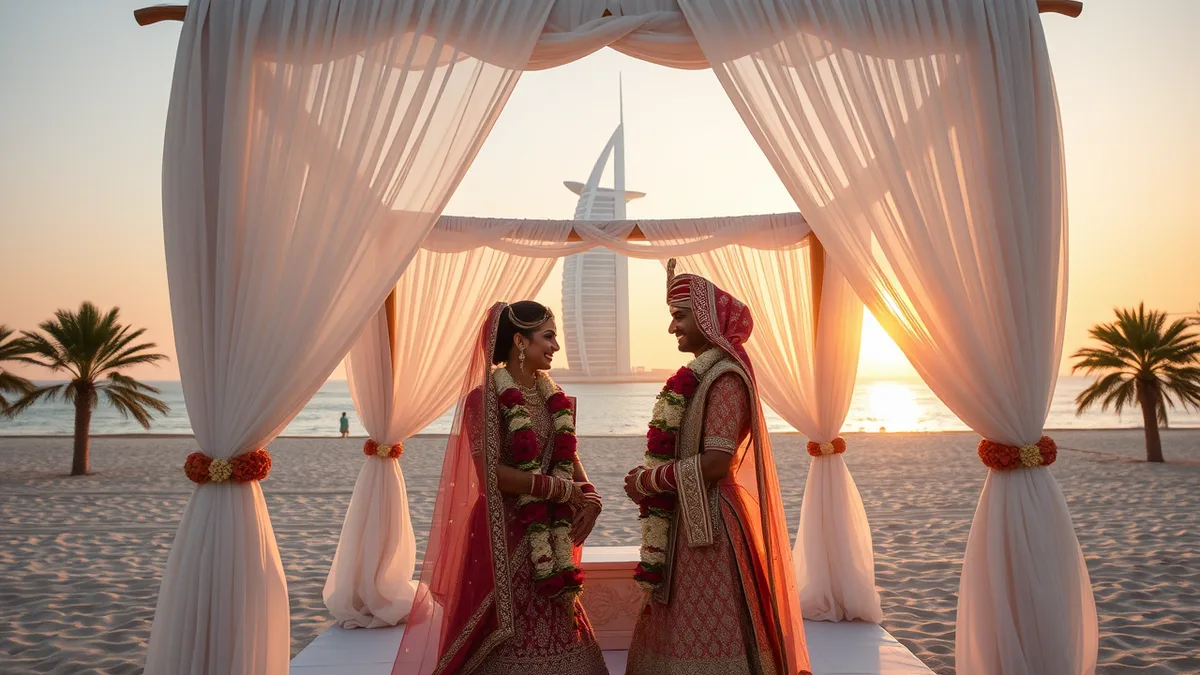
- Night 3, Wedding ceremony. Hotel ballroom or private resort lawn. Mandap setup, full pheras, baraat where the venue permits it.
- Night 4, Reception. Plated dinner, stage, speeches.
The venues families actually use cluster around a known shortlist: Atlantis The Palm, Madinat Jumeirah (Mina A’Salam and Al Qasr), JW Marriott Marquis, Bulgari Resort, Address Sky View, Burj Al Arab, Armani Hotel, Caesars Palace Bluewaters, Anantara The Palm, and the Ritz-Carlton DIFC. For intimate desert weddings of 40 to 80 guests, Al Maha Desert Resort and Bab Al Shams sit in their own category-the dune setting is the design language, not the ballroom.
The hidden logistics nobody on the SERP writes about
This is the section that decides whether your wedding goes smoothly or whether you spend the rehearsal dinner on the phone with a consulate. None of the Dubai-resident operators write about this honestly because most of these problems do not exist for them. They exist for you, the family flying in.
Marriage registration
A Hindu (or Sikh, Christian, or any non-Islamic) wedding ceremony performed in the UAE is not automatically a legally registered marriage under UAE law. The phera ceremony, the nikah, the church wedding-religiously valid, legally not registered with UAE authorities by default.
In practice, Indian families handle this one of three ways. They register the marriage in India before the Dubai ceremony (most common, simplest). They register it in India after returning. Or they use the Indian Consulate’s marriage registration service in Dubai, which (per current Consulate guidance) requires at least one party to hold a UAE residence visa, a 30-day notice period after newspaper publication of the notice, and supporting documents including singleness certificates. Specifics shift; check the Consulate General of India, Dubai for the current procedure before relying on this route. Families who want their Dubai wedding to also be the legal date plan for it 60 days out, not 6.
Document attestation
Any Indian document you plan to use officially in the UAE (birth certificate, passport copies, divorce decree if applicable, no-objection letters) needs a two-step attestation chain. First the Ministry of External Affairs in India (or via an MEA-authorised agency). Then the UAE Embassy or Consulate in India. Realistic timeline: three to four weeks if everything is clean, six weeks if anything bounces. This is the single most underestimated calendar item in an NRI Dubai wedding. If your wedding is in November and you start attestation in August, you are cutting it fine.
Alcohol permit logistics
UAE liquor licensing is real and enforced. The good news: every five-star hotel ballroom on the shortlist above is already pre-licensed for alcohol service at private events, and the venue manages permits internally. You will not deal with paperwork.
The friction shows up with private villa weddings, beach venues outside hotel grounds, and some rooftop event spaces. These need a separate event-specific permit, usually sourced through the venue’s appointed liquor license partner (companies like MMI and African+Eastern handle most of this). Expect 7 to 14 days lead time and a per-event fee that scales with quantities.
For a 200-guest Indian wedding, a sensible open-bar quantity plan is roughly one bottle of wine per two guests across the event and two beers per guest, plus spirits for the cocktail night. In INR, plan Rs 4 to Rs 8 lakh (AED 17,000 to 35,000) for a premium open bar across all four nights. Indian wedding crowds drink less than Western weddings of comparable size on the wedding night itself, more on the sangeet.
Pandit availability
This is the one most families get wrong. Dubai has a substantial Hindu community and ISKCON Dubai operates as the main temple, but pandits attached to ISKCON or other Dubai temples primarily handle daily worship and community festivals. Wedding officiation is not their core practice. A small number of independent pandits in Sharjah and Ajman do officiate weddings, but availability is thin, and matching your specific tradition (Iyer, Iyengar, Smartha, Madhwa, Punjabi, Gujarati, Marwari) gets harder still.
The honest path for most premium weddings: fly your pandit in from India. Round-trip economy airfare plus a fee in the Rs 50,000 to Rs 1 lakh range, plus accommodation. The pandit lands two days before the ceremony, walks the mandap setup with the decorator, and runs the ritual to your family’s exact tradition. We coordinate this end-to-end. The alternative is using a Sharjah-based pandit we have a working relationship with, which works for families where strict tradition-matching is less critical.
DJ and music licensing
UAE noise ordinances are stricter than India and are actively enforced. Beach and outdoor venues have a hard music cutoff at 11pm in most emirates. Indoor ballroom events can extend to 2am with the venue’s prior approval, sometimes later. If your sangeet is on a beach and you have not negotiated this in writing, the music stops at 11. Build the choreography around the constraint instead of fighting it.
Cultural sensitivity
Dubai is among the most tolerant cities in the Gulf for non-Muslim ceremonies. Hindu, Sikh, Christian, and interfaith weddings happen there every week without issue. The practical caveats are quiet ones: public-facing spaces (open beaches, malls, public parks) carry an implicit modesty expectation that affects what your reception entrance, baraat, and outdoor photography can look like. Premium private venues-the hotels and resorts on the shortlist-have no such constraint. Inside a Madinat Jumeirah lawn or an Atlantis ballroom, your wedding looks the way it would in Udaipur.
Real costs in INR and AED
We quote in rupees first because that is the currency your family budgets in. AED conversions use 1 INR = 0.045 AED.
Intimate Dubai Indian wedding (60 to 80 guests, 2 days) Rs 45 to 75 lakh total (AED 195,000 to 325,000). Suits a haldi-mehndi combined morning plus a wedding-and-reception evening, hosted at a single hotel venue.
Mid-range Dubai Indian wedding (150 to 200 guests, 3 days) Rs 1.2 to 2 crore (AED 520,000 to 870,000). The most common bracket. Three nights, two venues, full-production sangeet, decor by an India-flown designer.
Luxury Dubai Indian wedding (300+ guests, 4 to 5 days at Atlantis or Burj Al Arab tier) Rs 3 to 6 crore and upward (AED 1.3M to 2.6M+). Multiple venues, signature-property hosting, custom-fabricated mandap and stage, India-based celebrity choreographer if used, full hospitality desk for international guests.
Planner fee. Dubai-resident planners typically charge 10 to 15 percent of total budget, which on a Rs 2 crore wedding works out to Rs 20 to 30 lakh, and on a Rs 4 crore wedding Rs 40 to 60 lakh. Our wedding planner cost guide explains how planners in India charge.
What goes wrong without an experienced planner
These are not hypothetical. Each one has happened to a family who tried to coordinate a Dubai wedding by phone from India.
1. Wrong-licensed venue, no alcohol. Family books a beach venue priced 30 percent under the hotel ballroom alternative, finds out four weeks before the wedding that the event permit window has closed and the venue cannot serve alcohol that night. We pre-check licensing status as the first item in venue shortlisting.
2. Pandit lands, immigration issue. Pandit flies in on a tourist visa without the right invitation letter or supporting paperwork and gets held at Dubai immigration. The UAE does not run a dedicated short-stay religious visa, so the pandit travels on a standard tourist visa with an invitation letter from the host family and the venue. We process this documentation as a separate workstream, with the pandit arriving 48 hours before any ritual.
3. Family flies in early, no coordination. Bride’s relatives land three days before the wedding and find no one to receive them, no transport, no hotel briefing. We run an arrivals desk from the day the first international guest lands.
4. Decorator quotes ignore import duty. An India-based decorator quotes a mandap fabrication at Rs 12 lakh, then the customs duty on shipping it to Dubai adds another Rs 3.5 lakh that nobody flagged. We either source the structure UAE-side or build duty into the original quote, in writing.
5. Outdoor mandap permit denied late. An outdoor lawn ceremony hits a noise-permit refusal two days before the event because of a neighbouring property complaint. Indoor backup plans are agreed at the contracting stage, not negotiated mid-crisis.
Why an India-based planner beats a Dubai-resident planner
Three things shift the math:
You are not paying an FX premium on the 400 hours of pre-wedding coordination. Dubai operators quote in AED and the conversion lands harder than it looks on paper.
Network direction. The pandit, the choreographer, the bridal makeup artist, the mehndi artist, the photographer your family wants, the customised decor, 90 percent of an Indian wedding’s creative supply chain is in India. We manage that supply chain natively. Dubai-resident planners broker it through layers.
Family fluency. Visa coordination for elderly relatives, conversations with the groom’s mother about the muhurat conflict, NRI tax questions on gold transfers, dietary segmentation across Jain, vegetarian, Halal, and non-vegetarian guest lists-these are conversations Indian planners have weekly. We do this for destination weddings across India and for NRI families every quarter. The NRI wedding planning timeline is worth a read in parallel-it covers the India-side calendar in detail.
For execution week, we partner with a permanent on-ground Dubai team that handles licensing, vendor relationships with UAE-side suppliers, and day-of crew. The family deals with one accountable planner. The structure is the same one we use for luxury weddings in Udaipur or Goa.
Frequently Asked Questions
Do I need a UAE visa for the wedding ceremony itself?
Indian passport holders need a UAE tourist visa for any visit. The 30-day e-visa applies whether you are getting married or attending. Guests from the US, UK, EU, and most other passports get visa-on-arrival. For couples and immediate family, a regular tourist visa is sufficient for a religious ceremony. No special wedding visa exists.
Can my pandit officiate even if he is not UAE-licensed?
For a private religious ceremony inside a hotel venue or private property, yes. UAE law does not require religious officiants to be locally licensed for private religious rites performed outside a state-recognised marriage registration. Where it matters is if you also want the same ceremony to be the legal marriage on UAE record-which, as covered above, is a separate process and not what the pandit handles anyway.
How early should we start planning?
Eight to twelve months minimum. The MEA attestation chain alone needs a four-to-six-week buffer, the better venues book 9 to 12 months out for peak season (November to February), and an NRI family typically needs two India trips for fittings and vendor sign-off. Twelve months is comfortable. Eight is workable. Under six gets compromised.
What does a realistic 100-guest, 3-day Dubai Indian wedding cost?
Plan for Rs 85 lakh to Rs 1.4 crore (AED 370,000 to 615,000) all-in, assuming a 4-star or 5-star hotel venue across three event nights, full decor, India-flown pandit, photographer, and bridal team, and a mid-tier open bar. The range depends mostly on venue tier and decor scale.
Can guests get short-stay UAE visas easily?
Yes. Indian passport holders apply for a 30-day or 60-day tourist e-visa, approved typically within 72 hours, costing AED 350 to 650 depending on duration. Most other nationalities (UK, US, EU, Canada, Australia) get visa-on-arrival for 30 to 90 days. For elderly relatives or anyone with a complicated travel history, we recommend applying 6 to 8 weeks ahead.
Will alcohol be available at the wedding?
Yes, at any pre-licensed hotel venue (which covers every venue on the shortlist above), without you handling paperwork. For private villa or beach venues outside licensed grounds, a separate event permit is needed and is sourced through the venue’s liquor partner with 7 to 14 days lead time.
What is the best season for a Dubai Indian wedding?
October to April. November to February is peak-daytime highs around 24 to 27 degrees, evenings cool enough for outdoor receptions. Avoid June to September entirely, when temperatures cross 40 degrees and outdoor anything becomes impossible. Ramadan dates shift each year, and while non-Muslim ceremonies continue during Ramadan, public daytime food and music conventions change, so confirm dates if your wedding falls in that window.
Hotel ballroom or private villa for the ceremony?
For 150 guests or more, a hotel ballroom wins on reliability-licensing, catering, parking, backup power, weather contingency are all internal. For 60 to 100 guests where you want a private feel, a Palm Jumeirah or Emirates Hills villa works beautifully, accepting the trade-off that licensing, catering, and security need to be assembled separately. For intimate weddings under 60 guests, a desert resort like Al Maha is its own answer.
Planning your Dubai Indian wedding with Velvet Knot
We work with eight to twelve NRI families a year on Dubai weddings. The pattern is consistent: a parent or sibling already lives in the UAE, the couple is split between India and somewhere further west, and the family wants a planner who speaks both halves of the wedding fluently.
If your wedding is 8 to 12 months out and you want an early read on venues, budget, and the attestation calendar, we are happy to walk through it on a no-obligation call. You can reach Saru directly on WhatsApp at +91 7700027573, or read about how we work and our services before getting in touch.
The earlier the conversation, the cleaner the planning. Eight months is comfortable, twelve is ideal, and the attestation paperwork is the one calendar item that does not negotiate.
Sources and further reading
Velvet Knot believes in showing our work. The references below are the authoritative sources we consult when planning weddings in this category.
- Foreign Marriage Act, 1969: Government of India
- Visa & residency, Government of UAE: Government of UAE
Planning the budget? See our Dubai wedding cost guide.
Begin Your Engagement
Want a real number for your wedding?
Tell us your city, guest count and dates. Team Velvet Knot will come back within 24 hours with an itemised budget.