Mangalsutra: Meaning, Tradition, and Modern Variants
- What the mangalsutra is
- Regional variants of the mangalsutra
- The Mangalsutra Dharanam ritual
- Modern interpretations of the mangalsutra
- Planning the mangalsutra: what families typically decide
- Related South Indian rituals
- The regional forms in one table
- What actually drives the price
- Frequently Asked Questions
- Related rituals on Velvet Knot
- Sources and further reading
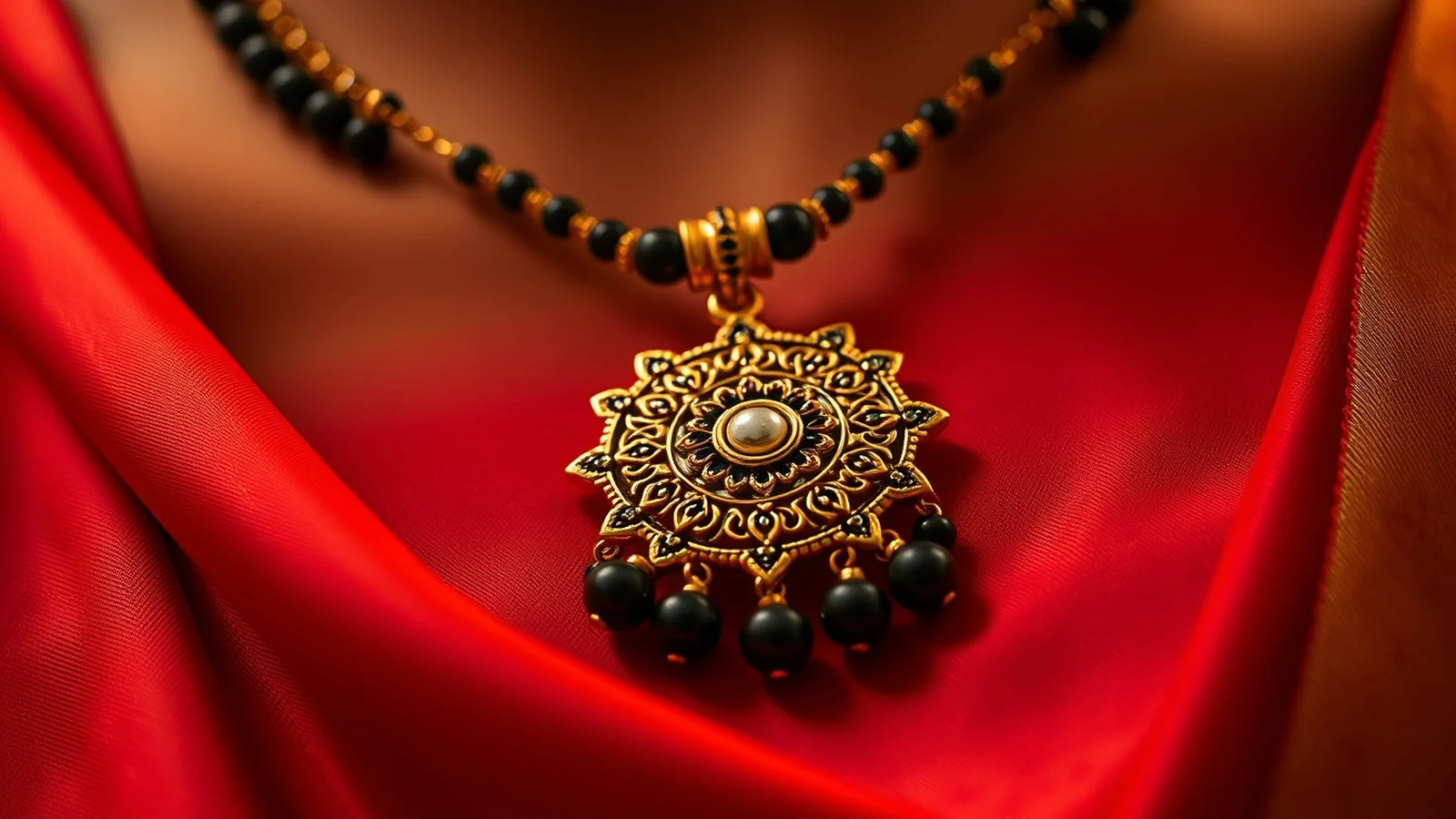
The Mangalsutra is the sacred wedding necklace worn by a married Hindu woman, tied around her neck by the groom during the wedding ceremony. The word literally means “auspicious thread” (Sanskrit: mangala = auspicious, sutra = thread). In most Hindu wedding traditions, the moment the groom ties the mangalsutra is the moment the marriage becomes formally solemnised. The mangalsutra varies significantly across communities, regions, and modern interpretations, but its underlying meaning is the same across all of them.
What the mangalsutra is
The mangalsutra is a necklace worn by a Hindu bride from the wedding ceremony onward, traditionally for the duration of her husband’s life. It carries deep cultural, religious, and personal significance. In a Hindu wedding, the act of the groom tying the mangalsutra around the bride’s neck (called the Mangalsutra Dharanam, the “donning of the auspicious thread”) is one of the central solemnising rites of the marriage.
The specific design of the mangalsutra varies by community. Some are simple: a string of black beads with a small gold pendant. Others are elaborate, with multiple strands, intricate gold work, gemstones, or distinct regional pendants. But across all variations, the mangalsutra carries the same essential meaning: it is the visible, wearable symbol of the wife’s marital status and her connection to her husband.
Regional variants of the mangalsutra
North Indian Mangalsutra (Punjabi, Marwari, Bihari, North Indian Hindu)
The most-photographed form. A gold chain (typically yellow gold, 22-karat) with alternating black beads (called nallapusalu or simply kala motiya). Two gold pendants hang at the centre, often connected. The black beads are believed to ward off the evil eye; the gold represents prosperity and marital wealth. North Indian mangalsutras typically have 2-3 strands, with the strands varying in length so the pendants sit at different levels on the chest.
South Indian Thali / Thirumangalyam
The South Indian equivalent is called the Thali (Tamil), Thirumangalyam (Tamil), Mangalyam (Telugu), or Mangalsutra (Kannada). It is structurally different from the North Indian version: typically a single thick yellow gold pendant on a yellow thread (cotton or silk, sometimes with gold work) rather than a chain of beads. Sub-traditions have distinct pendant designs:
- Tamil Brahmin Iyer: a Thali shaped like the Tirupati Lord (Venkatesvara) emblem
- Tamil Brahmin Iyengar: a Thali with the Sri Vaishnava emblem (Namam and Disk)
- Tamil non-Brahmin (Vellalar, Mudaliar, Chettiar): a distinctive Thali design specific to each community
- Telugu Smartha: a pendant called the Mangalasutram, often with a Lord Vishnu or Shiva emblem
- Kannada Madhva and Smartha: a thick gold pendant, often with both the Tulasi (basil) and Shiva emblems
- Malayali Hindu Nair / Nambudiri: a unique Thali with intricate gold work; the Nair tradition has a distinct shape called Thali
The South Indian Thali is typically worn on a yellow thread for 21 days after the wedding (called the Thali Pari), then transferred to a gold chain.
Maharashtrian Mangalsutra
The Maharashtrian version is distinctive: two gold cups (called vati) connected by black beads (called kalo manyaa). The two vatis represent the bride and groom, and they sit close to the throat (not low on the chest like North Indian variants). The Maharashtrian mangalsutra is often only one strand and is among the most distinctive regional variations.
Bengali tradition (Loha, Pola, Shankha: and the rise of the modern mangalsutra)
Traditional Bengali Hindu marriage does not have a mangalsutra. Instead, the bride wears three other items signalling her married status: the Loha (iron bangle), the Pola (red coral bangle), and the Shankha (white conch shell bangle). These three are the Bengali equivalent of the mangalsutra. In modern urban Bengali weddings, especially in inter-community marriages, brides increasingly wear a North Indian-style mangalsutra in addition to the Loha-Pola-Shankha, but the three bangles remain the traditional marker.
Marwari and Rajasthani variants
The Marwari mangalsutra is a multi-strand version of the North Indian style, often with 5 or 7 strands of black beads and an elaborate central pendant. Rajput and other Rajasthani Hindu communities have distinct pendant designs incorporating royal symbols (peacock, sun, lotus).
Sikh tradition
Sikh weddings do not have a formal mangalsutra rite (the wedding solemnisation happens via the four Laavan around the Guru Granth Sahib, not via the tying of a thread). However, modern Punjabi Sikh brides often wear a mangalsutra-style necklace as a cultural item, particularly in inter-community Sikh-Hindu weddings.
The Mangalsutra Dharanam ritual
In most Hindu weddings the Mangalsutra Dharanam happens after the Saptapadi (the seven steps around the sacred fire) and before the Sindoor Daan (the application of sindoor in the bride’s hair parting). In some South Indian traditions, the Mangalyam Dharanam happens BEFORE the Saptapadi and is considered the actual solemnisation rite.
The ritual sequence:
- The family priest invokes specific mantras (Vedic Sanskrit) blessing the mangalsutra.
- The mangalsutra is touched to the family deity icons in some traditions, or held over the sacred fire briefly.
- The groom holds the mangalsutra in both hands. In South Indian traditions he may pass it through the sacred fire briefly.
- The bride lowers her head. The groom ties the mangalsutra around her neck, typically with three knots in South Indian tradition. The first knot is tied by the groom; the remaining two are often tied by his sister (or another close female family member).
- Conch shells (Shankha) are blown by male family members in many traditions to mark the moment.
- Women in attendance chant the Lalitha Sahasranamam, Aagamarshana Sukta, or other auspicious recitations specific to the family’s lineage.
Modern interpretations of the mangalsutra
Several trends in 2026 mangalsutra practice:
- Minimalist designs. Many modern brides prefer simpler, smaller mangalsutras that can be worn daily. Single-strand mangalsutras with smaller pendants are increasingly common.
- Diamond and contemporary materials. Diamond-set mangalsutras, mangalsutras with semi-precious stones, and even platinum mangalsutras are now mainstream choices, particularly in urban families.
- Wearing flexibility. Traditional rules required wearing the mangalsutra at all times. Modern brides often have a “ceremonial” mangalsutra (worn at weddings, festivals, family functions) and a “daily” version (simpler, more comfortable for work).
- Inter-community mangalsutras. Inter-tradition marriages often see brides wearing two mangalsutras (one from each tradition) or a custom-designed piece blending both.
- Career-driven design. Working professionals increasingly request mangalsutras that fit under formal clothing (collared shirts, business suits) without being visible. Designers respond with short-chain and pendant-only options.
Planning the mangalsutra: what families typically decide
- Heirloom vs new. Many families pass down a mangalsutra from grandmother or mother. Others commission a new piece. Both are valid; the decision is often emotional.
- Design discussion. If commissioning, the design needs to be locked at the 6-month mark. Jewellers like Tanishq, Malabar Gold, and traditional family jewellers (Tribhovandas Bhimji Zaveri in Mumbai, Mehrasons in Delhi) take 6-12 weeks to craft a custom mangalsutra.
- Budget. Mangalsutra budgets in 2026 range from Rs 15,000-50,000 for simple designs to Rs 2-15 lakh for elaborate gold-and-diamond pieces. Heirloom restoration runs Rs 10,000-50,000.
- The wedding day moment. The Mangalsutra Dharanam is photographed extensively. Brief your photographer for close-up shots of the groom’s hands, the knot-tying moment, and the bride’s reaction.
Related South Indian rituals
- mangala snanam, the dawn ritual bath
- the Kashi Yatra ritual
- the jeelakarra bellam ritual
- talambralu, the rice shower
The regional forms in one table
The variants are described individually above. This table sets them side by side, which
is the comparison most readers actually arrive looking for. Pendant designs vary by
sub-community and often by family, so the last column describes the general form rather than
a single correct design.
| Tradition | What it is called | Form | How it is worn |
|---|---|---|---|
| North Indian, Punjabi, Bihari | Mangalsutra | A gold chain with alternating black beads and two central pendants | Long, sitting low on the chest |
| Tamil | Thali or Thirumangalyam | A single thick gold pendant, the design specific to the community | On a yellow thread first, transferred to a gold chain later |
| Telugu | Mangalyam or Mangalasutram | Two gold discs, the pustelu, tied with three knots | On a turmeric-smeared thread |
| Kannada | Mangalsutra | A thick gold pendant, often carrying more than one emblem | On a thread, then a chain |
| Malayali Hindu | Thali | A distinct shape with fine gold work | On a thread or chain by community practice |
| Maharashtrian | Mangalsutra | Two gold cups, the vati, joined by black beads | Short, sitting high near the throat |
| Marwari and Rajasthani | Mangalsutra | Multiple strands of black beads with an elaborate central pendant | Long, and the heaviest of the forms |
| Bengali | No traditional mangalsutra | The Loha, Pola and Shankha bangles carry the same meaning | Worn on the wrists, not the neck |
What actually drives the price
The budget ranges are given above. What families find harder to anticipate is which
choices move the number, because the pendant everyone is discussing is rarely the biggest
variable.
- Gold weight, not gold design. Most of the cost is the metal, and the
metal is priced by weight on the day. A heavier traditional Marwari or South Indian piece
costs more than a lighter but more intricate one, however the discussion in the showroom
goes. - Making charges. These are quoted either as a percentage of the gold
value or as a flat rate per gram, and the two produce very different totals on a heavy
piece. Ask which basis is being used before agreeing a design, not after. - Stones. Diamonds and coloured stones are priced separately from the
gold and are where the range widens most sharply. - Hallmarking. Check the piece carries a valid hallmark for its stated
purity, and keep the invoice. It matters for insurance and for any future exchange.
The timing point is the one most often missed. A custom piece takes weeks at the bench,
and the wedding season is exactly when every jeweller’s workshop is busiest. Lock the design
early, get the delivery date in writing, and if the piece is an heirloom being restored or
reset, allow longer again, because restoration work is unpredictable in a way new
manufacture is not.
Frequently Asked Questions
What does the mangalsutra symbolise?
The mangalsutra symbolises the marital bond between husband and wife, the wife’s status as a married woman, and the auspicious blessing of her marriage. The black beads ward off the evil eye; the gold represents prosperity. In most Hindu traditions, the moment the groom ties the mangalsutra is the moment the marriage is religiously solemnised.
Do South Indian and North Indian mangalsutras differ?
Yes, significantly. The North Indian mangalsutra is a chain of black beads with gold pendants. The South Indian Thali / Thirumangalyam is typically a single thick gold pendant on a yellow thread. Each sub-community within South India has its own pendant design (Iyer, Iyengar, Telugu Smartha, Kannada Madhva, Nair, Nambudiri all differ).
Is the mangalsutra mandatory for a Hindu marriage?
In most Hindu wedding traditions (North Indian, Marwari, Tamil Brahmin, Telugu, Kannada, Maharashtrian), yes. The Mangalsutra Dharanam is considered the solemnisation rite. In some traditions (Bengali, certain Punjabi Sikh) other items (Loha-Pola-Shankha, the four Laavan respectively) serve the same function. Modern inter-faith weddings may or may not include a mangalsutra depending on the family’s tradition.
What does the mangalsutra cost in 2026?
Simple gold-and-bead mangalsutras start at Rs 15,000-30,000. Mid-range gold designs with intricate pendants run Rs 50,000-2 lakh. Diamond-set mangalsutras, multi-strand Marwari designs, and elaborate heirloom-style pieces range from Rs 2-15 lakh. The price depends primarily on gold weight and design complexity.
Can the mangalsutra be worn under work clothes?
Modern designs increasingly accommodate this. Short-chain mangalsutras with a simple pendant fit under collared shirts and business suits. Many brides have a daily-wear minimalist mangalsutra alongside a ceremonial heirloom-style piece for festivals and family functions.
What happens to the mangalsutra after the husband passes away?
Cultural practice varies. In some traditional Hindu communities, the widow removes the mangalsutra as a sign of her changed marital status. In other communities (particularly modern urban families), the mangalsutra is retained as a memory and continues to be worn. The decision is personal and family-specific.
Related rituals on Velvet Knot
The Mangalsutra Dharanam is one rite within a longer wedding sequence. For the full ritual order see our Hindu wedding rituals guide. For the related rites see our Saptapadi guide and the Haldi ceremony guide. For community-specific mangalsutra traditions read our Tamil Brahmin, Telugu, Maharashtrian, and Marwari wedding tradition guides. To plan your wedding with Velvet Knot, request a quote.
Sources and further reading
- Hindu Marriage Act, 1955 (text on India Code): Government of India
- Hindu wedding overview: Encyclopaedia Britannica
- Samskara (Hindu rite of passage): Encyclopaedia Britannica
Begin Your Engagement
Want a real number for your wedding?
Tell us your city, guest count and dates. Team Velvet Knot will come back within 24 hours with an itemised budget.