Sindoor Daan: The Sacred Application of Sindoor in Hindu Weddings
- What Sindoor Daan is
- The Sindoor Daan ritual sequence
- Regional variants of the Sindoor Daan
- The science and symbolism of sindoor
- What sindoor is actually made of
- Modern interpretations of Sindoor Daan
- Planning notes for the Sindoor Daan
- Related post-wedding rituals
- Related wedding rituals
- Frequently Asked Questions
- Related rituals on Velvet Knot
- Sources and further reading
Sindoor Daan (also spelled Sindoor Dana) is the rite in a Hindu wedding where the groom applies vermillion powder (sindoor) along the parting of the bride’s hair. In Bengali, Bihari, and many North Indian Hindu wedding traditions, this is the moment the marriage is formally solemnised: the visible, public sign that the bride is now married. After the Sindoor Daan, the bride is expected to apply sindoor daily for the rest of her married life as a visible marker of her marital status.
What Sindoor Daan is
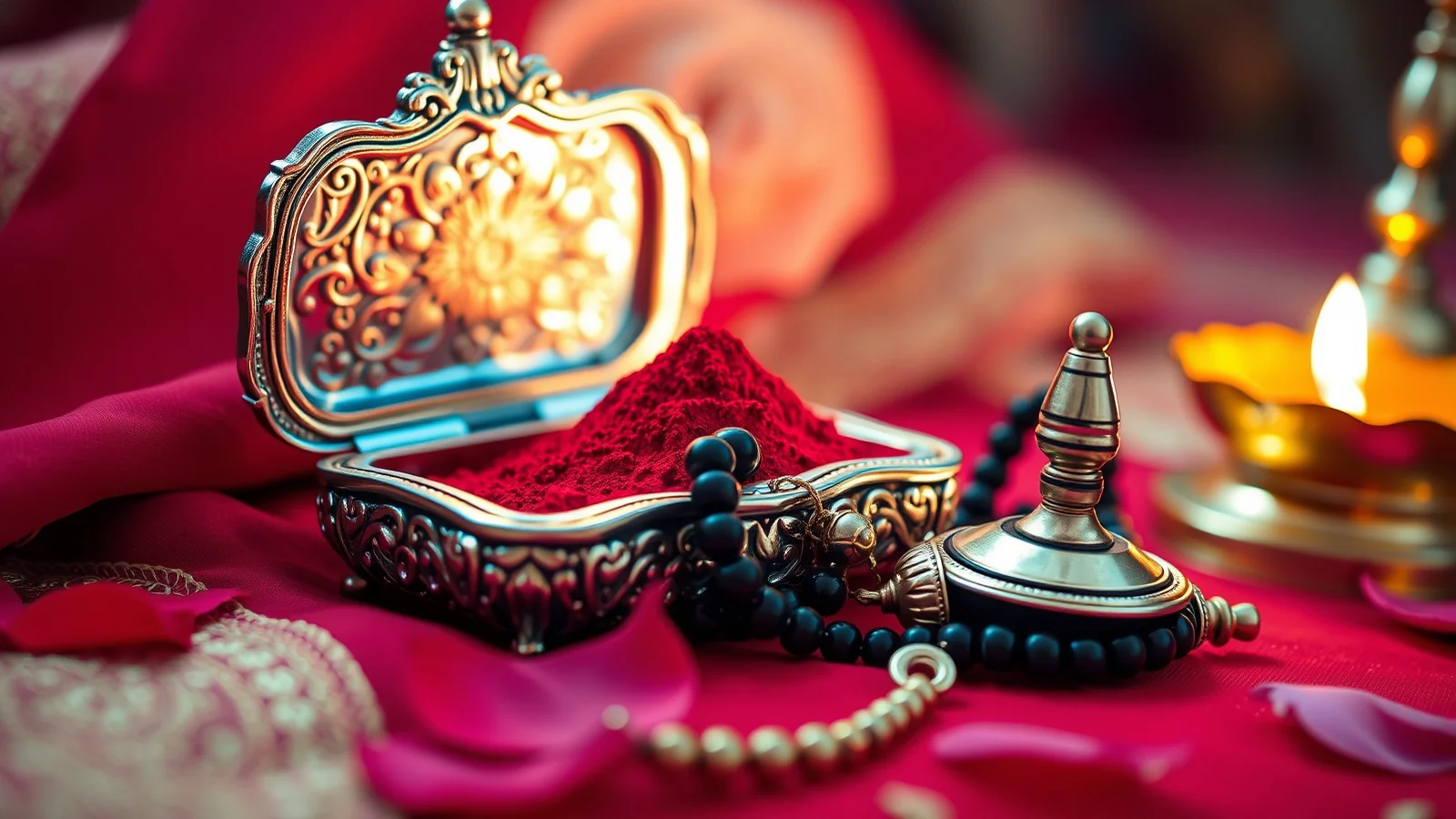
The Hindi word sindoor refers to a deep red or orange-red powder traditionally made from turmeric and lime, sometimes mixed with mercury sulphide (vermillion) for the most vibrant colour. Daan means “gift” or “application”. The Sindoor Daan is the rite in which the groom applies this powder along the parting of the bride’s hair (called the maang in Hindi), marking her transition to a married woman.
The ritual is one of the most photographed moments of a Hindu wedding. The visible mark of red on the bride’s hair parting is the immediate, unambiguous signal to all assembled guests that the marriage is now solemnised. In Bengali Hindu tradition specifically, the Sindoor Daan is considered the actual moment of marriage solemnisation, more so than the Saptapadi or the Kanyadaan.
The Sindoor Daan ritual sequence
- Timing in the wedding. The Sindoor Daan typically happens after the Saptapadi (the seven steps around the sacred fire) and the Mangalsutra Dharanam, near the conclusion of the main wedding ceremony. In Bengali weddings, it follows the Mala Badal (garland exchange) and the Saat Paak (seven circles) as the climactic moment.
- The bride’s preparation. The bride lowers her head and parts her hair to expose the central parting line. In many traditions, she covers her hair with a section of her saree pallu as a sign of modesty just before the rite.
- The groom’s application. The groom takes a small quantity of sindoor (typically loose powder in a small box called a sindoor daani) and, using his fingertip or a small kumkum stick, applies a vertical streak of sindoor along the bride’s hair parting from the forehead backward. The application is brief, typically 5-15 seconds.
- The sealing moment. The bride keeps her head lowered as women in attendance (particularly Sumangali (married women) of the family) bless the moment with ulu dhwani (a high-pitched ululation in Bengali tradition) or the Shankha Dhwani (conch shell blowing). The bride is now formally married.
- Photographic moment. The first close-up of the bride with sindoor applied is the iconic “married bride” photograph that appears in family albums for the next 50 years.
Regional variants of the Sindoor Daan
Bengali tradition (the most ritually elaborate)
The Bengali Sindoor Daan is the climactic moment of the wedding. The bride sits in a specific position, the groom applies sindoor while the priest recites verses from the Veda. The Sindoor Daan is followed immediately by the bride raising her head, looking at the assembled family, and the families exchanging blessings. The Bengali tradition treats the Sindoor Daan as the moment of solemnisation.
North Indian tradition (Punjabi, Marwari, Bihari, Eastern UP)
The Sindoor Daan happens after the Saptapadi and is one of several solemnising rites alongside the Mangalsutra Dharanam. In Punjabi families, it sometimes happens just before the Vidaai (the bride’s departure). The application is briefer and less ritually elaborate than the Bengali version.
Maharashtrian (Kunku application)
Maharashtrian Hindu tradition uses kunku (the Marathi word for vermillion) applied at a specific point during the wedding. The application is performed by the groom and is structurally similar to the Sindoor Daan, though it uses local terminology and slightly different ritual sequencing.
Tamil Brahmin Iyer / Iyengar
Tamil Brahmin weddings traditionally do not perform a formal Sindoor Daan rite in the North Indian style. The bride’s married status is signaled instead through the Mangalsutra Dharanam (tying of the Thali), the application of kumkum on the forehead, and the wearing of the Mangalyam. Sindoor in the hair parting is increasingly worn by Tamil Brahmin brides as a cultural element but is not part of the formal wedding ceremony in most cases.
Telugu and Kannada Hindu
Similar to Tamil Brahmin tradition. Sindoor in the hair parting is not a formal wedding rite but is increasingly worn by Telugu and Kannada brides as a marker of married status.
Sikh tradition
Sikh weddings (Anand Karaj) do not include a Sindoor Daan rite. The Sikh Rehat Maryada does not include sindoor as a wedding ritual. Sikh brides may or may not wear sindoor: this is a personal choice rather than a religious requirement.
The science and symbolism of sindoor
Several layers of meaning are attributed to the sindoor ritual:
- Astrological symbolism. The bright red colour of sindoor is associated with Mangal (Mars) in Hindu astrology. Mangal is the deity of war, marriage, and family. Wearing sindoor is believed to invite Mangal’s blessings on the marriage.
- Anatomical interpretation. Traditional Ayurvedic thought holds that the area at the start of the hair parting (the “Brahma randhra”) is a sensitive nerve point. The application of sindoor at this point is believed to stimulate energy and bring health benefits to the married woman. Modern medical thought does not support these claims, though the cultural belief persists.
- Social signaling. The visible red mark in the hair parting is an unambiguous public marker of marital status. In traditional Indian society, this signal allowed others to identify a married woman without having to ask. The signal remains culturally significant even in modern urban India.
- Religious symbolism. Red is the colour of Shakti (divine feminine energy). The application of sindoor is sometimes interpreted as the activation of Shakti in the bride’s life as a married woman.
What sindoor is actually made of
Traditional sindoor is made from:
- Turmeric and lime: the safe, traditional ingredients. The chemical reaction between turmeric (curcumin) and slaked lime (calcium hydroxide) produces the bright red colour. This is the safest form of sindoor for daily wear.
- Vermillion (mercury sulphide): used in some traditional sindoor for the most vibrant red colour. Mercury-based sindoor is associated with skin allergies and health concerns and is increasingly banned in commercial sindoor production.
- Synthetic dyes: modern commercial sindoor often uses synthetic dyes. Some commercial brands have been found to contain lead, mercury, and other harmful chemicals. Quality matters.
Modern brides increasingly opt for organic or natural-ingredient sindoor (typically turmeric-and-lime based) to avoid the health concerns associated with industrial-grade products.
Modern interpretations of Sindoor Daan
- Smaller, subtler application. Traditional Sindoor Daan applies a generous amount of sindoor along the entire hair parting. Modern brides increasingly request a smaller, more discreet application that fits with daily professional life.
- Wearing flexibility. Traditional rules required daily sindoor application. Many modern brides apply sindoor on ceremonial occasions only (festivals, family functions, traditional gatherings) and skip it on regular workdays.
- Modern Sindoor Daani designs. The small container holding the wedding sindoor (the sindoor daani) has become a designer item. Many brides commission custom-engraved silver or gold daanis as wedding mementos.
- Sindoor in feminist debates. Some modern feminist Hindu thinkers question whether the daily wearing of sindoor (visible from a distance, signaling marital status) is appropriate in a contemporary context. The debate parallels the Kanyadaan debate. The decision sits with each bride.
Planning notes for the Sindoor Daan
- Sindoor sourcing. The wedding sindoor is typically packaged in the Sindoor Daani. Source a quality product (organic or turmeric-and-lime based) from a reputable brand. Avoid cheap commercial sindoor with synthetic dyes: the application stains skin and clothing and may cause allergic reactions.
- Hair styling brief. The bride’s hair should be styled so the central parting is exposed for the Sindoor Daan. Brief the hair stylist 24 hours ahead and confirm the parting placement.
- Photography brief. The Sindoor Daan is the single most-photographed solemnising moment in a Bengali wedding and one of the top three in any North Indian Hindu wedding. Specific shots: the groom’s hand approaching the bride’s parting, the moment of application, the bride raising her head with sindoor visible, the family’s reaction.
- Outfit considerations. Sindoor stains clothing. The bride’s saree pallu and the groom’s shirt should be pre-treated or be of a colour that hides minor stains.
Related post-wedding rituals
Related wedding rituals
Frequently Asked Questions
What does Sindoor Daan mean?
Sindoor Daan literally means “the application of sindoor” in Sanskrit-Hindi. It is the Hindu wedding rite in which the groom applies sindoor (vermillion powder) along the central parting of the bride’s hair, marking her formal transition to a married woman. In Bengali and many North Indian traditions, this is the moment the marriage is religiously solemnised.
Is Sindoor Daan mandatory in a Hindu wedding?
It is mandatory in Bengali, Marwari, Punjabi, Bihari, and most North Indian Hindu wedding traditions. Tamil Brahmin, Telugu, Kannada, and Malayali Hindu traditions historically do not include the Sindoor Daan as a formal rite, though the bride may wear sindoor culturally. Sikh, Buddhist, Jain, and Christian Indian weddings do not include the Sindoor Daan.
What is the difference between sindoor and kumkum?
Sindoor is the red powder applied in the hair parting after marriage. Kumkum is the red powder applied on the forehead (typically by women regardless of marital status). Both are made from similar ingredients (turmeric and lime). Sindoor is specifically a marker of married status; kumkum is a broader Hindu cultural element worn by women at religious occasions, temple visits, and festivals.
Does sindoor have to be applied every day?
Traditional practice required daily application. Modern brides apply sindoor on ceremonial occasions only or skip daily application entirely. The decision is personal and family-dependent. Traditional families may expect daily application; modern urban families typically do not.
Is sindoor safe to wear?
Quality matters. Traditional sindoor made from turmeric and lime is safe. Commercial sindoor with synthetic dyes or mercury sulphide can cause skin allergies, hair damage, and (in extreme cases) heavy metal toxicity. Choose organic or natural-ingredient sindoor from a reputable brand.
Can a widow apply sindoor?
Traditional Hindu practice held that widows do not wear sindoor after their husband’s death. This practice is increasingly questioned in modern Hindu society, with widows in many urban communities choosing to continue wearing sindoor as a personal preference. The decision is highly individual and family-specific.
Related rituals on Velvet Knot
The Sindoor Daan is one rite within a longer Hindu wedding sequence. For the full sequence see our Hindu wedding rituals guide. For related rites read our Saptapadi, Mangalsutra, and Kanyadaan guides. For Bengali-specific Sindoor Daan tradition see our Bengali wedding traditions guide. To plan your wedding with Velvet Knot, request a quote.
Sources and further reading
- Hindu Marriage Act, 1955 (text on India Code): Government of India
- Hindu wedding overview: Encyclopaedia Britannica
- Turmeric (Curcuma longa): Encyclopaedia Britannica
Begin Your Engagement
Want a real number for your wedding?
Tell us your city, guest count and dates. Team Velvet Knot will come back within 24 hours with an itemised budget.