The Oberoi Gurgaon Wedding Cost 2026 (Per Plate + Hall)
- What makes The Oberoi, Gurgaon special
- Ballrooms, lawns and event spaces with capacities
- Detailed cost breakdown, line by line
- Per-event breakdown across a two-day celebration
- Sample budget for a 250-guest, 2-day wedding
- What swings the cost up or down
- Decor themes and vendor coordination
- Guest experience and logistics
- Best season and dates for a Gurgaon wedding
- How to book, lead time and negotiation
- Nearby Delhi-NCR alternatives and final verdict
- Planning a Gurgaon wedding
- Frequently Asked Questions
- Sources and further reading
A 2-day wedding for around 250 guests at The Oberoi, Gurgaon typically runs Rs 1.6 crore to Rs 3.2 crore all-in, covering venue hire, catering, decor and production. Food and beverage plates sit at roughly Rs 4,500 to Rs 8,500 per guest before taxes and add-ons.
What makes The Oberoi, Gurgaon special
The Oberoi, Gurgaon is a contemporary urban resort set on Udyog Vihar, minutes from the Delhi border and Indira Gandhi International Airport. Unlike the palace-heritage properties that dominate luxury Indian weddings, this is a study in restrained, design-forward modern luxury: serene reflection pools, clean architectural lines, floor-to-ceiling glass, and landscaped courtyards that let the setting do the talking.
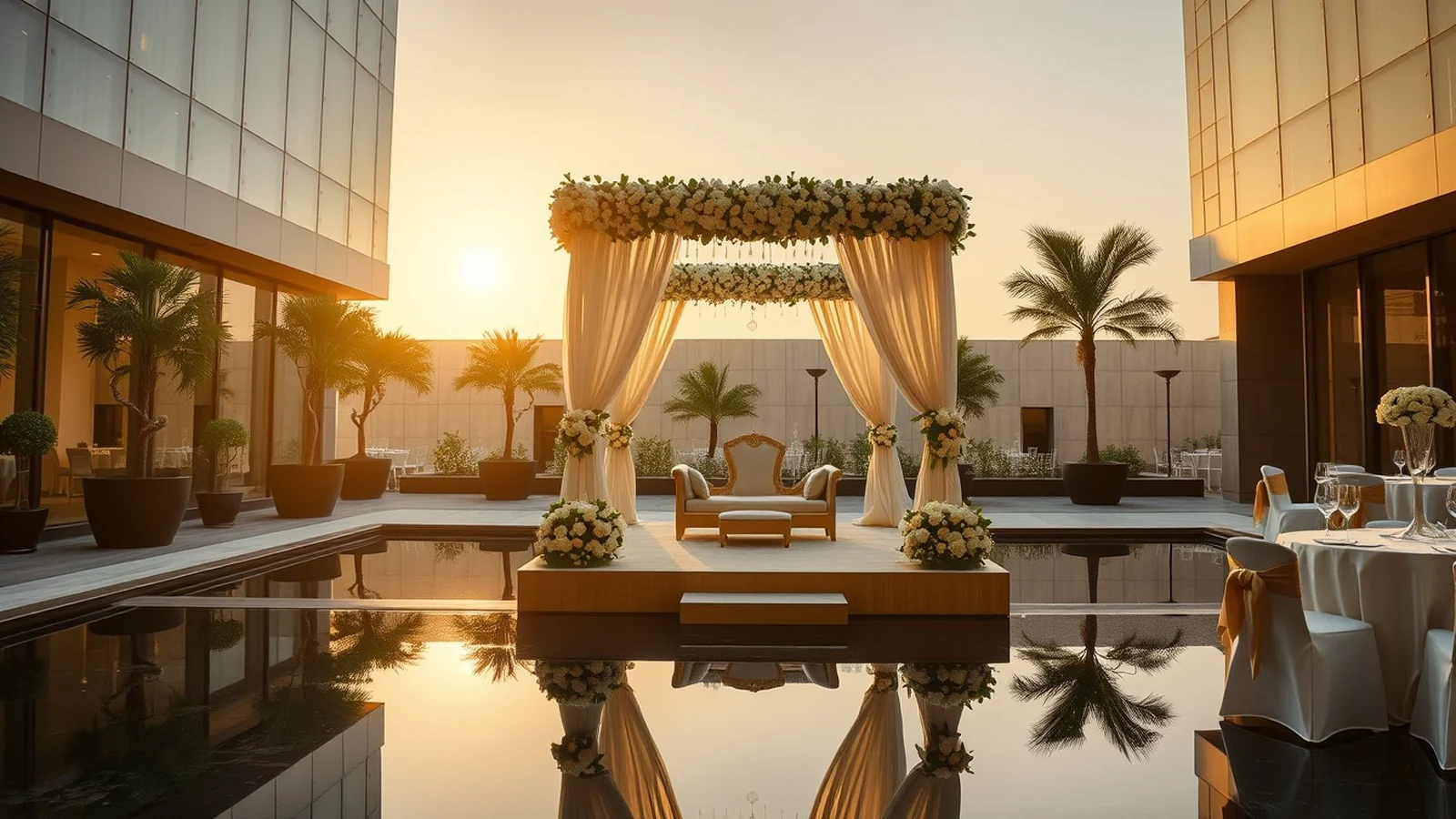
For couples who want sophistication over ornamentation, the appeal is immediate. The hotel is celebrated for its calm sense of arrival, its award-winning service culture, and cuisine that consistently ranks among the finest in the National Capital Region. The signature water-court, with its long central reflection pool flanked by lawns, photographs beautifully at dusk and lends itself to minimalist, high-impact staging rather than heavy traditional mandap builds. The interplay of water, stone, and greenery gives designers a canvas that reads as luxurious with very little added, which is a meaningful advantage when decor is often the largest single line in a wedding budget.
The property suits refined celebrations of roughly 150 to 450 guests. It is a natural fit for design-conscious families, cross-cultural weddings, and couples who prize privacy, seamless logistics, and proximity to the airport for out-of-town and international guests. The staff-to-guest ratio, the quiet efficiency of the banquet team, and the hotel’s reputation for discretion make it a favourite for families who want a polished celebration without the chaos that can come with larger, more sprawling venues. If you are comparing it against nearby heritage-scale options, see our 5-star hotel wedding cost guide for how the modern-luxury tier is priced.
Ballrooms, lawns and event spaces with capacities
The Oberoi, Gurgaon offers a compact but versatile set of indoor and outdoor venues, which is part of why it works so well for a single cohesive celebration rather than a sprawling multi-venue affair. The spaces flow into one another, making it easy to move guests from a poolside cocktail to a banquet dinner without long transfers, and the short internal distances are a genuine comfort for elderly relatives and young children.
| Space | Style | Seated capacity | Reception / float |
|---|---|---|---|
| Grand Ballroom | Pillarless banquet hall | 250 to 350 | 400 to 500 |
| Water-court lawns | Outdoor, reflection pools | 200 to 300 | 350 to 450 |
| Poolside deck | Cocktail / sundowner | 120 to 180 | 200 to 250 |
| Landscaped courtyard | Intimate ceremony | 80 to 150 | 150 to 200 |
| Private dining rooms | Sit-down family functions | 20 to 60 | 60 to 90 |
The pillarless ballroom is the anchor for sangeet or reception nights, offering clean sightlines for stage productions and enough ceiling height for trussing, LED walls, and aerial floral installations. The water-court lawns are the property signature: an open-air setting where the reflection pools mirror lighting and floral installations, ideal for a phera ceremony or an evening cocktail. Poolside and courtyard spaces handle mehendi, haldi, and welcome dinners for smaller groups, and their daytime light is especially flattering for informal, colour-forward functions.
Because capacities are moderate rather than cavernous, families of 500-plus guests should plan careful flow or trim the list, whereas a 200 to 300 guest wedding fits the property perfectly. A practical approach is to pair an indoor and an outdoor space each day so you always have a weather fallback, and to reserve a private dining room for a close-family lunch or a post-wedding brunch. The banquet team will walk you through how each space transitions between functions, including turnaround times for re-setting the ballroom overnight between a sangeet and a reception.
Detailed cost breakdown, line by line
Ultra-luxury weddings in Delhi-NCR are priced as a package built around a food-and-beverage minimum guarantee plus venue rental, then layered with decor, production, and services. Here is what each line typically costs at a property of this calibre in 2026.
- Venue and ballroom hire: Rs 4 lakh to Rs 12 lakh per event space per day, often folded into or waived against the F&B minimum for multi-function bookings.
- Catering, per plate: Rs 4,500 to Rs 8,500 per guest for vegetarian and mixed multi-cuisine menus. Premium live counters, imported ingredients, and elaborate dessert stations push the top end higher.
- Beverage and bar: Rs 1,800 to Rs 4,500 per guest if serving alcohol, subject to permits; mocktail and soft-bar packages cost less.
- Decor and floral: Rs 25 lakh to Rs 90 lakh depending on scale, imported flowers, and custom fabrication across functions.
- Stage, sound, lighting and production: Rs 15 lakh to Rs 50 lakh for professional AV, trussing, LED walls, and technical crews.
- Photography and film: Rs 6 lakh to Rs 25 lakh for a top-tier team covering multiple days, including cinematic film and same-day edits.
- Room block: Rs 18,000 to Rs 40,000 per night per room; a 40 to 60 room block over two nights is common for family and out-of-town guests.
- Entertainment: Rs 5 lakh to Rs 40 lakh for DJs, live bands, celebrity performers, or choreographed acts.
- Planner fee: 10 to 15 percent of total spend for a full-service wedding planner managing design and logistics.
- GST: 18 percent on hotel banqueting and most services, a material line to budget for.
Because the hotel operates on minimum guarantees rather than flat hall rent, your realistic starting point is guest count multiplied by per-plate, plus taxes, before any decor. It is worth asking the banquet team early which items sit inside the hotel package, such as basic staging, dance floor, standard table linen, and house sound, and which are outsourced to specialist vendors. That line between in-house and external spend is where many first-time couples underestimate the final number. For a broader benchmark across venues, our India wedding venue cost guide maps these ranges by property tier.
Per-event breakdown across a two-day celebration
It helps to see how the budget distributes across a typical function sequence rather than as one lump sum. A two-day North Indian wedding here usually splits into four or five events, each with its own tone, catering style, and production needs.
- Mehendi and haldi (day one, daytime): Usually the most relaxed and colourful functions, hosted poolside or in the courtyard. Budget lighter on production, heavier on daytime florals, marigold, and comfortable seating. Catering leans toward chaat counters and regional snacks, often Rs 2,500 to Rs 4,000 per plate.
- Sangeet (day one, evening): The big performance night, best suited to the pillarless ballroom. This is where AV, stage, LED, and choreography spend concentrates. Plated or elaborate buffet dinners run Rs 5,500 to Rs 8,500 per plate, and this event often carries the largest single entertainment line.
- Wedding ceremony (day two, evening): The emotional centrepiece, ideally staged on the water-court lawns with the mandap reflected in the pools. Decor here should be tasteful rather than overwhelming so the setting shows through. Catering is often vegetarian and traditional.
- Reception (day two, late evening): A formal, elegant close, frequently back in the ballroom with a premium bar and a live band or DJ. This is where beverage spend and the finest menu tier land.
Splitting the budget this way makes trade-offs obvious. If you want the sangeet to be a showpiece, you can deliberately keep the mehendi and haldi simple. If the ceremony is your priority, invest in the water-court lighting and hold production budget back on the earlier functions. Planners typically model each event as its own mini-budget, then roll them up, which is far more accurate than a single blended per-plate estimate. Keeping this event-by-event view also makes it easier to see where GST and service charges stack up, because taxes apply on each function’s F&B and hire lines rather than on a single figure.
Sample budget for a 250-guest, 2-day wedding
The table below models a realistic two-day celebration for 250 guests: a sangeet and cocktail on day one, and the wedding ceremony with reception on day two. Figures are indicative 2026 estimates and exclude GST unless noted.
| Line item | Basis | Estimated cost (Rs) |
|---|---|---|
| Catering, 2 days | 250 guests x Rs 6,500 x 2 | 32,50,000 |
| Beverage / bar | 250 guests x Rs 3,000 x 2 | 15,00,000 |
| Venue and space hire | 4 spaces across 2 days | 18,00,000 |
| Decor and floral | All functions | 45,00,000 |
| Production, sound, lighting | Stage and AV | 28,00,000 |
| Photography and film | Full multi-day team | 14,00,000 |
| Room block | 50 rooms x 2 nights x Rs 26,000 | 26,00,000 |
| Entertainment | DJ plus live act | 15,00,000 |
| Planner fee | 12 percent of subtotal | 23,20,000 |
| Subtotal | 2,16,70,000 | |
| GST at 18 percent (applicable lines) | Approx 32,00,000 | |
| All-in total | Approx 2,48,00,000 |
Trim the guest list to 150, choose a single hero function for heavy decor, and hold beverage to a soft bar, and the all-in figure can land near Rs 1.6 crore. Scale to 400 guests with imported florals, a celebrity performer, and a larger room block, and you cross Rs 3.2 crore comfortably. As a second scenario, an intimate 120-guest single-evening wedding, ceremony and reception combined on the water-court lawns, with restrained seasonal decor and a soft bar, can be delivered in the Rs 90 lakh to Rs 1.2 crore band including taxes. That lower-count model is increasingly popular with couples who would rather spend on experience and cuisine than on sheer scale. Treat every figure here as a planning anchor, not a quote: the hotel prices to your final function list, menu tier, and date, so use these numbers to frame conversations, then confirm against a live proposal.
What swings the cost up or down
Two weddings with the same guest count at the same hotel can differ by a crore or more. The biggest levers are within your control at the planning stage.
- Guest count: The single largest driver, because catering, beverage, and room block all scale linearly with heads. Moving from 400 to 250 guests can cut Rs 40 lakh or more.
- Number of functions: A four-function wedding multiplies decor, production, and F&B minimums. Consolidating to two well-produced events saves substantially.
- Decor ambition: Imported flowers, custom fabrication, and multi-designer installations are where budgets balloon. Local seasonal florals with strong lighting design deliver 80 percent of the impact at a fraction of the cost.
- Season and day: Peak winter Saturdays command premium rates; a weekday or shoulder-season date carries more negotiating room.
- Alcohol and permits: A full premium bar with imported labels can add Rs 15 lakh to Rs 30 lakh over a soft-bar approach.
- Entertainment tier: A resident DJ costs a fraction of a headline Bollywood act, which alone can run Rs 20 lakh to Rs 40 lakh.
- Room block size: Larger inventory holds carry cancellation exposure; right-size to confirmed out-of-town guests.
A disciplined couple who prioritises one show-stopping function and keeps the rest elegant but restrained will always get more value than one who spreads the budget thinly across every event. It also pays to negotiate the package as a whole rather than line by line: hotels are more flexible on space hire and room rates when the total F&B commitment is strong, so bundling functions gives you leverage you lose if you book piecemeal.
Decor themes and vendor coordination
The Oberoi’s architecture rewards a specific decor philosophy: work with the space, not against it. Heavy, maximalist mandap builds that suit a palace lawn can look cluttered here, whereas clean lines, monochrome or tonal palettes, and considered lighting look extraordinary. Popular directions that photograph well on this property include modern minimalist white-and-green with abundant candlelight, soft pastel florals mirrored in the reflection pools, and contemporary metallic accents against the hotel’s stone and glass.
Because the hotel typically works with an approved or preferred list of decor, production, and catering-augmentation vendors, it is worth confirming early whether you must select from that panel or can bring an external designer, and whether an outside-vendor fee applies. Using preferred vendors has real advantages: they know the load-in points, the power availability, the setup and dismantling windows, and the hotel’s rules on open flame, rigging, and noise cut-off times. An external designer you love can still work, but budget extra coordination time and confirm access logistics in writing.
Vendor coordination is where a full-service planner earns their fee. On a two-day wedding you may be running catering, decor, lighting, sound, photography, entertainment, makeup, and transport teams simultaneously, each with its own timeline and access needs. A single point of coordination prevents the classic problems: a decor team that overruns into guest arrival, an AV crew that clashes with the ceremony sound, or a floral install that blocks a service corridor. Insist on a detailed production schedule shared with the hotel banquet manager at least a week out, and a walkthrough the day before to lock stage positions, guest flow, and contingency plans.
Guest experience and logistics
One of the property’s quiet strengths is how easy it makes the guest experience, and that is worth designing around deliberately. The short transfer from Indira Gandhi International Airport, often 20 to 30 minutes depending on traffic, means international and out-of-station guests arrive relaxed rather than road-weary, which sets the tone for the whole celebration. Build a warm welcome around that arrival: a greeter, a cool towel and welcome drink, and a printed itinerary in the room.
Because the venue is compact, guests are never far from their room, the functions, or the restrooms, which matters enormously for elderly relatives and families with young children. Plan a clear signage and hospitality-desk setup so guests always know where the next function is and when. For a room block of 40 to 60 rooms, assign a hospitality team to manage check-ins, luggage, and special requests so the couple’s family is not fielding logistics on the wedding morning.
Transport is the other logistics piece to get right. If a portion of guests stay off-site at nearby hotels, arrange scheduled shuttles rather than leaving people to find their own way, and share a WhatsApp broadcast with timings. Valet and parking flow at peak arrival, dietary tagging for guests with restrictions, and a discreet medical and first-aid point are the small details that separate a smooth luxury wedding from a stressful one. A planner who has worked this property before will have these runbooks ready. You can find teams that know the venue through our Gurgaon wedding planner directory.
Best season and dates for a Gurgaon wedding
The National Capital Region has a clear wedding calendar shaped by weather and the Hindu muhurat season. October through March is prime: cool, dry evenings that make outdoor water-court and poolside functions genuinely pleasant. December and January deliver the most atmospheric golden-hour light but can turn cold at night, so heaters and covered options matter.
Peak demand and peak pricing cluster around the November to February muhurat dates and long weekends. If your priority is value and availability, look at late September, early October, or February to March shoulder windows, and favour a Thursday or Friday over a Saturday. Monsoon months from July to September are the least popular for outdoor use but can unlock genuinely soft rates for indoor ballroom celebrations, and the greenery around the property is at its most lush in that season.
There are finer date nuances worth knowing. Auspicious muhurat clusters concentrate demand into a handful of dates each season, so if your family is tied to a specific muhurat you should book much earlier and expect premium pricing. Air quality is a real consideration in NCR from late October into November, when it can affect outdoor comfort; couples sensitive to this often favour December to February or the spring window. Avoid clashing with major festival weekends and long public holidays if you want easier vendor availability and better room rates. Because the property is compact and popular, prime winter Saturdays are often booked 10 to 14 months ahead. Flexibility on date is one of the most effective ways to improve both your rate and your choice of spaces.
How to book, lead time and negotiation
Securing a date at The Oberoi, Gurgaon follows a predictable path. Start by contacting the hotel’s banquet and events team directly, or engage a full-service planner who can approach the property on your behalf and negotiate the package holistically.
- Enquiry and site visit: Share your dates, guest count, and function list. Walk the water-court, ballroom, and poolside to confirm flow and capacity fit.
- Proposal: The hotel returns a package built on a food-and-beverage minimum guarantee, space hire, and room-block terms.
- Negotiation: Multi-function bookings, larger room blocks, and off-peak dates create leverage. Clarify what is waived against the F&B minimum.
- Booking: A signed agreement and advance deposit, typically 25 to 40 percent, holds the date. Read cancellation and postponement clauses carefully.
- Final headcount: Guaranteed numbers are usually locked 72 hours out, and you pay on the guarantee or actuals, whichever is higher.
On negotiation, the strongest levers are your total F&B commitment, room-block size, and date flexibility. Ask specifically about complimentary rooms for the couple and immediate family, upgrade allocations, a bridal suite, extended checkout on the departure day, and whether menu tastings are included. Push to have space-hire charges credited against the F&B minimum on multi-function bookings. Get every inclusion in writing, from cake and standard decor to house sound and dance floor, so there are no surprises on the final invoice.
For prime winter Saturdays, begin 12 to 15 months ahead. Shoulder-season and weekday dates can sometimes be secured in 5 to 8 months. A local planner shortens the whole process and often has standing relationships that unlock better terms; see our Gurgaon wedding planner directory or the Delhi planner listings to find a team that knows this property.
Nearby Delhi-NCR alternatives and final verdict
If The Oberoi, Gurgaon is booked on your date, or you want to compare aesthetics and scale, the region offers several strong alternatives across different styles.
- ITC Grand Bharat, Gurgaon: A palatial golf resort on the Aravalli fringe, far grander in scale and heritage styling, suited to very large celebrations of 500-plus guests.
- The Leela Ambience, Gurugram: A large convention-scale hotel with expansive ballrooms, ideal for high-headcount receptions with strong city access.
- JW Marriott Mussoorie: A hill-station destination option for couples wanting mountain views and a getaway feel rather than a city resort.
The Oberoi’s distinct advantage over these is its restrained, design-led intimacy and its unmatched proximity to the airport. Where ITC Grand Bharat sells scale and heritage grandeur, The Oberoi sells calm, contemporary sophistication. Match the venue to your guest count and the mood you want: a compact, elegant celebration reads far better here than a sprawling one that strains capacity.
Choose The Oberoi, Gurgaon if you want a modern-luxury celebration defined by restraint, service, and cuisine rather than palace theatrics. Budget honestly: a genuinely luxurious two-day wedding here starts around Rs 1.6 crore for a tightly curated 150-guest celebration and rises past Rs 3 crore for a 400-guest event with imported decor and headline entertainment. The value is real, but it comes from an all-in food, service, and setting proposition, not from cut-rate hall hire. Compare it against the broader tier in our 5-star wedding cost guide, then request a bespoke quote through our get a quote page to match your exact guest count and function list.
Planning a luxury venue wedding?
Speak to our team for a tailored shortlist and cost plan.
Planning a Gurgaon wedding
Frequently Asked Questions
What does a wedding at The Oberoi, Gurgaon cost in 2026?
A realistic two-day wedding for around 250 guests lands between Rs 1.6 crore and Rs 3.2 crore all-in, covering venue hire, catering, decor, production, and services. A tightly curated 150-guest celebration can start near Rs 1.6 crore, while a 400-guest event with imported decor crosses Rs 3.2 crore.
What is the per-plate cost at The Oberoi, Gurgaon?
Catering typically runs Rs 4,500 to Rs 8,500 per guest for vegetarian and mixed multi-cuisine menus before taxes. Premium live counters, imported ingredients, and elaborate dessert stations push toward the top of that range. Beverage and bar service, where permitted, adds roughly Rs 1,800 to Rs 4,500 per guest.
How many guests can the venue accommodate?
The property suits weddings of roughly 150 to 450 guests. The pillarless Grand Ballroom seats 250 to 350, and the signature water-court lawns handle 200 to 300 seated or up to 450 for a floating reception. It is at its best for celebrations of 200 to 300 guests.
How far ahead should I book?
For prime winter Saturdays between November and February, begin 12 to 15 months in advance, as the property is compact and in high demand. Shoulder-season and weekday dates can sometimes be secured 5 to 8 months out. A signed agreement plus a 25 to 40 percent deposit holds the date.
What is the best season for a wedding here?
October through March is ideal, with cool, dry evenings that make the outdoor water-court and poolside functions pleasant. December and January give the most atmospheric light but need heaters at night. For better rates and availability, consider shoulder windows in late September, early October, or February to March.
How does it compare with ITC Grand Bharat, Gurgaon?
ITC Grand Bharat is a palatial golf resort built for very large, heritage-styled weddings of 500-plus guests. The Oberoi, Gurgaon offers the opposite: restrained, contemporary luxury with an intimate scale and unmatched airport proximity. Choose The Oberoi for design-forward elegance and ITC Grand Bharat for grandeur and scale.
Sources and further reading
- The Oberoi, Gurgaon: official hotel site
- Haryana Tourism: official state tourism board
- Incredible India: Ministry of Tourism
- 5-star hotel wedding cost in India. Velvet Knot guide
More metro venues: Leela Ambience Gurugram wedding cost.
Begin Your Engagement
Want a real number for your wedding?
Tell us your city, guest count and dates. Team Velvet Knot will come back within 24 hours with an itemised budget.