5-Star Hotel Wedding Cost in India 2026 (By Chain + City)
- Why couples choose a 5-star hotel as the wedding venue
- 5-star hotel wedding cost by chain (2026)
- 5-star hotel wedding cost by city (2026)
- Sample budget: 400-guest 5-star hotel wedding in Hyderabad (2026)
- What’s NOT in most hotel wedding quotes (the gotchas)
- More five-star venue guides
- Related cost guides
- How hotel wedding pricing is actually constructed
- The room block: attrition, release dates and the biggest hidden cost lever
- Banquet capacity maths: why stated capacity is not seated capacity
- In-house versus outside vendors, decor restrictions and entry charges
- Taxes, service charges and how the headline number becomes the final invoice
- What is genuinely negotiable at a five star, and what never is
- Weekday versus weekend, season, and how far ahead to book
- City business hotel versus resort property: two different cost structures
- Multi-function weddings: how three days across several spaces changes the quote
- When a five star is the wrong choice, honestly
- Frequently Asked Questions
- Sources and further reading
A 5-star hotel wedding in India in 2026 typically costs Rs 40 lakh to Rs 3 crore for 250-600 guests across 2-3 days. The appeal is turnkey: in-house catering, decor partners, banquet teams, and on-site guest rooms in one contract. Per-plate runs Rs 3,500-8,500, ballroom hire Rs 4-25 lakh per evening, and room blocks for out-station guests are negotiated into the package. Mumbai and Delhi sit at the top of the price range; Hyderabad, Bangalore, and Chennai mid-range.
Why couples choose a 5-star hotel as the wedding venue
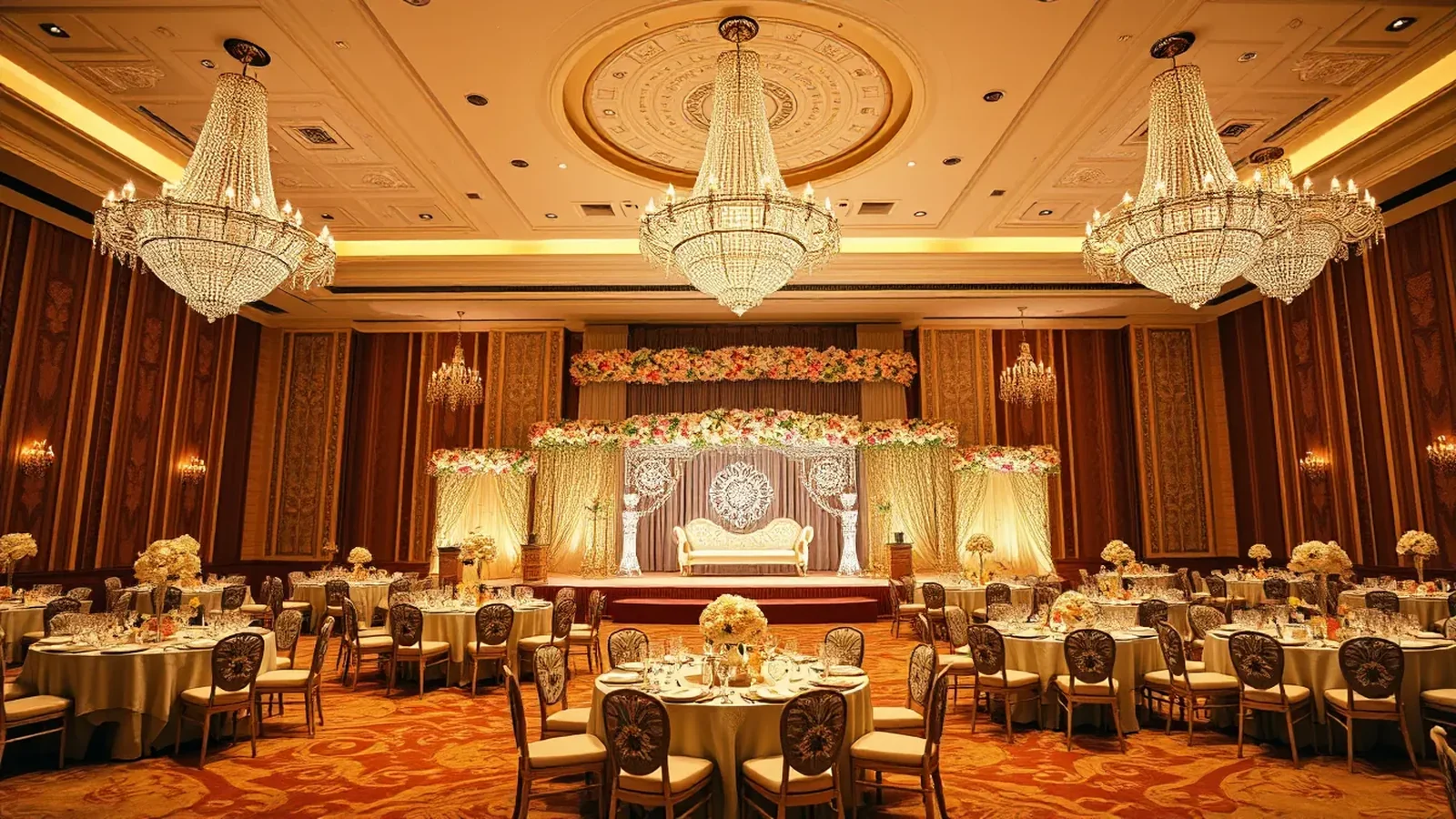
A 5-star hotel is the turnkey choice: one property handles the ceremony, reception, catering, decor coordination, and out-station guest accommodation. For families who want service certainty and on-site rooms for travelling guests (without managing 15 separate vendors) the hotel model is the lowest-stress path. The trade-off versus a farmhouse is less creative control (in-house catering is usually mandatory) and capacity caps set by ballroom size. Before you take any hotel’s quoted capacity at face value, read our study of 323 event spaces at 42 Indian venues: the advertised figure is a median 1.5 times what the room actually seats for dinner.
5-star hotel wedding cost by chain (2026)
Taj (IHCL)
Taj city hotels and palaces. Ballroom hire Rs 5-25 lakh, per-plate Rs 4,500-8,500. Strong heritage-luxury positioning.
ITC Hotels
ITC Maratha, ITC Kohenur, ITC Grand Chola, ITC Maurya. Ballroom hire Rs 5-20 lakh, per-plate Rs 4,000-8,000. Known for catering depth.
Oberoi
Premium positioning, smaller wedding inventory. Per-plate Rs 5,000-9,000.
Marriott, Hyatt, Leela, Taj Vivanta
Broad mid-luxury banquet supply across all metros. Ballroom hire Rs 4-15 lakh, per-plate Rs 3,500-7,000.
5-star hotel wedding cost by city (2026)
- Mumbai: Highest in India. Ballroom hire Rs 8-25 lakh, per-plate Rs 5,000-8,500. Mumbai planner.
- Delhi NCR: Ballroom Rs 6-20 lakh, per-plate Rs 4,500-8,000. Delhi planner.
- Hyderabad: ITC Kohenur, Park Hyatt, Taj Krishna. Ballroom Rs 4-12 lakh, per-plate Rs 3,800-7,000. Hyderabad planner.
- Bangalore, Chennai, Pune: Ballroom Rs 4-15 lakh, per-plate Rs 3,500-7,000.
Sample budget: 400-guest 5-star hotel wedding in Hyderabad (2026)
| Line item | Range |
|---|---|
| Ballroom + venue hire (3 events) | Rs 12-25 lakh |
| Catering (Rs 5,500 per plate, 3 events) | Rs 60-80 lakh |
| Room block (out-station guests, 2 nights) | Rs 15-40 lakh |
| Decor + production | Rs 25-60 lakh |
| Photography + film + entertainment | Rs 20-45 lakh |
| Bar, planner, service charge + GST | Rs 35-75 lakh |
| Total | Rs 1.7-3.2 crore |
What’s NOT in most hotel wedding quotes (the gotchas)
- Service charge + 18% GST stack: adds 24-28% to catering and venue
- Mandatory in-house catering: most 5-stars don’t allow outside caterers
- Decor restrictions: some hotels mandate their decor partner or charge royalty on outside decorators
- Minimum guarantee: a minimum spend or guest count below which you still pay the minimum
- Overstay and extra-hour charges
More five-star venue guides
- Le Meridien Jaipur wedding cost
- Renaissance Mumbai Powai wedding cost
- Andaz Delhi Aerocity wedding cost
- Sheraton Grand Bengaluru Whitefield wedding cost
Related cost guides
- wedding cake cost in India
- wedding cost per plate
- wedding cost by guest count
- a Rs 1 crore wedding budget
How hotel wedding pricing is actually constructed
A five star does not sell you a venue. It sells you a minimum. Almost every branded hotel in India prices a wedding as a bundle of three commitments that sit on top of each other: a food and beverage minimum, a room-night commitment, and a venue rental that is often waived or discounted once the first two are large enough. Families read the per-plate number, assume that is the deal, and then discover that the contract obliges them to spend a floor amount whether or not their guests eat it.
The food and beverage minimum is the anchor. A hotel will quote, for example, a minimum guarantee of 350 covers at a stated per-plate rate for a given banquet hall, and you pay for 350 covers even if 290 people walk in. That minimum is set by the hall, the day, and the season, not by your guest list. Understanding it is the single most useful thing you can learn before your first site visit, and it explains why per-plate costs in hotels behave so differently from standalone caterers.
The room-night commitment then layers on. Hotels make more margin on rooms than on banqueting, so a wedding that blocks 60 rooms for three nights unlocks concessions a wedding that blocks 12 rooms will never see. As a planner estimate, a 400-guest hotel wedding in a metro typically lands between Rs 55 lakh and Rs 1.4 crore all-in once rooms, food, decor and production are combined, and the spread inside that range is driven far more by contract structure than by menu choices. If you are still setting a top-line figure, work through how to plan a wedding budget in India before you take a single quote.
The room block: attrition, release dates and the biggest hidden cost lever
The room block is where hotel weddings quietly gain or lose Rs 10 lakh. When you sign, you commit to a number of rooms across specific nights. In return you get a wedding rate, usually below the public rate, plus concessions such as complimentary suites, late checkout, or a percentage of rooms on a courtesy basis. The trap is the attrition clause: if you fill fewer rooms than committed, you pay a percentage of the shortfall anyway, commonly in the region of 80 to 90 percent of the unsold room revenue.
Indian family guest lists are famously fluid, and that is exactly the behaviour attrition punishes. A common failure looks like this: a family blocks 80 rooms for three nights on the assumption that out-of-town relatives will stay the full duration, but half of them arrive on the morning of the main function and leave that night. The hotel is owed for two thirds of the block. Nothing was wasted at the buffet, yet the invoice grew.
Three defences work. First, negotiate a stepped block that ramps up on the peak night rather than a flat block across all nights. Second, ask for a release date, typically 30 to 45 days out, at which unclaimed rooms return to the hotel without penalty. Third, push for a reasonable attrition allowance, often 10 to 20 percent, written into the contract rather than promised verbally. If you are comparing this against non-hotel formats, a farmhouse wedding carries no room risk at all, but it also gives you no accommodation solution.
Banquet capacity maths: why stated capacity is not seated capacity
Hotel capacity sheets are marketing documents. A ballroom listed at 800 pax is quoting a theatre-style or standing-reception number. Once you seat guests at round tables of ten with service aisles, that same room realistically holds 400 to 450. Then subtract for the stage, and a wedding stage with a mandap or a couple’s seating set is rarely under 400 to 600 square feet including steps and backdrop depth.
Work it as a subtraction, not a multiplication. Take the pillarless carpet area. Allow roughly 18 to 22 square feet per seated guest with round tables. Deduct the stage footprint, the dance floor if you want one, and the buffet or live-counter run, which in an Indian wedding easily eats 200 to 400 square feet along one wall plus queueing space in front of it. What is left is your real capacity. A ballroom of 8,000 square feet often ends up comfortably hosting 350 seated with a stage and buffet, not the 800 on the brochure.
This matters financially because hotels will happily sell you a hall that technically fits your numbers and then charge you a foyer or pre-function area rental when the room proves too tight for cocktails and registration. Walk every hall with your planner and a tape measure, and ask to see a floor plan with a wedding layout already drawn, not an empty CAD outline. Guest count drives almost everything else, which is why the cost by guest count view is the sanest place to start scoping.
In-house versus outside vendors, decor restrictions and entry charges
Every five star has a vendor policy, and it is a revenue line, not a formality. Food and beverage is almost always exclusively in-house. Alcohol is in-house or corkage-charged. Decor, lighting, sound, photography and mehendi artists are usually open, but the hotel will levy an outside-vendor entry charge, a royalty, or an equipment-entry fee. As a planner estimate this commonly runs from a token amount to two or three percent of the vendor’s own contract value, and at some properties it is a flat lakh-scale fee for the decor partner alone.
Then come the physical restrictions, which quietly reshape your design. Most hotels prohibit nails, screws or adhesive on walls and ceilings. Rigging points are limited and metered. Naked flame is restricted, so the havan or agni ritual needs written clearance and often a fire marshal on site. Ceiling drapes may need fire-retardant certification. Load-in windows are short, sometimes only from midnight to 6 am, and overtime labour on the hotel side is billed to you.
Ask for the vendor policy in writing before you sign, not after. The specific questions that matter: is there an approved-vendor list and is it mandatory, what is the entry fee formula, what are the load-in and strike hours, and who pays for damage assessed after strike. Heritage and palace properties are stricter still, which is one of several reasons palace wedding costs behave differently from ballroom weddings.
Taxes, service charges and how the headline number becomes the final invoice
The per-plate number you are quoted is almost never the number you pay. Banqueting and hotel accommodation attract GST, and the applicable rate on rooms varies by the declared tariff bracket while banqueting and outdoor catering are taxed at their own rate. Many hotels also add a service charge before tax is applied, so the tax is calculated on the grossed-up figure. Between service charge and GST, a Rs 3,500 per plate quotation can settle nearer Rs 4,300 to Rs 4,500 per plate on the final bill.
Beyond that, watch the recurring add-ons that appear on almost every hotel wedding invoice: bartender and service-staff charges beyond the included ratio, generator or power backup for external production loads, valet and parking beyond an allotted count, extra-hour venue charges when the sangeet overruns, plated-service supplements over buffet, and cake or dessert-station cutting fees.
The one instruction that saves the most money is procedural. Ask for a pro-forma invoice on the full assumed scope, taxes included, before you pay the booking advance. If the hotel will only give you a per-plate rate card, you do not yet have a quote. Cross-check the total against a realistic Indian wedding cost breakdown so you can see what proportion of your budget the venue is absorbing.
What is genuinely negotiable at a five star, and what never is
Rates move less than concessions do. A branded hotel guards its published per-plate rate because discounting it sets a precedent across the sales team. What it will move on is value: complimentary suites for the couple and parents, upgraded room categories, a waived hall rental on secondary functions, a free mehendi or haldi space, welcome amenities, airport transfers, a complimentary anniversary night stay, later checkout, and extended venue hours without overtime billing. In practice, well-run negotiation on a Rs 70 lakh hotel wedding extracts Rs 5 lakh to Rs 9 lakh of value without the per-plate rate changing at all.
What never moves: taxes, in-house food and beverage exclusivity, fire and safety rules, and the alcohol policy where state excise licensing governs it. Statutory items are not a negotiating posture, they are law, and a salesperson who agrees to bend them is telling you something worrying about the property.
Timing decides your leverage. The strongest negotiating position is a weekday date in a soft month, booked either very early when the calendar is empty or inside 60 days when the hotel is filling a hole. The weakest is a Saturday inside peak season with 90 days to go, when the hotel already has three competing enquiries. If you are engaging professional help, understand what a wedding planner costs against the concessions a planner routinely recovers, because on hotel contracts the fee often pays for itself.
Weekday versus weekend, season, and how far ahead to book
Indian hotel banqueting runs on the muhurat calendar, not the western wedding season. Peak clusters fall in November and December, then again around late January to early March, with a secondary run in April and May in some regions. On an auspicious Saturday inside those clusters, hotels apply premium minimums, refuse rental waivers, and quote per-plate rates that can sit 20 to 35 percent above the same hall on a Tuesday in July.
Moving to a weekday inside peak season typically recovers 10 to 20 percent as a planner estimate. Moving out of peak season entirely, into the monsoon months or the deep summer, can recover 25 to 40 percent and unlocks concessions that simply do not exist in November. Families who cannot move the date can still move the timing: a lunch function is materially cheaper than a dinner function at the same property because bar consumption collapses.
On lead time, 9 to 14 months is the sensible booking window for a peak-season metro ballroom. Marquee properties in Mumbai and Delhi release their peak dates earlier than that and can be gone 18 months out. Under 90 days you are shopping distress inventory, which is genuinely cheaper but leaves you no ability to choose the hall.
City business hotel versus resort property: two different cost structures
A city hotel sells you a ballroom. A resort sells you the property. That distinction changes almost every line of the quote. A city business hotel prices banquet space by the hall, runs multiple events simultaneously, and expects most of your guests to sleep at home or in nearby hotels. Room commitments are modest, room-night rates are moderate, and your logistics costs are low because everyone is already in the city.
A resort prices around exclusivity or near-exclusivity. Buyouts, or partial buyouts of a room category, are common and they front-load the cost enormously. But the resort absorbs functions a city hotel would bill separately: a lawn haldi, a poolside sangeet, a beachfront or terrace mandap, and breakfast for a captive guest list. Per-guest it can be higher, but the decor bill often falls because the setting does work that fabric would otherwise have to do.
The deciding variable is what share of your guests travel. If more than half are flying in, a resort usually wins on total cost and on guest experience. If most guests are local, a resort buyout means you are paying for rooms nobody sleeps in. Compare the formats against destination wedding venues and, for cooler-weather properties, hill station venues, where transport and altitude logistics add their own line items.
Multi-function weddings: how three days across several spaces changes the quote
Most families do not book one event, they book five. A typical hotel wedding uses a lawn or poolside for haldi, a smaller hall for mehendi, the ballroom for sangeet, an outdoor or pre-function space for the baraat and mandap, and the ballroom again for reception. Each of those spaces carries its own minimum guarantee or rental, and the hotel prices them as separate events even though they run consecutively.
This is where consolidated negotiation pays. Booking all functions with one property gives you a single large food and beverage commitment, which is the number the hotel actually cares about, and that is the leverage you use to get secondary spaces at waived or nominal rental. Booking function by function, or splitting across two hotels, destroys that leverage and usually costs more in total.
Two operational costs are consistently underestimated. The first is turnaround: converting a ballroom from sangeet to reception overnight means a second full decor build, a second labour crew, and often overtime charges from the hotel. Ask whether a same-day flip is even permitted before you plan two functions in one hall. The second is meal creep, because a three-day wedding also needs breakfasts, hi-teas and late-night snacks for resident guests, and those add covers nobody counted. Weddings structured this way commonly settle in the range covered by our Rs 1 crore wedding budget guide rather than the ballroom-only estimates families begin with.
When a five star is the wrong choice, honestly
There are budgets and there are weddings where a hotel is simply the wrong instrument. The clearest case is a small guest list with a large appetite for design. At 120 guests, a hotel minimum guarantee forces you to pay for 250 or 300 covers to access a decent hall, so you fund empty chairs. That same money spent on a boutique property, a heritage haveli or a well-built farmhouse buys a far more distinctive event.
The second case is a family that wants a specific community caterer. Hotel food and beverage exclusivity is close to absolute, and while some properties will bring in a specialist chef under their own kitchen supervision at a premium, most will not let your family’s Marwari halwai or a particular biryani kitchen operate on site. If the food is the point of the wedding, the hotel model works against you.
The third case is a very large guest list on a controlled budget. Above roughly 800 guests, hotel economics stop being competitive against convention centres, banquet complexes and open grounds, and few city hotels can seat that number in one room anyway. Families working within a Rs 50 lakh wedding budget at high headcounts almost always get better value outside the branded-hotel format, while a Rs 25 lakh budget at a five star realistically caps the guest list near 150. Choose the hotel when you are buying service standards, guest accommodation and reliability. Choose something else when you are buying atmosphere, food or scale.
Planning at Rs 5 crore and above? Velvet Knot takes on four weddings a year through By Invitation, where one senior team is given to a single family for the year.
Costed breakdowns for individual properties:
- Conrad Pune wedding cost
- Hyatt Regency Ahmedabad wedding cost
- Hyatt Regency Chandigarh wedding cost
- ITC Narmada Ahmedabad wedding cost
- JW Marriott Chandigarh wedding cost
- JW Marriott Kolkata wedding cost
- JW Marriott Pune wedding cost
- Ritz Carlton Pune wedding cost
- Taj Coromandel Chennai wedding cost
- Taj Madikeri Coorg wedding cost
- The Park Hyderabad wedding cost
- Westin Pushkar wedding cost
Newly costed venues: Noor Mahal Karnal wedding cost, The Tivoli Chattarpur wedding cost.
Frequently Asked Questions
How much does a 5-star hotel wedding cost in India?
For 250-600 guests across 2-3 days in 2026, Rs 40 lakh to Rs 3 crore all-in. Per-plate is Rs 3,500-8,500 and ballroom hire Rs 4-25 lakh per evening depending on city and chain.
Which is better for a wedding: a hotel or a farmhouse?
A hotel is turnkey with on-site guest rooms but caps capacity and usually mandates in-house catering. A farmhouse handles larger guest counts with full creative control but needs you to bring everything. Hotels suit 250-600 guests; farmhouses suit 500-1,500.
Do 5-star hotels allow outside caterers?
Most don’t, in-house catering is typically mandatory, which is a key difference from farmhouse and some palace venues.
Are room blocks included in a hotel wedding package?
Not automatically. Room blocks for out-station guests are negotiated separately, though bundling them with the wedding package usually unlocks better rates.
Sources and further reading
- ITC Hotels: weddings
- Indian Hotels Company (Taj Group)
- Velvet Knot: Wedding venue cost guide
- Velvet Knot: Wedding reception cost guide
Still deciding? Read our palace vs hotel wedding comparison.
More Hyderabad venues: Trident Hyderabad wedding cost, Westin Hyderabad wedding cost, Sheraton Hyderabad wedding cost.
More venue cost guides: Taj Mahal Lucknow wedding cost, Lebua Lucknow wedding cost.
More venue cost guides: ITC Grand Chola Chennai wedding cost, ITC Maurya New Delhi wedding cost.
More venue cost guides: The St. Regis Mumbai wedding cost, The Ritz-Carlton Bengaluru wedding cost.
Begin Your Engagement
Want a real number for your wedding?
Tell us your city, guest count and dates. Team Velvet Knot will come back within 24 hours with an itemised budget.