Mumbai Luxury Wedding Cost 2026 (Venues + Per Plate)
- What a luxury Mumbai wedding looks like
- Top luxury wedding venues in Mumbai
- Mumbai luxury wedding cost breakdown 2026
- Cost by guest count
- Sample budgets at three tiers
- Best season and muhurat dates
- Wedding communities and traditions in Mumbai
- Logistics in Mumbai
- How to plan a luxury Mumbai wedding smartly
- Planning your Mumbai wedding with Velvet Knot
- Break down your budget
- Timing and booking
- Frequently Asked Questions
- Sources and further reading
A luxury Mumbai wedding runs Rs 1.5 crore to Rs 5 crore for 200 to 500 guests across two to three days in 2026. India’s priciest per-plate market, with sea-facing five-star ballrooms like The Taj Mahal Palace and the Renaissance Powai lakeside.
Free download: the Mumbai luxury wedding budget sheet
The budget table on this page as a one-page PDF, with a column for your own quotes, the questions to ask before you sign and the costs that often sit outside the quote. Share a few details about your wedding in the form at the end of this page and the download link appears as soon as you send it.
Comparing specific Mumbai hotels? These have their own guides, each with the property’s halls, plate rates and a worked budget: JW Marriott Juhu wedding cost, Taj Mahal Palace Mumbai wedding cost, St Regis Mumbai wedding cost, Grand Hyatt Mumbai wedding cost, Taj Lands End wedding cost, The Leela Mumbai wedding cost, The Oberoi Mumbai wedding cost, Four Seasons Mumbai wedding cost and ITC Maratha wedding cost. Read on for the city-wide numbers.
What a luxury Mumbai wedding looks like
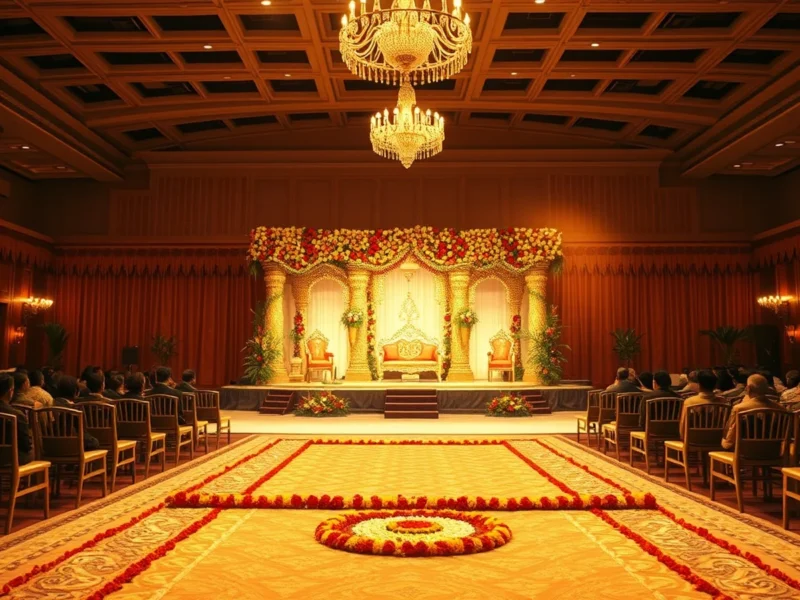
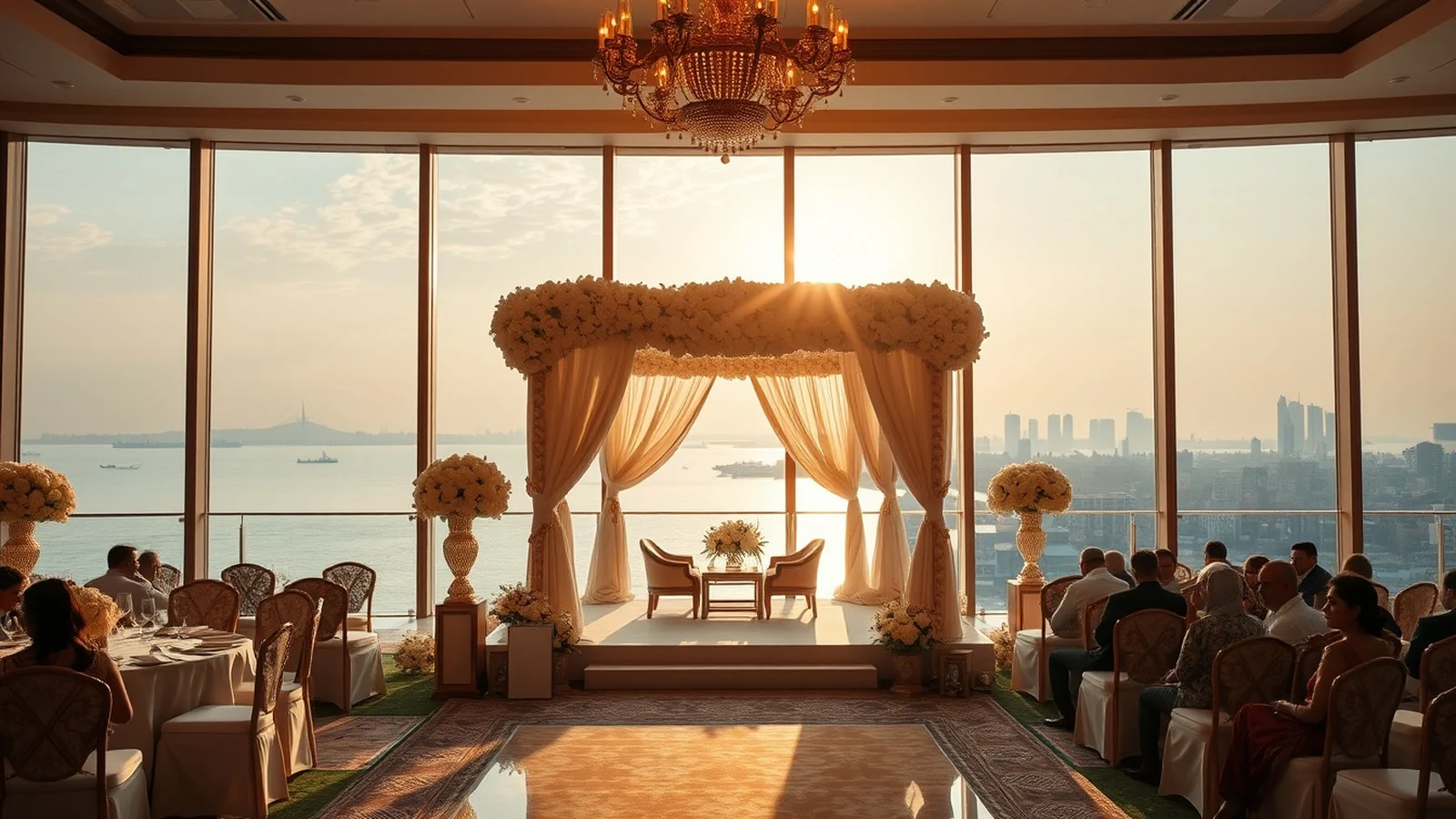
A luxury wedding in Mumbai is defined by one hard reality: land is the scarcest, most expensive commodity in India, and it shapes every decision a couple makes. Where a Delhi or Hyderabad family might take over ten acres of farmhouse or a sprawling palace lawn, a Mumbai celebration is almost always a five-star hotel affair, staged inside pillarless ballrooms, on rooftop decks, or across compact sea-facing lawns. What the city gives up in acreage it returns in prestige, service polish, and location. A reception at The Taj Mahal Palace in Colaba or an Arabian Sea sunset at The Oberoi carries a brand weight that no amount of open ground elsewhere can match.
The second defining feature is spend per head. Mumbai commands India’s highest per-plate rates and the steepest venue minimums, so budgets here buy refinement rather than sheer scale. Because of this, Mumbai lists tend to be more curated than the 800 to 1,200-guest sprawls common in North India. Families deliberately trim the invite to 200 to 400 of the people who truly matter, then spend generously on each of them. The result is an intimate-but-opulent format: fewer guests, richer food, tighter production values, and a guest experience that feels personal rather than industrial. For couples weighing the numbers, our Indian wedding cost breakdown sets the national benchmark that Mumbai then sits at the very top of.
Expect a two to three-day arc: a sangeet or cocktail evening, the main wedding, and a grand reception, occasionally with a mehendi brunch or haldi bookending the affair. Total outlay for a genuinely luxury build lands between Rs 1.5 crore and Rs 5 crore in 2026, with the mid-point around Rs 2.5 crore for roughly 350 guests done well.
Top luxury wedding venues in Mumbai
Mumbai’s marquee venues cluster into a few clear tiers, each suited to a different vision. Choosing well is the single biggest lever on both cost and character, and a planner who knows each property’s real minimums will steer you faster than any brochure.
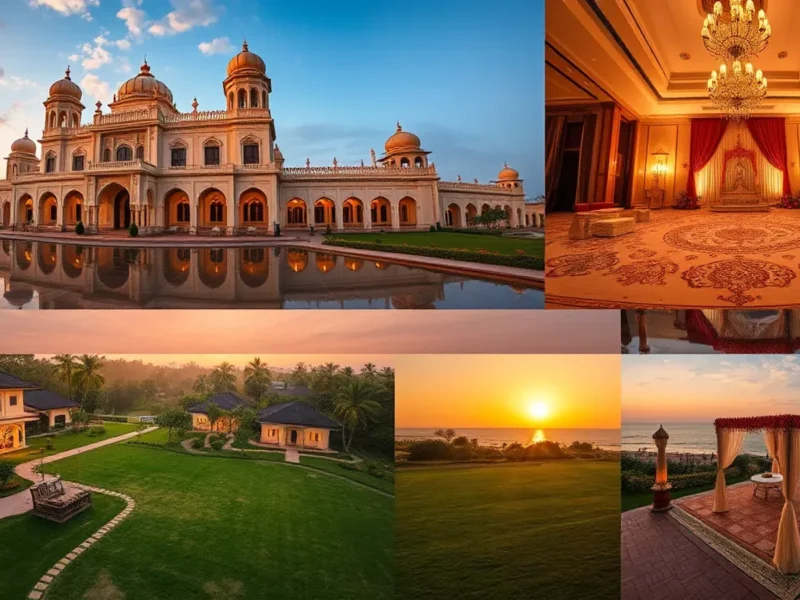
Iconic and heritage. The Taj Mahal Palace in Colaba is the city’s grand dame, unbeatable for a legacy reception where the address itself is the statement. The Leela Mumbai near the airport pairs landscaped courtyards and koi ponds with large indoor ballrooms, ideal for couples who want green space without leaving the city.
Sea-facing and grand. Taj Lands End in Bandra delivers Arabian Sea and Bandra Fort views from its banquets; JW Marriott Juhu offers beachfront lawns and one of the city’s most popular poolside sangeet settings; Sahara Star near the domestic airport provides a vast domed, resort-format space that comfortably absorbs 700-plus guests, a rarity in space-starved Mumbai.
Contemporary five-stars. Grand Hyatt Santacruz and ITC Grand Central in Parel bring big pillarless ballrooms for 500-plus; The St Regis in Lower Parel is the fashion-forward high-rise choice with slick production infrastructure; the Renaissance Mumbai Powai is the standout lakeside address, its Powai Lake backdrop giving city weddings a resort feel; Sofitel BKC anchors the corporate-luxury Bandra Kurla Complex for well-connected guest lists.
A few more addresses earn a place on any serious shortlist. The Trident at Nariman Point shares The Oberoi’s sea frontage at a slightly softer tariff, suiting couples who want South Mumbai prestige without the very top rate. Taj President in Cuffe Parade fits refined, mid-scale South Mumbai receptions, while in the suburbs the Hyatt Regency Sahar and Novotel Juhu serve well-connected, airport-adjacent lists. Heritage clubs such as the Willingdon and the CCI offer old-Mumbai character for members, and for outdoor scale that hotels simply cannot match, families increasingly look to banquet estates on the northern fringe toward Madh Island and Gorai.
Beyond hotels, a handful of banquet estates and club lawns round out the map, but for a true luxury build the five-star ballroom remains Mumbai’s default. Compare the full shortlist in our best wedding venues in Mumbai guide.
Mumbai luxury wedding cost breakdown 2026
Venue and hall hire
Ballroom, lawn, and rooftop hire across a multi-event weekend runs roughly Rs 20 lakh to Rs 80 lakh. In practice most Mumbai hotels bundle hall charges into a catering minimum rather than billing them separately, so the headline hire figure is often absorbed once your guaranteed guest count and per-plate clear the property’s threshold.
Catering and per-plate
This is where Mumbai earns its reputation as India’s costliest market. In-house luxury per-plate rates run Rs 3,500 to Rs 9,000-plus, climbing with cuisine breadth, live counters, imported ingredients, and premium bar packages. For 350 guests across four functions, catering alone typically lands between Rs 60 lakh and Rs 1.4 crore. Because per-plate compounds across every event and every guest, it is the number that dominates a Mumbai budget more than any other line.
Decor and production
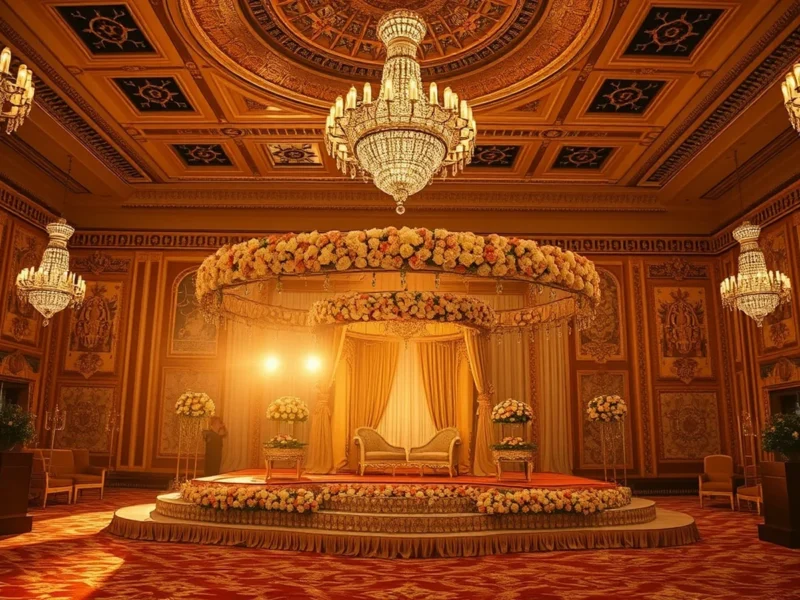
Floral design, structural sets, staging, sound, and lighting run Rs 35 lakh to Rs 1 crore for a luxury build. Mumbai’s compact venues favour vertical, high-impact production, canopies, suspended installations, and layered lighting, over the wide ground-level scenography possible on open lawns. For inspiration on palettes, see our wedding colour palette ideas and mandap decoration ideas.
Photography, film and entertainment
Top-tier photography and cinematography packages, plus celebrity performers, DJs, and live acts, run Rs 25 lakh to Rs 60 lakh. Mumbai’s proximity to the film and music industry means the country’s most sought-after artists and crews are local, a genuine advantage over other cities.
Rooms, hospitality and logistics
A partial room block for outstation guests, airport transfers, guest hampers, and on-ground hospitality adds Rs 20 lakh to Rs 70 lakh. Five-star room nights in Mumbai are themselves among India’s priciest, so even a modest block moves the total materially.
Cost by guest count
Because Mumbai lists skew smaller but pricier, the total does not scale as steeply with headcount as elsewhere, per-plate and fixed production costs carry most of the weight. Ranges below assume a two to three-day luxury build at five-star venues in 2026.
| Guests | Format | Estimated total (2026) |
|---|---|---|
| 150 | Intimate luxury, single premium hotel | Rs 1.2-2 crore |
| 300 | Full luxury, multi-event ballroom weekend | Rs 1.8-3.2 crore |
| 500 | Grand build, large-format venue | Rs 2.8-4.5 crore |
| 700 | Ultra-scale, Sahara Star or resort-format | Rs 4-5 crore-plus |
Note how tightly the bands cluster: a 150-guest Mumbai wedding can cost as much as a 400-guest wedding in a Tier-2 city, purely on per-plate and venue premium. For the national comparison, see our wedding budget planning guide.
Sample budgets at three tiers
The table below shows what each tier buys for a roughly 350-guest Mumbai wedding in 2026. All figures are inclusive of GST and planner fees.
| Tier | Budget | What it buys |
|---|---|---|
| Premium | Rs 1.5-2.2 crore | One strong five-star venue, two to three events, per-plate around Rs 3,500-5,000, established decor team, top-tier photography. |
| Luxury | Rs 2.2-3.5 crore | Marquee hotel across a full weekend, per-plate Rs 5,000-7,000, marquee decor house, cinematic film crew, name entertainment, room block. |
| Ultra-luxury | Rs 3.5-5 crore-plus | Iconic address (Taj, Oberoi, Leela), per-plate Rs 7,000-9,000-plus, bespoke set design, celebrity performers, full hospitality and guest-experience programme. |
The jump between tiers is worth understanding concretely. The gap from Premium to Luxury, roughly Rs 70 lakh to Rs 1.3 crore, does not buy more guests; it buys a better address, a per-plate lifted by Rs 1,500 to Rs 2,000 a head with wider live counters and a premium bar, a marquee decor house over a competent one, and a room block that keeps outstation guests in the wedding hotel. The step from Luxury to Ultra-luxury is spent almost entirely on intangibles: an iconic Taj or Oberoi address, bespoke rather than catalogue set design, a marquee performer, and a hospitality programme, hampers, transfers, and dedicated guest managers, that most attendees will remember longer than the food. Compare these against a resort alternative in our 5-star hotel wedding cost guide.
Best season and muhurat dates
Mumbai’s wedding calendar is dictated by its climate. The peak season runs November to February, when humidity drops, evenings turn pleasant, and sea-facing lawns and rooftops become genuinely comfortable. This window carries the highest demand and the firmest pricing, with December in particular commanding a premium as the city’s social calendar peaks and hotels hold their rates.
Avoid June to September outright. The southwest monsoon brings heavy, sustained rain and near-total humidity, making any outdoor element a gamble and pushing everything indoors. March to May is dry but increasingly hot and sticky, workable for fully indoor, air-conditioned builds and often available at softer shoulder-season rates.
Auspicious muhurat dates in the Hindu calendar concentrate demand into specific weeks, and Mumbai’s best venues book twelve to eighteen months ahead for prime November to February dates. If your muhurat is flexible, a weekday or a shoulder-season date can unlock materially better rates on the same property. Families should also register the marriage in parallel, see our guide to marriage registration in Maharashtra.
Want a real number for your wedding? Send us your dates and guest count and we will come back with an itemised estimate for your wedding, not a range copied off a price list.
Wedding communities and traditions in Mumbai
Mumbai is India’s most cosmopolitan wedding market, and the city’s mix of communities shapes catering, decor, and venue choice in distinct ways. Understanding your community’s expectations, and your guests’, is central to getting the build right.
Gujarati and Marwari families form the largest and most influential slice of Mumbai’s luxury wedding market. Both traditions lean toward elaborate multi-day celebrations, pure-vegetarian and often Jain-friendly catering, and grand, colourful decor, and both spend generously. Live vegetarian chaat and regional counters are non-negotiable, which pushes catering complexity and cost. Maharashtrian weddings, the city’s own tradition, tend toward elegant, ritual-rich ceremonies with the distinctive mundavalya and antarpat, and increasingly favour luxury hotel settings for the reception.
Sindhi and Punjabi families bring larger, more exuberant celebrations with strong sangeet and cocktail cultures and non-vegetarian menus, favouring big-format ballrooms and high-energy entertainment. Mumbai’s small but influential Parsi community holds refined, tradition-bound ceremonies, often at heritage venues and community grounds. Whatever the community, a planner fluent in each tradition’s rituals, menu rules, and vendor ecosystem prevents costly missteps and keeps elders confident.
Logistics in Mumbai
No Indian city tests wedding logistics like Mumbai, and getting them right separates a smooth celebration from a stressful one. Traffic is the first constraint: a venue thirty minutes away on a map can be ninety in evening peak. The single most effective decision is to host every function at one hotel, or at properties clustered in the same zone, so guests never fight cross-city traffic between events.
Parking and valet are genuine constraints at South Mumbai and suburban venues alike, where ground is scarce. Confirm valet capacity early and plan overflow, because a shortfall strands guests on arrival. Room blocks near the venue matter more here than in most cities: outstation guests should ideally stay in the wedding hotel itself, both for convenience and to avoid late-night commutes across a city that never fully sleeps but does snarl.
Guest transport, coordinated coaches or car fleets between the hotel, ceremony, and any offsite event, is worth budgeting for on larger lists. Finally, permits for amplified music, late-hour functions, and any public-facing setup must be secured in advance; Mumbai’s noise and civic rules are enforced, and a good planner handles these quietly so the celebration never pauses.
How to plan a luxury Mumbai wedding smartly
Smart planning in Mumbai is not about cutting corners, it is about spending where guests notice and negotiating hard where they do not. Because per-plate dominates the budget, guest-list discipline is the highest-leverage decision you will make. Trimming a 500 list to a curated 350 of genuine relationships can save Rs 40 to 70 lakh while making the celebration feel warmer, not smaller.
Timing is the next lever. A weekday date or a shoulder-season window (late February, March, or a monsoon-edge indoor build) can unlock materially better rates on the very same five-star property, without any visible compromise in quality. Negotiating the catering minimum and per-plate inclusions, rather than the hall hire, is where a planner who knows each hotel’s true floor recovers the most money.
For couples wanting acreage and exclusivity that Mumbai’s real estate simply cannot offer, consider a short-haul destination in Lonavala or Alibaug, both a comfortable drive away and increasingly home to luxury villas and resorts that absorb overflow or host a full weekend. It is often the smart middle path between a city hotel and a far-flung palace. Weigh the trade-offs with our wedding planner cost guide.
Planning your Mumbai wedding with Velvet Knot
In a market where per-plate minimums and hidden inclusions decide the total, that alignment is worth real money: we know each hotel’s genuine floor, its negotiable levers, and its shoulder-season rates.
Our direct relationships with the wedding-sales teams at Mumbai’s marquee properties, the Taj, Oberoi, Leela, JW Marriott, Grand Hyatt, St Regis, and the Powai lakeside, mean faster holds on prime dates and better-structured contracts. From guest-list strategy and muhurat-date planning to full multi-day production and logistics, we run the entire build so your family can be present rather than managing. Start with our Mumbai wedding planner team, and browse the city’s best venues to shape your shortlist.
Planning a luxury wedding in this city?
Speak to our team for a tailored venue shortlist and cost plan.
Break down your budget
Timing and booking
Newly costed venues: Radisson Blu Alibaug wedding cost.
Also on Velvet Knot: the ITC Grand Central wedding cost guide.
Also on Velvet Knot: the Trident Nariman Point wedding cost guide.
Frequently Asked Questions
How much does a luxury wedding in Mumbai cost in 2026?
For 200 to 500 guests over two to three days, expect Rs 1.5 crore to Rs 5 crore, with the mid-point around Rs 2.5 crore for roughly 350 guests. Per-plate catering of Rs 3,500 to Rs 9,000-plus at the top hotels drives most of the total.
Why are Mumbai weddings the most expensive in India?
Mumbai carries the country’s highest real-estate and venue premium, so five-star ballroom minimums, per-plate rates, and room nights all sit above every other city. Budgets here buy location, service, and prestige rather than acreage.
Which are the top luxury wedding venues in Mumbai?
The Taj Mahal Palace and The Oberoi for heritage grandeur, Taj Lands End and JW Marriott Juhu for sea-facing lawns, Grand Hyatt, St Regis, ITC Grand Central and Sofitel BKC among contemporary five-stars, the Renaissance Powai for a lakeside setting, and Sahara Star for 700-plus formats.
What is the per-plate cost at a luxury Mumbai hotel?
Roughly Rs 3,500 to Rs 9,000-plus per plate in 2026, rising with cuisine breadth, live counters, imported ingredients, and premium bar packages. Because it compounds across every guest and event, per-plate is the single biggest driver of a Mumbai wedding budget.
When is the best time for a Mumbai wedding?
November to February is peak season, with pleasant, low-humidity evenings ideal for sea-facing venues; December commands a premium. Avoid the June to September monsoon entirely, and treat March to May as workable only for fully indoor, air-conditioned builds at softer rates.
Should we consider Lonavala or Alibaug instead of Mumbai city?
If you want acreage, exclusivity, or a full weekend takeover that Mumbai’s scarce land cannot offer, Lonavala and Alibaug are a comfortable drive away with luxury villas and resorts. They work well for destination overflow or a complete offsite build, often as a smart middle path between a city hotel and a far palace.
Sources and further reading
- Maharashtra Tourism (Government of Maharashtra)
- Britannica: Mumbai
- Incredible India: Mumbai
- Velvet Knot: Indian wedding cost breakdown
- Velvet Knot: Best wedding venues in Mumbai
More metro venues: JW Marriott Juhu wedding cost, The Leela Mumbai wedding cost, Grand Hyatt Mumbai wedding cost.
More venue cost guides: ITC Maratha Mumbai wedding cost.
More venue cost guides: The St. Regis Mumbai wedding cost, Four Seasons Mumbai wedding cost.
Wedding paperwork: marriage registration in Maharashtra.
Begin Your Engagement
Want a real number for your wedding?
Tell us your city, guest count and dates. Team Velvet Knot will come back within 24 hours with an itemised budget.