Wedding Catering Cost in India 2026: Per-Plate Pricing by Cuisine, City, and Scale
- The per-plate grid by tier
- Per-plate by cuisine
- Per-plate by city
- The 4-event package model
- Live counter costs
- The hidden costs that are not in the per-plate
- Vegetarian, Jain, and dietary segmentation
- How catering fits the total wedding budget
- Menu inspiration
- Reception planning ideas
- Related catering costs
- Related food and guest costs
- Timing and service planning
- Headcount and the welcome dinner
- Per-function food costs
- A worked catering budget: 300 guests, four events
- Comparing three caterer quotes line by line
- Frequently asked questions
- Planning your wedding catering with Velvet Knot
- Sources and further reading
Wedding catering in India costs Rs 800 to Rs 3,500 per plate in 2026, with most couples spending Rs 1,200 to Rs 2,000 per guest for a multi-cuisine menu. Live counters, premium cuisines, and bar service push it higher. For a 300-guest, 4-event wedding, total catering usually lands between Rs 15 lakh and Rs 40 lakh. Guest count and number of events drive the figure most.
What you’ll find here
If you have searched for wedding catering costs in India, the SERP is mostly caterer marketing pages telling you “Rs 500 to Rs 2,000 per plate” with a smiling chef and no honest segmentation. That range is technically not wrong. It also tells you nothing useful, because a vegetarian Mehendi lunch in a tier-2 city at Rs 650 per plate and a multi-cuisine reception in Mumbai at Rs 4,500 per plate are both “wedding catering” and they are not the same product.
This guide breaks the actual price grid down by cuisine, city tier, scale, dietary mix, and event count, with the hidden line items families miss until the final invoice. We are a premium pan-India planner, and these numbers are the ranges we negotiate against weekly.
The per-plate grid by tier
The cleanest mental model is five tiers. The variables that move you up: live counter count, plated versus buffet, premium proteins (lamb, prawns, fish), brand-name caterer, and event production around the food (chef-action stations, mixologist, sushi).
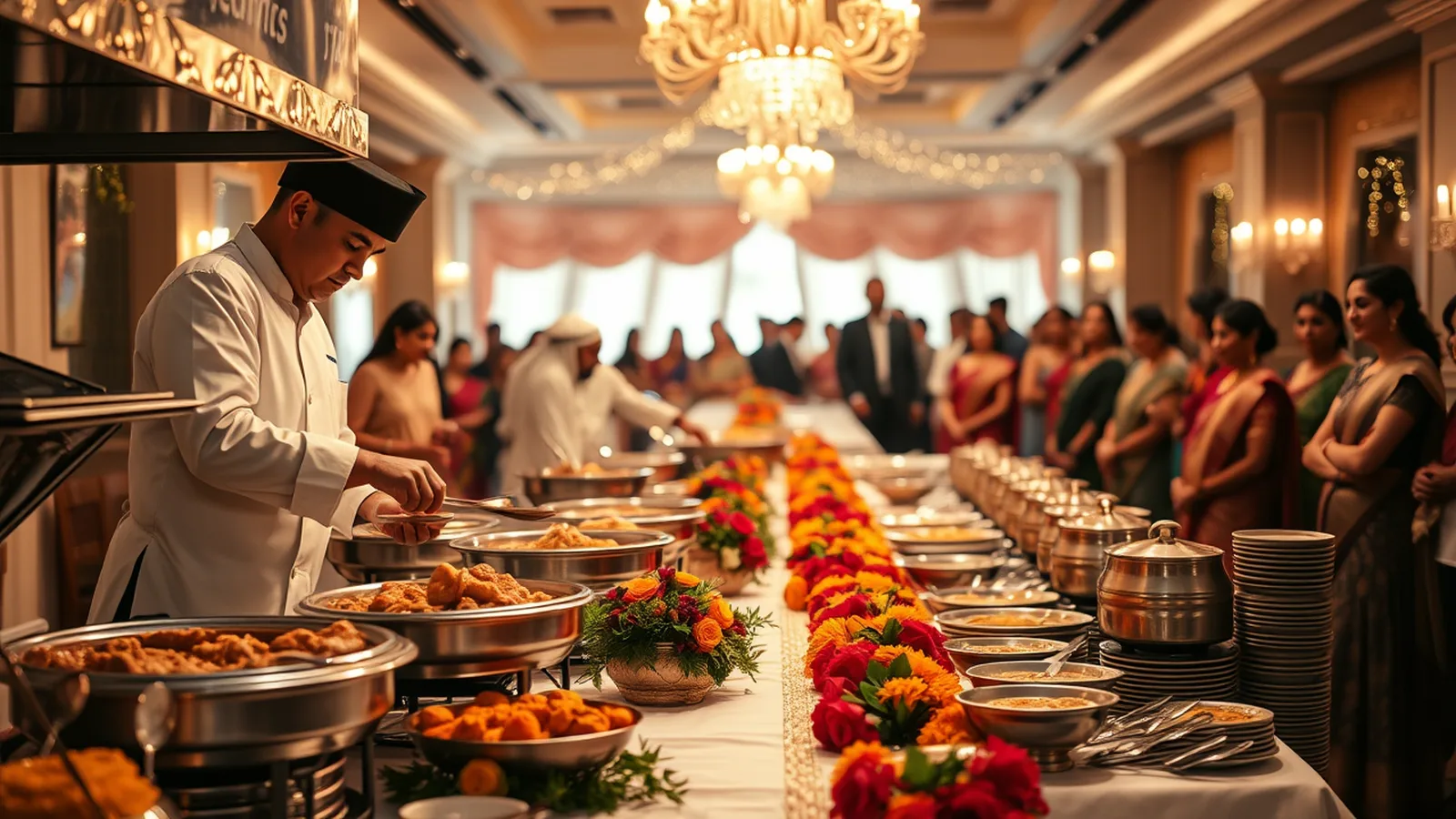
Budget tier: Rs 600 to Rs 1,200 per plate. Tier-2 and tier-3 city local caterers, buffet service, 8 to 12 dishes across veg and non-veg, no live counters, basic dessert. Workable for community-hall weddings, smaller Mehendi or Haldi events, or any 400-plus guest count where the per-plate has to come down. Quality varies enormously and is fully dependent on the specific caterer; some at this tier serve genuinely well, others are factory-line.
Mid tier: Rs 1,200 to Rs 2,000 per plate. Regional caterer chains with proper kitchens, 15 to 18 dishes, 1 to 2 live counters, decent dessert spread including ice cream and rabri-jalebi, branded mineral water, basic service staff. This is where most mid-range Indian weddings sit. Rs 50 lakh to Rs 1 crore total weddings typically land here for food.
Premium tier: Rs 2,000 to Rs 3,500 per plate. Established caterers like Foodlink (Mumbai/Pune), Vibe Catering, Bawarchi Worldwide, Speciality Restaurants catering arm, or the catering wings of luxury hotels at off-site events. 20 to 25 dishes, 3 to 4 live counters, plated options for select courses, dessert spread including mithai station and continental desserts. This is where Rs 1 crore to Rs 2.5 crore weddings typically land.
Luxury tier: Rs 3,500 to Rs 6,000 per plate. Hotel-grade catering by Taj, Oberoi, ITC, Leela, Hyatt at their own properties, or top-end specialist caterers off-site. 30-plus dishes, 5 to 7 live counters including premium ones (sushi, oyster bar, chef-action), plated multi-course for the wedding dinner, branded liquor inclusions, full waited service. Rs 2.5 crore weddings and up.
Celebrity tier: Rs 6,000 plus per plate, often Rs 10,000 to Rs 15,000. This is what runs at Ambani-tier weddings, where the food bill alone crosses Rs 10 crore for the multi-day event. Imported ingredients, chefs flown in, full Michelin-style execution. Statistically irrelevant for 99 percent of weddings, but worth knowing the ceiling.
Per-plate by cuisine
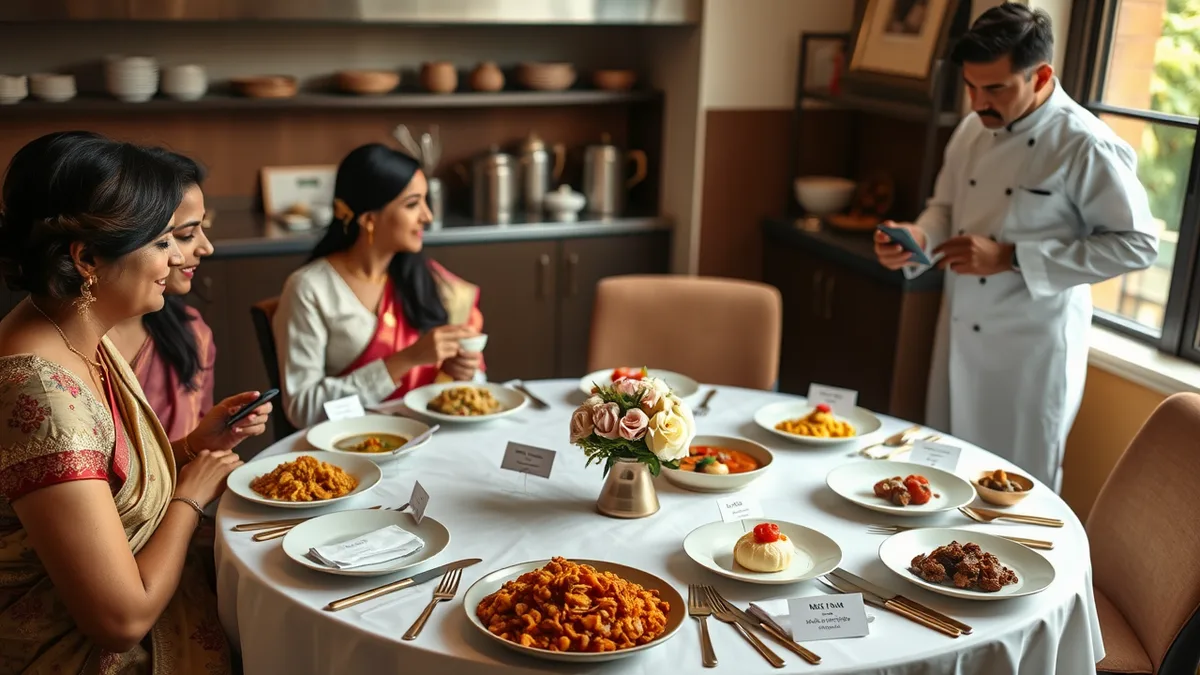
The cuisine choice moves the per-plate meaningfully, and not always in the direction families expect. Vegetarian food is generally cheaper than non-vegetarian by Rs 200 to Rs 500 per plate, but the gap narrows at the top end where vegetarian gets fancy with Jain options, exotic vegetables, and live counter complexity.
North Indian vegetarian. Punjabi-Marwari-Rajasthani-style. Rs 900 to Rs 2,500 per plate across tiers. The most commoditised cuisine in Indian wedding catering, lowest per-plate at any given tier.
North Indian non-vegetarian. Adds tandoor lamb, butter chicken, mutton curry, rogan josh. Rs 1,200 to Rs 3,000 per plate. The premium over veg comes from lamb pricing more than chicken.
South Indian vegetarian. Traditional sit-down meal on banana leaf or its modern buffet adaptation. Rs 800 to Rs 2,200 per plate. Very common for South Indian weddings in tier-1 and tier-2 cities. The Iyer-Iyengar wedding sadya in Chennai or Bangalore typically falls here.
South Indian non-vegetarian with seafood. Chettinad, Mangalorean, Andhra-style with prawns, fish, mutton. Rs 1,500 to Rs 3,500 per plate. The seafood premium is real, particularly for inland venues.
Bengali. Plated Bengali meals with fish, prawns, mutton, the elaborate dessert section. Rs 1,800 to Rs 4,000 per plate. Bengali wedding catering carries a small premium even at mid-tier because of the seafood density and the sheer dessert variety.
Hyderabadi and Lucknowi nawabi. Dum biryani, kebab spread, nihari, haleem. Rs 1,500 to Rs 3,500 per plate. Halal sourcing pushes the per-plate up at the premium end.
Mughlai. Overlaps with nawabi but heavier on the curry-and-bread side. Rs 1,400 to Rs 3,200 per plate.
Continental. European-leaning with risottos, pastas, grilled mains. Rs 1,500 to Rs 3,500 per plate. Often layered onto an Indian spread for the reception or sangeet.
Live counters multi-cuisine. Pan-Asian (Thai, Chinese, Japanese), Italian wood-fired pizza, sushi bar, mocktail and mixology stations. Rs 150 to Rs 400 per plate per counter, on top of the base catering. A wedding with 4 live counters can easily add Rs 800 to Rs 1,500 per plate to the base.
Per-plate by city
The metro premium is real and runs roughly 30 to 40 percent over tier-2 cities, with destination wedding catering carrying its own premium on top.
Mumbai, Delhi NCR, Bangalore. The most expensive metros for wedding catering. Mid-tier Rs 1,500 to Rs 2,500 per plate, premium Rs 2,500 to Rs 4,500 per plate, luxury Rs 4,500 to Rs 7,000 per plate. The premium covers higher kitchen rent, urban staffing costs, and brand-name caterer markup.
Hyderabad, Chennai, Pune, Kolkata, Ahmedabad. Strong tier-1.5 markets. 15 to 25 percent below the top metros. Mid-tier Rs 1,200 to Rs 2,000, premium Rs 2,000 to Rs 3,500.
Jaipur, Udaipur, Lucknow, Chandigarh, Kochi. Tier-2 wedding markets with mature catering ecosystems. Mid-tier Rs 900 to Rs 1,800, premium Rs 1,800 to Rs 3,200. Destination wedding pricing in Udaipur and Jaipur is a different category (see below).
Tier-3 and smaller towns. Mid-tier Rs 700 to Rs 1,400. Quality more variable, repertoire less premium.
Destination wedding catering premium. Catering at Udaipur palace venues, Jaisalmer desert camps, Goa beach resorts, Kerala backwaters, Lonavala farmhouses runs 30 to 80 percent over the same caterer’s city rate. The premium covers: transporting kitchen equipment to site, accommodating staff for 3 to 5 nights, ingredient procurement at remote locations, and venue access fees. Foodlink’s Mumbai rate versus Foodlink’s Udaipur rate is a Rs 600 to Rs 1,200 per plate gap on the same menu.
The 4-event package model
This is the line item that confuses families more than any other. A typical Indian wedding has 4 catered events: Mehendi (lunch or dinner), Sangeet (cocktail dinner), Wedding (lunch or dinner depending on muhurat), Reception (dinner). Many families assume this means 4x the single-event cost. It does not.
Caterers price wedding packages on a 4-event basis with a discount typically 10 to 20 percent off the equivalent 4 independent bookings. A 200-guest wedding at Rs 2,000 per plate single-event would be Rs 4 lakh per event, Rs 16 lakh across 4 events at the standalone rate. The package rate typically lands Rs 13 lakh to Rs 14.5 lakh.
The catch: the menu is differentiated per event, not identical. Mehendi is usually a lighter daytime spread (Rs 1,400 per plate against the Rs 2,000 base). Sangeet is cocktail-style with smaller plates (Rs 1,600 per plate). Wedding and reception are the full Rs 2,000 to Rs 2,500 spread. The package quote should itemise per event, not just give you a blended number.
A second catch: guest count varies per event. The Mehendi typically draws 50 to 60 percent of the wedding-day count (close family and friends). The Sangeet draws 70 to 80 percent. The wedding and reception are full count. If your caterer is quoting you 200 guests across all 4 events, they are either overcharging Mehendi or you are confused about your invite list. Get an event-by-event count in the contract.
Live counter costs
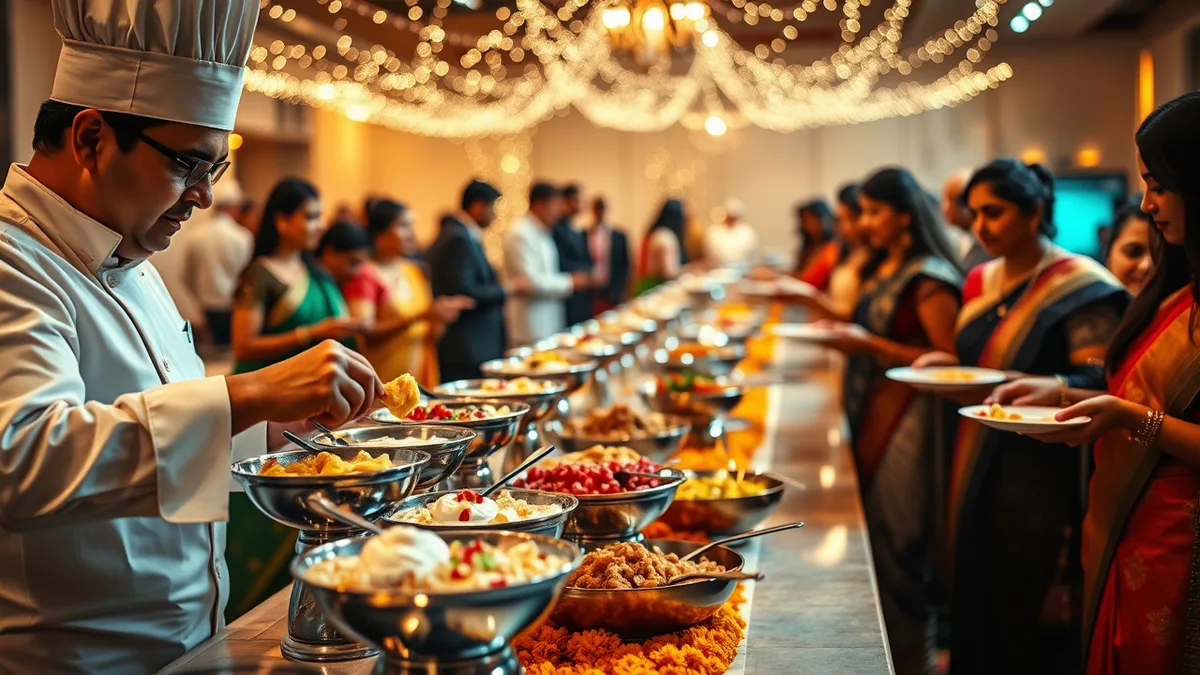
Live counters are where reception per-plates spike. Each counter is essentially a chef station serving live-cooked food from a focused menu.
Dosa or chaat counter. Rs 150 to Rs 250 per plate uplift across the event. Cheapest counter, easy to staff, popular fillerfor sangeets and mehendis.
Mocktail and mixology bar. Rs 200 to Rs 400 per plate uplift. The premium version with bartender flair, fresh-pressed juices, and themed glassware moves higher.
Live grill or tandoor. Rs 200 to Rs 350 per plate uplift. Lamb chops, seekh kebabs, paneer tikka cooked live.
Pasta or pizza counter. Rs 200 to Rs 400 per plate uplift. The wood-fired pizza counter is the premium version.
Sushi or pan-Asian counter. Rs 350 to Rs 600 per plate uplift. The most expensive standard counter, mostly seen at premium and luxury weddings.
Chaat-trolley and street-food themed counters. Rs 150 to Rs 300 per plate uplift. Vada pav, pani puri, pav bhaji, kulfi-falooda. Cheaper and very popular for Mehendi and Sangeet.
A 4-counter reception with sushi, live grill, pasta, and mocktail can add Rs 900 to Rs 1,800 per plate to the base catering, so what reads as a Rs 2,500 per plate base becomes Rs 3,400 to Rs 4,300 effective.
Want a real number for your wedding? Send us your dates and guest count and we will come back with an itemised estimate for your wedding, not a range copied off a price list.
The hidden costs that are not in the per-plate
The per-plate quote is rarely the final bill. The line items that get added separately:
Service staff. Buffet service might be included; plated waited service is usually charged separately at Rs 500 to Rs 2,000 per staff member for the event. A 200-guest plated reception typically needs 12 to 16 service staff. Budget Rs 15,000 to Rs 30,000 per event for staffing.
Tea, coffee, and beverage stations. Often quoted separately at Rs 80 to Rs 150 per plate for unlimited tea, coffee, and welcome drinks across the event.
Mineral water and soft drinks. Branded mineral water is usually included; soft drinks at unlimited consumption is often a Rs 100 to Rs 250 per plate add-on.
GST. 5 percent on the food invoice is standard. Always quoted plus-GST, not inclusive.
Transport. For outstation or destination venues, kitchen equipment transport and staff travel-and-stay is a separate line. Rs 50,000 to Rs 3 lakh depending on distance and event scale.
Breakage and damage deposit. Often Rs 25,000 to Rs 1 lakh refundable.
Equipment rental. Chafing dishes, induction setups, plate-cutlery rentals, kitchen tents. Sometimes included in the per-plate at the premium tier, often itemised separately at mid-tier. Rs 50,000 to Rs 3 lakh for a full multi-event wedding.
Setup-strike fees. The 4-hour setup and 2-hour breakdown per event is occasionally charged at outdoor and destination venues where staff time accumulates. Rs 15,000 to Rs 50,000.
A wedding quoted at Rs 2,000 per plate often lands at Rs 2,400 to Rs 2,700 per plate effective after the hidden items. Build the buffer.
Vegetarian, Jain, and dietary segmentation
Vegetarian versus non-vegetarian. The gap is Rs 200 to Rs 500 per plate at most tiers, narrower at the premium end where vegetarian menu complexity rises.
Jain catering surcharge. Strict Jain food (no root vegetables, no onion-garlic, prepared in a separate kitchen with separate utensils to avoid cross-contamination) typically adds Rs 300 to Rs 600 per plate over the equivalent vegetarian menu, sometimes more if the caterer has to bring in a Jain-specialist cook. For weddings with 30 to 80 strict-Jain guests, the standard pattern is a dedicated Jain section of the buffet, separately staffed and labelled, with the surcharge applied only to the Jain head count.
Halal catering. For Muslim weddings, halal-only sourcing is the baseline expectation and does not usually carry a surcharge from halal-specialist caterers. From non-halal-specialist caterers, expect a Rs 200 to Rs 400 per plate uplift to bring in halal proteins separately.
Vegan, gluten-free, and allergy segmentation. Increasingly common for NRI-heavy guest lists. Premium caterers handle it with sufficient notice (3 to 4 weeks ahead, with confirmed head counts) at no surcharge. Mid-tier caterers may add Rs 150 to Rs 300 per plate for the segmented menu.
How catering fits the total wedding budget
Across the wedding budgets we work on, catering typically lands at 25 to 35 percent of total spend for a venue-plus-catering wedding (where catering is brought in separately) and 35 to 45 percent of total spend for a hotel-venue wedding (where catering and venue are bundled).
For a Rs 50 lakh wedding, that means Rs 12 lakh to Rs 17 lakh on food across all events. For a Rs 1.5 crore wedding, Rs 40 lakh to Rs 65 lakh. For a Rs 5 crore wedding, Rs 1.5 crore to Rs 2.2 crore on food including liquor, counters, and segmentation.
This is consistent with the broader cost-build we cover in the wedding planner cost guide and the India-specific cost guide. Catering sits alongside decoration and photography and bridal makeup as the four big-ticket line items families budget independently.
For Hindu weddings, the catering composition skews vegetarian by default with a separate non-veg counter, and the Hindu wedding planner page goes deeper on tradition-specific menu choices. For destination weddings, the catering premium discussed above is the single biggest budget shift to model.
Menu inspiration
Reception planning ideas
Planning your wedding menu and catering?
Velvet Knot plans catering end to end and gives honest per-plate advice. Speak to our team for a menu and per-plate estimate matched to your guest count and city.
Related catering costs
Related food and guest costs
Timing and service planning
Headcount and the welcome dinner
Per-function food costs
Related costs: read what a wedding cake costs in India.
A worked catering budget: 300 guests, four events
The per-plate grid only becomes a budget once it meets a real guest list. The worked example below uses the mid-tier rates and the attendance pattern set out earlier on this page: a Mehendi drawing just over half the wedding count, a Sangeet drawing three quarters, and full attendance at the wedding and reception.
| Event | Guests | Per plate | Food cost | Typical additions |
|---|---|---|---|---|
| Mehendi lunch | 165 | Rs 1,400 | Rs 2.3 lakh | Chaat counter, tea and coffee |
| Sangeet dinner | 225 | Rs 1,600 | Rs 3.6 lakh | Mocktail bar, live grill |
| Wedding lunch or dinner | 300 | Rs 2,000 | Rs 6.0 lakh | Service staff, Jain section |
| Reception dinner | 300 | Rs 2,500 | Rs 7.5 lakh | Two or three live counters |
| Total food | Rs 19.4 lakh at single-event rates, about Rs 15.5 to 17.5 lakh as a package | Before GST, staffing and equipment |
Add the items listed under hidden costs and the effective figure moves up by 20 to 35 percent, which puts this wedding at roughly Rs 19 to 24 lakh on food once the package discount is applied. That is the number to hold in the budget. The per-plate number is the one to negotiate.
Comparing three caterer quotes line by line
Three quotes on the same menu rarely arrive in the same shape. One is inclusive, one is itemised and one quietly leaves things out. Lay them side by side against the lines below before comparing totals.
| Line | Ask each caterer | Red flag |
|---|---|---|
| Guest count per event | Is the count set event by event? | One count applied to all four events |
| Minimum guarantee | What count am I billed for if fewer guests come? | A guarantee above your realistic attendance |
| Menu | Is every dish named, with quantities for starters? | Phrases such as chef’s choice of three starters |
| Counters | Are counters billed on the whole guest count? | Counters priced per plate but not listed per event |
| Staff | How many service staff per event, and are they included? | No staff number in writing |
| GST | Is the per-plate before or after GST? | A total with no tax line |
| Equipment and setup | Are chafing dishes, cutlery and kitchen setup included? | Equipment described as extra at actuals |
| Outstation costs | Who pays for staff travel and stay at a destination venue? | Travel described as to be decided |
| Tasting | Is a tasting included, and is it the final menu? | Tasting only after the advance is paid |
| Cancellation | What happens to the advance if the date moves? | No written cancellation terms |
Where the minimum guarantee catches families
Caterers and hotels plan kitchens and staff against a guaranteed number, and most bill that number even if fewer guests arrive. The guarantee is usually fixed a few days before each event. The costly mistake is agreeing it early, from the invitation list, rather than from confirmed replies. For a 300-guest wedding, a guarantee 30 guests too high at Rs 2,500 per plate costs Rs 75,000 at a single meal. Our guide to wedding cost by guest count shows how the whole budget moves with the list.
Frequently asked questions
What is a realistic per-plate cost for a mid-range Indian wedding in 2026?
For a mid-range wedding in a tier-1 or tier-1.5 Indian city across 4 events with 200 to 300 guests, plan for Rs 1,500 to Rs 2,500 per plate as the base catering rate, before live counters and hidden costs are added. With 2 to 3 counters and the standard add-ons, the effective per-plate typically lands Rs 2,000 to Rs 3,200. For premium weddings, the effective per-plate moves to Rs 3,500 to Rs 5,500 once counters, plated service, and segmentation are included.
Why is destination wedding catering 30 to 80 percent more expensive?
The same caterer charges more at a destination venue because they have to transport kitchen equipment, accommodate staff for 3 to 5 nights, procure ingredients at a remote location with limited supplier options, and pay venue access fees. A Foodlink quote in Mumbai versus the same caterer at an Udaipur palace runs a Rs 600 to Rs 1,200 per plate gap on identical menus. Plan for it explicitly when comparing city versus destination weddings.
How much do live counters add to the per-plate cost?
Each counter adds Rs 150 to Rs 600 per plate to the base catering depending on what is served. Cheaper counters (chaat, dosa, mocktail) sit at the Rs 150 to Rs 250 end. Premium counters (sushi, pan-Asian, live grill) sit at Rs 350 to Rs 600. A 4-counter reception with one premium counter typically adds Rs 900 to Rs 1,800 per plate. Counters are charged on the full guest count, not just on people who actually visit them.
What does Jain catering cost compared to regular vegetarian?
Strict Jain food, which excludes root vegetables, onion, and garlic and is prepared in a separately staffed kitchen to prevent cross-contamination, typically adds Rs 300 to Rs 600 per plate over the regular vegetarian rate. For weddings with 30 to 80 Jain guests, the standard approach is a dedicated Jain buffet section with the surcharge applied only to the Jain head count, not the full guest list.
Is the per-plate quote inclusive of GST and service staff?
Usually neither. GST at 5 percent on the food invoice is added separately. Plated service staff at Rs 500 to Rs 2,000 per staff member per event is also typically separate, with mid-range receptions needing 12 to 16 staff. Always ask for the all-in effective per-plate, including GST, staffing, transport, equipment, and segmentation surcharges, before signing.
How are 4-event wedding catering packages priced?
Caterers offer 4-event packages (Mehendi, Sangeet, Wedding, Reception) at a 10 to 20 percent discount versus four independent bookings. The menu is differentiated per event: Mehendi lighter at around 70 percent of the base, Sangeet cocktail-style at 80 percent, Wedding and Reception at the full rate. Guest count also varies per event, with Mehendi typically 50 to 60 percent of the full wedding count. Always get the package quote itemised event by event.
How do we negotiate the catering quote down?
Get three caterer quotes in writing on the same menu spec. Negotiate counters as a bundle, not individually. Push for service staff and equipment to be included in the per-plate rather than separate line items. Lock guest counts 3 weeks before, not on the morning of, because last-minute count increases carry the worst rate. For 4-event packages, ask for the loyalty discount even if you are a first-time client; most caterers will give 5 to 10 percent on a multi-event booking.
What is a minimum guarantee in wedding catering?
It is the guest count you agree to pay for at each event, whatever the actual attendance. Caterers and hotels plan food and staff against it, so set it from confirmed replies a few days before the event rather than from the invitation list, and get the deadline for changing it in writing.
Planning your wedding catering with Velvet Knot
Catering is one of the three line items we negotiate hardest on, alongside venue and decor, because the per-plate compounds across guest count and event count. A Rs 200 per plate negotiation on a 300-guest, 4-event wedding is Rs 2.4 lakh saved without changing the menu.
We work with 8 to 12 caterers across the major Indian cities at the premium and mid-premium tier, and the right one for your wedding depends on cuisine, venue, dietary segmentation, and what other line items are already eating the budget. For premium pan-India weddings, our services page covers how the catering brief gets built, and the get-quote conversation is the cleanest way to start. You can also reach Saru on WhatsApp at +91 7700027573.
The food is the line item your guests remember 6 months later. The per-plate is worth getting right.
Catering is one of the biggest single line items in a wedding. See how it fits alongside everything a full-service planner coordinates.
Sources and further reading
Begin Your Engagement
Want a real number for your wedding?
Tell us your city, guest count and dates. Team Velvet Knot will come back within 24 hours with an itemised budget.