Farmhouse Wedding Cost in India 2026 (Delhi NCR + Beyond)
- Why farmhouses dominate the Delhi-NCR wedding market
- Farmhouse wedding cost breakdown (2026)
- Sample budget: 600-guest farmhouse wedding in Delhi-NCR (2026)
- Farmhouse vs hotel vs palace: which to choose
- What’s NOT in most farmhouse quotes (the gotchas)
- Costs for an open-ground wedding
- What “raw venue” actually means for your budget
- Tenting and flooring: the largest line after catering
- Power: generators, backup and the fuel bill
- Washrooms and guest comfort: the line nobody budgets
- Kitchen setup: building a production kitchen on grass
- Noise rules and time limits: how NCR compresses your running order
- Weather contingency: the most expensive thing families skip
- Guest transport, parking and valet at an out-of-city venue
- Licences and permissions for an open venue
- Farmhouse weddings outside Delhi NCR
- Security, insurance and damage deposits
- When a farmhouse genuinely costs more than a hotel
- Frequently Asked Questions
- Sources and further reading
A farmhouse wedding in India in 2026 typically costs Rs 35 lakh to Rs 2.5 crore for 300-800 guests across 2-3 days, with venue rental of Rs 3-25 lakh per day. Farmhouses dominate the Delhi-NCR luxury wedding market because they handle 500-1,500 guest counts that hotels cannot, while allowing fully custom decor and outside vendors. Per-plate catering runs Rs 1,800-5,500 depending on the caterer and venue tier.
Why farmhouses dominate the Delhi-NCR wedding market
Delhi-NCR runs on farmhouse weddings for a simple reason: capacity. The big-fat North Indian wedding routinely crosses 600-1,200 guests, which most hotels physically cannot host. Farmhouses across Chhatarpur, Sohna Road, Mehrauli, and the Gurgaon-Manesar belt offer sprawling lawns, multiple event areas, and the freedom to bring your own decorator, caterer, and production team: the opposite of a hotel’s in-house-only model.
This freedom is also why farmhouses suit couples who want a fully bespoke aesthetic rather than a hotel’s standard wedding package.
Farmhouse wedding cost breakdown (2026)
Venue rental
Premium farmhouses (Westin Sohna, Heritage Village Manesar, the Chhatarpur belt): Rs 3-25 lakh per day. Multi-day weddings negotiate package rates.
Catering
Outside caterers are the norm. Per-plate Rs 1,800-5,500. For 600 guests across 3 events: Rs 40 lakh to Rs 1.2 crore. See our catering cost guide.
Decor, production, power
Because farmhouses are blank canvases, decor and production are larger line items than at hotels: Rs 15 lakh to Rs 1 crore including generators, flooring, and tenting. See the decor cost guide.
Sample budget: 600-guest farmhouse wedding in Delhi-NCR (2026)
| Line item | Range |
|---|---|
| Venue rental (2-3 days) | Rs 8-30 lakh |
| Catering (Rs 3,200 per plate, 3 events) | Rs 55-75 lakh |
| Decor + production + tenting + power | Rs 30-70 lakh |
| Photography + film + entertainment | Rs 18-45 lakh |
| Bar, hospitality, planner, GST | Rs 25-60 lakh |
| Total | Rs 1.4-2.8 crore |
Farmhouse vs hotel vs palace: which to choose
Choose a farmhouse for large guest counts (500+), full creative control, and Delhi-NCR convenience. Choose a 5-star hotel for turnkey service and out-station guest accommodation on-site. Choose a heritage palace for a destination-wedding experience. See our full wedding venue cost guide and how to choose a venue.
What’s NOT in most farmhouse quotes (the gotchas)
- Generators and power backup: farmhouses rarely have load capacity for full production lighting; Rs 2-10 lakh
- Flooring and tenting for lawns: Rs 5-25 lakh
- Outside-vendor / royalty charges some farmhouses levy on your caterer or decorator
- Security deposit: refundable, Rs 2-15 lakh
- Guest accommodation: farmhouses rarely have rooms; out-station guests need nearby hotels
Costs for an open-ground wedding
What “raw venue” actually means for your budget
A farmhouse rents you land, a boundary wall and a gate. Almost nothing else. That single sentence explains why families who compare a farmhouse rental against a hotel package conclude the farmhouse is cheap, then finish the wedding 40 to 60 percent over the number they started with. A hotel quote is a bundle. It carries the banquet hall, the air conditioning, the kitchen, the washrooms, the power, the housekeeping, the security, the fire clearance and the parking inside one per plate figure. A farmhouse quote carries the ground and the dates.
Here is the honest list of what you are bringing in yourself. Structure and flooring, air cooling or heating, power generation and distribution, the entire kitchen, portable washrooms, water, lighting beyond the basic garden fittings, furniture, housekeeping staff, waste removal, security, signage, parking management and often the drinking water tankers. As a planner estimate, these bought-in services typically add Rs 1,800 to Rs 3,500 per guest on top of catering and rental at a mid-to-premium Delhi NCR farmhouse in 2026.
Run the comparison the correct way. Do not put farmhouse rental beside a hotel per plate rate. Put the fully loaded farmhouse number, rental plus infrastructure plus catering plus decor, against the hotel’s fully loaded number from our 5-star hotel wedding cost guide. Only then are you comparing like with like. The same discipline underpins the stage-by-stage method in how to plan a wedding budget in India.
Tenting and flooring: the largest line after catering
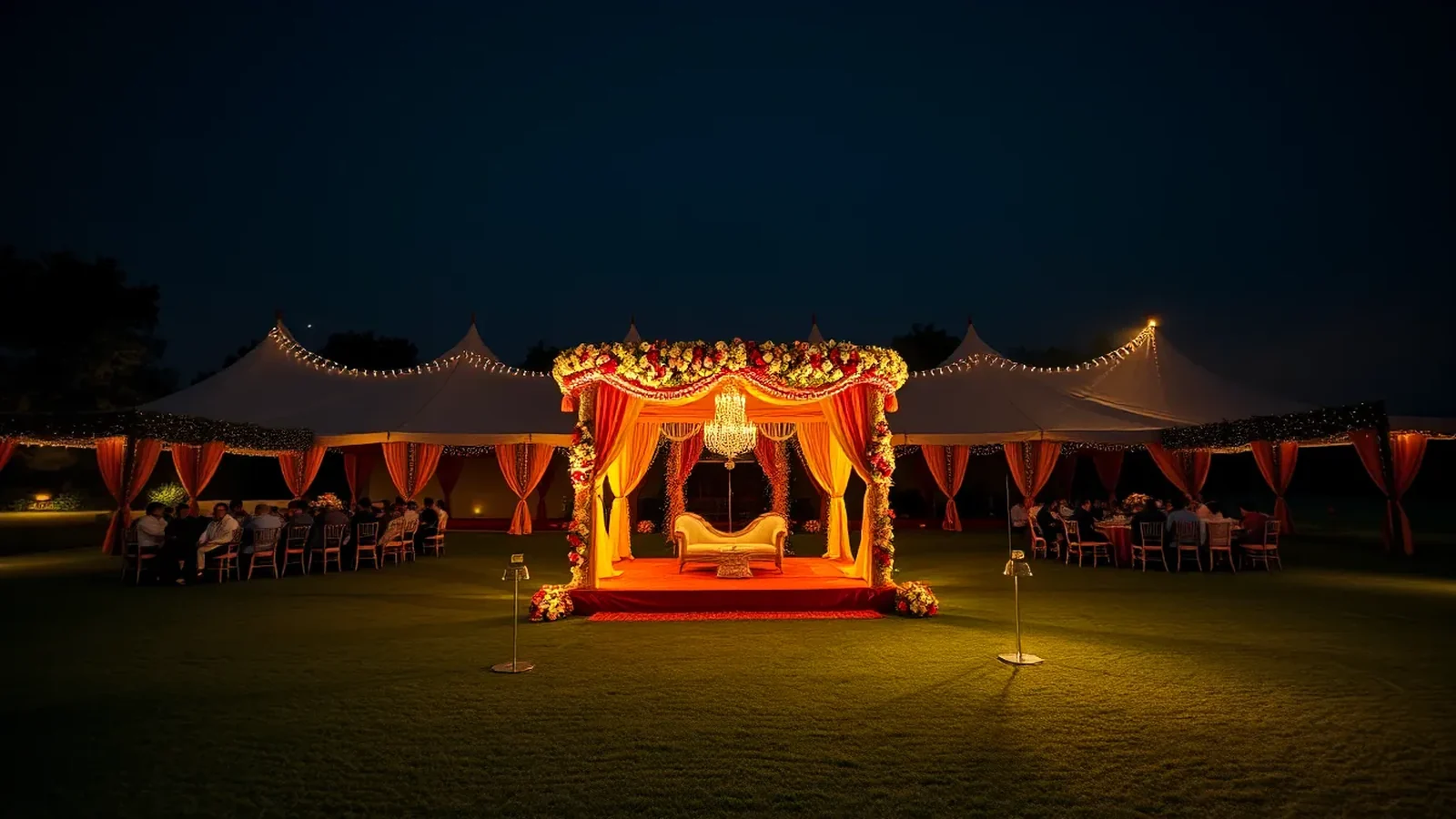
On a raw ground, the tent is the venue. You are not buying decoration, you are buying a building that stands for four days. That means the structural frame, the roof, the side walls, the ceiling liner, the raised platform, the flooring above it and the wind and load engineering that keeps all of it safe. At most Delhi NCR farmhouse weddings this becomes the single biggest line item after food, and at design-heavy weddings it overtakes food.
How tenting is actually priced. Vendors quote per square foot of covered area, not per guest, so the number moves with your layout, not your headcount. Planner estimate ranges for 2026: a basic covered German hangar or pagoda structure with plain lining runs roughly Rs 90 to Rs 160 per square foot, a clear-span structure with proper trussing, a finished ceiling and side glazing runs roughly Rs 200 to Rs 400 per square foot, and a fully clad climate-controlled structure with a hard shell finish can cross Rs 500. A 600-guest dinner needs 9,000 to 12,000 square feet of covered area before you add the stage, the buffet spine and the service corridor.
Flooring is a separate line and families forget it every time. Farmhouse lawns are grass and soil. Grass dies under 600 pairs of feet, soil turns to slurry after a light shower, and heels sink. A raised plywood deck with carpet or a vinyl finish typically adds Rs 60 to Rs 150 per square foot, and you need it under the dining area, the walkways, the stage and the bar. Skipping the deck to save money is the decision families most regret on the night.
Multi-day means multi-build. Three functions in three different corners of the property is three structures or one structure struck and rebuilt overnight. Both cost more than one build. If you can hold two functions in the same footprint with a changed ceiling and lighting design, you can often take 15 to 25 percent off the tenting bill without the guests noticing.
Power: generators, backup and the fuel bill
No farmhouse in India has enough sanctioned load to run a wedding. The property supply is sized for a house and a garden, perhaps 15 to 30 kVA. A wedding for 500 to 700 guests with cooling, a lit stage, a sound rig, a working kitchen and a decorated approach draws far more. Trying to run the event off the house supply is how you get a tripped main at the varmala.
Sizing, in plain terms. As a planner rule of thumb, a 500 to 700 guest winter farmhouse function needs roughly 250 to 400 kVA of generation, and a summer function with heavy cooling can need 500 to 750 kVA. Air cooling is the swing factor: ducted air conditioning for a covered structure can pull more power than the entire rest of the event combined. Lighting and sound for a serious production add 60 to 120 kVA on their own.
Always order N plus one. A single generator is a single point of failure and a failure at a farmhouse means total darkness, because there is no grid to fall back on. Order a redundant set sized to carry the critical load: lighting, sound, kitchen refrigeration and the washroom block. Planner estimate for 2026: silent DG sets rent at roughly Rs 9,000 to Rs 22,000 per day per set depending on capacity, and fuel is billed separately at actual consumption, commonly Rs 25,000 to Rs 90,000 across a full wedding day. Add an operator, a distribution panel, cabling and earthing.
Ask for the electrical layout, not just the quote. A competent vendor will hand you a load sheet, a distribution plan and an earthing note. If a vendor cannot produce a load sheet, they are guessing, and you will discover the guess at 9 pm.
Washrooms and guest comfort: the line nobody budgets
A farmhouse typically has two or three household bathrooms. That is a genuine hazard at 600 guests, and it is the fastest way to turn a beautiful wedding into a story about queues. Portable washroom units are not optional at scale, and the good ones are not cheap.
Plan the ratio before the aesthetics. A workable planning ratio is one washroom cubicle per 40 to 50 guests, weighted towards the ladies side, plus a separate block for staff so that 150 service and kitchen personnel are not using the guest facilities. For 600 guests that is roughly 12 to 16 guest cubicles. Planner estimate for 2026: basic portable cabins run around Rs 3,500 to Rs 7,000 per cubicle per day, while luxury trailer units with vanity counters, running hot water, ventilation and interior finishes run roughly Rs 12,000 to Rs 30,000 per cubicle per day. Add water supply, waste holding tanks, pump-out at the end and an attendant per block per shift.
Guest comfort extends past the washroom. Delhi NCR winters at an open venue are genuinely cold after 10 pm: budget patio heaters at roughly Rs 1,200 to Rs 2,500 per heater per day with gas, one per 20 to 25 seated guests. Summer needs industrial cooling, mist fans or ducted air. Also budget mosquito fogging on the morning of, a stocked first aid point, and a lit, level path from the parking to the entrance, because gravel and grass in the dark are how elderly guests fall.
Kitchen setup: building a production kitchen on grass
Farmhouses do not have commercial kitchens. A caterer serving 600 people plated or across a 40-counter buffet needs a working production line: gas banks, tandoors, ranges, prep tables, chilled storage for raw material, a wash-up area, a dish pit, water supply and drainage. At a farmhouse, all of that is built from nothing in the back of the property, then dismantled.
What this actually costs you. Most premium caterers do not itemise it. They fold it into a higher per plate rate, which is why the same caterer quotes Rs 300 to Rs 700 more per plate at a raw venue than at a hotel-style banquet. Some quote it separately as a setup or logistics charge of roughly Rs 1,50,000 to Rs 5,00,000 depending on scale and the number of functions. Either way you are paying for it. Ask your caterer directly: is the on-site kitchen build inside the per plate rate or outside it. Get the answer in writing.
Two further farmhouse-specific costs. First, food safety: with no cold room on site you need refrigerated storage or reefer vehicles, and in summer this is a health matter, not a luxury. Second, water: if the borewell water is hard or the supply is limited, you are buying tankers, and potable water for cooking is a separate purchase from washing water. Benchmarks for the food line itself sit in our wedding cost per plate guide.
Noise rules and time limits: how NCR compresses your running order
Open-air venues are governed by noise rules, and in Delhi NCR they are enforced. Under India’s noise pollution regulations, loudspeakers and public address systems are generally not permitted between 10 pm and 6 am, with limited state-notified exemptions on a small number of festival nights. Residential-zone ambient limits are lower than commercial ones, and most farmhouse belts sit in or adjacent to residential and green zones.
What this does to your timeline. The classic North Indian running order, baraat at 8 pm, jaimala at 10 pm, dinner at 11 pm, pheras at 2 am, does not survive a hard music cut-off. Either you compress everything forward by two hours, which families resist, or you accept the ceremony proceeds with dhol and shehnai only and amplified sound stops. The expensive version of this problem is the sound vendor and the DJ sitting idle while you pay them, or a complaint that brings a patrol car to the gate mid-function.
Plan it into the design, not around it. Move the loud, high-energy segment early, put the amplified entertainment before the cut-off, and design the post-cut-off portion around acoustic instruments and lighting. Some planners budget for a sound engineer whose only job after 10 pm is holding levels down and managing the perimeter. Check the specific position for your venue and date with the local authority and your Delhi wedding planner before the invitations print the timings.
Weather contingency: the most expensive thing families skip
A hotel does not need a rain plan. A farmhouse does. Unseasonal rain in Delhi NCR is no longer rare, western disturbances hit through winter, and a single hour of rain on an unprotected ground destroys flooring, shorts lighting circuits, floods the kitchen line and puts 600 guests under whatever roof exists. Every planner has watched this happen to somebody who declined the contingency line.
What a real wet-weather plan costs. There are three levels. The cheap one is a standby contract: a tent vendor holds crew, side walls and pumps on call, typically Rs 40,000 to Rs 1,50,000 as a retainer, and you pay the balance only if you invoke it. The middle option is building in the protection from the start, fully closed side walls, a waterproof ceiling liner, drainage channels and raised flooring, which typically adds 10 to 18 percent to the tenting bill. The expensive one is a genuine covered alternative footprint, effectively a second structure, which can add Rs 4,00,000 to Rs 15,00,000.
The mistake to avoid. Do not treat this as insurance against a low-probability event. Treat it as basic infrastructure, the same way you treat generators. Families who cut it saved perhaps 3 percent of the budget and then spent multiples of that on emergency mobilisation at 6 pm on the wedding day, at emergency rates, with no negotiating position. If you are working to the structure in our Rs 1 crore wedding budget guide, contingency belongs in the plan from version one.
Guest transport, parking and valet at an out-of-city venue
Farmhouse belts sit outside the city, and that is a cost centre. The main NCR farmhouse corridors are a 45 to 90 minute drive from central Delhi in evening traffic, and outstation guests are usually housed in hotels nowhere near the venue. If you do not solve movement, guests arrive late, leave early and remember the traffic rather than the wedding.
Budget the shuttle properly. Planner estimates for 2026: a 40 to 50 seat coach runs roughly Rs 10,000 to Rs 18,000 per day per vehicle including driver and fuel, a Tempo Traveller runs roughly Rs 5,500 to Rs 9,000, and premium sedans for the immediate family run Rs 4,000 to Rs 8,000 each. For 150 outstation guests moving twice a day across three days, this becomes a Rs 3,00,000 to Rs 7,00,000 line on its own. Add a transport coordinator with a manifest, because the coordination is what actually makes it work.
Parking and valet at a farmhouse are a real operation. Six hundred guests arrive in roughly 200 to 280 vehicles. Farmhouse parking is usually an unlit field, which means marshals, portable lighting, a hard or matted surface if it has rained, and a valet team of 15 to 25 for a large function at roughly Rs 900 to Rs 1,500 per person per shift. Also budget a dedicated approach lane so that guest cars and the caterer’s supply trucks are not fighting on the same single-lane road. If you are weighing venue locations across the region, compare against Gurgaon wedding costs and Noida wedding costs before committing.
Licences and permissions for an open venue
A hotel arrives pre-permitted. A farmhouse does not. When you book a five star, the fire clearance, the occupancy certificate, the kitchen licence and usually the liquor licence are the hotel’s problem. Take the wedding to private land and several of those obligations move to you, your planner or your vendors.
The categories to check, well in advance. Temporary structure and fire safety clearance for the tenting, which typically requires the tent vendor’s fire retardancy certification and an inspection. Liquor: a temporary event or occasional licence issued through the relevant state excise department, with different rules and dry days in Delhi, Haryana and Uttar Pradesh, so an NCR venue on the Haryana side follows Haryana’s rules regardless of where the family lives. Music licensing for the public performance of recorded and live music. Food safety registration for the caterer under FSSAI. Any local permission for amplified sound, generators or the use of a public approach road.
How to handle it without drama. Do not accept a verbal assurance that everything is covered. Ask for the actual certificates, in writing, at least three weeks before the date, and keep printed copies in the production file on site. Requirements and fees vary by state and by municipality and they change, so verify current rules with the relevant authority rather than relying on what a vendor did last season. A good planner runs this as a checklist with owners and dates against each item, which is one of the things you are paying for in the wedding planner fee.
Farmhouse weddings outside Delhi NCR
The format exists nationally, but it is priced very differently. Delhi NCR is the only market where the farmhouse is the default luxury wedding venue, which is exactly why NCR farmhouse rentals are the highest in the country. Elsewhere the raw-venue wedding takes local forms, and the infrastructure bill stays broadly similar while the ground rent collapses.
Where it works and roughly what changes. In Hyderabad, the equivalent is the large farm or resort ground on the ORR belt, and rentals commonly run 40 to 60 percent below comparable NCR properties, which is part of why the numbers in our Hyderabad luxury wedding cost guide read lower for the same production value. Around Bengaluru the format lives in the plantation and estate properties on the Kanakapura and Nandi Hills roads, covered in Bangalore wedding costs. Around Jaipur, farm venues on the Delhi and Ajmer roads compete directly with heritage properties, so read them alongside Jaipur wedding costs. Mumbai is the exception: land economics push the format out to Karjat, Lonavala and Alibaug, where it behaves as a destination wedding.
The trap in cheaper markets. Low rent tempts families into remote ground with no vendor ecosystem nearby. If the tenting crew, the generators and the caterer’s equipment all travel 150 kilometres, transport, crew accommodation and crew food can eat the entire rental saving. Cheap land plus expensive logistics is not a bargain.
Security, insurance and damage deposits
An open venue with a perimeter you do not control needs staffing. Farmhouses have long boundary walls, service gates and often adjoining fields, and on a wedding night there are 150 outside personnel on site who nobody can identify by face. Budget bouncers and guards at roughly Rs 1,200 to Rs 2,500 per person per shift, plan for 8 to 15 personnel at a 600-guest function, and add a dedicated guarded room for gifts, envelopes and jewellery, which is where nearly every wedding theft in India actually happens.
Damage deposits are standard and often misunderstood. Most farmhouse owners hold a refundable security deposit, commonly Rs 1,00,000 to Rs 5,00,000 depending on the property’s tier, against lawn damage, tree damage, broken fittings, nails driven into walls, oil stains from the kitchen line and late vacation of the site. Photograph the entire property with your planner at handover and again at handback, with timestamps. Deposits are far more often lost to a dispute about pre-existing damage than to anything the wedding actually did.
Event insurance is genuinely worth pricing at a raw venue. Public liability cover for guest injury, and cover for cancellation or postponement, are available from Indian general insurers and typically price at a small fraction of a percent of the insured amount. On land you do not own, with structures built for the week and a few hundred guests walking on temporary flooring in the dark, the liability question is not theoretical.
When a farmhouse genuinely costs more than a hotel
Add it all up and the farmhouse is not automatically the cheaper option. Below roughly 250 guests, a farmhouse is usually the more expensive route. The infrastructure bill, tenting, flooring, generators, washrooms and kitchen build, is largely fixed rather than per head, so it spreads across too few guests and the effective per guest cost overtakes a good five star banquet.
Single function weddings also favour the hotel. If you are hosting one evening rather than three or four, you pay a full build and strike for a few hours of use. Farmhouse economics reward multi-day weddings that amortise the infrastructure across several functions. So does a summer date: peak-summer cooling at an open venue can add Rs 3,00,000 to Rs 10,00,000 in cooling and power that a hotel simply includes.
Where the farmhouse clearly wins. Above roughly 400 guests, across two or more functions, in the November to February window, wanting a design you cannot execute inside a fixed banquet hall, and comfortable running a production rather than signing a package. That is the sweet spot, and in NCR it is why the format dominates. If your brief is instead a single elegant evening for 200, look at the venues in our luxury Delhi NCR venues roundup and price it against Delhi wedding costs before committing to a raw ground.
The decision rule, stated plainly. Build the full farmhouse number including every line on this page, then hold it against the hotel’s all-in number for the same guest count and the same number of functions. Use the headcount bands in wedding cost by guest count to sanity check both. If the farmhouse is not at least 15 percent cheaper on a fully loaded basis, take the hotel, because you are also buying back the operational risk that the farmhouse hands you.
Newly costed venues: The Umrao wedding cost, The Tivoli Chattarpur wedding cost.
Frequently Asked Questions
How much does a farmhouse wedding cost in India?
For 300-800 guests across 2-3 days in 2026, Rs 35 lakh to Rs 2.5 crore all-in. Venue rental alone is Rs 3-25 lakh per day in the Delhi-NCR premium belt.
Why are farmhouse weddings so popular in Delhi?
Capacity and control. Farmhouses host 500-1,500 guests that hotels cannot, and they allow outside caterers, decorators, and fully custom production, which Delhi’s large, design-driven weddings demand.
Are farmhouse weddings cheaper than hotel weddings?
The venue rental is often cheaper, but because you bring everything else (catering, decor, power, tenting, hospitality), the all-in cost can match or exceed a hotel wedding. The trade-off is control and capacity, not always savings.
Do farmhouses provide guest accommodation?
Most don’t. Out-station guests stay at nearby hotels, which adds a logistics and transport layer a planner typically manages.
Sources and further reading
- Federation of Hotel and Restaurant Associations of India
- Wedding Sutra: venue coverage
- Velvet Knot: Wedding venue cost guide
- Velvet Knot: Wedding catering cost guide
Still deciding? Read our farmhouse vs resort wedding comparison.
Begin Your Engagement
Want a real number for your wedding?
Tell us your city, guest count and dates. Team Velvet Knot will come back within 24 hours with an itemised budget.