The Umrao Gurgaon Wedding Cost 2026: Lawns, Rooms and Real Budgets
- The short answer: what a wedding at The Umrao costs
- Cost breakdown
- The lawns and halls, and which suits which function
- The 60 room constraint against a 1000 guest list
- Location, NH8 and the airport, and what that means for guests
- Worked example: 700 guests over three days
- Parking and arrival when most guests self drive
- Who this venue is wrong for
- What is included versus charged separately
- Frequently Asked Questions
- Sources and further reading
A full wedding at The Umrao, Samalkha typically lands between Rs 42 lakh and Rs 1.75 crore in 2026. The venue sells 15 acres of lawns that seat up to 1500, but holds only 60 air-conditioned rooms, so almost every guest drives in from Delhi NCR. That single fact reshapes the catering, parking and hospitality budget.
The short answer: what a wedding at The Umrao costs
For a three function wedding at The Umrao, Samalkha, most families should plan on Rs 42 lakh to Rs 1.75 crore, all in. The lower end assumes about 350 to 400 guests, one lawn, a single overnight for close family, restrained florals and a house sound and light package. The upper end assumes 900 to 1200 guests across two or three lawns, imported and out of season flowers, a built stage with a custom entrance, a live act and a full production crew. The middle of that band, roughly Rs 80 lakh to Rs 1.1 crore, is where most 600 to 800 guest weddings actually settle once the final invoices are reconciled.
The number is wide because The Umrao is not a fixed price product. It is a large open air property that sells space, food and beverage, and a small block of rooms, then leaves almost everything else to your vendors. Two families using the same lawn on the same weekend can be Rs 60 lakh apart purely on the strength of their decor brief and their guest count. Food and beverage is the one line that scales with brutal predictability, and on a lawn wedding of this scale it will usually consume between 35 and 45 per cent of the total.
Costs move more with the venue and the guest count than with anything else, so it is worth talking to a wedding planner in Gurgaon before the shortlist is fixed.
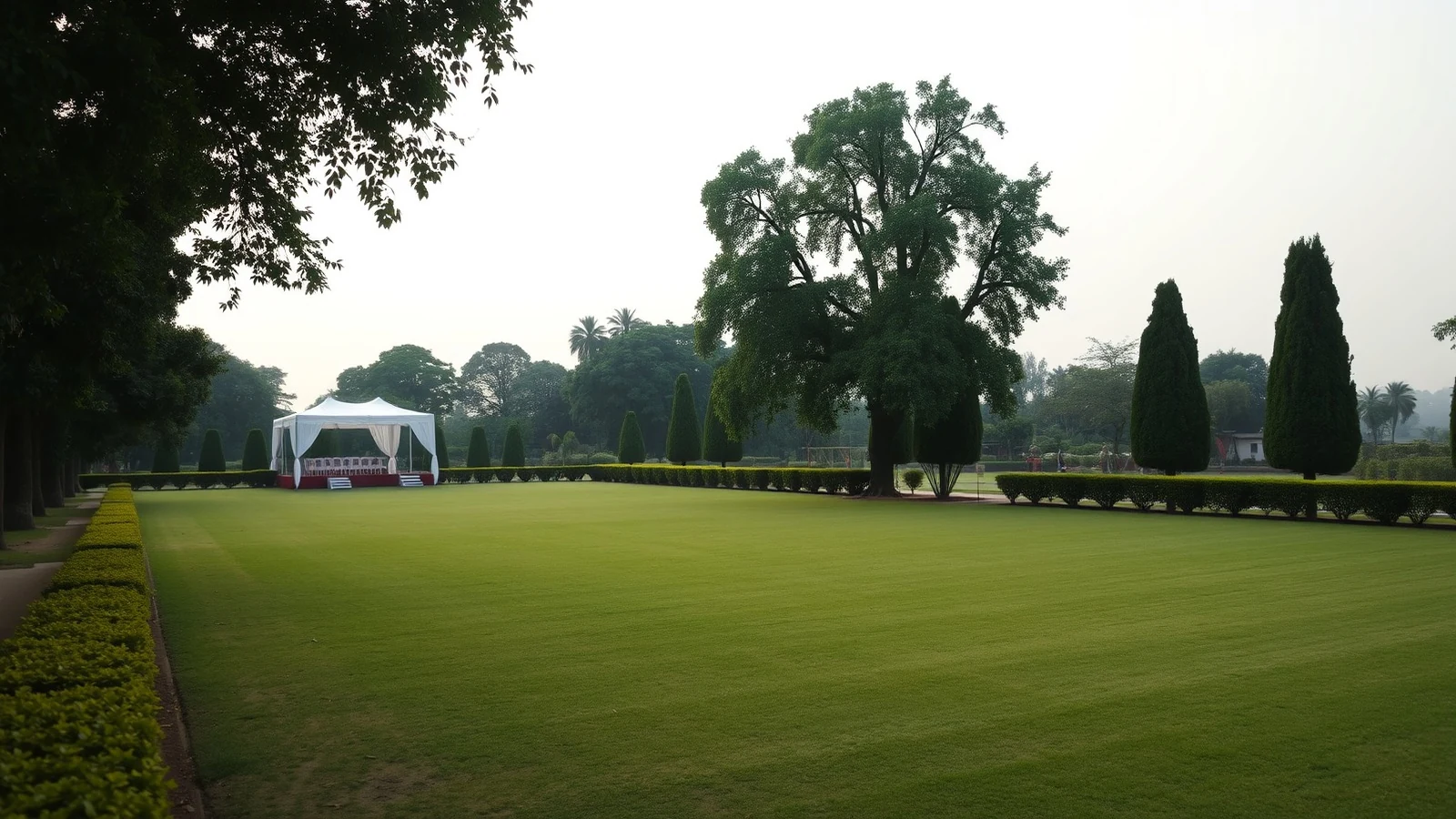
Two structural facts drive everything else on this page. First, the lawns are enormous: four of them, each seating around 1000 and holding around 1500 on a floating format, on 15 acres, with the property designed to host up to 1800 people. Second, there are only 60 air-conditioned rooms. That mismatch is not a flaw, it is the venue’s business model. It is built for the NCR wedding where guests arrive by car in the evening and leave by one in the morning. Price it as a day guest venue, not a resort takeover, and the budget behaves. Price it as a destination wedding and the hospitality line will quietly break.
If you are still comparing formats, our Delhi wedding cost guide sets the wider NCR benchmark, and the farmhouse wedding cost breakdown explains why open air venues price so differently from indoor hotel ballrooms. For a shortlist with live 2026 rates for your specific dates, use our enquiry form.
Cost breakdown
The table below is the working shape of a wedding at this property. Ranges assume 2026 rates, a peak season Saturday or Sunday in the November to February window, and a guest count in the 500 to 900 band. Off season dates in July and August, and midweek dates in any month, typically sit 15 to 30 per cent below the figures shown, mostly through rental waivers and softer minimum guarantees rather than through cheaper food.
| Line | Typical range | What moves it |
|---|---|---|
| Venue rental, per lawn or hall, per function | Rs 2.5 lakh to Rs 9 lakh | Which lawn, day of week, season, and whether you are taking one space or blocking the property. Rental is often reduced or waived against a food and beverage minimum guarantee, so negotiate the two together, never separately. |
| Food and beverage | Rs 1,700 to Rs 3,500 per plate | Vegetarian versus mixed menu, number of live counters, dessert and chaat stations, and whether alcohol is on the venue licence or brought in. Service charge and GST sit on top of the quoted plate rate. |
| Decor, florals and entrance | Rs 8 lakh to Rs 45 lakh | Lawn area is the single biggest multiplier. A 1000 seat lawn needs three to four times the flower volume of a 250 seat hall. Imported blooms, custom fabrication and a built mandap push this line hardest. |
| Rooms and hospitality | Rs 6 lakh to Rs 20 lakh | Only 60 rooms exist. Nights blocked, whether you take all 60, and how many overflow rooms you pick up at hotels on NH8 or in Aerocity. Airport transfers for outstation guests sit here too. |
| Production, sound, light and staging | Rs 5 lakh to Rs 18 lakh | Open lawns need far more rigging and far more light than an indoor hall. Generator backup, truss, LED walls and a raised stage are all separate. Delhi and Gurgaon noise rules effectively cap amplified sound at night, which changes the rig you need. |
| Planning, coordination and contingency | 8 to 15 per cent of spend | Scope of the planner, number of functions, and how much guest logistics you hand over. Our wedding planner cost guide explains the fee models. Hold a further 5 to 8 per cent for on the day additions, which at this scale are close to certain. |
A note on how quotes arrive. Large lawn venues in the NCR usually present a bundled per plate figure with rental folded in, then list decor, production and rooms as exclusions. That bundle looks cleaner than it is. Ask for rental and food to be separated on paper, because the minimum guarantee is the number that actually binds you. If the venue quotes a minimum of 700 covers and 520 people turn up, you pay for 700. On a Rs 2,400 plate that is Rs 4.3 lakh of food nobody ate, and it is the most common avoidable overspend at properties of this size.
Compare these numbers against a ballroom before committing. The five star hotel wedding cost guide shows how a hotel absorbs production, power and rooms into its own rate card, which can make a smaller hotel wedding cost less per guest than a large lawn wedding even though the headline plate rate looks higher.
The lawns and halls, and which suits which function
The Umrao’s usable inventory is straightforward once you stop thinking of it as one venue. Lawns 1, 2, 3 and 4 each seat roughly 1000 and hold around 1500 in a floating format. The Main Hall seats about 250 and holds around 275 floating. The Poolside Banquet Hall seats about 200 and holds around 300 floating. The whole property is designed to carry up to 1800 people, and the practical range starts as low as 130 for a small indoor function.
The obvious allocation is the one most planners land on. Put the reception or the main wedding on a lawn, because that is the only space that can absorb 700 plus people with a stage, a dance floor and enough catering counters to keep queues short. Put the mehendi or the haldi on a second lawn if you want daylight and open space, or in the Poolside Banquet Hall if you want a smaller, contained afternoon with a natural backdrop and no dependence on the weather. Keep the Main Hall for the sangeet only if your sangeet guest list is genuinely under 250, which for most NCR families it is not. More often the Main Hall works better as a wet weather fallback, a cocktail room for the immediate family after the main function ends, or a holding space for the baraat.
Two operational points matter more than the seating chart. First, adjacency. If you book two lawns for two functions on the same evening, sound bleed between them is a real problem on open ground, and it is worse than most families expect from a floor plan. Ask which lawns share a boundary and how the venue has separated them before, and if the answer is vague, stagger the functions in time rather than in space. Second, coverage. A 1000 seat lawn under a clear sky is beautiful in November and unusable in unseasonal rain. Pandal or German hangar coverage on a lawn of that size is a meaningful cost, frequently Rs 3 lakh to Rs 8 lakh depending on span and finish, and it is almost always an exclusion. Decide in the contract stage whether you are buying coverage or buying a gamble.
Third, and this is the one that gets missed, lawn size drives decor cost non linearly. Doubling the seated capacity does not double the flower bill, it tends to increase it by a factor closer to two and a half, because an empty lawn reads as empty from every angle and needs perimeter treatment, pathway lighting and vertical structures that a hall simply does not. If your guest list is 400, take one lawn and dress it tightly rather than taking a 1000 seater and trying to fill it. Our venue cost guide covers this space to spend ratio across venue types.
The 60 room constraint against a 1000 guest list
This is the defining tension of The Umrao and the single thing to get right before you sign. Sixty air-conditioned rooms against lawns that hold 1500. At two people per room that is 120 beds for a guest list that may run eight or ten times larger. There is no version of this property that houses your whole wedding.
Handled correctly, that is not a problem, it is a saving. The Umrao’s natural guest is the Delhi NCR family whose guests live within an hour’s drive. Those guests do not want a room. They want to arrive at eight, eat well, dance, and be home by one. If 85 per cent of your list is local, you need the 60 rooms only for the couple, the immediate families, the outstation elders, the priest and possibly the performing artists, and your hospitality line stays around Rs 8 lakh to Rs 13 lakh for the full block over two nights. That is a fraction of what a resort takeover would cost.
Handled badly, it is expensive and chaotic. If a third of your guest list is flying in from Mumbai, Kolkata or overseas, you are running an off site room programme for 200 or 300 people, and every one of them needs a transfer to and from the property for every function. The nearest sensible overflow is the hotel cluster along NH8 towards Manesar and IFFCO Chowk, and Aerocity near the airport for guests who want to be close to their flights. Budget realistically: Rs 7,000 to Rs 18,000 per room per night depending on property and season, plus Rs 2,500 to Rs 4,000 per vehicle per movement for coaches and cars. Three hundred outstation guests over two nights with four movements each will add Rs 25 lakh to Rs 40 lakh that never appears on the venue’s quote.
The practical rule is a ratio test. Count the percentage of your guest list that will not need a bed. If that number is above 80 per cent, The Umrao is well matched to your wedding and the 60 rooms are sufficient. If it is between 60 and 80 per cent, it works but you need a dedicated hospitality lead and a proper transport plan. If it is below 60 per cent, you are paying lawn prices for capacity you cannot house, and a resort property on the Jaipur highway or a hotel with a large room block will almost certainly cost you less overall. For weddings at Rs 5 crore and above where the entire guest list is flown in and hosted, look at our by invitation service instead.
One more thing. Allocate the 60 rooms on paper, by name, six weeks out. At every large NCR venue the last week collapses into requests from relatives who assumed a room existed. Sixty is a small number and it will be contested. A published allocation, circulated early, prevents a very unpleasant conversation on the morning of the wedding.
Location, NH8 and the airport, and what that means for guests
The Umrao sits at Samalkha on NH8, on the stretch of highway that runs between South West Delhi and Gurgaon, close to Indira Gandhi International Airport. For a wedding, that position does three useful things and one inconvenient one.
The useful things first. Airport proximity is genuine and it matters. Outstation guests can land, clear the terminal and be at the property without crossing the city, which removes the worst variable in any Delhi wedding, namely the drive from the airport to somewhere in the middle of town at six in the evening. It also means your artists, photographers and out of town vendors arrive on time. Second, the venue draws from both Delhi and Gurgaon, so a mixed guest list does not force half the room into a two hour journey. Third, being on a national highway rather than inside a colony means access roads are wide and coach movement is straightforward, which is not true of many farmhouse venues on the Chattarpur and Rajokri belts.
The inconvenient thing is that NH8 is one of the busiest highway corridors in the country and the stretch near the airport is heavily trafficked on Friday and Saturday evenings. A drive that takes 30 minutes at noon can take 75 at eight in the evening. Build that into your running order. If your muhurat is fixed and your baraat is coming from central or east Delhi, add a full hour of buffer over the map estimate, and tell guests the arrival time you want rather than the time the function starts. In practice this means printing an arrival window on the invitation insert, not a start time.
Two further points for outstation guests. Communicate the property’s highway side clearly, because on a divided national highway a missed turn costs 15 minutes and a U turn in heavy traffic. Send a pinned location and the name of the nearest recognisable landmark, not just the address. And if you have elderly guests flying in, the airport proximity is worth using properly: a same day arrival and a room at the venue for the two nights of the main functions is a far kinder plan than a hotel 40 minutes away with four highway transfers.
Worked example: 700 guests over three days
The following is a realistic, upper middle build for a family that wants the wedding to look substantial without commissioning bespoke fabrication. Three functions: a mehendi lunch on Lawn 3 for 300, a sangeet on Lawn 2 for 650, and the wedding and reception on Lawn 1 for 700. Sixty rooms taken for two nights. Peak season Friday to Sunday. Roughly 88 per cent of the guest list is local to Delhi NCR.
| Line | Assumption | Cost |
|---|---|---|
| Venue rental | Three lawn bookings across three days, partially offset against a food and beverage minimum guarantee | Rs 14 lakh |
| Food and beverage | Approximately 2,100 covers across three functions at an average of Rs 2,400 per plate, before taxes | Rs 50 lakh |
| Decor and florals | Three lawn sets, entrance treatment, mandap, stage, pathway and perimeter lighting, partial coverage on the main lawn | Rs 22 lakh |
| Rooms and hospitality | All 60 rooms for two nights at roughly Rs 11,000 per room per night, plus welcome hampers and airport pickups for outstation family | Rs 13.2 lakh |
| Production, sound, light, power | Open lawn rig for three functions, generator backup, LED wall for the sangeet | Rs 9 lakh |
| Photography, film and entertainment | Two person photo and film team across three days, one mid tier live act, DJ for two nights | Rs 12 lakh |
| Guest logistics | Valet team, parking marshals, signage on the approach, two shuttle coaches for outstation guests | Rs 4.5 lakh |
| Planning and coordination | Full service planning at approximately 10 per cent of managed spend | Rs 12.5 lakh |
| Contingency | 8 per cent held against on the day additions, weather cover and guest count overrun | Rs 10 lakh |
| Total | 700 guests, three functions, three days | Rs 1.47 crore |
Read that total as an upper middle build, not a ceiling and not a floor. The same 700 guests can be delivered at close to Rs 92 lakh by taking two lawns instead of three, moving the mehendi indoors to the Poolside Banquet Hall, holding the plate rate at Rs 1,900, and cutting the floral brief to seasonal Indian stems with structural lighting doing the heavy lifting. The same 700 guests can also cross Rs 2.1 crore with imported flowers, a custom built entrance, a headline performer and a full second production crew for the sangeet.
Two lines in that table are worth watching in particular. The food and beverage figure of Rs 50 lakh is 34 per cent of the total and is the least compressible number on the page, because it is set by headcount, not by taste. The decor figure of Rs 22 lakh is the most compressible and the one where families most often overspend, because on a 1000 seat lawn it is easy to keep adding without seeing a visible difference. Set a decor number before you brief the designer, not after.
Parking and arrival when most guests self drive
At The Umrao, parking is not a footnote, it is a core piece of guest experience. If 700 people arrive and 88 per cent of them are local, you should expect somewhere between 220 and 300 cars, most of them landing inside a 45 minute window between eight and nine in the evening. That is the moment your wedding either feels organised or feels like a traffic jam with a shehnai.
Plan for it in four parts. First, count the cars, do not guess. Take your local guest list, divide households by an average of 2.4 people per car for NCR weddings, and add 15 per cent for vendors, family, artists and staff. Second, stage the valet. One valet desk cannot clear 250 cars. Two receiving points with separate stacking areas, and at least 12 to 16 valet staff on a 700 guest night, is the working benchmark. Budget Rs 1.5 lakh to Rs 3 lakh for valet and marshalling at this scale, and confirm in writing whether the venue provides it or whether you are contracting it.
Third, manage the highway approach. Because the property sits on NH8, cars queueing to turn in create a hazard and a delay that compounds quickly. Marshals should be positioned before the turn in, not at the gate, with lit batons and reflective vests. Ask the venue how it has handled entry queueing for 1000 plus guest events previously, and ask specifically about the exit, which is the harder problem. Everyone leaves within about 25 minutes of the last course, and an unmanaged exit at a highway venue is genuinely unsafe.
Fourth, plan the late departure. Guests who have been drinking will be driving home on a national highway after midnight. A pre booked cab desk near the exit, and a visible offer of it, is inexpensive and worth every rupee. Some families now retain 10 to 15 drivers for the night for elderly relatives and for anyone who needs one. At Rs 1,200 to Rs 1,800 per driver, it is a rounding error against a Rs 1.4 crore wedding and it is the kind of detail guests remember. This is the sort of operational load a planner absorbs, and if you are weighing whether to hire one, our planner cost guide sets out what full service coordination actually covers.
Who this venue is wrong for
Families whose guest list is mostly outstation
Sixty rooms cannot carry a fly in wedding. If more than 40 per cent of your list is arriving from another city or country, you will spend Rs 25 lakh to Rs 40 lakh on off site rooms and transfers that a resort property would have absorbed into a single negotiated rate. The lawns are wasted on you, and the logistics will dominate the week.
Weddings under 250 guests
Below about 250, the property works against you. A 1000 seat lawn dressed for 200 people looks thin no matter how much you spend, and the fix is more decor, which means you pay a large venue premium and then pay again to disguise the size. An intimate wedding is better served by a hotel ballroom or a smaller farmhouse, and the per guest cost will be lower on both.
Anyone who needs loud music past the cut off
Amplified sound at open air venues across Delhi and the NCR is restricted at night under noise pollution rules, and enforcement near residential and highway zones is real. If a sangeet that runs at full volume until three in the morning is central to your plan, an open lawn on NH8 is the wrong choice. An indoor banquet, where sound is contained, is the honest answer.
Couples who want a fixed, all inclusive price
This is an unbundled venue. It sells space, food and a small room block, and everything else, decor, production, coverage, valet, is contracted separately by you or your planner. If you want one invoice and one point of accountability, a five star hotel package will suit you better even at a higher headline plate rate.
What is included versus charged separately
Assume nothing here, and get the exclusion list in writing before the advance goes out. What is generally included in a venue and catering contract at a property of this type is the lawn or hall itself for a defined time window, standard tables, chairs and basic linen, the kitchen and catering service staff, house public address for announcements, basic ambient lighting on the lawn, security at the gate, and housekeeping. Rooms, when booked, come with standard hotel amenities and breakfast.
What is almost always charged separately is the longer list. Decor and florals in full, including the mandap, stage, entrance and any fabric or fabrication. Pandal or hangar coverage against weather. Professional sound, DJ, truss, moving lights and LED. Generator backup beyond the house load, which an LED wall and a full lighting rig will exceed. Bar service, and if you are bringing your own alcohol, a corkage charge plus the excise permit, which in Haryana and Delhi is a real, dated document that someone has to physically obtain. Photography and film. Valet and parking management, unless explicitly stated. Fireworks or cold pyro, where permitted at all. Additional service staff beyond the standard ratio, which on a 700 guest lawn wedding you will need. Room service, laundry and minibar consumption in the 60 rooms, which is billed to the master account by default unless you cap it in advance.
Three contractual points to settle at signing. One, the minimum guarantee and how it is measured, by plates served or by confirmed headcount, and whether unused covers roll across functions. Two, the overtime clause. Lawn contracts often specify an end time and charge steeply per hour beyond it, and Indian weddings run late by nature, so negotiate a stated grace period rather than discovering the rate at two in the morning. Three, taxes and service charge. A per plate rate quoted at Rs 2,400 typically becomes closer to Rs 2,800 once service charge and GST are applied, and on 2,100 covers that difference is Rs 8.4 lakh. Always model your budget on the landed figure.
Finally, ask what happens to the master account for the 60 rooms. The most common post wedding dispute at properties of this size is not the food bill, it is Rs 2 lakh of unbudgeted room service and minibar charges from relatives who reasonably assumed it was covered. Set a per room incidental cap, tell your guests, and put it in the contract.
Frequently Asked Questions
What is the per plate cost at The Umrao?
Expect roughly Rs 1,700 to Rs 3,500 per plate before service charge and GST, depending on whether the menu is vegetarian or mixed, how many live counters you add, and the season. A quoted rate of Rs 2,400 typically lands near Rs 2,800 once taxes and service charge are applied, so always budget on the landed figure rather than the headline one.
How many guests can The Umrao actually hold?
The property spans 15 acres and is designed to host up to 1800 people, with a practical working range from about 130 for a small indoor function upwards. Lawns 1, 2, 3 and 4 each seat around 1000 and hold around 1500 floating, the Main Hall seats about 250, and the Poolside Banquet Hall seats about 200 with roughly 300 floating.
Are 60 rooms enough for a large wedding there?
Only if the great majority of your guests are local to Delhi NCR and will drive home the same night. Sixty rooms is enough for the couple, immediate family, elders, the priest and artists. If more than about 40 per cent of your list is outstation, you will need an off site room block on NH8 or in Aerocity plus a full transport plan, which adds significant cost.
How far is The Umrao from Delhi airport?
It sits at Samalkha on NH8, close to Indira Gandhi International Airport, so outstation guests can reach the property without crossing the city. Allow generously for traffic on Friday and Saturday evenings, when the highway corridor is heavily loaded and a 30 minute drive can stretch past an hour.
Is venue rental waived if I meet a food minimum?
Often, partially. Large lawn venues in the NCR commonly offset some or all of the rental against a minimum food and beverage guarantee. Negotiate the two together, and confirm exactly how the minimum is measured, because if your guaranteed cover count exceeds your actual attendance you pay for the difference regardless.
Which lawn should I use for the main wedding?
Take the largest available lawn for the function with the biggest headcount, usually the wedding or reception, since only a lawn absorbs 700 plus guests with a stage, dance floor and enough catering counters to keep queues short. Use the Poolside Banquet Hall for a smaller daytime mehendi, and hold the Main Hall as a weather fallback or a family cocktail space.
Sources and further reading
- The Umrao, official website, for current inventory, lawn capacities and enquiry contacts.
- Delhi Tourism, Government of NCT of Delhi, for official visitor information, travel guidance and regional context for outstation guests.
- Britannica: Gurugram, for background on the city, its position on the Delhi NH8 corridor and its growth as an NCR hub.
Begin Your Engagement
Want a real number for your wedding?
Tell us your city, guest count and dates. Team Velvet Knot will come back within 24 hours with an itemised budget.