Ashirbaad: The Bengali Blessing Ceremony Before the Wedding
- What ashirbaad is
- Paddy and durba grass
- What happens
- How it differs from a North Indian engagement
- Where it sits in the Bengali sequence
- Aiburo bhaat, and what follows
- The gold, and what it signifies
- Sourcing dhaan and durba outside Bengal
- The piri, and the alpona
- Practical notes
- Frequently Asked Questions
- Sources and further reading
Ashirbaad is the Bengali ceremony in which elders from each family visit the other’s home and bless the bride and groom with husked paddy and durba grass, along with gold. It is a blessing rather than a negotiation, which is what distinguishes it from a North Indian engagement.
What ashirbaad is
Ashirbaad, also written aashirbaad or ashirwad, means blessing. In Bengali practice it is a distinct pre-wedding ceremony, usually held some days before the wedding, in which the elders of each family travel to the other’s home to bless the young person they are about to gain.
The elders of the groom’s family go to the bride’s home and bless her. Separately, the elders of the bride’s family go to the groom’s home and bless him. The two visits are reciprocal and are usually held on the same day or close together.
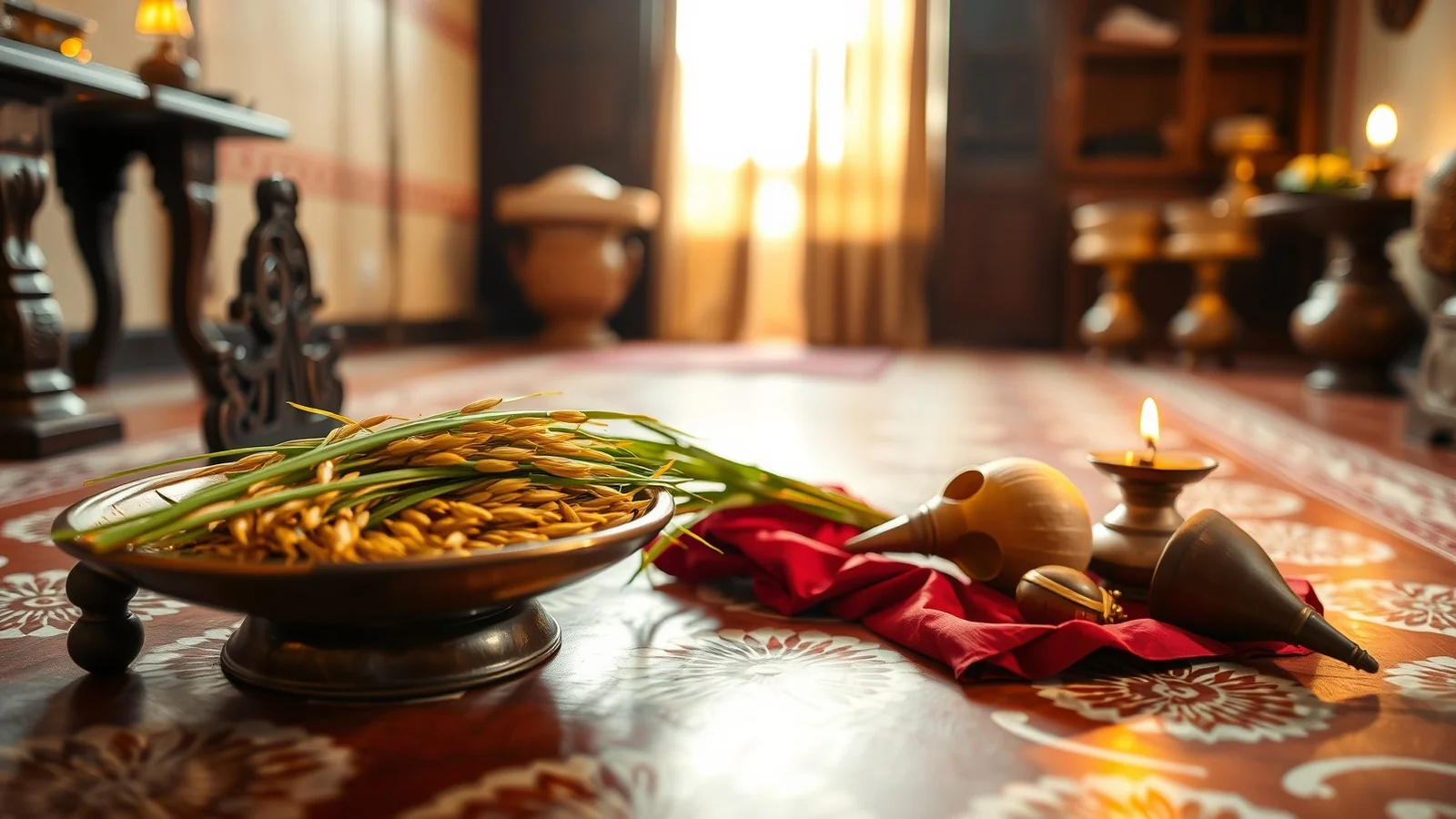
The blessing itself is specific. The elders sprinkle husked paddy, dhaan, and blades of durba grass over the head of the bride or groom, and present gold ornaments. That combination of grain and grass recurs throughout Bengali ritual and is the signature of the ceremony.
Paddy and durba grass
The two materials are chosen for what they represent, and neither is decorative.
Dhaan, husked paddy, is unmilled rice: the grain still in its husk, capable of being sown. It stands for prosperity in its productive form rather than as stored wealth. Bengal is a rice culture, and paddy is the most direct expression of sustenance available.
Durba grass is a hardy creeping grass that survives drought, spreads readily and is almost impossible to kill. It stands for resilience, longevity and continuation of the line. It appears again in the gath bandhan knot in North Indian practice and in the offerings at Ganesh puja.
Sprinkled together over the head, they form a compact wish: may you be prosperous and may you endure. It is a more agricultural and less transactional set of symbols than the trays and cash of a North Indian engagement.
What happens
- The elders travel. A delegation of senior relatives, traditionally excluding the parents in the strictest form of the custom, goes to the other family’s home.
- The young person is seated on a low wooden seat, the piri, often decorated with alpona, the white rice-paste patterns characteristic of Bengali ritual.
- The blessing. Each elder in turn sprinkles dhaan and durba over the head, sometimes touching the head or chin.
- Gold is given. Ornaments are presented, and in many families this is the principal jewellery gift of the whole wedding.
- Sweets. Bengali sweets are fed and distributed, and a substantial meal usually follows.
- Fish and other gifts, in many families, along with clothing and a saree for the bride.
The strict form excludes the parents from the blessing party, on the reasoning that the parents’ role comes later at the wedding itself. Many families have relaxed this, and parents now commonly attend.
How it differs from a North Indian engagement
Ashirbaad is frequently described in English as the Bengali engagement, and that translation is misleading in one important way.
A sagai is an agreement between families, marked by an exchange of rings and reciprocal trays of gifts. Both sides give, both sides receive, and the symmetry of the exchange is part of what is being demonstrated.
Ashirbaad is a blessing conferred by elders on a young person. The direction is downward, from senior to junior, not lateral between families. The bride does not bless the groom’s elders in return; they bless her, and her elders separately bless him.
There is usually no ring exchange in the traditional form, though many modern Bengali families now add one. And the agreement to marry has typically already been settled before ashirbaad happens, so the ceremony confirms rather than negotiates.
The South Indian nischitartham is different again, centring on a written agreement and the fixing of the wedding muhurtam.
Where it sits in the Bengali sequence
- Ashirbaad. The blessing, some days before the wedding.
- Aiburo bhaat. The last meal eaten as an unmarried person, hosted by the family.
- Gaye holud. The Bengali turmeric ceremony, closely related to haldi, in which turmeric paste is sent from the groom’s house to the bride’s.
- Bor Jatri and Bou Boron. The groom’s party travels; the bride’s family receives them.
- Subho Drishti and Mala Badal. The first look and the exchange of garlands. See the garland exchange.
- Saat Paak and Sindoor Daan. Circling and the application of vermilion. See sindoor daan.
- Bidaay and Bou Bhaat. The departure and the reception at the groom’s home. See the vidaai and griha pravesh.
The full sequence is covered in our guide to Bengali wedding traditions, and the costs in the Bengali wedding cost guide.
Aiburo bhaat, and what follows
Ashirbaad opens a short run of Bengali pre-wedding ceremonies that are worth knowing as a set, since families outside the tradition often plan for the wedding and are surprised by the preceding week.
Aiburo bhaat is the last meal eaten as an unmarried person, hosted separately for the bride and the groom by their own families. It is a full traditional Bengali spread served on a banana leaf, and the person being fed is treated as guest of honour in their own home. It is affectionate, slightly teasing, and for many people the most enjoyable event of the whole wedding.
Gaye holud follows, the Bengali turmeric ceremony, in which the paste used on the bride is sent from the groom’s house along with gifts, fish and sweets. It differs from the North Indian haldi in that the material itself travels between the households, which makes it an exchange rather than two parallel events.
The gold, and what it signifies
In many Bengali families the ashirbaad jewellery is the principal gift of the entire wedding, and this catches out families organising a mixed-tradition event who have budgeted for the wedding day instead.
Gold given at ashirbaad is given by the elders, not by the parents in the strictest form, and it is given to the young person directly rather than to the family. It is understood as hers or his personally, which is the same principle that governs muh dikhai gifts in North Indian practice.
The convention is worth stating plainly to younger relatives, because the alternative is a set of assumptions nobody voices. Gifts given freely by one family to the other’s child are custom. Anything demanded of a family as a condition of the marriage is dowry, which is a criminal offence in India under the Dowry Prohibition Act, 1961.
Sourcing dhaan and durba outside Bengal
The two materials at the centre of the ceremony are the two hardest things to obtain if the wedding is anywhere other than West Bengal.
Dhaan is husked paddy, rice still in its husk. It is not the same as the raw rice sold for cooking, and substituting cooking rice is noticeable to anyone who knows the ritual. Durba is a specific creeping grass, and generic lawn grass is not a substitute.
- The usual solution is a relative in Kolkata sending a package, which needs a fortnight rather than a few days.
- Bengali grocers in most Indian metros and in cities with a Bengali diaspora stock both around the wedding season.
- Priests engaged for Bengali ceremonies outside Bengal usually have a supply chain and should be asked first.
- Quantity is small, so a single package covers both reciprocal visits.
For the rest of the sequence, see our guide to Bengali wedding traditions.
The piri, and the alpona
Two visual elements make a Bengali ashirbaad recognisable, and both take preparation.
The piri is a low, flat wooden seat, often carved and painted, on which the person being blessed sits. It is used again at the wedding itself, where the bride is famously carried on one for the Saat Paak. Families that own one keep it for generations; those that do not usually rent or buy one for the wedding.
Alpona is the white rice-paste pattern painted on the floor around the seat, drawn freehand by the women of the family. It takes hours and is done the night before or that morning, and it is one of the few Bengali ritual arts still practised widely. A printed floor sticker is now sold as a substitute and is unmistakably not the same thing to anyone who knows.
Practical notes
- Source the dhaan and durba properly. Husked paddy and durba grass are specific items, not generic rice and greenery. Outside Bengal they need ordering ahead, and a Kolkata-based relative sending them is the usual solution.
- Decide whether parents attend. The strict form excludes them. Families disagree about this and it is better settled beforehand.
- Coordinate the two visits. They are reciprocal and are usually held the same day. Two families each waiting for the other to go first is a real and slightly comic failure mode.
- Plan the gold. In many Bengali families the ashirbaad jewellery is the principal gift of the wedding, not a token.
- Prepare the piri. The low decorated wooden seat is traditional, and alpona takes time to lay. A chair works but is noticeably not the same.
- Keep it small and warm. This is a house ceremony. It does not improve at scale.
Planning a wedding that honours these traditions?
Team Velvet Knot plans weddings across every major Indian tradition, and we brief vendors on the rituals so nothing gets rushed, mistimed or quietly dropped from the running order. Tell us your dates and your community, and we will come back with an honest plan.
The puja that follows: read our full guide to the Satyanarayan puja.
Frequently Asked Questions
What is the ashirbaad ceremony?
Ashirbaad means blessing. It is the Bengali pre-wedding ceremony in which elders of each family visit the other’s home and bless the bride or groom by sprinkling husked paddy and durba grass over their head, and present gold ornaments.
Why paddy and durba grass?
Husked paddy is rice still capable of being sown, so it represents prosperity in its productive form. Durba grass is hardy, spreads readily and is almost impossible to kill, so it represents resilience and longevity. Together they form a compact wish: be prosperous and endure.
Is ashirbaad the same as an engagement?
Not quite, and the difference matters. A North Indian sagai is a lateral agreement between families with rings and reciprocal gifts. Ashirbaad is a blessing conferred downward by elders on a young person, and the decision to marry has usually already been made before it happens.
Do the parents attend?
In the strictest form, no. The blessing party is made up of other senior relatives, on the reasoning that the parents have their own role at the wedding itself. Many families have relaxed this and parents now commonly attend, so it is worth agreeing beforehand.
When is ashirbaad held?
Some days before the wedding, with the two reciprocal visits usually on the same day or close together. It comes before aiburo bhaat and gaye holud in the Bengali sequence.
Are rings exchanged at ashirbaad?
Not in the traditional form, though many modern Bengali families now add a ring exchange. The substance of the ceremony is the blessing with paddy and durba and the giving of gold, rather than an exchange between the couple.
Sources and further reading
Begin Your Engagement
Want a real number for your wedding?
Tell us your city, guest count and dates. Team Velvet Knot will come back within 24 hours with an itemised budget.