Muh Dikhai: The Face Showing Ceremony at the Groom’s Home
- What muh dikhai means
- Where the custom comes from
- How the ceremony runs
- What gifts are given
- Regional names and variations
- What the bride should know beforehand
- How families are changing the ceremony
- Gift etiquette, for both sides
- Practical notes
- Related post-wedding rituals
- Frequently Asked Questions
- Sources and further reading
Muh dikhai is the post-wedding ceremony at the groom’s home where the bride’s veil is lifted and the women of his family see her face for the first time. Each relative who looks gives her a gift, and it is her formal welcome into the household.
What muh dikhai means
Muh means face and dikhai means showing. Muh dikhai, also written mooh dikhai or munh dikhai, is the ceremony in which the new bride’s face is formally shown to the female relatives of her husband’s family after she arrives at his home.
It is held on the day the bride arrives, immediately after or shortly following the griha pravesh, her first entry into the marital home. In some families it is held the next morning, once the household has recovered from the wedding.
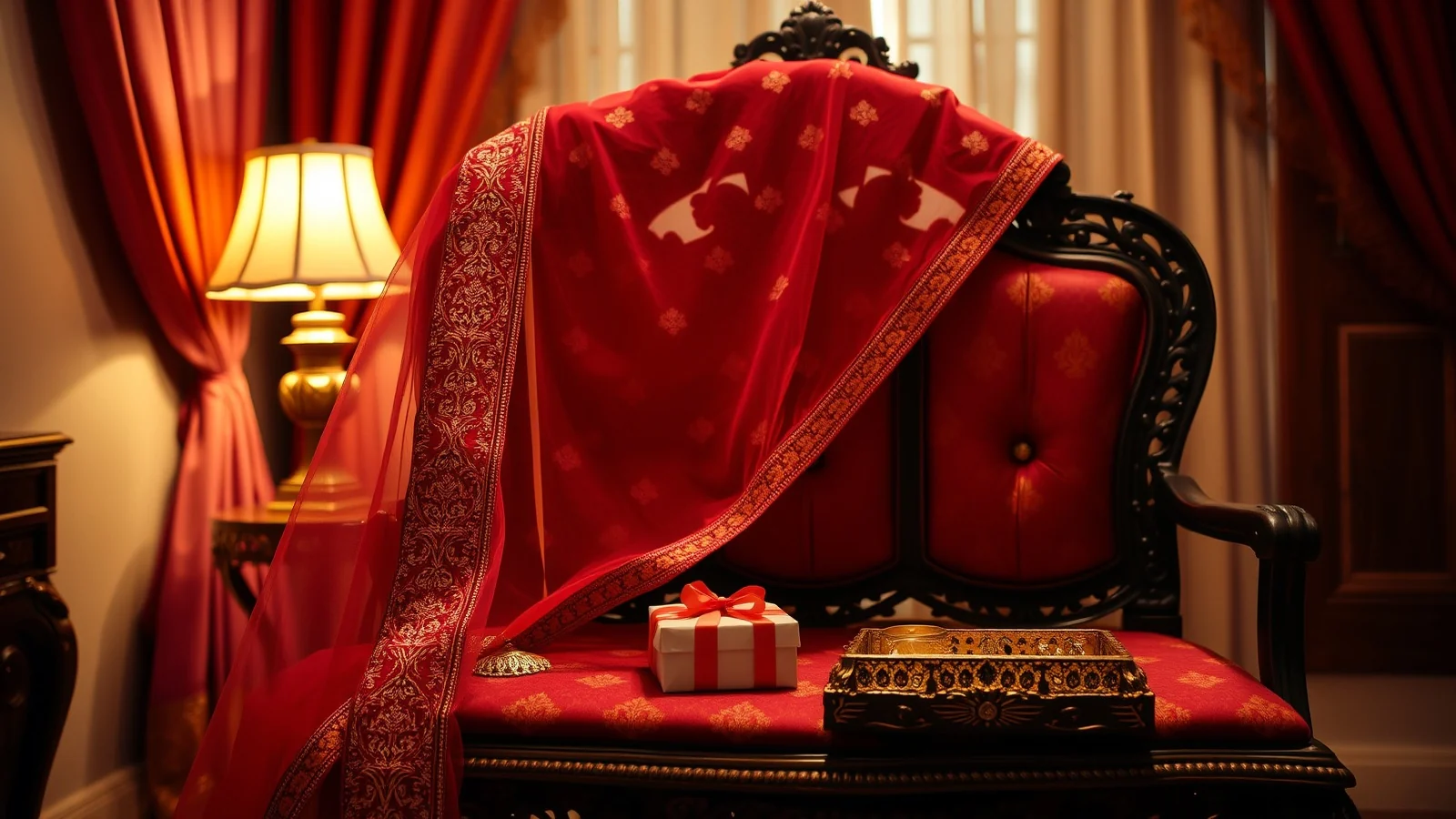
The bride is seated, usually on a decorated seat or bed, with her ghunghat or dupatta covering her face. The women of the family approach one at a time. Each lifts the veil, looks at her face, blesses her, and gives her a gift. This is the whole ceremony, and it is quieter and more intimate than anything that has happened in the previous three days.
Where the custom comes from
The ritual is a direct survivor of arranged marriage practice in an era of limited travel and limited photography. The groom’s extended family, aunts, grandmothers, cousins, neighbours, would genuinely not have seen the bride before. Muh dikhai was the occasion on which they met her.
The gift-giving is the second half of the logic. A new bride arrived in an unfamiliar house with no independent resources of her own. The gifts given at muh dikhai, traditionally jewellery, cash, sarees or heirloom pieces, were hers personally rather than the household’s, and constituted the beginning of her own security. In many families this remains explicit: muh dikhai gifts belong to the bride, not to the couple and not to the family.
That original purpose has largely dissolved. Couples now meet long before the wedding and the extended family has seen the bride on a phone screen a hundred times. What survives is the welcome, and it does that job well.
How the ceremony runs
- The arrival. The bride enters the marital home for the first time and performs griha pravesh, usually kicking over a vessel of rice at the threshold.
- The seating. She is seated in the main room, veiled, often on a decorated seat with the family gathered around.
- The showing. Female relatives approach in rough order of seniority. The mother-in-law and the husband’s grandmother generally go first, then aunts, then sisters-in-law, then cousins and neighbours.
- The gifts. Each woman gives something as she lifts the veil. Jewellery from the closest relatives, cash or clothing from others.
- The blessing. Older women bless the bride, often touching her head or feeding her something sweet.
In many families the groom’s sister or a young cousin sits beside the bride throughout, both to make introductions and to make sure she is not left alone in a room full of strangers. It is a small kindness with a real function.
What gifts are given
Custom varies, but a rough hierarchy holds across most North Indian families.
- Mother-in-law. Usually the most significant gift, often a gold piece or a family heirloom passed to the new bride.
- Grandmother and senior aunts. Jewellery, silver, or a saree of significance.
- Sisters-in-law and cousins. Clothing, smaller jewellery, or cash.
- Neighbours and distant relatives. A token cash amount, often in an envelope.
Two points are worth stating plainly. First, the gifts are traditionally the bride’s own property, and treating them otherwise runs against the purpose of the custom. Second, muh dikhai is a gift-giving ritual and not a dowry practice. Dowry, meaning any demand made of the bride’s family as a condition of the marriage, is a criminal offence in India under the Dowry Prohibition Act, 1961. Gifts given voluntarily by the groom’s family to the bride at her welcome are a different thing entirely, and no family should allow the two to be blurred.
Regional names and variations
The ceremony exists across much of India under different names and with different emphases.
- North India generally. Muh dikhai, with veil lifting and gifts, most strongly observed in Punjabi, Haryanvi, Uttar Pradesh and Rajasthani families. See Punjabi and Marwari traditions.
- Gujarati. A closely equivalent welcome ritual is performed as part of the bride’s arrival. See Gujarati wedding traditions.
- Bengali. The bride’s arrival ceremony is called bou bhaat in its fuller form and includes the family formally receiving her. See Bengali wedding traditions.
- Muslim. A parallel custom is widely observed when the bride arrives at her husband’s home after the nikah and rukhsati. See Muslim wedding traditions.
- South Indian. There is no direct veil-lifting equivalent, since the ghunghat itself is not part of the tradition. The welcome is performed through reception rituals and the nalangu. See South Indian wedding traditions.
What the bride should know beforehand
Muh dikhai is the point at which a bride, usually exhausted and often far from home, meets a large number of people who all already know who she is. A little preparation makes it a great deal easier.
- Ask for a written list. Names, relationships and, ideally, one detail about each person. Most grooms are happy to prepare it and it has never once been unwelcome.
- Learn the address terms. Whether the household uses bhabhi, jethani, devrani, nanad, chachi or something regional matters more than remembering names, because using the wrong term for a senior relative is noticed.
- Know what you are expected to say. In most families, very little. A greeting and touching the feet of the seniors is usually the whole requirement.
- Decide about the ghunghat in advance. Some families expect it, others do not, and a bride who has assumed one way and finds the other is uncomfortable for the whole ceremony. Ask the groom to check.
- Have someone beside you. A sister-in-law or cousin who can whisper names. Most families provide this instinctively; if yours has not thought of it, request it.
The gifts are hers. This is worth being clear about with everyone at the outset, gently and early, because the alternative is a conversation months later that is much harder to have.
How families are changing the ceremony
Muh dikhai is being reshaped more actively than most post-wedding rituals, because its original premise, that nobody has seen the bride, is now obviously untrue.
The veil is often symbolic or absent. Many families keep the gift-giving and the blessing and drop the ghunghat entirely, particularly where the bride has been visiting the household for months. The ceremony survives as a welcome rather than as a reveal.
It is moving to the next morning. Holding it immediately on arrival, at midnight, after a full day of ceremonies and the vidaai, produces a bride who is barely conscious and photographs to match. Morning muh dikhai is now common and is a straightforward improvement.
It is becoming reciprocal. A growing number of families hold an equivalent ceremony for the groom at the bride’s home, where her relatives meet him formally and give him gifts. There is no traditional name for it, families invent one, and it addresses an obvious asymmetry in the older practice.
The guest list is shrinking. Families are increasingly separating the intimate family version from the larger social reception, and the ceremony is much better for it.
Gift etiquette, for both sides
The gift-giving is the part guests worry about, and the conventions are simpler than people fear.
For those giving. Scale to relationship, not to what others are giving. Close relatives give jewellery or something of family significance; more distant relatives and neighbours give cash, clothing or a small token. Cash is given in an envelope, conventionally in an amount ending in one, such as a hundred and one or a thousand and one, since the extra rupee is considered auspicious and marks the sum as a blessing rather than a transaction. Nothing about this is competitive and treating it as such is poor form.
For the receiving family. Someone should quietly note who gave what. Not for accounting, but because the bride will want to thank people specifically and will otherwise have no idea. A phone note taken discreetly by a sister-in-law is enough.
For everyone. The line that must not be crossed is any suggestion that a gift is expected from the bride’s family in return, or that anything is owed. Voluntary gifts to a new bride at her welcome are a warm custom. Demands made of her family are dowry, and dowry is a criminal offence in India under the Dowry Prohibition Act, 1961. Families should keep the distinction visible, particularly to younger relatives who may not know where the line sits.
Practical notes
- Schedule it for energy, not tradition. A bride who has been awake for twenty hours and has just been through the vidaai is in no state to meet forty new relatives. Many families now hold muh dikhai the following morning, and it is a better ceremony for it.
- Brief the bride on who is who. A written list of names and relationships, given quietly beforehand, spares her an hour of guessing.
- Keep the guest list contained. The ceremony works at fifteen to thirty women. At a hundred it becomes a receiving line.
- Record the gifts. Not for accounting, but because the bride will want to know later who gave her what, and nobody remembers.
- Photograph it properly. It is indoor, low light and easy to miss, and it produces the most genuinely emotional images of the post-wedding day.
For the full arc of post-wedding rituals and how they connect, see our complete guide to Hindu wedding rituals.
Planning a wedding that honours these traditions?
Team Velvet Knot plans weddings across every major Indian tradition, and we brief vendors on the rituals so nothing gets rushed, mistimed or quietly dropped from the running order. Tell us your dates and your community, and we will come back with an honest plan.
Related post-wedding rituals
Frequently Asked Questions
What does muh dikhai mean?
It literally means face showing. It is the ceremony at the groom’s home where the new bride’s veil is lifted so that the women of her husband’s family can see her face, bless her and give her a gift. It is her formal welcome into the household.
When is muh dikhai held?
Traditionally on the day the bride arrives at her marital home, immediately after or shortly following the griha pravesh. Many families now hold it the next morning instead, which is far kinder to a bride who has been awake for a day and a night.
Who lifts the bride’s veil?
The women of the groom’s family, one at a time, generally in order of seniority. The mother-in-law and the husband’s grandmother usually go first, followed by aunts, sisters-in-law, cousins and neighbours. Each lifts the veil, blesses her and gives a gift.
What gifts are given at muh dikhai?
Jewellery, cash, sarees or heirloom pieces, scaled roughly by closeness of relationship. The mother-in-law’s gift is usually the most significant. Traditionally these gifts are the bride’s own personal property rather than the household’s or the couple’s.
Is muh dikhai the same as dowry?
No, and the distinction matters. Muh dikhai gifts are given voluntarily by the groom’s family to the bride as a welcome. Dowry means property or money demanded from the bride’s family as a condition of the marriage, and it is a criminal offence in India under the Dowry Prohibition Act, 1961.
Do South Indian weddings have muh dikhai?
Not in the veil-lifting form, since the ghunghat is not part of South Indian bridal tradition. The welcoming function is served instead through reception rituals and the nalangu, an evening of games that introduces the bride to her new family.
Sources and further reading
Begin Your Engagement
Want a real number for your wedding?
Tell us your city, guest count and dates. Team Velvet Knot will come back within 24 hours with an itemised budget.