Vidaai Ceremony: Meaning, Rituals, and Modern Practice
- What Vidaai means and why it matters
- The ritual sequence of a traditional Vidaai
- Regional variations of the Vidaai
- Modern Vidaai: how the ceremony has changed
- The music tradition: what songs are sung at a Vidaai
- Photography brief for the Vidaai
- Related inspiration
- Related post-wedding rituals
- Frequently Asked Questions
- Related ceremonies on Velvet Knot
- Sources and further reading
The Vidaai (also spelled Bidaai) is the closing ceremony of a Hindu wedding, marking the moment the bride leaves her parental home and formally transitions into her husband’s family. It is the most emotional moment of any Indian wedding, layered with symbolism: the bride throwing rice over her shoulder as a parting gift to her parents, the doli or car departure, the songs of farewell sung by family women. The Vidaai is not just an exit. It is a ritualised goodbye that carries the weight of every other ceremony that preceded it.
What Vidaai means and why it matters
The Hindi word vidaai means “farewell” or “send-off”. In the context of an Indian wedding, the Vidaai is the closing rite that follows the Saptapadi (the seven steps), the Sindoor Daan (the application of sindoor), and the formal solemnisation of the marriage. The bride, now formally married, prepares to leave her parental home with the groom’s family.
The Vidaai carries weight that few other Indian rites match. It is the moment when the abstract idea of “leaving home” becomes physical reality. For Hindu families, particularly in North India, the Vidaai is the most-photographed and most-felt ceremony of the entire wedding sequence. It is what the family will remember about the wedding twenty years later.
The ritual sequence of a traditional Vidaai
- Preparation. After the wedding ceremony (typically the Saptapadi and the Sindoor Daan), the bride changes into a traveling outfit, often a saree or lehenga in red or pink. Her parents and immediate family gather. The departure timing is usually set 1-3 hours after the wedding ceremony completes, often late evening or early next morning.
- Final aarti. The bride’s mother performs a final aarti for both the bride and groom. The aarti acknowledges the new son-in-law’s arrival into the extended family and blesses the couple for the journey ahead. In some families this is preceded by a Phera puja.
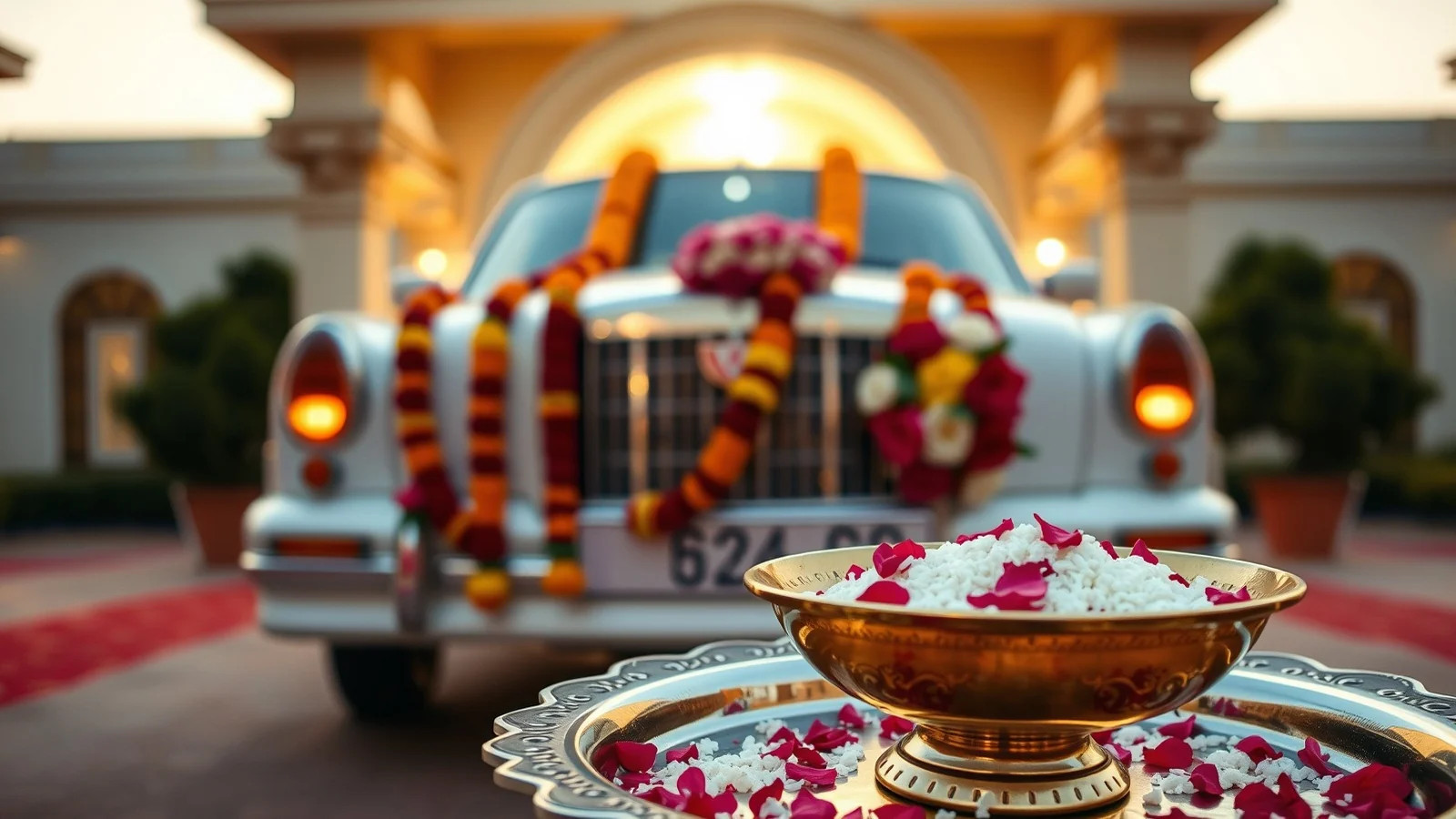
- Rice-throwing ritual (the Khoi Bhada). The bride is given a handful of puffed rice or wheat (called khoi) and asked to throw it backward over her shoulder without looking. The rice symbolises the bride’s gratitude to her parental home, repaying everything she has received with this symbolic offering. Family elders catch the rice in their cupped hands. In some traditions the bride throws the rice three times (some say five). This is the single most photographed Vidaai moment.
- The doorway crossing. The bride crosses the threshold of her parental home with the groom by her side. In many traditional families the bride is carried (by brothers or close male relatives) across the threshold rather than walking. The crossing is itself a ritual: the bride is leaving the protection of her parental home and entering the world of her husband’s family.
- The doli (or car) departure. Traditionally the bride departed in a doli (a palanquin carried by four men). Modern weddings replace the doli with a car (often a vintage car or a luxury sedan), occasionally a horse-drawn carriage in destination weddings. The bride sits in the doli or car, the groom either alongside or in a separate vehicle.
- The songs. Family women (particularly the bride’s mother, aunts, and elder female cousins) sing Vidaai songs as the bride departs. These are traditional folk songs (Punjabi Vidaai geet, Marwari Banno geet, Bengali Bidaai songeet) that describe the bride’s farewell and the parents’ loss. The songs are typically accompanied by tears from family women and the bride herself.
- The departure. The doli or car drives away with the bride. Family stands at the gate or driveway watching. The wedding is now formally complete.
Planning the wedding these rituals belong to?
Velvet Knot plans luxury Indian weddings end to end, from every ceremony and its decor to the venue, vendors and guest hospitality. Share your dates for a tailored plan.
Regional variations of the Vidaai
Punjabi Vidaai
The Punjabi Vidaai has the strongest musical tradition. Songs include Babul mera, Sadda chidiyaan da chamba, and similar folk and film-influenced Vidaai geet. Dhol players are silent during the actual departure (out of respect for the emotional moment), then play softly as the family disperses afterward.
Marwari Vidaai
The Marwari version is more ritually elaborate. The bride performs a final puja with the family Kuldevi (family deity). The Khoi Bhada is performed three times. A Bhaat ritual (gifts brought by the bride’s maternal uncle) happens immediately before the Vidaai. Marwari Vidaai songs are typically in Rajasthani folk tradition.
Bengali Bidaai
Bengali tradition calls this the Bidaai. The bride performs the Sindoor Daan and immediately the Vidaai sequence begins. Family women sing Bidaai geet, often referring to the bride’s parental nicknames. The bride departs in a car (traditionally a palki in older format).
South Indian Vidaai (called the Grihapravesham at the groom’s home, but the bride’s departure has different names)
South Indian Vidaai is generally shorter and less musically elaborate. Tamil Brahmin families call the departure the Naga Valli. Telugu families call it the Pelli close-out. The bride departs after the Sumangali blessings. Often less weeping, more ritual closure with garlands and aarti.
Sikh Doli
Sikh weddings have a closing ceremony called the Doli (the same word used for the palanquin). After the Anand Karaj at the Gurudwara, the bride returns home, changes, and the Doli departure happens at the bride’s home. Often accompanied by the Doli geet sung by family women. Sikh families have particularly emotive Vidaai music: the song Babul (originally an Indian classical / film composition) is iconic.
Gujarati Vidaai
Gujarati Vidaai includes the Bidaai ritual but also a specific moment called the Phera Phali (where the bride’s brothers carry her on their shoulders to the departing vehicle). Songs include Gujarati film and folk Vidaai geet.
Modern Vidaai: how the ceremony has changed
Three things have shifted in 2026 Vidaai practice:
- Format compression. Many urban couples and NRI families compress the Vidaai into a 30-45 minute ceremony rather than the traditional 2-3 hour sequence. The full ritual (aarti, Khoi Bhada, doorway crossing, doli) still happens but is photographed efficiently.
- Less weeping, more celebration. Modern couples increasingly treat the Vidaai as a “send-off” rather than a “farewell”. The bride still does the Khoi Bhada and the family sings Vidaai songs, but the tone shifts toward celebrating the journey rather than mourning the departure.
- NRI Vidaai logistics. When the bride is moving abroad (to the US, UK, UAE), the Vidaai often takes place with the entire family knowing she will not return for months or years. This adds emotional weight. We brief the photography team specifically for these: the photographs become the family’s most-shared record of the moment.
The music tradition: what songs are sung at a Vidaai
Traditional and modern Vidaai songs (depending on community):
- Punjabi / Hindi film: “Babul ka aangan”, “Babul Mora”, “Sadda chidiyaan da chamba” (folk), “Babul” (Aankhen 1968), “Aaj Mere Yaar Ki Shaadi Hai” (Aadmi 1968): modern Bollywood
- Marwari / Rajasthani folk: “Banno teri ankhiyan”, “Padharo Mhare Des” (different context but used), “Hichki” folk songs
- Bengali: “Bidaai geet” tradition with various regional folk compositions, “Lagi nahi chhute Raam” (devotional, but used)
- Sikh: “Babul”, “Mehndi Hai Rachne Wali” (Zubeidaa 2001): modern Bollywood adaptation
- Modern Bollywood Vidaai standards used across communities: “Maa Da Laadla”, “Babul” (Hum Apke Hain Kaun), “Vidaai” (Pyaar Toh Hona Hi Tha), “Aaja Mahi” (Singh Is King)
Photography brief for the Vidaai
The Vidaai is the single most important photography moment of the wedding. Specific shots the family will want:
- The bride’s final aarti with her mother
- The Khoi Bhada (rice-throwing) moment, from behind the bride looking toward the family
- The bride’s parents’ faces during the rice-throwing
- The bride hugging each family member individually
- The doorway crossing
- The doli or car departure with the family watching
- The first 30 seconds after the car leaves: the family standing at the gate
The photographer needs to be briefed 24 hours ahead. Many wedding photographers under-cover the Vidaai because they assume it is “the end” of the wedding when it is actually the climax.
Related inspiration
Related post-wedding rituals
- griha pravesh, the bride’s first entry
- muh dikhai, the face showing ceremony
- pag phera, the bride’s first return home
Frequently Asked Questions
What does the Vidaai ceremony mean?
Vidaai literally means “farewell” in Hindi. In the context of an Indian wedding, it is the closing ceremony when the bride leaves her parental home for the first time as a married woman and joins her husband’s family. The ceremony has been part of Indian wedding tradition for centuries and carries deep emotional and cultural significance.
What is the meaning of throwing rice at Vidaai?
The Khoi Bhada (rice-throwing ritual) is the bride’s symbolic act of repaying her parental home for everything she has received. The rice represents prosperity, blessings, and gratitude. By throwing it backward over her shoulder without looking, the bride is saying “I give back to you what you have given me: may my parental home remain blessed and prosperous after I leave.”
How long does the Vidaai ceremony take?
Traditional Vidaai runs 2-3 hours including the final aarti, Khoi Bhada, photography, the family farewells, and the doli or car departure. Modern compressed Vidaai (urban couples, NRI families) typically runs 45-90 minutes.
Is the Vidaai still relevant in modern weddings?
Yes, and increasingly photographed as the emotional centrepiece of the wedding. Modern interpretations may compress the format and shift the tone (from weeping farewell to celebratory send-off), but the core ritual elements (aarti, Khoi Bhada, doorway crossing, doli departure) remain consistent across nearly all Hindu wedding traditions in India.
Do South Indian and Bengali weddings have a Vidaai?
Yes, but the format and emotional weight differ. South Indian Vidaai is generally shorter and less musically elaborate. Bengali Bidaai includes the same core rituals (aarti, the bride’s farewell to family) but with Bengali Bidaai geet and the specific moment when the bride is carried out of her parental home. See our South Indian wedding traditions and Bengali wedding traditions guides for community-specific detail.
Should the bride cry at her Vidaai?
There is no rule. Some brides cry deeply, some hold composure, some smile through the ceremony. Cultural expectation in traditional families has historically been emotional weeping, but modern Vidaai is more open to whatever the bride and family feel naturally. The ceremony itself carries the weight; the bride’s expression does not need to match a specific template.
Related ceremonies on Velvet Knot
The Vidaai is the closing ceremony. For the ceremonies that precede it, see our Saptapadi guide, the Haldi ceremony guide, and the broader Hindu wedding rituals guide. For community-specific Vidaai variations, read our Punjabi, Marwari, Bengali, and South Indian wedding tradition guides. To plan your wedding with Velvet Knot, request a quote.
Sources and further reading
- Hindu Marriage Act, 1955 (text on India Code): Government of India
- Hindu wedding overview: Encyclopaedia Britannica
- Samskara (Hindu rite of passage): Encyclopaedia Britannica
Begin Your Engagement
Want a real number for your wedding?
Tell us your city, guest count and dates. Team Velvet Knot will come back within 24 hours with an itemised budget.