Saptapadi: The Seven Vows of Hindu Marriage Explained
- What the Saptapadi actually is
- The seven vows in detail
- Regional variations of the Saptapadi
- Planning notes for the Saptapadi from a working wedding planner
- Related wedding traditions
- Related South Indian rituals
- Related wedding rituals
- The seven steps in one table
- What happens immediately after the seventh step
- Frequently Asked Questions
- Related rituals on Velvet Knot
- Sources and further reading
The Saptapadi (literally “seven steps”) is the central rite of a Hindu wedding. The bride and groom take seven steps around the sacred fire, with each step accompanied by a specific vow. The vow content varies across regional traditions, but the seven-step sequence is consistent across almost every Hindu wedding format in India.
What the Saptapadi actually is
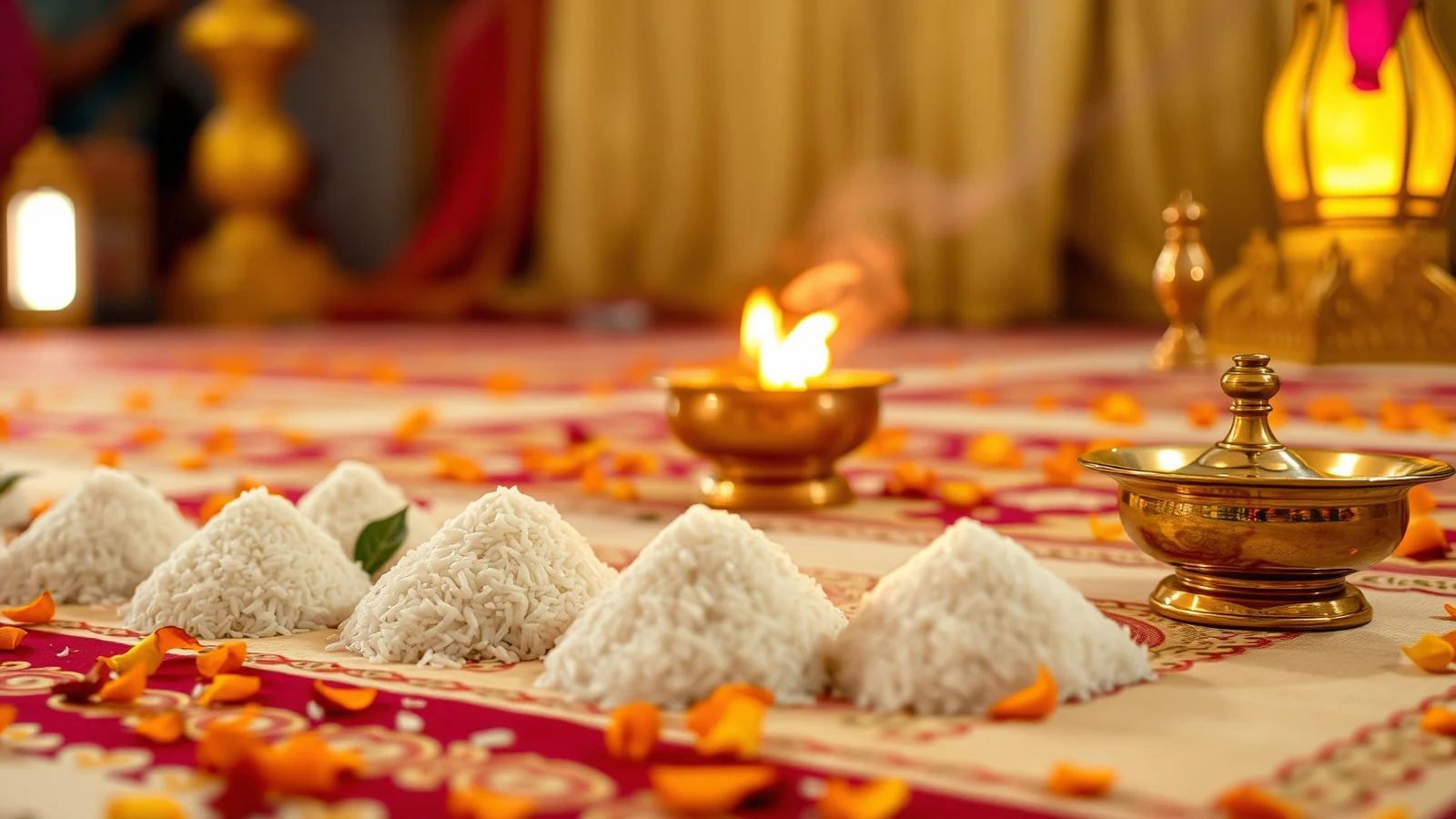
The Saptapadi (Sanskrit: सप्तपदी, “seven steps”) is the rite within a Hindu wedding where the bride and groom take seven steps together, typically around the Vivaha Homa (sacred fire), or in some Tamil and Telugu traditions, with the bride placing her right foot on seven small rice mounds. Each step is paired with a vow recited by the priest, or by the couple themselves, depending on the family tradition.
The Saptapadi is treated as the moment the marriage becomes binding under Hindu law. The Hindu Marriage Act, 1955, Section 7(2), specifically recognises the Saptapadi as the point at which a Hindu marriage is solemnised when the rite is observed in that form. This is why most Hindu wedding planning is structured around making the Saptapadi the centrepiece of the ceremony.
The seven vows in detail
Vow content varies. The most widely-cited form is the Rigvedic version that appears in most North Indian and Bengali weddings. Tamil Brahmin Iyer and Iyengar weddings, Maharashtrian weddings, and Marwari weddings each have variations in wording, though the underlying themes (food, strength, prosperity, family, friendship, health, lifelong partnership) are consistent. The form below is the most commonly used in 2026 weddings we plan.
Step 1: Anna Vrata: the vow for nourishment
Sanskrit (approximate): “ॐ ईशे एकपदी भव सा मामनुव्रता भव विष्णुस्त्वानुनयतु”
English meaning: “Let us take the first step together for the wellbeing of our home and for sustenance. May we share food and provide for each other and our family.” The first vow is the vow of nourishment: the commitment to feed each other and the household.
Step 2: Bala Vrata: the vow for strength
English meaning: “Let us take the second step together for strength of body, mind, and spirit. May we draw strength from each other to face life’s challenges.” The vow of physical, emotional, and spiritual strength.
Step 3: Dhana Vrata: the vow for prosperity
English meaning: “Let us take the third step together for the prosperity of our home and the preservation of wealth. May we work together to build resources, both material and spiritual.” The vow for prosperity and shared financial future.
Step 4: Saukhya Vrata: the vow for happiness
English meaning: “Let us take the fourth step together for happiness, in good times and difficult. May we bring comfort and joy to one another.” The vow for shared happiness across all phases of life.
Step 5: Praja Vrata: the vow for family
English meaning: “Let us take the fifth step together for the children we may have and for their welfare. May we be blessed with strong, virtuous offspring.” The vow for the continuation of the family. In modern interpretations, families often extend this vow to include shared care for elders and the wider family circle.
Step 6: Ritu Vrata: the vow for health and seasons
English meaning: “Let us take the sixth step together for a long life of harmony across all seasons. May we stay in good health and care for each other through the cycles of life.” The vow for longevity and shared health.
Step 7: Sakhi Vrata: the vow for lifelong friendship
English meaning: “Let us take the seventh step together as lifelong friends. May our bond be eternal, our trust unbroken, our companionship complete.” The most quoted of the seven vows: the vow of permanent friendship. After the seventh step, the priest declares the marriage solemnised.
Regional variations of the Saptapadi
Tamil Brahmin (Iyer and Iyengar)
In Tamil Brahmin weddings, the Saptapadi is performed with the bride stepping on seven small mounds of rice, each held by the groom. The vows are recited in Sanskrit by the family purohit, and the order of recitation differs slightly between Iyer and Iyengar lineages. The Saptapadi follows the Mangalsutra Dharanam (tying of the thirumangalyam).
Telugu (Smartha and Vaishnava)
In Telugu weddings, the Saptapadi is preceded by the Talambralu (sprinkling of rice mixed with turmeric) and follows the Mangalasutra Dharanam. The seven steps are taken around the sacred fire, with the priest reciting the vows in Sanskrit.
Maharashtrian
Maharashtrian weddings perform the Saptapadi after the Antarpat (the cloth between bride and groom is removed) and the Lajja Homa. The vows are recited in Sanskrit, with regional Marathi commentary often added by the priest for the family’s understanding.
Marwari and Rajasthani
The Saptapadi is performed around the Agni (sacred fire) after the Phera (four circumambulations). The vows are recited in Sanskrit, and the bride’s elder brother often pours puffed rice into the fire at specific steps.
Bengali
The Bengali Saptapadi takes place after the Saat Paak (the bride is carried in seven circles around the groom) and the Subho Drishti (first glance). The vows are recited in Sanskrit, with the priest using the Rigvedic form.
Planning notes for the Saptapadi from a working wedding planner
Three practical points families often miss when planning around the Saptapadi:
- Time the Saptapadi to the muhurtam, not the convenience window. The muhurtam is a specific astrological time set by the family purohit. For Tamil Brahmin and Telugu weddings this is often pre-dawn (4-7 AM). For North Indian weddings it is more commonly late evening. The Saptapadi must complete within the muhurtam window, which is typically only 30-90 minutes wide. Reception, dining, and photography are scheduled around it, not the other way around.
- Photography brief matters. The Saptapadi is the most-photographed moment of any Hindu wedding. Brief the photographer to capture each of the seven steps in sequence, plus the moment after the seventh step when the priest declares the marriage solemnised. This is the photograph the family will display for the next 50 years.
- Have an English translation ready for non-Sanskrit-fluent guests. Many families print a short Saptapadi explainer card placed at each seat, or have the MC announce a one-line English translation as each step happens. This is particularly appreciated by NRI guests and inter-community weddings where one side may not follow Sanskrit ritual recitation.
Related wedding traditions
Related South Indian rituals
Related wedding rituals
What follows the seven steps: read our full guide to the Arundhati nakshatra darshan.
The seven steps in one table
The seven vows are set out individually above. This table puts them in one place for
readers who want the sequence at a glance, and for families printing an order-of-ceremony
card for guests who do not follow Sanskrit. The names below are the ones most commonly used
by priests; a family purohit may use different names for the same steps.
| Step | Name | What is asked for | A short English rendering |
|---|---|---|---|
| First | Anna Vrata | Nourishment | That we provide food and sustenance for our home and family |
| Second | Bala Vrata | Strength | That we draw strength from each other in body, mind and spirit |
| Third | Dhana Vrata | Prosperity | That we build and keep our resources together |
| Fourth | Saukhya Vrata | Happiness | That we bring each other comfort and joy in good times and hard |
| Fifth | Praja Vrata | Family | That our family and those who come after us are cared for |
| Sixth | Ritu Vrata | Health and the seasons | That we keep good health together through all the cycles of life |
| Seventh | Sakhi Vrata | Lifelong friendship | That we walk on as friends, our trust unbroken |
The seventh is the one families quote afterwards, and it repays being said aloud in a
language the room understands. In most traditions it is also the legally operative moment
under Section 7(2) of the Hindu Marriage Act, 1955, which is why priests generally mark its
completion clearly rather than moving straight into what follows.
What happens immediately after the seventh step
The Saptapadi does not end the ceremony, and the rites that follow it are among the most
photographed of the whole wedding. Knowing they are coming is the difference between
capturing them and finding out afterwards that the camera team had already stood down.
- The grinding stone. In many traditions the groom helps the bride place
her toe on a stone, the ammi in Tamil practice, as an image of steadiness in the marriage.
It is brief and easily missed. - The Arundhati darshan. The couple are shown the star Arundhati, paired
in the sky with Vasishtha, as an image of constancy. In a daytime wedding this is done by
indication rather than sight, which confuses guests unless someone explains it. - The toe rings and the sindoor. Depending on the tradition, silver toe
rings are placed, sindoor is applied, or both. These are close-up moments and want a second
camera rather than the wide one. - The blessings. Elders bless the couple in turn, which in a large family
takes considerably longer than the schedule usually allows for it.
Two scheduling notes follow. First, none of this is padding, so it belongs in the
run-of-show with real minutes against it rather than being treated as the gap before lunch.
Second, the muhurat governs the seventh step and not what comes after, so where the window
is early these rites often run in low light and need planning for.
Same-sex couples in India also take the seven steps at their weddings, often with the partners taking turns to lead. Our guide to planning a same-sex commitment ceremony covers how the rite is adapted.
Also on Velvet Knot: the eight types of Hindu marriage.
Frequently Asked Questions
Is the Saptapadi mandatory for a Hindu wedding to be legal?
Under Section 7(2) of the Hindu Marriage Act, 1955, when the ceremonies and rites include the Saptapadi, the marriage is solemnised at the moment of the seventh step. If a Hindu family’s tradition uses different rites (for example, some South Indian traditions emphasise the Mangalyam Dharanam), those rites are recognised as the moment of solemnisation. The Saptapadi is the most commonly recognised solemnisation point in Indian courts.
How long does the Saptapadi take?
5 to 15 minutes depending on the elaborateness of vow recitation. The priest typically reads each vow in Sanskrit, sometimes with regional-language commentary, and the couple takes the step before moving to the next. In a tightly-run ceremony the Saptapadi can be completed in under 6 minutes; in a more elaborate version with extended vow commentary it can run 15-20 minutes.
Do the bride and groom recite the vows themselves?
Traditionally the priest recites the vows in Sanskrit and the couple takes each step. In modern weddings, particularly inter-community or NRI weddings, the couple themselves recite (or repeat after the priest) an English translation of each vow. Both approaches are accepted.
Can the Saptapadi be performed by a same-sex couple?
The Saptapadi as a rite has been performed in Hindu same-sex weddings, though the legal recognition of same-sex marriage in India is still evolving. As a planning team we have worked on Hindu ceremonies for same-sex couples where the Saptapadi was the centrepiece, with the priest using a vow form adapted to the partnership.
What happens if a step is missed or done out of order?
The priest typically restarts that section. The seven steps need to be completed in order. In practice this is a non-issue at any well-coordinated wedding: the priest controls the pace and the couple follows direction.
Related rituals on Velvet Knot
The Saptapadi is one rite within a much longer Hindu wedding sequence. For the full ritual order see our Hindu wedding rituals guide, and for community-specific Saptapadi formats, read our Tamil Brahmin, Telugu, Maharashtrian, and Punjabi ritual guides. To plan a Hindu wedding with Velvet Knot, start at our Hindu wedding planner page.
Sources and further reading
Velvet Knot believes in showing our work. The references below are the authoritative sources we consult when planning weddings in this category.
- Hindu Marriage Act, 1955, Section 7. Solemnisation: Government of India
- Saptapadi overview, Encyclopaedia Britannica: Britannica
- Vivaha Samskara (the Hindu marriage sacrament), Britannica: Britannica
Begin Your Engagement
Want a real number for your wedding?
Tell us your city, guest count and dates. Team Velvet Knot will come back within 24 hours with an itemised budget.