Tamil Brahmin Wedding Rituals: Iyer and Iyengar Ceremony Guide (2026)
- Pre-wedding rituals
- Wedding day rituals
- Post-wedding rituals
- Food and the sappadu
- The bride and groom’s look
- A typical Tamil Brahmin wedding day
- Tamil Brahmin wedding decor and music
- Modern Tamil Brahmin weddings
- How Velvet Knot coordinates this wedding
- Related traditions
- Related South Indian traditions
- How the muhurtham is fixed
- What a Tamil temple-city wedding costs
- Related South Indian rituals
- The Tamil Brahmin wedding sequence at a glance
- What Iyer and Iyengar families actually do differently
- The Pallikai Thellichal and what the family has to arrange
- Frequently Asked Questions
- Sources and further reading
A Tamil Brahmin (Iyer and Iyengar) wedding runs across roughly 2 to 3 days, with a core sequence of Nischayathartham, Pallikai Thellichal, Naandi, Kashi Yatra, Maalai Maatral, Oonjal, Kanyadaanam, Mangalya Dharanam (the tying of the thali in three knots), and Saptapadi. The ceremonies are vibrant, daytime, and timed to a precise morning muhurtham.
Planning a Tamil Brahmin wedding? Free download: the ritual-by-ritual planning timeline
Every ritual on this page in order, with when it happens, what the family arranges and when to book it, on one printable page. Share a few details about your wedding in the form at the end of this page and the download link appears as soon as you send it.
The Tamil Brahmin wedding, common to both Iyer (Shaivite) and Iyengar (Vaishnavite) families, is one of the most ritual-rich Hindu wedding traditions, conducted almost entirely in daylight and built around a sequence of beautiful, symbolic rites. There is no large baraat; instead the focus is on the temple-like sanctity of the ceremonies, the chanting of the priests, and the participation of married women, the sumangalis.
This guide walks the full Tamil Brahmin wedding sequence in order, with the planning notes that matter for each. The Iyer and Iyengar versions share most rites with small differences in mantras and emphasis. We coordinate Tamil weddings across Chennai, Bengaluru, and for families settled worldwide.
Pre-wedding rituals
Nischayathartham
The formal engagement, where the two families meet, the horoscopes are confirmed compatible, the wedding date and muhurtham are fixed, and gifts and a sacred plate are exchanged. The lagna patrika, the wedding agreement, is read aloud.
Sumangali Prarthanai
A prayer ceremony to seek the blessings of the sumangalis, married women of the family lineage, both living and ancestral, for a happy married life. It is usually held a few days before the wedding at the bride’s or groom’s home.
Pallikai Thellichal and Naandi
In the Pallikai Thellichal, nine types of grains are sown in decorated clay pots by the sumangalis, symbolising fertility and prosperity, and later immersed in a water body. The Naandi, or Vratham, is a ceremony seeking ancestral blessings, where the bride and groom are given protective threads (kankanam) on their wrists. Planner note: these home rituals run alongside the venue setup, so home and venue logistics must be coordinated.
Wedding day rituals
Kashi Yatra
One of the most charming Tamil rites: the groom pretends to renounce married life and sets off on a mock pilgrimage to Kashi, carrying an umbrella, a walking stick, and a fan. The bride’s father intercepts him, persuades him that married life is the higher path, and offers his daughter’s hand. It is performed with great humour.
Maalai Maatral and Oonjal
The couple exchange flower garlands (Maalai Maatral) three times, often amid playful attempts by relatives to lift them out of reach. In the Oonjal, the couple sit on a decorated swing and are gently rocked while the sumangalis sing traditional songs and circle them with lamps, coloured rice balls, and water to ward off the evil eye. The swaying swing symbolises the steady rhythm of married life through life’s ups and downs.
Kanyadaanam and Mangalya Dharanam
In the Kanyadaanam, the bride’s father gives her hand in marriage, and the bride sits on her father’s lap holding a coconut. The Mangalya Dharanam is the central moment: the groom ties the mangalsutra, the thali, around the bride’s neck with three knots, the first by the groom and the next two by his sister, as the nadaswaram and the getti melam drums reach a crescendo to drown out any inauspicious sound. Planner note: the getti melam cue is exact and the photographers must be in position; this is the single most important shot of the day.
Saptapadi and Pradhana Homam
The couple take the seven steps (Saptapadi) around the sacred fire, each step a vow, and the Pradhana Homam completes the fire rituals. The groom helps the bride touch the ammi, a grinding stone, with her toe and shows her the Arundhati star, symbolising marital steadfastness.
Planning a Tamil Brahmin wedding?
Velvet Knot plans luxury Tamil Brahmin weddings end to end, from the sacred rituals and mandap to the venue, catering and guest hospitality. Share your dates and city for a tailored plan.
Post-wedding rituals
Sammandhi Mariyathai and Grihapravesham
The two families formally honour each other with gifts in the Sammandhi Mariyathai. The bride is then welcomed into her new home with the Grihapravesham, and a reception is held for the wider circle.
Food and the sappadu
The Tamil Brahmin wedding meal is a vegetarian feast, the sappadu, served on a banana leaf with a precise placement of items. Expect sambar, rasam, multiple kootus and poriyals, appalam, the sweet payasam and the festive boondi or jangiri, and the tangy mango pachadi. The morning tiffin of pongal, vada, and filter coffee is itself a cherished part of the day. Planner note: authentic banana-leaf catering with the right item placement needs a specialist caterer. See our catering cost guide.
The bride and groom’s look
The Tamil Brahmin bride wears the nine-yard madisar saree in vibrant Kanjeevaram silk, traditional temple jewellery including the maang tikka, the oddiyanam waist belt, and jasmine flowers in her hair. The groom wears a silk veshti (dhoti) and an angavastram, often bare-chested in the most traditional ceremonies, with the sacred thread (poonal) visible.
A typical Tamil Brahmin wedding day
The ceremonies are daytime and timed to the muhurtham, which is often early morning. The day flows from the Naandi and the bride and groom getting ready, into the Kashi Yatra and Maalai Maatral, the Oonjal, then the Kanyadaanam and the all-important Mangalya Dharanam at the exact muhurtham, followed by the Saptapadi and homam, and a grand banana-leaf lunch. Because the timing is fixed and the rites are many, the morning runs to a tight, priest-led schedule.
Tamil Brahmin wedding decor and music
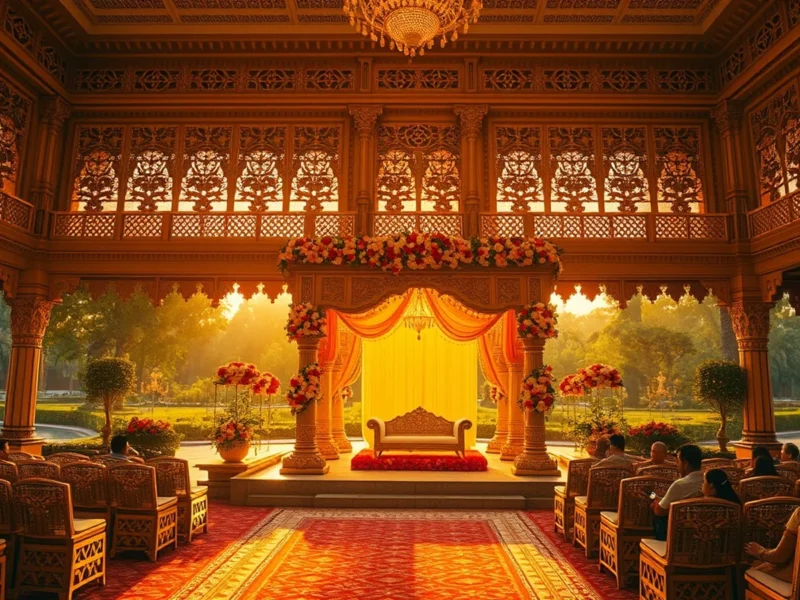
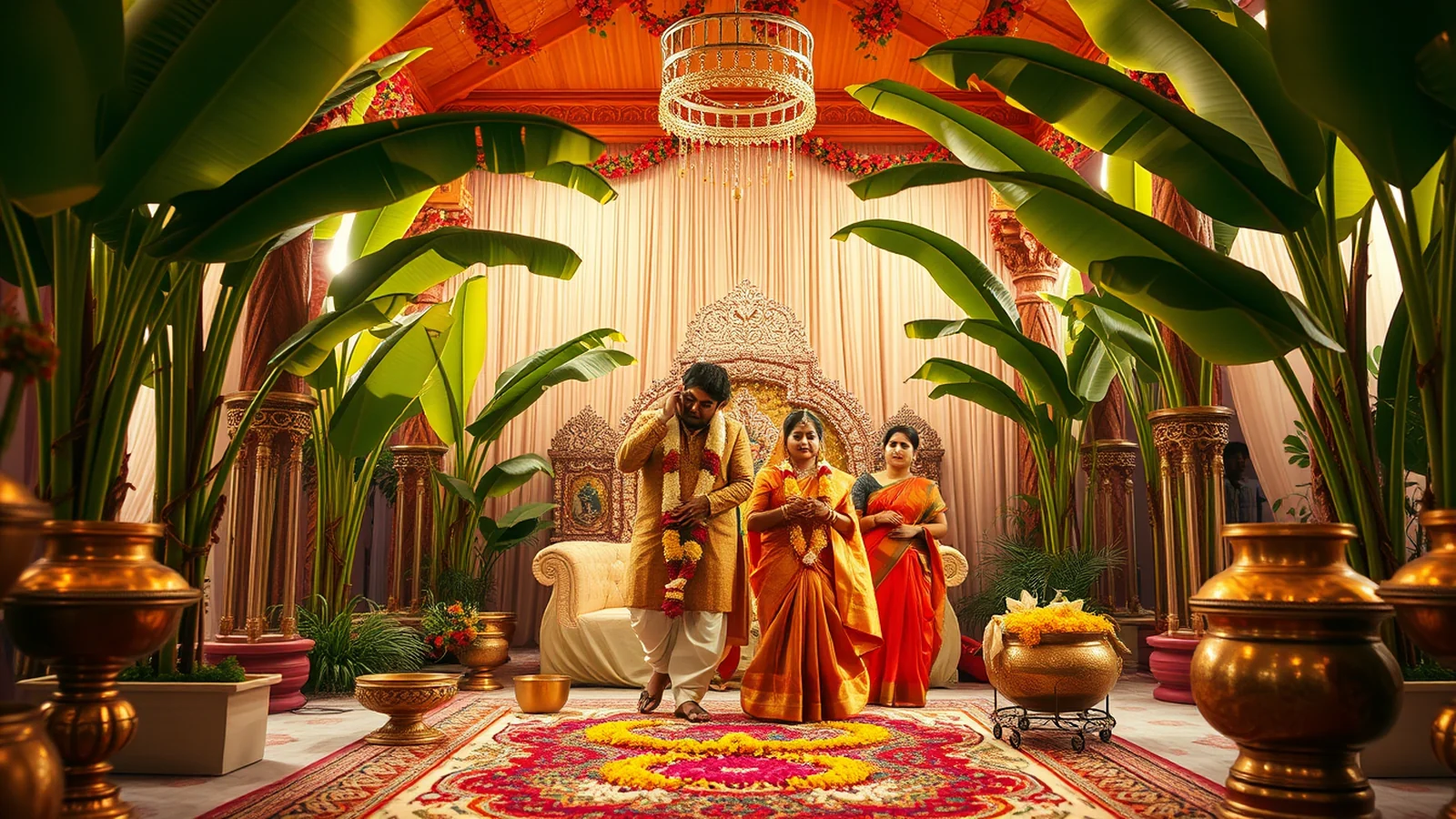
The visual language is unmistakably South Indian: banana trees and mango-leaf torans at the mandapam entrance, kolam patterns in rice flour, abundant jasmine and marigold, and brass lamps and traditional pots (kalasam). The nadaswaram and tavil ensemble plays through the ceremonies, and the getti melam, a loud, rapid drumbeat, marks the most auspicious moments, above all the tying of the thali. A live nadaswaram artist for the muhurtham is essential rather than optional in a traditional Tamil Brahmin wedding.
Modern Tamil Brahmin weddings
While the Iyer and Iyengar core remains carefully preserved, modern couples increasingly frame it with a mehndi, a sangeet, and an evening reception, and many now choose a destination format at a heritage venue or temple town. The traditional early-morning muhurtham still anchors the wedding day, with the surrounding events arranged around it. Inter-community South Indian weddings, blending Tamil with Telugu or Kannada customs, are increasingly common and simply brief both sets of priests in advance.
How Velvet Knot coordinates this wedding
South Indian weddings are ritual-dense and run to a precise muhurtham, so the real planning challenge is sequencing the rites, the priests, and the vendors against an astrologically fixed time, often early in the morning. We build a tight run-of-show, brief the photographers on the key moments, source specialist priests and authentic catering, and hold the multi-event flow together. Tell us your dates and guest count and we will send a scoped proposal: request a quote. You can also browse everything a full-service planner coordinates, and our South Indian wedding planner page.
Related traditions
Related South Indian traditions
How the muhurtham is fixed
What a Tamil temple-city wedding costs
Related South Indian rituals
- the Kashi Yatra ritual
- the oonjal swing ceremony
- the nalangu games ceremony
- nischitartham, the South Indian engagement
- laja homa and the brother’s role
Traditions in this region: read our full guide to Chettiar and Nagarathar wedding traditions.
The Tamil Brahmin wedding sequence at a glance
A Tamil Brahmin wedding is one of the longest ritual sequences in Hindu practice, and
much of it happens at home before anyone reaches the venue. The table gives the order,
where each rite is performed and what it is for. Iyer and Iyengar families share this
sequence; the differences are in the mantras and in the emphasis rather than in the order.
| Rite | Where | Who leads it | What it marks |
|---|---|---|---|
| Nischayathartham | Home or a small hall | Both families and the priest | Horoscopes confirmed, muhurtham fixed, the lagna patrika read aloud |
| Sumangali Prarthanai | Home, days before | The sumangalis of the lineage | Blessings sought from married women of the family, living and ancestral |
| Pallikai Thellichal | Home | The sumangalis | Nine grains sown in decorated clay pots, later immersed in water |
| Naandi (Vratham) | Home | Priest, separately for each | Ancestral blessings, and the kankanam protective thread tied on the wrist |
| Kashi Yatra | Venue, wedding morning | Groom and the bride’s father | The mock pilgrimage, resolved by the offer of the bride’s hand |
| Maalai Maatral | Venue | The couple, lifted by cousins | Three garland exchanges, performed with a good deal of teasing |
| Oonjal | Venue | The sumangalis | The swing, rocked while songs are sung and lamps circled to ward off the evil eye |
| Kanyadaanam | At the mandapam | The bride’s father | The bride sits on her father’s lap holding a coconut as her hand is given |
| Mangalya Dharanam | At the exact muhurtham | The groom, then his sister | The thali tied in three knots as the getti melam drums cover all other sound |
| Saptapadi and Pradhana Homam | Before the sacred fire | Priest, with the couple | The seven steps, the ammi grinding stone, the Arundhati star |
| Sammandhi Mariyathai | After the ceremony | Both families | The two families formally honour each other with gifts |
| Grihapravesham | The groom’s home | The groom’s family | The bride’s welcome into her new household |
What Iyer and Iyengar families actually do differently
The two traditions are asked about constantly and the honest answer is that the wedding
order is largely shared. Iyers are Shaivite and follow the Smarta tradition; Iyengars are
Sri Vaishnava. The practical differences a family or a planner will notice are these.
- The invocation and the mantras. Iyengar ceremonies carry Sri Vaishnava
liturgy and the recitation of Tamil devotional verse alongside the Sanskrit, which
lengthens the ceremony noticeably. - The thali. The pendant differs by tradition and by family, and it is
not interchangeable. It is commissioned to the family’s own design well before the wedding. - Marks and observances. Iyengar practice includes the namam, and
several household observances around the ceremony differ accordingly. - The priest. An Iyer purohit and an Iyengar bhattar are not
substitutes for one another. In a wedding between the two, both families brief their own
priest and the pair agree the order in advance.
Beyond that, sub-community practice varies by family, by village of origin and by what a
particular household has always done. The family elders are the authority, and asking them
to walk the sequence before it is scheduled saves an argument on the morning.
The Pallikai Thellichal and what the family has to arrange
The Pallikai Thellichal is the rite most often left to the last minute, because it looks
decorative and is not. Nine grains are sown by the sumangalis into decorated clay pots a few
days before the wedding, kept watered, and immersed in a water body afterwards. The sprouting
is read as a good omen for the marriage, which means the pots have to be sown early enough
to actually sprout.
Three things follow. The pots and the grains need buying and decorating several days
ahead, not the night before. The sumangalis performing the rite need to be invited and
available on a specific morning, which for a dispersed family is a travel question. And
the immersion afterwards needs somewhere appropriate to do it, which is worth settling in
advance if the wedding is at a destination venue rather than in the family’s home town.
Frequently Asked Questions
What is the Kashi Yatra in a Tamil wedding?
The Kashi Yatra is a light-hearted rite where the groom pretends to renounce worldly life for a pilgrimage to Kashi, and the bride’s father persuades him to choose married life instead and offers his daughter’s hand.
What is the Mangalya Dharanam?
It is the central moment of a Tamil Brahmin wedding, when the groom ties the thali (mangalsutra) around the bride’s neck with three knots, accompanied by the loud getti melam drums and nadaswaram to drown out any inauspicious sound.
What is the Oonjal ceremony?
In the Oonjal, the couple are seated on a decorated swing and gently rocked while sumangalis sing songs and circle them with lamps and rice to ward off the evil eye, symbolising the steadiness needed through life’s ups and downs.
What does a Tamil Brahmin bride wear?
The nine-yard madisar saree in Kanjeevaram silk, temple jewellery including the oddiyanam waist belt, and jasmine flowers in her hair.
Are Tamil Brahmin weddings held during the day?
Yes. Unlike many North Indian night weddings, Tamil Brahmin ceremonies are conducted in daylight and timed to an auspicious morning muhurtham, with the key thali-tying moment fixed to the minute.
How long does a Tamil Brahmin wedding last?
The full celebration typically runs two to three days, including the engagement, the Sumangali Prarthanai and Naandi, the wedding-day rituals, and the reception.
Sources and further reading
Velvet Knot believes in showing our work. The references below are the authoritative sources we consult when planning weddings in this category.
- Hindu Marriage Act, 1955: Government of India
- Tamil cultural overview, Britannica: Britannica
Begin Your Engagement
Want a real number for your wedding?
Tell us your city, guest count and dates. Team Velvet Knot will come back within 24 hours with an itemised budget.