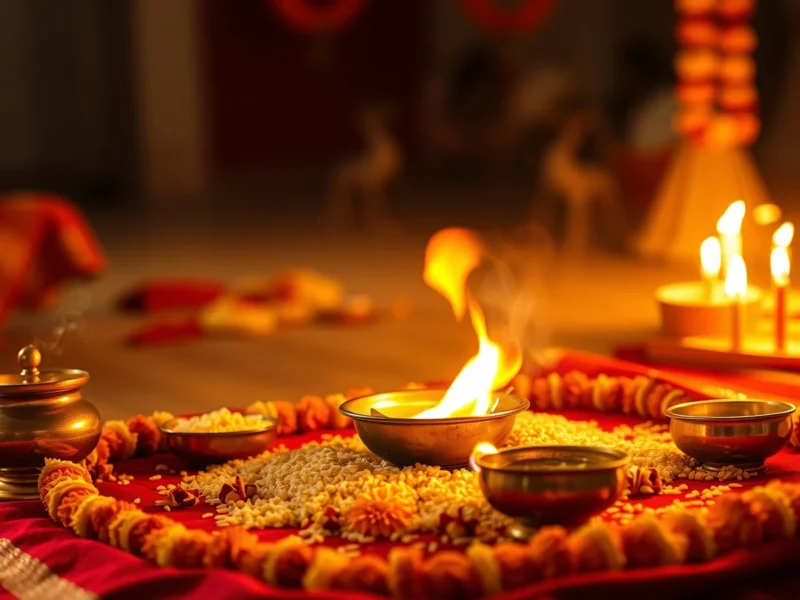
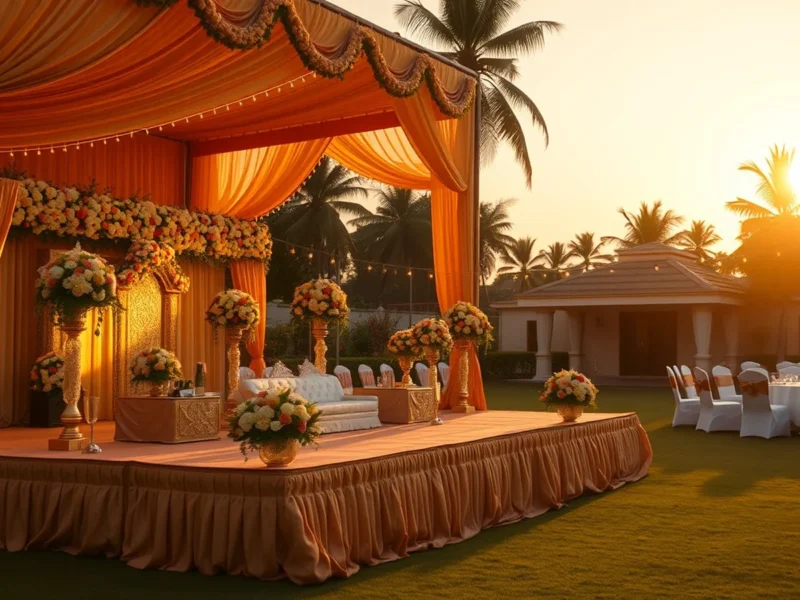
Maharashtrian Wedding Rituals and Traditions: Full Ceremony Guide (2026)
- Pre-wedding rituals
- Wedding day rituals
- Post-wedding rituals
- Distinctive Maharashtrian touches
- Food and feasting
- More Maharashtrian customs
- Modern Maharashtrian weddings
- How Velvet Knot coordinates a Maharashtrian wedding
- A typical Maharashtrian wedding day
- Maharashtrian wedding decor and music
- Related community traditions
- Related wedding rituals
- The Maharashtrian wedding sequence at a glance
- Why the ceremony is so short, and what that means for planning
- Deshastha, Konkanastha, Karhade and CKP practice
- Frequently Asked Questions
- Sources and further reading
A Maharashtrian wedding is famously simple, warm, and short, often completed in a single morning, with a core sequence of Sakharpuda, Halad Chadavane, Seemant Pujan, the Antarpat and Mangalashtak, Kanyadaan, Saptapadi, and Lajahoma. Distinctive touches include the green Nauvari saree, the mundavalya pearl strings, and the crescent nath.
Maharashtrian weddings are known for being refreshingly understated compared with the multi-day grandeur of many North Indian celebrations. The emphasis is on the rituals and the family, not on scale, and the main ceremony is often wrapped up in a morning. That simplicity is deliberate and is a large part of the culture’s charm, though modern Maharashtrian weddings increasingly add a sangeet and a reception around the traditional core.
This guide walks the Maharashtrian wedding sequence in order, with planning notes for each stage. We have coordinated Maharashtrian weddings across Mumbai, Pune, and Nagpur.
Pre-wedding rituals
Sakharpuda
The engagement, where the families exchange sugar, the sakhar, and gifts, and the couple exchange rings. It formalises the alliance and is usually an intimate family event held at home or a small hall.
Halad Chadavane
The Maharashtrian haldi, where turmeric paste is applied to the bride and groom by married women using mango leaves, first at the groom’s home and then carried to the bride’s. The bride traditionally wears a simple green or yellow saree. Planner note: the same haldi is ritually shared between the two homes, so the timing and transport of the consecrated paste between venues needs to be scheduled.
Seemant Pujan and Muhurat
On the eve or the morning of the wedding, the bride’s family welcomes the groom and his family at the venue threshold in the Seemant Pujan, honouring the groom as a form of Vishnu with aarti and gifts. The auspicious muhurat is fixed precisely, because Maharashtrian ceremonies run to a tight, astrologically determined time window that the whole day is built around.
Wedding day rituals
Ganpati and Gauri Puja
As with most auspicious Maharashtrian events, proceedings open with a Ganpati puja to remove obstacles, and the bride performs a Gauri, or Parvati, puja seeking a happy married life.
Antarpat and Mangalashtak
The signature Maharashtrian moment: a decorative curtain, the antarpat, is held between the bride and groom while the priests and assembled guests recite the Mangalashtak, eight sacred verses of blessing. On the final verse the curtain drops, the couple garland each other, and the entire assembly showers them with akshata, coloured rice, in a burst of celebration. It is the emotional high point of the ceremony and the shot every photographer must be ready for.
Kanyadaan and Vivah Homa
The bride’s parents give her hand in marriage in the Kanyadaan, and the couple sit before the sacred fire for the Vivah Homa. The groom ties the mangalsutra and applies sindoor, and the bride is given the green glass bangles that mark a married Maharashtrian woman.
Saptapadi and Lajahoma
The couple take the seven steps, the Saptapadi, and the seven vows, and in the Lajahoma the bride offers puffed rice into the fire with her brother’s help, symbolising the families’ shared prosperity. Planner note: Maharashtrian ceremonies move quickly, so the photography and ritual cues must be briefed tightly or the key moments pass before the team is in position.
Post-wedding rituals
Karmasampati and Varat
The ceremony formally concludes with the Karmasampati, and the couple leave in the Varat, the wedding procession to the groom’s home, often accompanied by a band and dancing.
Grihapravesh and reception
The bride is welcomed into her new home with the Grihapravesh, traditionally tipping a measure of rice at the threshold with her right foot before stepping in, followed by the reception where the wider circle of friends and colleagues is hosted.
Distinctive Maharashtrian touches
The bride’s look is unmistakable: a green Nauvari, or nine-yard, saree, the crescent-shaped nath, or nose ring, green chooda bangles, and the mundavalya, strings of pearls tied across the foreheads of both bride and groom. The groom often wears a dhoti, a kurta, and the distinctive Puneri or Kolhapuri pheta, the turban. Marigold and modak motifs feature heavily in the decor.
Food and feasting
A traditional Maharashtrian wedding meal is vegetarian and served on a banana leaf or a steel thali, and it is built around the festive sweet puran poli, a flatbread stuffed with jaggery and lentils. Expect masale bhaat, batatyachi bhaji, varan with rice and ghee, koshimbir salads, and the sweet shrikhand or basundi. Planner note: the puran poli station and an authentic Maharashtrian thali are points of pride and worth getting from a specialist caterer rather than a generic one. See our catering cost guide.
More Maharashtrian customs
Beyond the core ceremony, several smaller customs add texture. The Kelvan is a pre-wedding feast hosted by each family for their deity and close relatives. The Rukhwat is a charming display of homemade sweets, savouries, and decorative craft put together by the bride’s family and shown to guests. The Telwan sees oil and turmeric applied before the halad, and in some families a Gondhal, a devotional folk performance, is held to invoke the family goddess. The Sade and gifting of the green saree and the nath complete the bride’s transformation. These customs vary between Deshastha, Konkanastha (Chitpavan), Karhade, and CKP communities, each with subtle differences in deities honoured and the order of rites.
Modern Maharashtrian weddings
Contemporary Maharashtrian couples increasingly frame the simple traditional core with a sangeet, a haldi shoot, and a reception, and many now choose a destination format in Konkan, Lonavala, or further afield. The traditional morning muhurat is sometimes shifted to an evening slot to suit working guests, though purist families hold to the astrologically fixed time. Even with these additions, the antarpat and mangalashtak remain the non-negotiable heart of the ceremony.
How Velvet Knot coordinates a Maharashtrian wedding
The challenge with a Maharashtrian wedding is its speed and precision: the muhurat is fixed to the minute, the antarpat moment cannot be missed, and the haldi is shared across two homes. We build a tight run-of-show around the muhurat, brief the photographers on the antarpat and akshata cues, and coordinate the two-home halad logistics.
Tell us your dates and guest count and we will send a scoped proposal: request a quote. You can also browse everything a full-service planner coordinates.
A typical Maharashtrian wedding day
Because the ceremony is timed to a precise muhurat, the day is built backwards from that moment. It usually opens early with the Ganpati and Gauri pujas and the Seemant Pujan welcome, moves into the Antarpat and Mangalashtak as the muhurat arrives, and continues through the Kanyadaan, Vivah Homa, Saptapadi, and Lajahoma. A festive lunch follows, then the Varat procession and Grihapravesh, with a reception in the evening for the wider circle. The whole core can be done before lunch, which is why precise scheduling around the muhurat is the single most important planning task.
Maharashtrian wedding decor and music
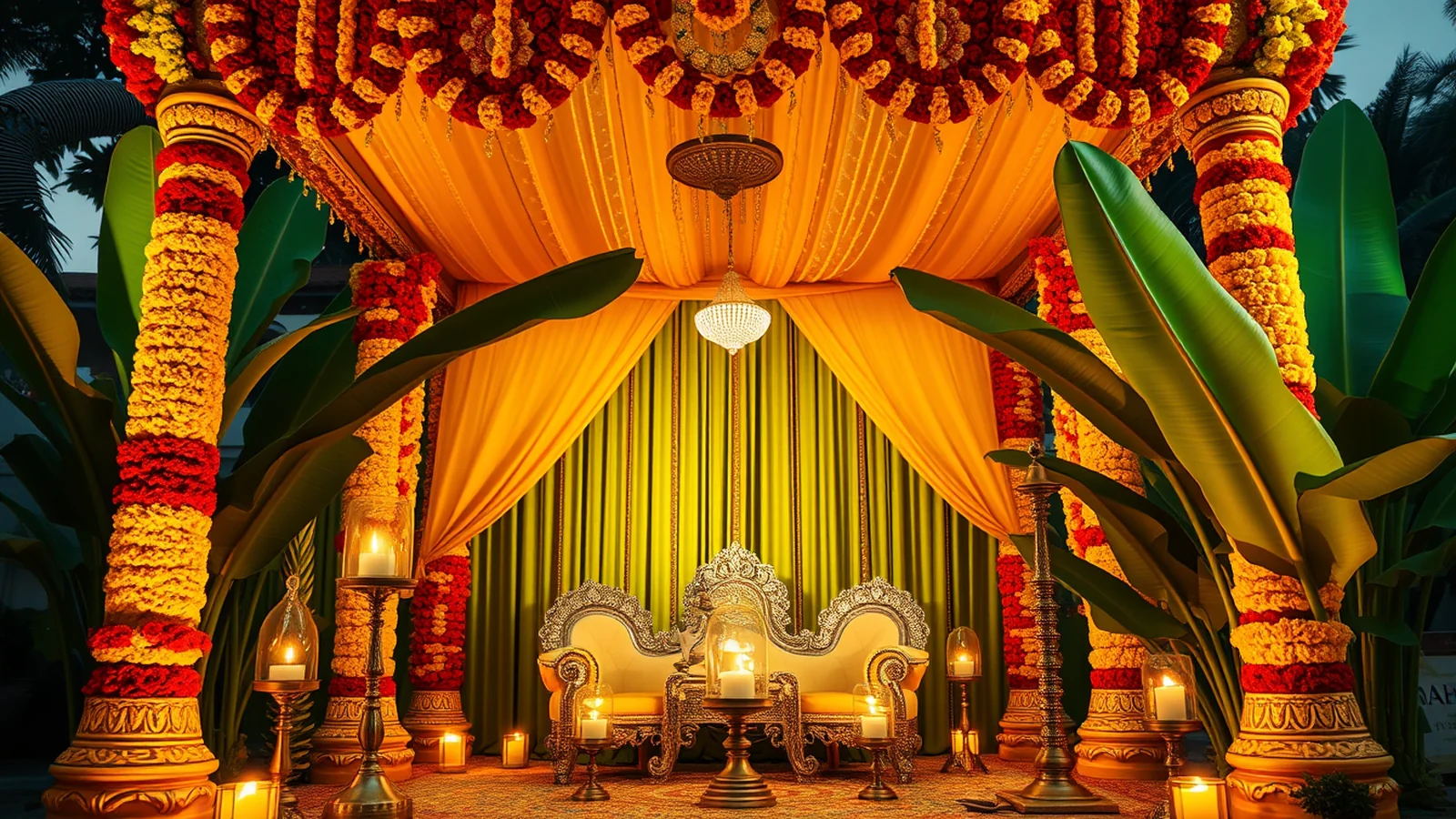
Maharashtrian decor is graceful rather than heavy, built around marigold torans, banana leaves, brass lamps, and the warm yellows and greens of the tradition. Music traditionally features the sanai and chaughada, the auspicious wind-and-drum pairing played at the muhurat, and the lezim and dhol-tasha troupes that energise the Varat procession. Modern weddings layer a sangeet and a DJ around this traditional core.
Related community traditions
Related wedding rituals
- griha pravesh, the bride’s first entry
- muh dikhai, the face showing ceremony
- the mehndi ceremony explained
- the Ganesh puja that opens a wedding
- gath bandhan, the tying of the knot
The Maharashtrian wedding sequence at a glance
The striking thing about this sequence is how much of it fits into a single morning. The
table gives the order, with the smaller customs that surround the core placed where they
actually fall.
| Rite | When | Who leads it | What it marks |
|---|---|---|---|
| Sakharpuda | Weeks or months before | Both families | The engagement, sealed with an exchange of sugar and gifts |
| Kelvan | Days before | Each family separately | A feast hosted for the family deity and close relatives |
| Telwan and Halad Chadavane | The day before | Married women of both homes | Oil, then turmeric applied with mango leaves, the paste carried between the two homes |
| Rukhwat | Displayed on the wedding day | The bride’s family | Homemade sweets, savouries and craft, shown to arriving guests |
| Seemant Pujan | Eve or wedding morning | The bride’s family | The groom welcomed at the threshold and honoured as a form of Vishnu |
| Ganpati and Gauri puja | Wedding morning, early | Priest, and the bride | Obstacles removed, and the bride’s own prayer for the marriage |
| Antarpat and Mangalashtak | At the muhurat | Priests and the whole assembly | Eight verses chanted, the curtain drops, akshata is showered. The marriage is solemnised here |
| Kanyadaan and Vivah Homa | Immediately after | The bride’s parents, then the priest | The giving of the bride, the fire rites, the mangalsutra and the green bangles |
| Saptapadi and Lajahoma | Before the sacred fire | Priest, with the couple and the bride’s brother | The seven steps, then puffed rice offered into the fire |
| Karmasampati | Close of the ceremony | Priest | The formal conclusion of the rites |
| Varat | After the feast | Both families | The procession to the groom’s home, with dhol-tasha and lezim |
| Grihapravesh | On arrival | The groom’s mother | The bride tips a measure of rice with her right foot and enters |
Why the ceremony is so short, and what that means for planning
Maharashtrian weddings are among the shortest in India and this is a feature, not a
compromise. The solemnising moment is the Mangalashtak: eight verses, the curtain, the
garlands, the shower of akshata. It takes minutes. Everything the ceremony needs to do is
done there, and the fire rites that follow complete rather than extend it.
The planning consequence is the opposite of what families expect. A short ceremony is
harder to cover than a long one, because there is no slack anywhere. In a four-hour North
Indian ceremony a photographer who is in the wrong place at the wrong moment gets another
chance. Here the curtain drops once. The practical answer is to treat the Mangalashtak as
a cued moment: the photographers positioned before the verses begin, a second camera on the
couple’s faces rather than on the priests, and someone who knows the verses counting down
to the last one.
The Halad has its own logistics problem for the same reason. The turmeric is applied
first at one home and then carried to the other, so it is one ritual across two addresses. Transport, timing and who carries the paste all need settling in advance, and if the two
families are in different cities the whole custom needs rethinking rather than improvising.
Deshastha, Konkanastha, Karhade and CKP practice
Maharashtrian Hindu practice is not uniform, and families notice the differences
immediately when two communities marry. The core above is common; what varies is the family
deity honoured, the specific pre-wedding observances, the wording and count of the verses,
and details of the bride’s dress and ornaments.
Deshastha, Konkanastha (also called Chitpavan), Karhade and Chandraseniya Kayastha
Prabhu families each have their own kuladevata, and the pre-wedding pujas are directed to
that deity, which is why the Kelvan is hosted separately by each side. Some families hold a
Gondhal, a devotional folk performance invoking the family goddess, and others do not. Practice within any of these groups also varies by region and by household, so the family
elders and the family priest are the authority rather than a general guide. In an
inter-community wedding, agreeing the order at the Sakharpuda rather than the week of the
wedding avoids the two priests negotiating in front of the guests.
Frequently Asked Questions
What is the Mangalashtak?
The Mangalashtak are eight sacred verses chanted while the antarpat curtain separates the couple. The marriage is considered solemnised at the moment the verses end, the curtain drops, and the couple garland each other.
Do Maharashtrian weddings have a baraat?
Traditionally there is no grand baraat as in North Indian weddings. The groom is welcomed at the venue threshold in the Seemant Pujan, and the celebratory procession, the Varat, comes after the ceremony rather than before.
How long does a Maharashtrian wedding last?
Maharashtrian weddings are among the shortest in India, with the main ceremony often completed in a single morning. Pre-wedding events like the sakharpuda and halad add a day or two around it, and modern weddings may add a sangeet and reception.
What is the Antarpat ceremony?
The Antarpat is the signature Maharashtrian moment where a curtain is held between the bride and groom while guests recite the Mangalashtak verses. When the curtain drops on the final verse, the couple garland each other and guests shower them with rice.
What does a Maharashtrian bride wear?
Traditionally a green nine-yard Nauvari saree, a crescent-shaped nath, or nose ring, green bangles, and the mundavalya pearl strings tied across the forehead of both bride and groom.
What is the Lajahoma?
In the Lajahoma, the bride offers puffed rice into the sacred fire with her brother’s help, a ritual symbolising prosperity and the bond between the two families.
What food is served at a Maharashtrian wedding?
The meal is typically vegetarian, served on a banana leaf, and centred on puran poli, with masale bhaat, varan, koshimbir, and sweets like shrikhand or basundi.
How much does a Maharashtrian wedding cost?
Because the format is simpler and shorter, costs are often lower than comparable North Indian weddings. A mid-range celebration in Mumbai or Pune typically runs Rs 20 lakh to Rs 50 lakh. See our wedding cost guide.
Sources and further reading
Velvet Knot believes in showing our work. The references below are the authoritative sources we consult when planning weddings in this category.
- Hindu Marriage Act, 1955: Government of India
- Maharashtra cultural heritage, Britannica: Britannica
Begin Your Engagement
Want a real number for your wedding?
Tell us your city, guest count and dates. Team Velvet Knot will come back within 24 hours with an itemised budget.