Griha Pravesh for a New Bride: The Rice Pot, the Right Foot and What It Means
- Two different ceremonies share one name
- The welcome at the threshold
- The rice pot, and why she kicks it
- What happens next
- Regional variation
- The kitchen entry and the first meal
- Threshold customs by region, in detail
- When the couple do not live with the family
- Practical notes
- Related post-wedding rituals
- Frequently Asked Questions
- Sources and further reading
Griha pravesh is the bride’s first entry into her marital home. She is welcomed with an aarti at the threshold, then tips over a small vessel of rice with her right foot before stepping inside, a gesture read as prosperity entering the household with her.
Two different ceremonies share one name
Before anything else, a clarification that saves a great deal of confusion. Griha pravesh means entering a home, and the phrase covers two quite separate ceremonies.
The first is the housewarming puja performed when a family moves into a newly built or newly purchased house. It involves a formal puja, often a havan, and is timed to an auspicious date. That is not what this guide is about.
The second, which is, is the ritual welcome of a new bride into her husband’s family home on the day she arrives after the wedding. It shares the name and the underlying idea, that entering a dwelling for the first time is a threshold moment requiring ritual marking, but the ceremony itself is entirely different: no havan, no priest in most cases, and a sequence of small domestic rituals performed by the women of the household.
The welcome at the threshold
The bride arrives, usually directly from the vidaai at her parents’ home, and is stopped at the doorway rather than walked straight in. What follows takes ten to fifteen minutes.
- Aarti. The mother-in-law performs aarti with a lit lamp, circling it before the couple. Water or rice is often circled over their heads and set aside to ward off the evil eye.
- Tilak. A tilak of kumkum is applied to the bride’s forehead.
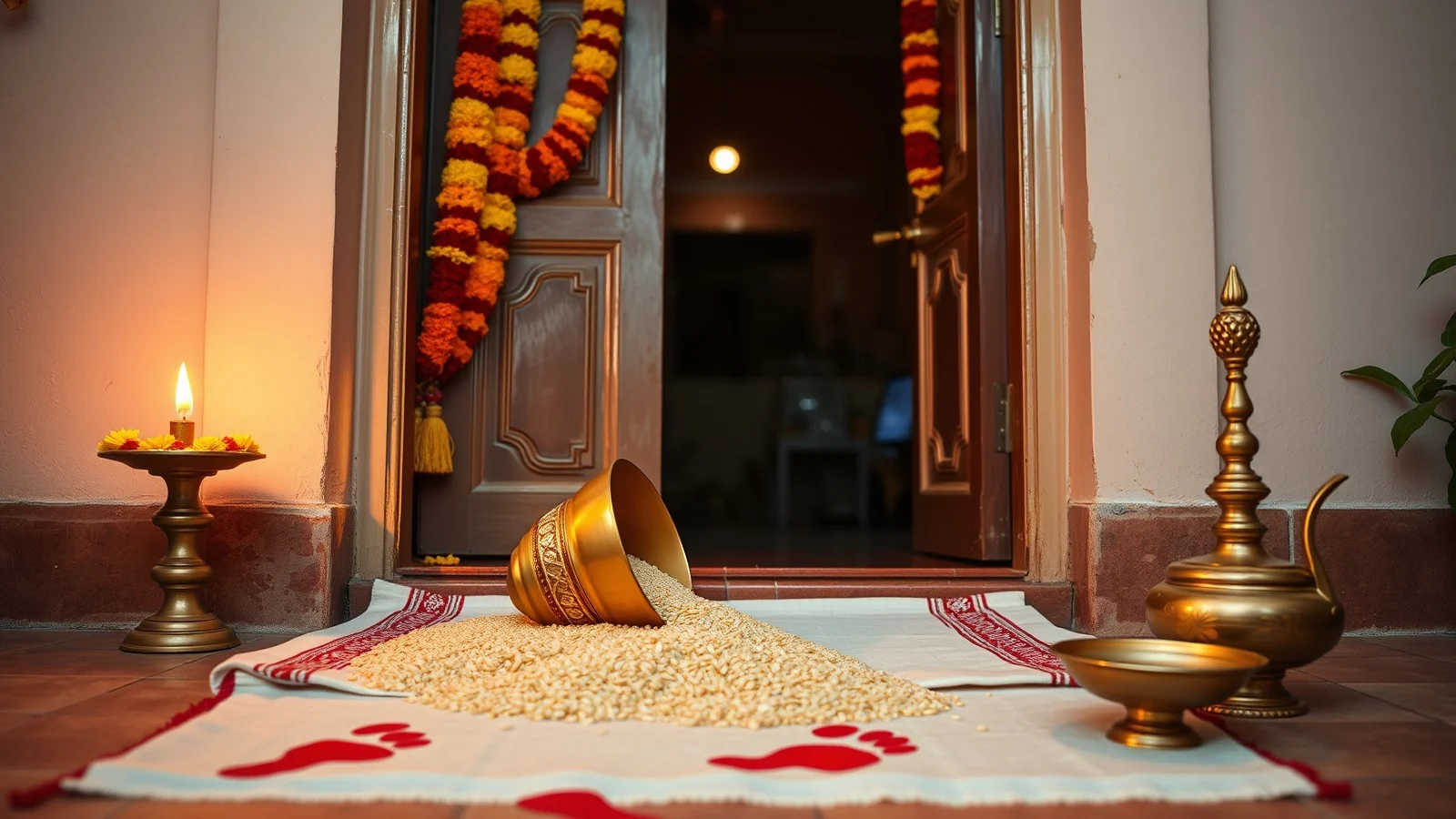
- The feet. In many families the bride’s feet are washed at the threshold, or dipped in a shallow tray of milk, or in alta, the red dye used in Bengali and Odia tradition.
- Footprints. Where alta or a rice paste is used, the bride then walks across a white cloth or the floor, leaving red footprints. These are sometimes preserved.
Only after this is she asked to enter, and the entry itself has its own rules.
The rice pot, and why she kicks it
The best known element of the ceremony is a small vessel, a kalash or measuring pot, filled with rice and placed at the threshold. The bride tips it over with her right foot as she steps inside, scattering the rice into the house.
The reading is consistent across the families that practise it. Rice is the standing symbol of abundance and sustenance in Indian ritual, and Lakshmi, the goddess of wealth and prosperity, is understood to enter the household with the new bride. Spilling grain inward rather than outward is the gesture of prosperity arriving. In some families the vessel contains rice mixed with coins for the same reason.
The right foot leads because in Hindu ritual practice the right side is the auspicious one, the side used for offerings, for giving and for entering sacred space. The same convention governs entry into temples. It is a small detail, and it is one of the few parts of the ceremony that older relatives will actually correct in the moment.
What happens next
Griha pravesh rarely stands alone. It opens a short sequence of arrival rituals that run into the evening or the following morning.
- Muh dikhai. The bride is seated and the women of the family lift her veil one by one, each giving a gift. See our muh dikhai guide.
- Kitchen entry. In many families the bride is taken to the kitchen and asked to make something sweet, often kheer, or simply to stir a pot. It is symbolic rather than practical.
- The name game. A ring or coin is dropped into a wide vessel of milk and water and the couple compete to find it, in a custom closely related to the South Indian nalangu games.
- Reception. In most modern weddings the reception follows on a later date, hosted by the groom’s family.
None of these are obligatory, and families vary in how many they observe. The threshold entry itself is the part that almost nobody skips.
Regional variation
- Punjabi and Haryanvi. Rice pot and aarti at the threshold, followed quickly by muh dikhai. See Punjabi wedding traditions.
- Bengali and Odia. Strong emphasis on alta, the red dye applied to the bride’s feet, and on the footprints she leaves entering the house. See Bengali and Odia traditions.
- Marathi. The bride’s entry involves tipping a measure of rice and announcing her new name in some families. See Maharashtrian wedding traditions.
- Gujarati. Aarti, a rice or wheat vessel, and a ring-finding game are all common. See Gujarati wedding traditions.
- South Indian. The bride’s arrival is marked with aarti and an oil lamp, but the rice-kicking element is largely a North Indian custom. See South Indian wedding traditions.
The kitchen entry and the first meal
In most families the threshold ritual is followed within a day by the bride’s first entry into the kitchen, and in traditional households this was treated as a distinct ceremony rather than an afterthought.
The bride is taken to the kitchen, often by her mother-in-law, and asked to cook or at least to stir something sweet. Kheer, the rice pudding, is the most common choice across North India, and halwa or a milk sweet elsewhere. In some families she simply lights the stove, or adds sugar to milk already on the heat, and the gesture is complete.
The symbolism is direct. The kitchen was the domain a new daughter-in-law was joining, and the first sweet thing she made there was understood to set the tone for what she would bring to the household. In many families the dish she prepares is then eaten by everyone present, and in some she serves it to her husband first.
It is worth being honest that this ritual carries assumptions about household roles that many families no longer hold. Plenty now perform it as a symbolic gesture with the couple cooking together, or with the groom making the sweet instead, and no tradition is damaged by that. What families should avoid is performing it unexamined and then discovering that one side read it as a statement about who will be cooking for the next thirty years.
Threshold customs by region, in detail
The threshold is one of the most ritually loaded points in an Indian home, and the specific customs vary considerably.
- The rice vessel. Standard across the Hindi belt. A measure or kalash of rice, sometimes mixed with coins, tipped inward with the right foot.
- Alta footprints. Bengali and Odia practice. The bride’s feet are dipped in red alta and she walks across a white cloth or the floor, leaving prints that are sometimes preserved for years.
- Milk and water. In several traditions the bride’s feet are washed at the door by the mother-in-law or an elder, a gesture of honouring rather than of cleaning.
- The handprint. In parts of Rajasthan and Gujarat the bride presses a palm dipped in kumkum or turmeric paste onto the wall beside the door, leaving a permanent mark of her arrival.
- Weighing or measuring. A few communities observe customs involving the bride’s height being marked or a measure of grain being set aside in her name.
- The lamp. Almost universal. A lit lamp is present at the threshold, and in South Indian practice the bride is received with a lamp rather than with a rice vessel to kick.
Where two families observe different threshold customs, both can usually be performed. They are short, they do not conflict theologically, and a bride who does both has generally made two sets of grandparents happy at a cost of ninety seconds.
When the couple do not live with the family
A large and growing share of Indian couples do not move into the groom’s family home after the wedding. They return to a flat in another city, or to another country entirely. The obvious question is whether griha pravesh still applies, and the answer families arrive at is usually yes, in one of three forms.
Perform it at the family home anyway. The bride visits her husband’s family home, performs the threshold entry there, and the couple then travel on to wherever they live. This is the most common resolution and it preserves the ritual’s meaning: she is entering the family, and the house stands for the family.
Perform it at the couple’s own home. The ritual is done at the flat the couple will actually live in, sometimes with a small puja, which brings it closer to the housewarming sense of the term. Families who choose this often do both, at different times.
Perform it symbolically on a later visit. Where the couple leave immediately, particularly NRI couples with short trips, the ceremony is held whenever they next visit. It loses nothing by being late, and it is far better than being skipped.
For couples planning a wedding from abroad, this is one of several post-wedding rituals that need to be positioned deliberately within a short trip rather than assumed. Our NRI short trip planning guide covers how to sequence them.
Practical notes
- Do it in daylight if you can. The bride usually arrives at night, exhausted, and the ceremony is photographed badly as a result. Families who shift it to the following morning get both a better ceremony and better images.
- Protect the floor. Alta stains. Lay a white cloth if the footprints matter to you, and something waterproof under it if they do not.
- Use unbroken rice. Whole grains, not broken rice, is the traditional preference, and it scatters better.
- Warn the bride about the right foot. It is the one detail everyone watches and nobody mentions in advance.
- Keep the doorway clear. Twenty relatives filming from inside the door leaves no room for the aarti, and this is the single most common practical failure.
For how griha pravesh fits into the full sequence from engagement to reception, see our complete guide to Hindu wedding rituals.
Planning a wedding that honours these traditions?
Team Velvet Knot plans weddings across every major Indian tradition, and we brief vendors on the rituals so nothing gets rushed, mistimed or quietly dropped from the running order. Tell us your dates and your community, and we will come back with an honest plan.
Related post-wedding rituals
The puja that follows: read our full guide to the Satyanarayan puja.
Frequently Asked Questions
What is griha pravesh for a bride?
It is her ritual first entry into her husband’s family home after the wedding. She is welcomed at the threshold with aarti and a tilak, then tips over a small vessel of rice with her right foot as she steps inside. It is distinct from the housewarming puja that shares the same name.
Why does the bride kick the pot of rice?
Rice symbolises abundance, and Lakshmi, the goddess of prosperity, is understood to enter the household along with the new bride. Spilling the grain inward is the gesture of wealth arriving with her. Some families add coins to the vessel for the same reason.
Which foot should the bride use to enter?
The right foot. In Hindu ritual practice the right side is the auspicious one, used for offerings and for entering sacred spaces, and the same convention governs temple entry. It is worth telling the bride in advance, because it is the detail relatives notice.
Is griha pravesh the same as a housewarming ceremony?
No, although they share the name. The housewarming griha pravesh is a formal puja, often with a havan, performed when a family moves into a new house. The bride’s griha pravesh is a short sequence of domestic welcome rituals performed by the women of the household on the day she arrives.
What is alta and why is it used?
Alta is a red dye applied to the feet, used mainly in Bengali and Odia tradition. The bride’s feet are dipped in it at the threshold so that she leaves red footprints as she walks into the house, a visible record of her arrival. Some families preserve the cloth she walks across.
Can griha pravesh be held the next morning?
Yes, and many families now do. The bride typically arrives at night after a full day of ceremonies and the vidaai, and a morning griha pravesh is easier on everyone, better lit for photographs, and gives the ritual the attention it deserves.
Sources and further reading
Begin Your Engagement
Want a real number for your wedding?
Tell us your city, guest count and dates. Team Velvet Knot will come back within 24 hours with an itemised budget.