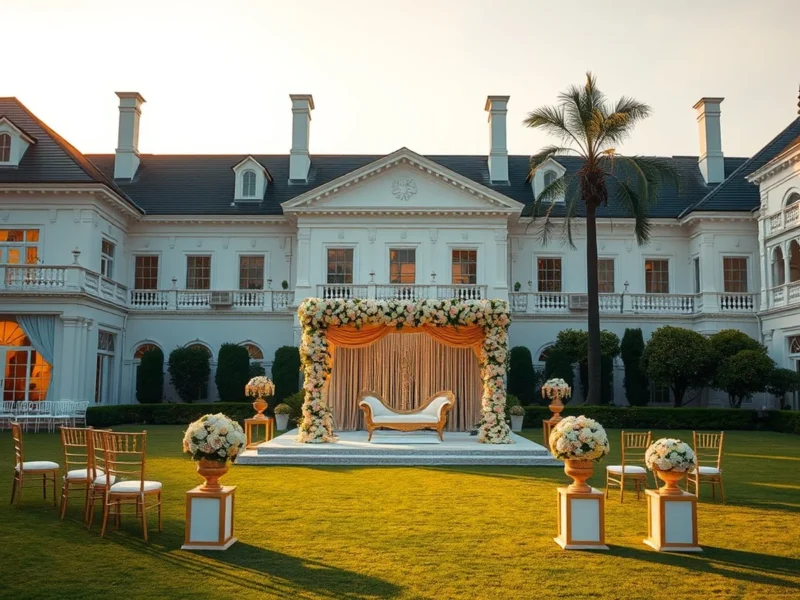
Satyanarayan Puja in an Indian Wedding: Meaning, Timing and How the Ritual Actually Runs
- Who Satyanarayan is and why this puja became the household standard
- When the puja is performed around a wedding
- Outside weddings: the purnima connection
- The setup: kalash, chowki and the samagri list
- Sankalpa: stating who is doing this and why
- Navagraha, panchang and the preliminary worship
- The five chapters of the Satyanarayan katha
- Aarti and the distribution of prasad
- Sinni: the prasad itself and the customs around it
- Who sits for the puja, and why the couple sit together
- Regional variation across India
- Fitting the puja into a real wedding weekend
- Frequently Asked Questions
- Sources and further reading
Satyanarayan is a form of Vishnu worshipped as the lord of truth. The puja is a household thanksgiving rite performed after a vow is fulfilled. Around a wedding, most families hold it the morning after the ceremony or at the couple’s first entry into their new home, and some hold it before the wedding as a blessing.
Who Satyanarayan is and why this puja became the household standard
Satyanarayan means the Narayan of truth. Narayan is one of the oldest names of Vishnu, and the compound frames him not as a distant cosmic preserver but as the deity who holds people to their word. That framing matters, because the puja is fundamentally about a promise kept. A family vows to perform it if something they want comes to pass, and then performs it once it has. A marriage, in the eyes of most families, is exactly that kind of fulfilment.
The rite spread widely for reasons that are practical as much as theological. It needs no temple, no consecrated fire pit in most versions, no elaborate priesthood and no fixed caste-linked eligibility. A married couple, a clean corner of the house, a copper pot, a priest for two hours and a plate of sweet prasad is the whole requirement. Compared with the multi-day yajnas that once marked thanksgiving, this was something an ordinary urban household could actually do, and it became the default vrat across most of Hindu India.
The other reason for its reach is the story attached to it. The Satyanarayan katha, traditionally attributed to the Reva Khanda of the Skanda Purana, is a set of short narratives in plain language about people who promise the puja and then forget. It teaches by consequence rather than by doctrine, which is why grandmothers can recite it and children sit through it. In a wedding context, that message lands particularly hard on a couple starting a household of their own.
When the puja is performed around a wedding
The most common slot is the morning after the wedding. The bride has arrived at the groom’s home, the griha pravesh has happened, and the family marks the first full day of the new household with a Satyanarayan puja. Practically, it is often the first calm hour of a weekend that has been anything but calm, and families treat it as the settling ritual that closes the wedding proper and opens married life.
A second common placement is at the couple’s first entry into their own home, which for many urban couples is weeks or months later, not the day after the wedding. Where the couple is moving into a separate flat, the housewarming and the Satyanarayan puja are usually merged into one morning. A third placement, less universal but perfectly standard in many families, is before the wedding: the puja is held a few days ahead as a blessing on the arrangements, often on the same day as the Ganesh puja that opens the wedding sequence.
Families differ, and no placement is more correct than another. What we do ask clients to settle early is which one they intend, because it changes the guest list, the catering headcount for that morning and whether the priest needs to be at the venue or at a residence. A puja that everyone assumed was happening somewhere else is one of the more avoidable failures of a wedding weekend.
Outside weddings: the purnima connection
When it is not tied to a wedding, the Satyanarayan puja is most often performed on a purnima, the full moon day. Kartik purnima, Vaishakh purnima and the purnima of the household’s own choosing are all common. Many families keep a standing practice of performing it every full moon, or once a year on a fixed one, as a rolling thanksgiving rather than a one-off vow.
Beyond purnima, families perform it on sankranti days, at the start of a new business, after a house purchase, after a recovery from illness, and at the birth of a child. The trigger is always the same shape: something was hoped for, it happened, and the household acknowledges it publicly. A wedding fits this pattern so neatly that in many communities it is simply assumed rather than discussed.
There is one scheduling consequence worth knowing. If your family’s practice is strictly purnima-bound, and the wedding muhurat falls nowhere near a full moon, you will either shift the puja to the nearest purnima after the wedding or accept the non-purnima date. Priests routinely allow the second, since a wedding is treated as its own valid occasion. Check with your family priest rather than assuming, because a few lineages are strict about it.
The setup: kalash, chowki and the samagri list
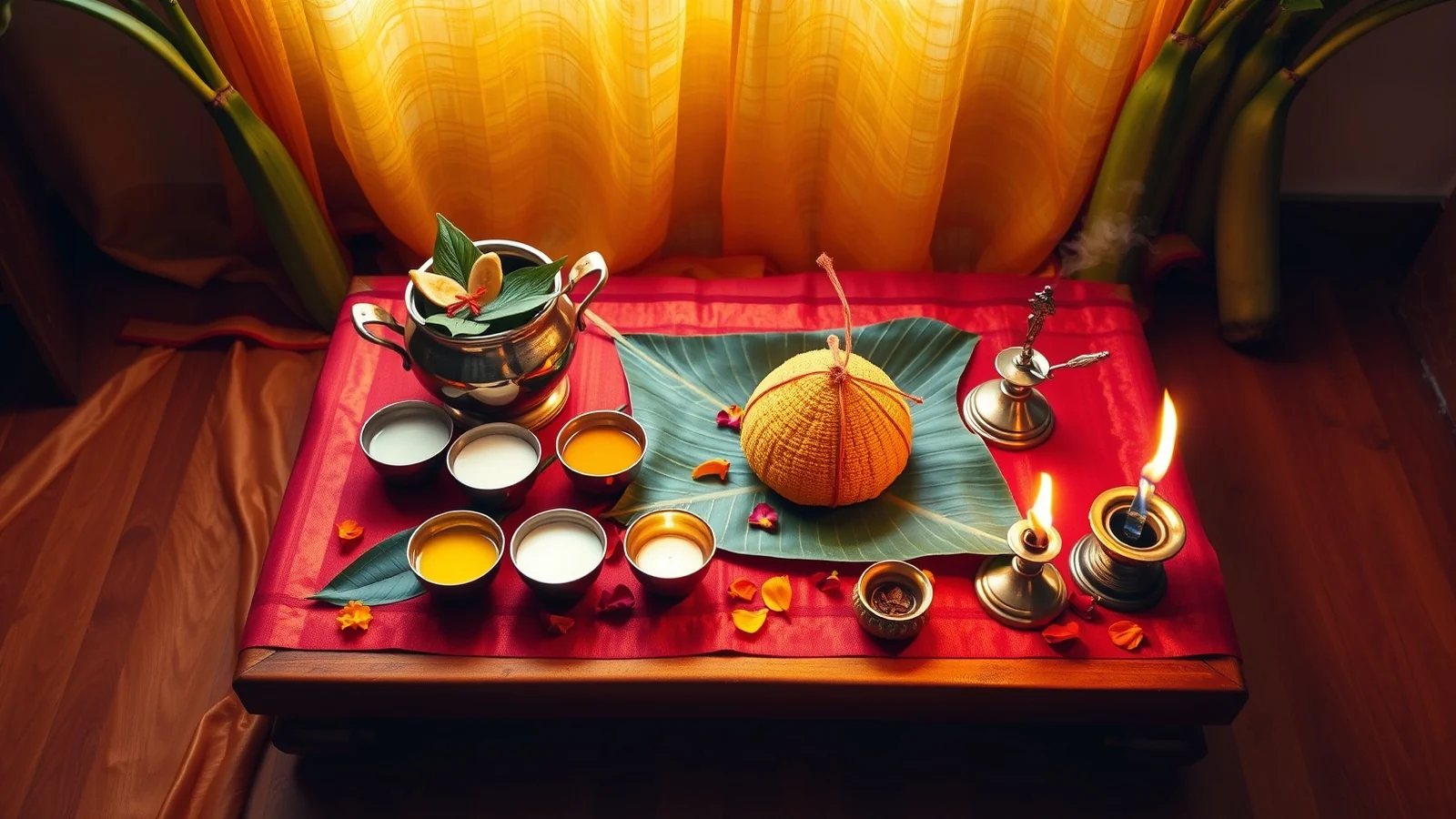
The physical arrangement is compact and consistent. A low wooden chowki is placed in the northeast of the room and covered with a red or yellow cloth. On it goes an image or small idol of Satyanarayan, and in front of it the kalash: a copper or brass pot filled with water, wound with a red thread, with mango leaves at the mouth and a whole coconut set on top. Around the base, an arrangement of rice or wheat grains, betel nuts and coins forms the base for the navagraha placement.
The samagri list a family needs to arrange is longer than people expect but all of it is easy to buy in one trip: turmeric, kumkum, sandal paste, akshata rice, flowers and a garland, incense, camphor, a ghee lamp with cotton wicks, betel leaves and nuts, whole fruit including bananas, panchamrit made from milk, curd, ghee, honey and sugar, and a length of new cloth to offer. Most priests in Hyderabad will send a written list on WhatsApp if you ask, and many can arrange the full kit for an additional fee.
Two things go wrong reliably. Banana leaves and fresh mango leaves get forgotten because they are not sold with the rest of the kit, and the ghee lamp is set up in a room with air conditioning blowing straight at it. Neither is fatal, but both create visible fuss at the exact moment you want stillness. Ask the priest to inspect the setup fifteen minutes before the start rather than at the start.
Sankalpa: stating who is doing this and why
The puja opens with the sankalpa, the formal statement of intent. The priest asks for the names of the people performing it, their gotra, and the occasion. He then recites the time and place in full traditional form: the era, the year, the season, the month, the lunar fortnight, the tithi and the day, followed by the names and the purpose. The couple hold water, rice and a flower in the right hand and release it into a plate at the close of the recitation.
This step is not a formality to be rushed. In ritual logic, the sankalpa is what binds the act to a specific person and a specific reason, which is precisely the theme of the whole puja. For a newly married couple it is also the first time they are named together in a ritual as a single household unit, which is why families often ask the priest to say it slowly and audibly.
Have the gotra and the correct full names written down beforehand. Bride-side and groom-side gotras, the bride’s post-marriage gotra convention in your community, and the spelling of names in Sanskrit pronunciation are all things that get argued about live if nobody prepared them. Ten minutes on a family WhatsApp group the night before removes the problem.
Navagraha, panchang and the preliminary worship
Before Satyanarayan himself is worshipped, the puja works outward from the smaller powers. Ganesh is invoked first, as in almost every Hindu rite, so that the ceremony proceeds without obstruction. Then comes the navagraha, the nine planetary deities, placed on a grid of rice or drawn on the base near the kalash and offered turmeric, kumkum, flowers and grain in sequence.
Alongside the navagraha, most priests perform a short panchang or panchdev worship and invoke the guardians of the directions, the kalash itself, and the family deities. Some also include a brief worship of the ancestors. The sequence varies by priest and by region, and a puja that runs ninety minutes in one household runs forty in another purely because of how much of this preliminary layer is included.
If you want a specific length, say so when you book. A priest can compress the preliminary worship considerably without cutting anything a family would notice, or expand it if the family wants a fuller version. What he cannot do is compress the katha, which is the heart of the rite and is expected to be read in full.
The five chapters of the Satyanarayan katha
The katha is read in five adhyayas or chapters, and the whole family is expected to sit through all five. The first sets the frame: the sage Narada, distressed by human suffering, asks Vishnu what relieves it, and Vishnu describes the Satyanarayan vrat and how to perform it. The second tells of a poor brahmin and then a woodcutter who hear of the vrat, perform it, and find their circumstances transformed.
The third and fourth chapters carry the moral weight. A merchant, childless, vows to perform the puja if he is given a child, and a daughter, Kalavati, is born. He puts the puja off. Years later he and his son-in-law are wrongly imprisoned while trading in a distant kingdom, and their ship’s cargo is found turned to leaves. Only when the vow is finally honoured and the prasad properly received is everything restored. The fifth chapter tells of a king who, riding back from a hunt, ignores prasad offered to him by cowherds performing the puja and loses his kingdom and his sons until he returns and accepts it with respect.
Versions differ in names and details between regions and printed booklets, so do not be surprised if your priest’s telling differs from a recording you have heard. The through-line never changes: the vow deferred, the prasad slighted, and the restoration once both are corrected. Read plainly to a couple on the morning after their wedding, it is a fairly pointed lesson about keeping the commitments you made in front of people.
Aarti and the distribution of prasad
After the fifth chapter, the aarti is performed. A camphor or ghee lamp is circled before the image while the family sings, most commonly the Satyanarayan aarti beginning with the well-known refrain to the lord of truth. Everyone present cups their hands over the flame and touches their eyes and head. The couple usually perform the aarti together, holding the plate between them, which makes for one of the better photographs of the whole weekend if you have briefed the photographer to stay quiet and wide.
Prasad is then distributed, and this is the part that is not optional. The katha itself makes the point twice, in the fourth and fifth chapters, that the prasad must be received and eaten with respect. In practice this means nobody at the puja leaves without taking it, and it is sent to family members who could not attend. It should not be thrown away, and older family members will notice if it is.
Charanamrit, a spoon of the water from the kalash mixed with tulsi, is offered alongside the prasad in most households. Panchamrit is distributed too. Keep small steel or leaf bowls ready, because handing out sticky sinni into open palms in a crowd of guests in wedding clothes causes exactly the problem you would expect.
Sinni: the prasad itself and the customs around it
The prasad, called sinni in much of North and East India, is a sweet cooked mixture with a specific composition. Semolina or whole wheat flour is roasted in ghee until it darkens and smells nutty, then sugar, milk and sometimes water are added and cooked down, and ripe banana is mashed in at the end. Cardamom, chopped cashew and raisins are common additions. Some families use whole wheat flour exclusively and consider semolina a modern substitute, and both are accepted.
A widespread custom is to measure the ingredients in units of one and a quarter, called sava, rather than round numbers: one and a quarter measures of flour, of sugar, of ghee and so on. Banana is treated as essential in most traditions, and in many households the sinni is prepared only after the cook has bathed and the kitchen has been cleaned, before the puja begins rather than during it.
Quantities are the practical trap. Families consistently underestimate, because sinni is served to every guest and also sent to households that did not attend. For a post-wedding puja with sixty people in the room, plan for at least twice what a normal household batch would be, and tell the caterer it is prasad rather than dessert so that it is cooked in ghee and kept separate from the rest of the service.
Who sits for the puja, and why the couple sit together
The couple sit together, with the bride on the groom’s left, and the parents or elders sit immediately behind or beside them. Where the puja is being performed on behalf of the whole household, the senior married couple of the family may sit as the primary performers and the newlyweds beside them. Both arrangements are normal, and the priest will place people once he knows whose sankalpa is being taken.
The reason this ceremony is treated as significant for a new couple is that it is usually their first act of worship as a household rather than as two families joining. The wedding rituals themselves, from the kanyadaan to the saptapadi, are performed as a giving and receiving between families. The Satyanarayan puja is the first one performed by the couple, for their own home, with their own sankalpa. Explaining that to a bride and groom before they sit down changes how they sit through it.
Guests need not be many. Twenty to sixty people is typical for a post-wedding puja, and there is no requirement for the wider wedding guest list to attend. Where the puja is held together with an ashirwad ceremony, the numbers naturally rise and the room and seating have to be sized accordingly. Floor seating on durries is standard, but arrange chairs at the back for older guests rather than making it an issue on the day.
Regional variation across India
The core rite is remarkably stable, but the packaging around it differs. In North India, particularly Uttar Pradesh, Bihar and Delhi, it is a purnima household puja with sinni as the defining prasad, frequently held after a wedding and at housewarmings. In Bengal it is often called Satyanarayan pujo and is very widely observed, with sinni made from atta, banana and milk, and it appears at almost every auspicious household transition, including alongside Bengali wedding rituals.
In Maharashtra the Satyanarayan puja is close to universal after a wedding and after moving house, and it is one of the most frequently performed domestic rites in the state, so much so that it is routine in Maharashtrian wedding planning to book the priest for it at the same time as the wedding itself. Gujarati families perform it too, though within Gujarati wedding traditions it competes with several other post-wedding household rites and is less automatic.
In the South it is known as the Satyanarayana Vratam, and in Telugu practice it is a major household observance in its own right, commonly performed after a wedding, on purnima, and at the opening of a new home or business. Telugu families often perform it with a fuller vratam structure and a longer preliminary worship than the North Indian version, and it sits alongside the other rites described in our guide to Telugu wedding rituals. Tamil and Kannada families observe it as well, with the same katha and local variations in the prasad.
Fitting the puja into a real wedding weekend
The honest problem is time, not devotion. A Satyanarayan puja needs ninety minutes to two hours from the moment everyone is seated, and the morning after an Indian wedding is the single most fragile slot in the schedule. Guests have slept four hours, the bride has been up since two, and a nine o’clock start realistically means a ten o’clock start. Book the priest for a later slot than you think you need, brief him that the katha will be read in full regardless, and do not stack a farewell brunch immediately behind it.
Venue restrictions are the second issue. Many banquet halls and almost all five star hotels in Hyderabad restrict open flame indoors, which affects the ghee lamp and the camphor aarti more than anything else, since the standard Satyanarayan puja does not require a full havan the way laja homa does. Get written confirmation on lamps and camphor at the contracting stage rather than the morning of, and if the hotel refuses, an open lawn, a terrace or a family residence solves it. This is a routine line item in any Hindu wedding ritual checklist and it belongs in the venue negotiation, not in the panic list.
For destination weddings, the two workable patterns are to carry your own priest and a packed samagri kit from home, or to book a local priest through the venue and accept that his version will differ in the preliminary worship. Both work. What does not work is assuming a resort in Goa or Udaipur can produce a priest, fresh mango leaves and a copper kalash at eight hours’ notice. Confirm it at the same time you confirm the mandap, and set the timing against the same muhurtham calculation you used for the wedding itself.
Budget is modest relative to the rest of the weekend. Priest dakshina for a Satyanarayan puja in Hyderabad typically runs from about Rs 2,500 for a straightforward home puja to Rs 11,000 or more at a hotel with a senior priest and assistants, with samagri and flowers adding roughly Rs 3,000 to Rs 8,000 depending on whether the priest or the decorator supplies them. Against the numbers in our wedding planning cost guide, it is one of the least expensive and most remembered hours of the entire event.
Planning a wedding that honours these traditions?
Team Velvet Knot plans weddings across every major Indian tradition, and we brief vendors on the rituals so nothing gets rushed, mistimed or quietly dropped from the running order. Tell us your dates and your community, and we will come back with an honest plan.
Frequently Asked Questions
Is the Satyanarayan puja compulsory after a wedding?
No. It is a vrat, a voluntary observance, not a mandatory samskara like the wedding rituals themselves. Many families treat it as unmissable because it has been performed in the household for generations, and in Maharashtra and Bengal in particular it is close to automatic after a wedding. Others never perform it at all. If neither side has an established practice, ask both sets of parents what their families have done rather than deciding on principle, since this is one of the rituals where the answer is family custom rather than rule.
Can the puja be done before the wedding instead of after?
Yes. Performing it a few days before the wedding as a blessing on the preparations is a recognised practice, and families often pair it with the Ganesh puja that formally opens the wedding sequence. Some families do both, one before and one after. If you hold it before, the sankalpa is typically taken in the parents’ names since the couple are not yet married, and the newlyweds then perform their own after the wedding or at their housewarming.
How long does the Satyanarayan puja take?
Plan for ninety minutes to two hours from seating to prasad. The five chapters of the katha alone take thirty to forty-five minutes when read properly. The preliminary worship, meaning Ganesh, navagraha, kalash and the family deities, is what varies most, and a priest can shorten or extend it considerably depending on the household’s practice. Add another twenty minutes for prasad distribution if you have a large room. Tell the priest your available window when you book rather than trying to hurry him mid-ceremony.
Who should sit for the puja, and can an unmarried person perform it?
Around a wedding, the newly married couple sit together with the bride on the groom’s left, often with the parents or the senior married couple of the household beside or behind them. There is no bar on an unmarried person performing the Satyanarayan vrat, and it is one of the more open rites in this respect, but in the wedding context the whole point is that the couple sit as one household. Where the family’s primary sankalpa is being taken by the elders, the couple sit alongside rather than in place of them.
What exactly is sinni and does it have to be made at home?
Sinni is the prasad: semolina or whole wheat flour roasted in ghee, cooked with sugar and milk, with mashed ripe banana added at the end, often with cardamom and dried fruit. Many families measure the ingredients in units of one and a quarter. Home preparation is traditional and preferred, and in many households it is cooked before the puja by someone who has bathed, in a cleaned kitchen. A caterer can make it, and at a hotel puja that is usually the practical choice, but tell them it is prasad so that it is cooked in ghee, kept separate from the general service and not garnished as a dessert.
Do we need a havan or fire for the Satyanarayan puja?
Generally no. The standard Satyanarayan puja is performed with a ghee lamp and camphor aarti rather than a fire pit, which is one reason it fits into hotel venues where a full havan is difficult. Some priests and some regional versions add a short homa at the end, so ask yours in advance and clear it with the venue if he does. Even without a homa, many hotels restrict open flame indoors, so confirm in writing that the ghee lamp and camphor aarti are permitted in the room you have booked.
Sources and further reading
Begin Your Engagement
Want a real number for your wedding?
Tell us your city, guest count and dates. Team Velvet Knot will come back within 24 hours with an itemised budget.