Laja Homa: The Puffed Rice Offering and the Brother’s Role in a Hindu Wedding
- What laja homa is
- Why puffed rice
- The brother’s role, and what it meant
- How it is performed
- Where it sits in the sequence
- Regional variation
- The mantras and what they ask for
- Variations in how the offering is made
- Why this ritual has survived so well
- If there is no fire
- Practical notes
- Frequently Asked Questions
- Sources and further reading
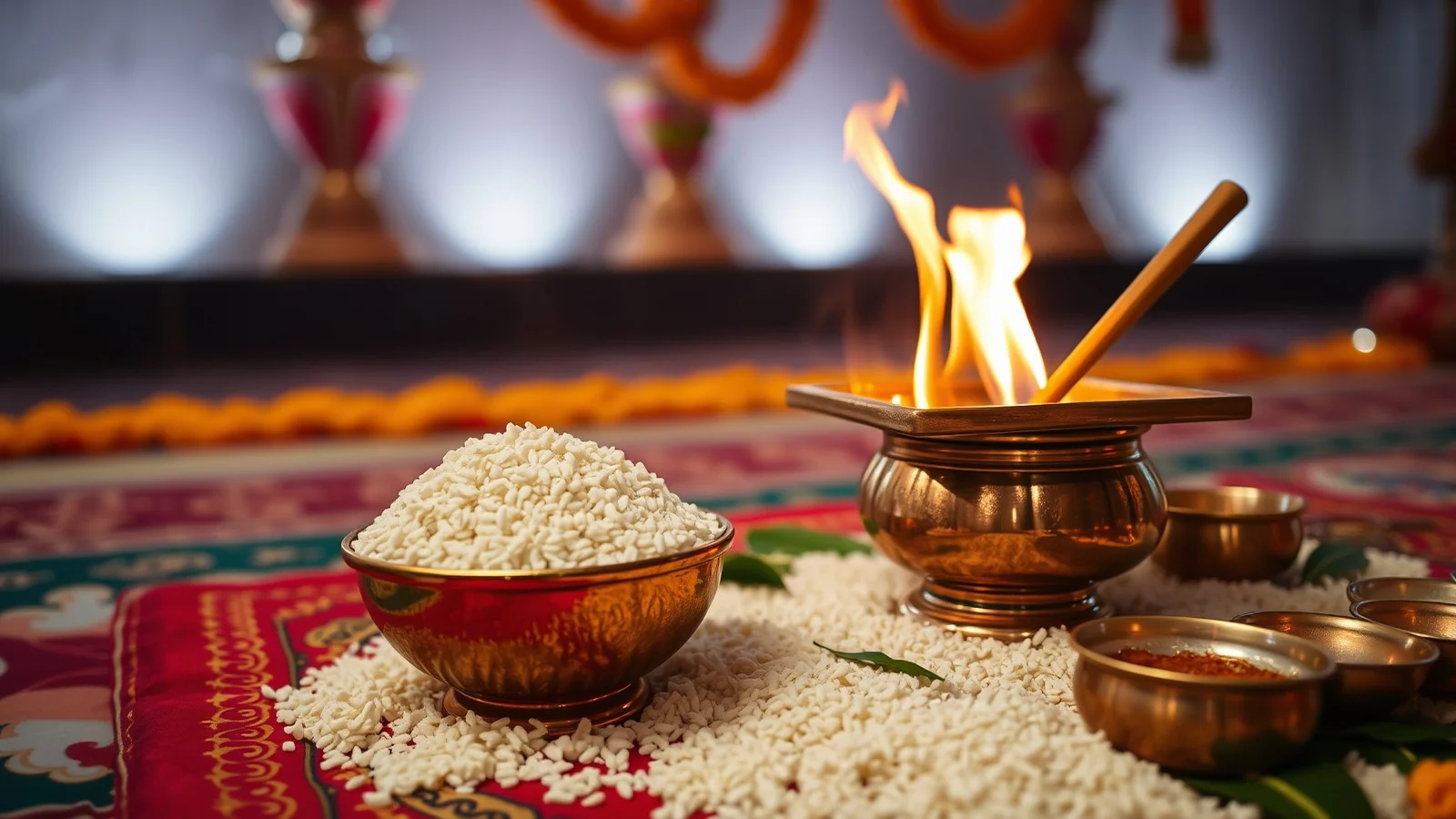
In laja homa the bride’s brother pours puffed rice into her cupped hands and she offers it into the sacred fire, usually with the groom’s hands supporting hers. It is the one ritual in a Hindu wedding built entirely around the brother, and it is a prayer for her married life.
What laja homa is
Laja means parched or puffed rice and homa means an offering made into fire. Laja homa is the ritual in which puffed rice is offered into the sacred fire on the mandap, by the bride, with her brother supplying the grain.
It is performed during or between the pheras, the circling of the fire, and it is repeated for each round in most traditions. The mechanics are specific: the brother stands behind or beside his sister and pours the puffed rice into her cupped palms. The groom places his hands under hers. Together they tip the grain into the flames while the priest chants.
Almost every other element of a Hindu wedding involves the parents, the priest or the couple. This one belongs to the brother, and in families with a strong sibling bond it is often the moment where he becomes visibly emotional rather than at the vidaai.
Why puffed rice
Puffed rice is grain that has been transformed by heat: the same seed, opened out, made light and white. That transformation is the point, and it is read in several ways.
Prosperity and abundance. Rice carries this meaning throughout Indian ritual, from the vessel kicked at griha pravesh to the shower of talambralu. Puffed rice takes up many times the volume of the raw grain, which makes the abundance visible.
Something offered, not kept. Unlike rice thrown on the couple, this rice goes into the fire. In Vedic practice the fire, Agni, is the messenger that carries offerings to the gods, so laja homa is a petition rather than a decoration.
The vow itself. The mantras recited over the offering ask for the bride’s long life, for the couple’s prosperity, and in the traditional formulation for the long life of her husband. The brother supplying the grain is the family of her birth contributing to the household she is joining.
The brother’s role, and what it meant
The structure of the ritual repays attention. The bride cannot perform laja homa alone. She needs grain, and the grain comes from her brother.
In the social arrangement the ritual comes from, a married woman left her parents’ household and joined her husband’s. Her brother was her permanent link back, the person who would fetch her for visits, represent her interests, and be responsible for her if anything went wrong. The pag phera ceremony, where the brother comes to bring his sister home a few days after the wedding, is the other half of the same relationship.
Laja homa states that publicly, at the most solemn point of the ceremony. She makes her offering for her new life using what her brother gives her. Everyone watching understands the implication: she is not being handed over and forgotten.
Where there is no brother, a cousin, uncle or another male relative stands in, and in a growing number of families a sister performs the role instead. No tradition is damaged by that, and priests generally accommodate it without comment.
How it is performed
- Position. The couple are seated or standing at the havan kund, the bride to the groom’s left in most traditions.
- The pour. The brother pours puffed rice into her cupped hands from a small vessel or a fold of cloth.
- The support. The groom places his hands beneath hers, so the offering is made jointly.
- The offering. The rice is tipped into the fire while the priest recites the mantras.
- The circling. A phera follows, with the couple tied together at the gath bandhan knot.
- Repetition. The sequence repeats, commonly three or four times depending on the tradition.
Some families use a shallow winnowing basket, the soop, rather than the hands. Others have the brother place the rice directly into the fire alongside the couple. The variation is in the mechanics, not in who supplies the grain.
Where it sits in the sequence
- Ganesh puja. The obstacle-remover worshipped first. See our Ganesh puja guide.
- Kanyadaan. The giving of the bride. See kanyadaan.
- Gath bandhan. The knot tied between the couple. See the gath bandhan guide.
- Laja homa and the pheras, interleaved, one offering per round.
- Saptapadi. The seven steps. See saptapadi, and how pheras and saptapadi differ.
- Sindoor daan and mangalsutra. See sindoor daan and the mangalsutra.
The full order is in our complete guide to Hindu wedding rituals.
Regional variation
- North Indian Hindu. Laja homa is standard and closely tied to the pheras. See Punjabi and Marwari traditions.
- Bengali. The ritual is well established, and the brother’s participation is particularly emphasised. See Bengali wedding traditions.
- Gujarati and Marathi. Performed within their own sequences with local names. See Gujarati and Maharashtrian traditions.
- South Indian. An offering of parched grain into the fire appears in Vedic South Indian ceremonies, though the sibling framing is less pronounced and the ritual sits differently in the order. See South Indian wedding traditions.
The mantras and what they ask for
The verses recited over laja homa are among the older layers of the Hindu wedding, and their content is specific rather than general.
The offering is made to Agni, the fire, and in the traditional formulation to other deities associated with prosperity and progeny. The recurring petitions are for the long life of the husband, for the bride’s wellbeing in her new home, for the prosperity of the household they are forming, and for children. The bride is the one making the offering; the words are spoken on her behalf or by her.
The framing is worth stating plainly, because it is asymmetric. The traditional verses ask for the husband’s long life rather than the couple’s, which reflects the social arrangement the ritual comes from. Many priests today recite versions that ask for both, and couples who care about this can ask for that in advance. Priests generally accommodate it, and it is a much easier conversation had a week early than at the fire.
Variations in how the offering is made
- Cupped hands. The most common. The brother pours into her palms, the groom’s hands support hers, and both tip the grain in together.
- The soop. A shallow winnowing basket, used in Bengali and some eastern traditions, from which the rice is offered.
- Direct offering. The brother places rice into the fire alongside the couple rather than into her hands, in some regional practices.
- Multiple siblings. Where there are several brothers, they may take turns across the rounds, which turns a single moment into a family sequence.
- With the groom leading. In a minority of traditions the groom takes the rice from the brother and passes it to the bride.
The variation is real, and the priest will follow whichever version the family’s tradition uses. What is constant is the source: the grain comes from the bride’s side, not the groom’s.
Why this ritual has survived so well
Laja homa is elaborate, requires a specific person, needs a fire, and is repeated several times. By the usual logic of ritual attrition it should have thinned out. It has not, and the reason is worth naming.
It gives the brother something to do. Indian weddings assign clear roles to parents, to the couple, and to the priest, and comparatively little to siblings. The bride’s brother is often the person most affected by the wedding after the parents and the couple themselves, and without laja homa he would spend the ceremony watching.
Families notice this. Photographers know to watch him during the offering rather than the couple, and it is common for a brother who held himself together through the vidaai rehearsal to lose composure entirely here. The ritual survives because it is one of the few that gives a real role to someone who badly needs one.
If there is no fire
A growing number of weddings are held in venues that will not permit an open flame indoors: hotel ballrooms with suppression systems, heritage properties with insurance restrictions, and most international destinations.
Families handle this in three ways. Some move the fire rituals outdoors to a terrace or lawn, which is the cleanest solution where weather allows. Some use a contained gas-fed havan kund of the kind now widely available, which most priests accept. A few perform the sequence symbolically with a lamp standing in for the fire, which priests vary in their willingness to do.
Whichever route is taken, it needs settling with the venue and the priest well in advance and in that order, because a venue that says no on the morning leaves no options. Laja homa is one of the rituals most affected, since it involves repeatedly throwing a flammable material into the flame.
Practical notes
- Tell the brother in advance. He has a real part with real timing, and being called forward unbriefed at the fire in front of four hundred people is not the experience anyone wants.
- Confirm who stands in if there is no brother. Settle it with the priest and the family beforehand rather than at the mandap.
- Check the quantity. Puffed rice is bulky and the ritual repeats. Families routinely under-order and end up scraping the vessel on the last round.
- Mind the fire. Puffed rice flares briefly when it hits the flame. Loose dupattas, long sleeves and low-hanging garlands need watching, and this is the one genuine safety point in the ceremony.
- Ventilate. Indoor mandaps with repeated offerings produce real smoke, and hotel fire alarms have been triggered by exactly this.
- Brief the photographer on the hands. The image is three sets of hands at the fire, and it is one of the most meaningful frames of the day.
Planning a wedding that honours these traditions?
Team Velvet Knot plans weddings across every major Indian tradition, and we brief vendors on the rituals so nothing gets rushed, mistimed or quietly dropped from the running order. Tell us your dates and your community, and we will come back with an honest plan.
Frequently Asked Questions
What is laja homa?
Laja means puffed rice and homa means an offering into fire. It is the ritual in which the bride’s brother pours puffed rice into her cupped hands and she offers it into the sacred fire, usually with the groom’s hands supporting hers, during the pheras.
Why does the bride’s brother take part?
Because the ritual is built around him. In the social arrangement it comes from, a married woman’s brother was her permanent link back to her birth family. Laja homa states publicly that she makes her offering for her new life using what her brother gives her.
What if the bride has no brother?
A cousin, uncle or another male relative stands in, and in a growing number of families a sister performs the role. Priests generally accommodate this without comment. It is worth settling with the family and the priest in advance rather than at the mandap.
Why puffed rice rather than plain rice?
Puffed rice is grain transformed by heat, taking many times the volume of the raw seed, which makes abundance visible. It is also offered into the fire rather than kept, and in Vedic practice the fire carries offerings to the gods, so it is a petition rather than a decoration.
How many times is laja homa performed?
Usually once per phera, so commonly three or four times depending on the tradition, interleaved with the circling of the fire. Some families use a winnowing basket instead of cupped hands, but the brother supplying the grain stays constant.
Is laja homa dangerous near the fire?
It needs care rather than worry. Puffed rice flares briefly on contact with the flame, so loose dupattas, long sleeves and low garlands should be watched. Indoor mandaps also produce real smoke over repeated offerings, and hotel fire alarms have been set off by it.
Sources and further reading
Begin Your Engagement
Want a real number for your wedding?
Tell us your city, guest count and dates. Team Velvet Knot will come back within 24 hours with an itemised budget.