Talambralu: The Rice Shower That Ends a Telugu Wedding Ceremony
- What talambralu is
- What goes into the rice
- What it means
- How it is performed
- Where it sits in the sequence
- Regional equivalents
- Why it comes exactly where it does
- The cousins, and why they matter
- What happens to the rice afterwards
- A note on scale
- Practical notes
- Frequently Asked Questions
- Sources and further reading
Talambralu is the Telugu ritual in which the newly married couple pour handfuls of turmeric rice over each other’s heads, repeatedly and competitively, while both families cheer. It is the release of tension immediately after the most solemn part of the ceremony.
What talambralu is
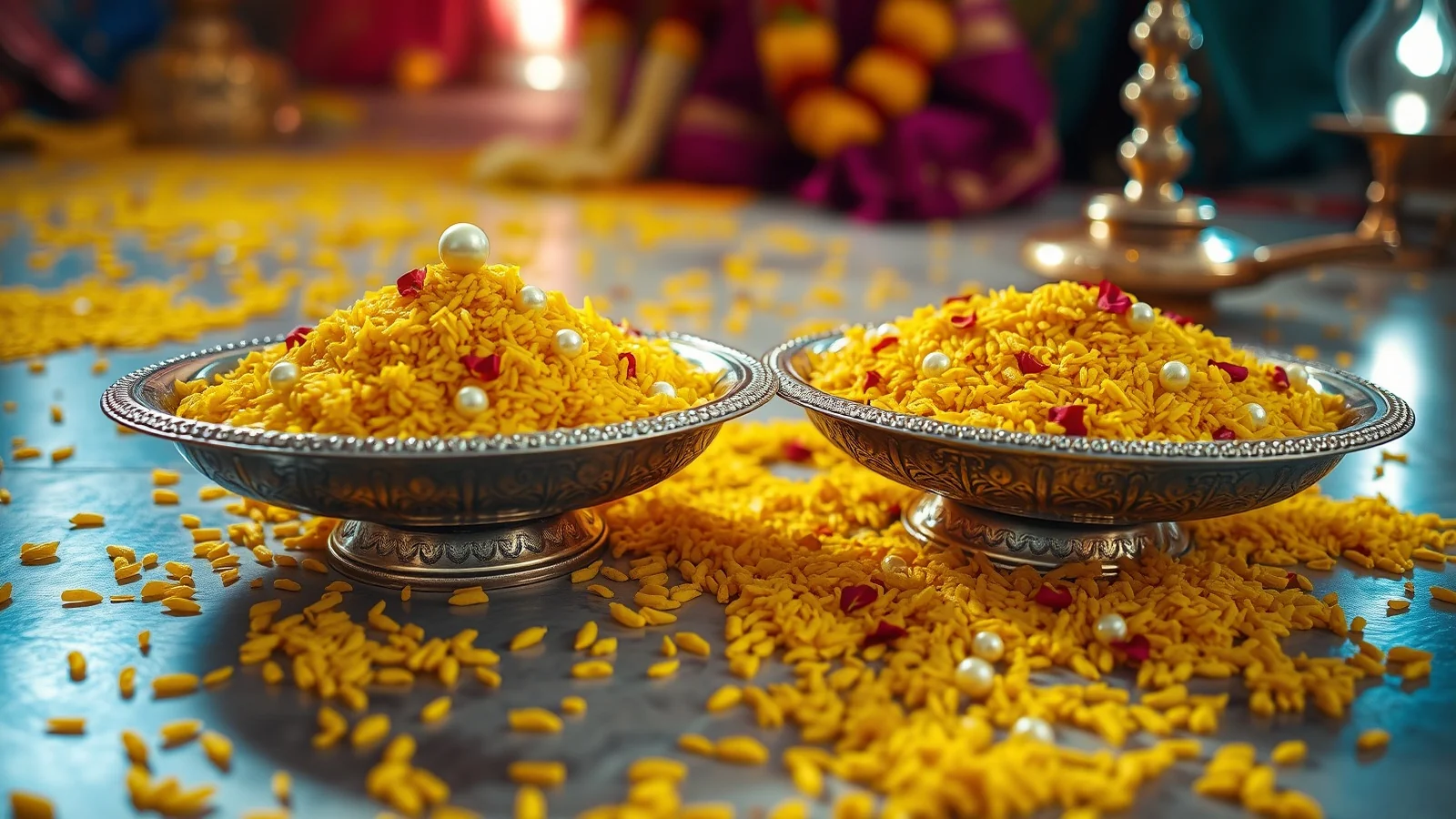
Immediately after the mangalsutra is tied, two silver or brass plates heaped with rice are placed in front of the couple. They take handfuls and pour them over each other’s heads. Then they do it again. And again.
Within a minute it stops being a ritual and becomes a contest. The cousins on both sides start refilling the plates. The families shout encouragement. Rice goes everywhere. It is, by a wide margin, the loudest and happiest thing that happens in a Telugu wedding, and it comes seconds after the quietest.
That placement is not accidental. The jeelakarra bellam and the tying of the mangalsutra are performed in near silence at a precisely calculated moment, with the whole hall watching and nobody breathing. Talambralu is what the room does next.
What goes into the rice
The mixture is not plain rice, and the ingredients carry meaning.
- Raw rice, unbroken grains, as the base. Rice is the standing symbol of prosperity and sustenance across Indian ritual.
- Turmeric, which colours the rice yellow and carries the same auspicious and purifying associations it does in haldi and mangala snanam.
- Pearls, in families that follow the older practice, mixed in for prosperity. Historically these were real, and in wealthy families the talambralu rice was sifted afterwards to recover them.
- Saffron, for fragrance and as a mark of wealth.
- Coins, in some families, again for prosperity.
- Flower petals, commonly jasmine or rose.
The rice is prepared by the women of both families beforehand, and the two plates are traditionally identical so that neither side starts with an advantage. That detail tells you how seriously the competition is taken.
What it means
Three readings run alongside each other, and families cite all three.
Prosperity showered on the couple. The most straightforward. Grain poured over the head is abundance arriving, the same logic that sits behind the rice vessel at griha pravesh.
Mutual blessing. The couple bless each other rather than being blessed by elders. In a ceremony where almost everything is done to them or for them by priests and parents, this is something they do to each other, at the same time, as equals.
Play as a beginning. The couple’s first act as a married pair is a game they are both trying to win, in public, laughing. It sets a tone deliberately, and it is the same instinct that produces nalangu in Tamil weddings and joota chupai in the north.
The folk belief attached to the contest is that whoever pours more rice will have the upper hand in the marriage. Nobody believes it, everybody repeats it, and the cousins refilling the plates are shameless about which side they are helping.
How it is performed
- Timing. Immediately after the mangalsutra is tied and the three knots are made.
- The plates. Two matched vessels, heaped, placed within reach of both.
- The rounds. Traditionally three, in practice as many as the families can sustain.
- The refill. Cousins and siblings scoop rice back off the mandap and into the plates, which is where the partisanship becomes obvious.
- The end. Called by the priest, usually when the mandap becomes genuinely unsafe to sit on.
In many families the couple are lifted or supported by their cousins so that one can reach higher than the other, which is treated as fair. The rice is swept up afterwards and, in traditional practice, not thrown away: it is considered auspicious and is often distributed or used.
Where it sits in the sequence
- Kanyadaanam. The giving of the bride. See kanyadaan.
- Jeelakarra bellam. Cumin and jaggery at the muhurtam. See the jeelakarra bellam guide.
- Mangalsutra. The thread is tied with three knots. See the mangalsutra.
- Talambralu. The rice shower.
- Saptapadi. The seven steps. See saptapadi.
- Sthalipakam and arundhati. Closing rituals, including showing the bride the star Arundhati.
The full Telugu order is set out in our guide to Telugu wedding rituals, and the wider regional context in South Indian wedding traditions.
Regional equivalents
- Telugu. Talambralu proper, with the competitive element fully developed. See Telugu wedding rituals.
- Kannada. An equivalent rice-showering ritual is performed with regional variations in the mixture. See Kannada wedding traditions.
- Tamil. Akshathai, blessed rice, is showered on the couple by elders rather than poured by the couple on each other. The difference is meaningful: one is a blessing received, the other is a game played. See Tamil Brahmin wedding rituals.
- North Indian. Rice and petals are thrown at several points, notably at the vidaai, but by the family rather than by the couple. See our guide to Hindu wedding rituals.
Why it comes exactly where it does
The placement of talambralu is one of the more sophisticated pieces of sequencing in any Indian wedding, and it is worth noticing.
The twenty minutes before it are the most concentrated of the day. The kanyadaanam is emotionally heavy for the bride’s parents. The jeelakarra bellam is performed in near silence at a fixed instant with the whole hall watching. The mangalsutra is tied while the chanting peaks. By the end of that run the room has been holding its breath for a long time, and the bride’s mother is usually crying.
Then somebody puts two plates of rice in front of the couple and the whole thing detonates into a food fight. It is a deliberate and very effective release, and families who compress or skip it to save schedule leave the room stuck in the heavier register for the rest of the ceremony.
The same structural instinct appears elsewhere: nalangu in Tamil weddings and joota chupai in North Indian ones both follow solemn passages for the same reason.
Planning the wedding these ceremonies belong to? We plan weddings across India and can take the schedule, the logistics and the coordination off your family entirely.
The cousins, and why they matter
Talambralu is nominally between the couple. In practice it is between the two sets of cousins, and that is the design rather than a corruption of it.
The refilling is where it happens. Someone on each side is scooping spilled rice back into their side’s plate, and doing it faster and less scrupulously than the other. Cousins block, shield, and occasionally tip a whole plate. Within a minute the two families’ younger generations are competing directly, in public, with everyone laughing.
This matters because those cousins are the people who will actually maintain the relationship between the two families over the next forty years. The parents have done the formal business of the wedding; the cousins have just done the informal one. It is the same social work that joota chupai performs in the north, and it is why both rituals survive while more solemn customs quietly disappear.
What happens to the rice afterwards
Several kilos of turmeric rice end up on the mandap, and traditional practice does not treat it as rubbish.
The rice has been present at the ceremony and is considered auspicious. In many families it is swept up carefully, and either kept, distributed to relatives, given to the temple, or used as feed for birds and cattle rather than thrown away. Some households mix a portion into the first rice cooked in the couple’s new home.
Where pearls were used, sifting the rice to recover them is a genuine post-ceremony task, traditionally done by the women of the family, and one reason most households now use imitation pearls instead.
The practical instruction for a hotel wedding follows from this: tell the banquet team not to bin it immediately, and nominate someone in the family to deal with it. Staff clearing a mandap at midnight will otherwise do the obvious thing, and older relatives who notice are genuinely upset by it.
A note on scale
Talambralu has inflated. In a home wedding of eighty people, two plates of rice and three rounds was the whole of it. At a five-hundred-guest hotel wedding the same ritual now routinely runs to buckets of rice, a dedicated refill team and several minutes of footage.
There is nothing wrong with that, and the larger version is genuinely enjoyable. But two things get lost. The first is the couple’s own experience: at a certain volume they stop playing with each other and start performing for a crowd. The second is the rice itself, which at scale is simply wasted rather than distributed. Families who want both the spectacle and the substance tend to run a big public round for the room and a smaller, closer one for the family.
Practical notes
- Tell the venue. Several kilos of turmeric rice will end up on the floor, the seating and the drapes. Hotels that have not been warned charge for it.
- Protect the outfits. Turmeric stains silk permanently. This is unavoidable and worth accepting in advance rather than discovering during.
- Use unbroken rice. Broken rice powders and clings; whole grains fall away cleanly.
- Skip real pearls unless you plan to sift. Most families now use imitation ones for exactly this reason.
- Warn the photographers to stay wide. This is a fast, unpredictable, high-energy moment and close lenses get coated.
- Let it run. Families who cut it short after one round to stay on schedule almost always regret it. It is thirty seconds of ritual and several minutes of the best footage of the day.
Planning a wedding that honours these traditions?
Team Velvet Knot plans weddings across every major Indian tradition, and we brief vendors on the rituals so nothing gets rushed, mistimed or quietly dropped from the running order. Tell us your dates and your community, and we will come back with an honest plan.
Frequently Asked Questions
What is talambralu?
Talambralu is the Telugu wedding ritual in which the newly married couple pour handfuls of turmeric-coloured rice over each other’s heads, repeatedly and competitively, immediately after the mangalsutra is tied.
What is in the talambralu rice?
Raw unbroken rice coloured with turmeric, usually with saffron and flower petals, and in families following older practice, pearls and small coins for prosperity. Both plates are traditionally identical so neither side starts with an advantage.
What does the ritual symbolise?
Prosperity being showered on the couple, the couple blessing each other as equals rather than being blessed by elders, and play as a deliberate beginning to the marriage. It is also the release of tension straight after the most solemn moment of the ceremony.
Does the winner really rule the marriage?
No. It is a joke every Telugu family repeats and nobody believes. The cousins refilling the plates are openly partisan about which side they help, which is part of the fun rather than a flaw in the contest.
How many rounds are there?
Three traditionally, and in practice as many as the families can sustain. The priest calls an end to it, usually once the mandap has become genuinely difficult to sit on.
Is talambralu the same as the Tamil akshathai?
No, and the difference matters. In Tamil practice, elders shower blessed rice on the couple. In talambralu the couple pour it over each other. One is a blessing received; the other is a game the couple play together.
Sources and further reading
Begin Your Engagement
Want a real number for your wedding?
Tell us your city, guest count and dates. Team Velvet Knot will come back within 24 hours with an itemised budget.