Kannada Wedding Traditions: The Complete Karnataka Ceremony Guide
- What defines a Kannada wedding
- Nischaya Tamboola: the engagement
- Naandi and the pre-wedding blessings
- Kashi Yatra: the mock pilgrimage
- Var Puja and welcoming the groom
- Kanyadaan and the Dhaare ceremony
- Mangalya Dharane and Saptapadi
- Okhli and the playful games
- Lingayat and Veerashaiva variations
- Vokkaliga, Brahmin and community customs
- Attire, feast and the modern Kannada wedding
- How the muhurtham is fixed
- What a Mysore wedding costs
- Related South Indian rituals
- Kannada wedding rituals in order
- Brahmin, Lingayat and Vokkaliga weddings compared
- Frequently Asked Questions
- Sources and further reading
Kannada wedding traditions blend Karnataka’s warmth with ancient Vedic and Veerashaiva custom. From the Nischaya Tamboola engagement and the playful Kashi Yatra to the sacred Dhaare water pouring and Mangalya Dharane, each ritual carries deep meaning. Customs shift across Brahmin, Lingayat and Vokkaliga communities, yet all celebrate union, family and blessing.
Planning a Kannada wedding? Free download: the ritual-by-ritual planning timeline
Every ritual on this page in order, with when it happens, what the family arranges and when to book it, on one printable page. Share a few details about your wedding in the form at the end of this page and the download link appears as soon as you send it.
What defines a Kannada wedding
A Kannada wedding, the Kannadiga Hindu marriage of Karnataka, is known for being warm, grounded and refreshingly free of excess. Compared with the grand multi day spectacles of some regions, the traditional Kannadiga celebration is intimate, deeply rooted in ritual meaning, and often completed in a single auspicious day chosen by the family astrologer. The ceremony carries the same Vedic backbone found across the south, yet Karnataka gives it a distinct flavour through its language, its food, its silks and its layered community customs.
What makes Kannada weddings especially interesting is variation. There is no single template. A Kannada Brahmin (Madhwa or Smartha) wedding follows an elaborate homa driven Vedic order. A Lingayat or Veerashaiva wedding centres on Ishtalinga worship and can dispense with the sacred fire and even the priest altogether. A Vokkaliga or Gowda wedding blends earthy agrarian custom with mainstream south Indian rites. Understanding these differences is the key to understanding Karnataka. For the wider regional picture, see our South Indian wedding traditions guide, and for the shared Vedic framework read our Hindu wedding rituals guide.
Nischaya Tamboola: the engagement
The formal beginning is the Nischaya Tamboola, also spoken as Nishchay Tamulam or simply the engagement. Tamboola refers to the betel leaves and areca nuts that are central to every auspicious South Indian exchange, and Nischaya means a firm decision. Here the two families formally fix the alliance. Elders exchange plates of betel leaves, areca nuts, coconut, fruit, turmeric and kumkum, and the horoscopes are matched and the wedding date confirmed.
Gifts flow both ways. The groom’s family presents the bride to be with a silk saree, blouse piece, sweets and a coconut, while the bride’s family gives the groom a dhoti, fruit, coconut and sweets. In many families the priest recites the lagna patrike, the written wedding invitation and horoscope, sealing the commitment aloud before both households. It is a joyful, food filled afternoon that turns two families into one extended clan.
Naandi and the pre-wedding blessings
Before the wedding day the families perform Naandi, a puja held separately in the bride’s and groom’s homes to invoke divine blessings and clear the path of obstacles. A kalasha, a copper or brass pot filled with holy water and topped with a coconut, is installed to represent the presence of the deities and the ancestors. The pot of water symbolises amrita, the nectar of life, and the priest prays that the wedding proceed without disruption. Naandi is often said to honour four guiding values: truth, righteousness, peace and love.
Around Naandi come the familiar joyful pre wedding customs. There is a turmeric and oil bath for both the bride and groom, close in spirit to the north Indian haldi ceremony, meant to purify and brighten the skin. Married women gather for songs, the home is decorated with mango leaf toranas and rangoli, and the Ganga puja or well worship invites the water goddess to bless the household. These rites weave the couple firmly into the fabric of family and community before the vows begin.
Kashi Yatra: the mock pilgrimage
One of the most loved and light hearted moments of a Kannada wedding is the Kashi Yatra, the mock pilgrimage. In this charming skit the groom pretends to renounce worldly life and sets off, umbrella and walking stick in hand, sometimes with a fan and a bundle of belongings, declaring that he will go to Kashi (Varanasi) to become an ascetic and pursue a life of study and devotion.
At the gate he is intercepted by the bride’s father or maternal uncle, who gently persuades him that the householder’s life is nobler than renunciation and that a worthy bride awaits him. Won over, the groom abandons his pilgrimage and returns to the mandap to marry. Beneath the humour lies real philosophy: it dramatises the Hindu ideal that grihastha, the householder stage, is a sacred duty, and that marriage is a spiritual path rather than a retreat from one. The whole gathering laughs, and the mood lifts before the solemn rites.
Var Puja and welcoming the groom
When the groom arrives at the wedding venue he is received with full honour in the Var Puja, the worship of the bridegroom. The bride’s family welcomes him as a form of Lord Vishnu, washing his feet in a rite sometimes called the pitambar, offering him a new silk dhoti and an angavastra or shawl, and garlanding him. In Vokkaliga custom the bride’s father specifically washes the groom’s feet and gifts him the silk dhoti and scarf that he then changes into for the ceremony.
The couple often exchange garlands in the jaimala or var mala, echoing the wider garland exchange tradition, sometimes with cousins lifting the bride and groom to make the friendly contest of who garlands whom that little bit harder. A decorative curtain, the antarpat, may be held between the couple during the opening mantras so that they see each other only at the auspicious moment.
Kanyadaan and the Dhaare ceremony
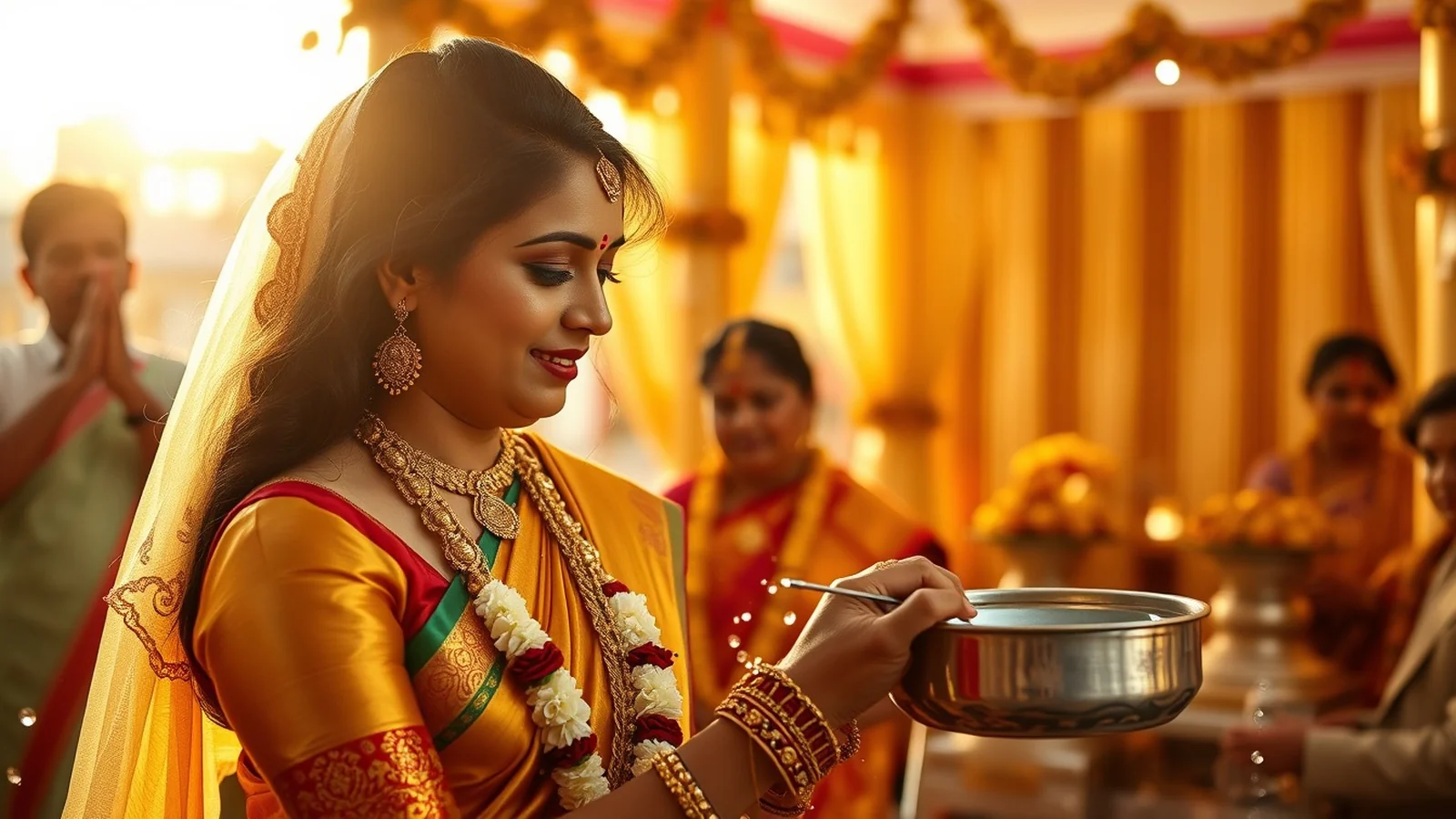
The emotional heart of a Kannada wedding is the Dhaare, also called Dhaare Eravana or Dhare Herdu, the pouring ceremony that gives the bride away. It is Karnataka’s distinctive form of kanyadaan. The bride’s parents place her hands into the groom’s hands, set a coconut and betel leaves on top, and then pour a steady stream of sacred water over the joined hands while the priest recites the sacred formulae. The flowing water, dhaare, symbolises the unbroken, purifying and irreversible nature of the gift of the daughter and the binding of the two lives.
This water pouring is so central that older Kannadigas often refer to the entire wedding simply as the dhaare. It is a tender, tearful moment, the parents entrusting their daughter to a new family, and it is the ritual that most clearly marks a wedding as Kannadiga rather than Tamil or Telugu. For a sense of how neighbouring communities handle the same rite, compare our Tamil Brahmin wedding rituals and Telugu wedding rituals guides.
Mangalya Dharane and Saptapadi
With the giving away complete, the groom performs the Mangalya Dharane, the tying of the mangalya or mangalsutra. To the beat of drums and the chorus of the gathering, and with the auspicious getti melam music at its loudest to drown out any inauspicious sound, he fastens the sacred thread strung with black beads and gold around the bride’s neck, tying two knots himself and a third often tied by his sister. He then applies sindoor to her forehead, marking her as a married woman. To understand the symbolism of this thread in depth, see our guide to the mangalsutra meaning and tradition.
The couple then perform the Saptapadi, the seven steps taken together, usually around the sacred fire, with each step carrying a vow for nourishment, strength, prosperity, happiness, progeny, health and lifelong friendship. The Saptapadi is the legally and spiritually decisive act of a Hindu marriage: once the seventh step is taken the couple are husband and wife. Read the full meaning of each vow in our Saptapadi seven vows guide.
Okhli and the playful games
After the solemn vows come the games that break the tension and mix the two families. In Okhli, a ring or coin is dropped into a wide vessel of milky, kumkum tinted water and the newlyweds plunge their hands in to find it, the winner of the best of several rounds teased as the one who will rule the home. It is pure fun, and the splashing and laughter loosen everyone up.
Other post wedding customs include the couple feeding each other sweets, the bride’s playful contests with her new sisters in law, and the aarti performed by married women to ward off the evil eye. Finally comes the bidding of farewell as the bride leaves for her marital home, a gentle Kannadiga version of the vidaai ceremony, followed by the griha pravesha, her ceremonial first entry into her new household, often by toppling a measure of rice with her right foot to signal incoming prosperity.
Planning the wedding these ceremonies belong to? We plan weddings across India and can take the schedule, the logistics and the coordination off your family entirely.
Lingayat and Veerashaiva variations
The Lingayat or Veerashaiva community, followers of the twelfth century social reformer Basavanna, hold weddings that differ meaningfully from the Vedic Brahmin model. Their faith centres on the Ishtalinga, a small personal emblem of Shiva that every initiate wears on the body and worships daily. A Lingayat wedding therefore opens with Ishtalinga puja or Lingadharane rather than fire worship, and it is frequently led by a guru or jangama, a Veerashaiva spiritual teacher, so that a Brahmin priest and even a homa fire may be entirely optional.
The philosophy also reshapes the rites. Because Basavanna’s teaching holds all souls equal before God and rejects caste and gender hierarchy, many Lingayat families omit or reinterpret kanyadaan, since the idea of a father gifting away a daughter as property sits uneasily with a doctrine of equality. The couple worship their Ishtalingas together, exchange garlands and vows before the guru, and receive blessings, producing a ceremony that can be simpler, shorter and more egalitarian while remaining profoundly devotional. Lingayat weddings still keep the Nischaya Tamboola, the turmeric rites and the joyful feast.
Vokkaliga, Brahmin and community customs
The Vokkaliga or Gowda community, Karnataka’s traditional agrarian landholders, follow rites close to the mainstream south Indian pattern with their own agrarian touches. Their weddings include the chapparashastra, the raising and worship of the wedding pandal, ganga puja to honour water, the foot washing pitambar for the groom, Saptapadi and the mangalya tying. Family and clan (kula) identity is strong, and the maternal uncle often plays a leading ceremonial role.
Kannada Brahmin weddings, whether Madhwa or Smartha, are the most elaborately Vedic, with extended homa, the sacred thread rites, kashi yatra, dhaare and saptapadi conducted over a long ritual morning by a purohita. Across all these communities the Kannadiga preference is for meaningful ritual over ostentation, for the blessing of elders, and for the gathering of the extended family. Regional distinctions, coastal Tulu and Konkani speaking families near Mangalore, for instance, add their own further layers, but the core Kannada framework of Naandi, Kashi Yatra, Dhaare, Mangalya Dharane and Saptapadi runs through them all.
Attire, feast and the modern Kannada wedding
Traditional Kannada bridal attire is elegant and understated. The bride wears a rich silk saree, most classically a Mysore silk in deep jewel tones or the striking Ilkal saree of northern Karnataka with its distinctive red pallu and kasuti embroidery, draped in the regional Kacche or nine yard Naavari style for the ceremony, paired with temple jewellery, jasmine flowers in the hair and a gold waistband. The groom wears a white or cream silk dhoti with an angavastra, and crowns the look with the famous Mysore Peta, the ornate silk turban that is a proud Karnataka emblem.
The feast is a highlight, traditionally vegetarian and served on a banana leaf. Guests enjoy bisi bele bath, the aromatic rice, lentil and tamarind dish that is Karnataka’s signature, alongside crisp vadas, huli and kootu, and the beloved sweets: obbattu or holige, the sweet stuffed flatbread, along with Mysore pak, chiroti and payasa. In modern Bengaluru and Mysuru celebrations couples layer in mehndi and sangeet evenings, designer sarees and destination venues, live counters and cinematic photography, yet the ritual core endures. Even the most contemporary Kannada wedding still turns on the Dhaare water, the tying of the mangalya and the seven shared steps, the ancient promises that make two people, and two families, one.
Planning a wedding rooted in your traditions?
Tell us your community, dates and vision. Team Velvet Knot will honour every ritual and put together a tailored plan and an honest budget.
How the muhurtham is fixed
What a Mysore wedding costs
Related South Indian rituals
- the Kashi Yatra ritual
- the oonjal swing ceremony
- mangala snanam, the dawn ritual bath
- the jeelakarra bellam ritual
- talambralu, the rice shower
- nischitartham, the South Indian engagement
Traditions in this region: read our full guide to Tulu and Bunt wedding traditions.
Kannada wedding rituals in order
The sections above explain each rite. This table puts them in the order most Kannadiga Hindu families follow, with the name each rite goes by and what it is for, so that a family briefing or a photographer’s shot list can be built from one place.
| Stage | Rite | What happens | Purpose |
|---|---|---|---|
| Before the wedding | Nischaya Tamboola | Families exchange betel leaves, areca nuts, coconut and gifts, and fix the date | Formal engagement |
| Before the wedding | Naandi | Puja at each home with a kalasha installed | Blessing and removal of obstacles |
| Before the wedding | Turmeric and oil bath | Both bride and groom are anointed at home | Purification |
| Before the wedding | Ganga puja | Worship of water, often at a well | Blessing of the household |
| Wedding day | Kashi Yatra | The groom sets off for Kashi and is persuaded back | Choosing the householder’s life |
| Wedding day | Var Puja | The groom is received and his feet are washed | Honouring the groom |
| Wedding day | Jaimala | Garlands are exchanged, sometimes behind an antarpat | Acceptance |
| Wedding day | Dhaare | Water is poured over the couple’s joined hands | Giving away the bride |
| Wedding day | Mangalya Dharane | The groom ties the mangalya to the sound of getti melam | Marking the marriage |
| Wedding day | Saptapadi | Seven steps together, usually around the fire | The binding vows |
| After the vows | Okhli | The couple search a vessel of coloured water for a ring | Play between the families |
| After the wedding | Griha pravesha | The bride enters her new home, toppling a measure of rice | Welcome and prosperity |
Brahmin, Lingayat and Vokkaliga weddings compared
| Element | Kannada Brahmin (Madhwa or Smartha) | Lingayat or Veerashaiva | Vokkaliga or Gowda |
|---|---|---|---|
| Who officiates | A purohita | Often a guru or jangama | A priest, with elders prominent |
| Sacred fire | Central, with an extended homa | May be omitted | Present |
| Focus of worship | Vedic rites | The Ishtalinga | Mainstream South Indian rites |
| Kanyadaan and Dhaare | Performed | Often omitted or reinterpreted | Performed |
| Distinctive rite | Kashi Yatra and the long ritual morning | Joint Ishtalinga worship | Raising the wedding pandal, and the maternal uncle’s role |
| Length | Usually the longest | Often simpler and shorter | Moderate |
When the two families come from different communities, agree early which elements will be kept, because the question of whether there will be a fire, and who will officiate, decides the venue booking. Many hotel ballrooms restrict open flame, which matters for a Brahmin homa and not for a Lingayat ceremony without one. For the date itself, see how South Indian families fix the muhurtham.
Temple weddings on Velvet Knot: ISKCON temple weddings.
Also on Velvet Knot: the gauri puja guide.
Frequently Asked Questions
What is the Dhaare ceremony in a Kannada wedding?
Dhaare, also called Dhaare Eravana or Dhare Herdu, is the giving away of the bride and Karnataka’s form of kanyadaan. The bride’s parents join her hands with the groom’s, place a coconut and betel leaves on top, and pour a steady stream of sacred water over the joined hands. The flowing water symbolises a pure, unbroken and irreversible union. It is so central that Kannadigas often call the whole wedding the dhaare.
How is a Lingayat wedding different from other Kannada weddings?
Lingayat or Veerashaiva weddings centre on Ishtalinga worship rather than the Vedic fire. They are often led by a guru or jangama instead of a Brahmin priest, and a homa fire and even the priest can be optional. Following Basavanna’s teaching of equality, many families omit or reinterpret kanyadaan, and the ceremony tends to be simpler, shorter and more egalitarian while remaining deeply devotional.
What is the Kashi Yatra ritual?
Kashi Yatra is a playful mock pilgrimage. The groom pretends to renounce worldly life and sets off with an umbrella and stick toward Kashi to become an ascetic. The bride’s father or uncle stops him, persuades him that married householder life is nobler, and leads him back to the mandap. It dramatises the Hindu ideal that marriage is a sacred duty rather than a retreat from the world.
What does the bride wear at a Kannada wedding?
The Kannada bride traditionally wears a rich silk saree, most classically a Mysore silk in jewel tones or an Ilkal saree from northern Karnataka with its red pallu and kasuti work, often draped in the nine yard Naavari or Kacche style. She completes the look with temple jewellery, a gold waistband and jasmine flowers in her hair. The groom wears a silk dhoti with an angavastra and the ornate Mysore Peta turban.
What food is served at a Kannada wedding?
The feast is traditionally vegetarian and served on a banana leaf. Karnataka’s signature bisi bele bath takes pride of place, alongside vadas, huli, kootu, rice and rasam. The sweets are beloved: obbattu or holige, the sweet stuffed flatbread, plus Mysore pak, chiroti and payasa. Modern Bengaluru and Mysuru weddings often add live counters and wider menus while keeping these classics central.
What is Mangalya Dharane?
Mangalya Dharane is the tying of the mangalya or mangalsutra, the moment a Kannada woman becomes a married wife. As drums and the getti melam music reach their peak, the groom ties the sacred black bead and gold thread around the bride’s neck, fastening two knots himself while his sister often ties a third, then applies sindoor to her forehead. It is immediately followed by the Saptapadi, the seven shared steps.
What is the order of rituals in a Kannada wedding?
A typical order is Nischaya Tamboola, Naandi and the turmeric bath before the wedding, then Kashi Yatra, Var Puja, the garland exchange, Dhaare, Mangalya Dharane and Saptapadi on the day, followed by games such as Okhli and the bride’s griha pravesha. Lingayat weddings follow a different pattern centred on Ishtalinga worship.
Sources and further reading
Begin Your Engagement
Want a real number for your wedding?
Tell us your city, guest count and dates. Team Velvet Knot will come back within 24 hours with an itemised budget.