Tulu and Bunt Wedding Traditions: The Dhare Ceremony, Bari Rules and Coastal Karnataka Customs
- Tulu Nadu is its own wedding culture, not a version of the Kannada one
- The dhare ceremony explained: what actually happens at the dhare mane
- Why the dhare replaces kanyadaan, and what that changes on the day
- Bari: the matrilineal clan rule that decides who may marry whom
- Aliyasantana: how the matrilineal system worked and how much survives
- Nischaya tamboola: the betrothal that fixes the match
- Muhurtha, the Aati month and the calendar traps of a coastal wedding
- Madarangi and the pre wedding nights
- Bale muhurtha and the plantain in Tulu ritual
- Thali, kasarkana and the ornaments of a Bunt bride
- The wedding feast: coastal food that people actually travel for
- Daiva, Bhuta Kola and the family shrine
- How Bunt families run these weddings today, at home and abroad
- Frequently Asked Questions
- Sources and further reading
A Tulu Bunt wedding turns on the dhare, where water is poured from a dhare vessel over the couple’s joined hands holding a coconut and betel. Who may marry whom is decided by bari, the mother’s clan. The tradition belongs to Dakshina Kannada, Udupi and Kasaragod, and follows its own calendar, ornaments and coastal feast.
Tulu Nadu is its own wedding culture, not a version of the Kannada one
The first thing to fix is geography. Tulu Nadu is the coastal strip that runs from roughly Kasaragod in northern Kerala through Mangalore and Udupi up to the edge of Uttara Kannada. The people there speak Tulu, a Dravidian language distinct from Kannada with its own vocabulary of kinship and ritual. Bunts are the largest landholding community of this belt, alongside Billava, Mogaveera, Jain Bunt and other Tulu speaking groups who share much of the same ceremonial grammar.
Because Dakshina Kannada sits inside the state of Karnataka, families outside the region often assume the wedding will look like the ceremonies described in our guide to Kannada wedding traditions. It does not. The Kannada ceremony, in its Brahmin and mainstream forms, is built around a Vedic sequence: kashi yatra, kanyadaan, mangalya dharane, saptapadi around fire. A traditional Bunt wedding has no kanyadaan at its centre and, in its older form, no priest and no homa fire at all.
What replaces it is the dhare. That single rite carries the legal and emotional weight that kanyadaan and saptapadi carry elsewhere. Understanding that substitution is the whole key to planning a Tulu wedding, because every decision about timing, seating, who stands where and who speaks follows from it. If you are comparing the coastal traditions side by side, the Konkani and Kodava customs are the closest neighbours in feel, and both are also priest light.
The dhare ceremony explained: what actually happens at the dhare mane
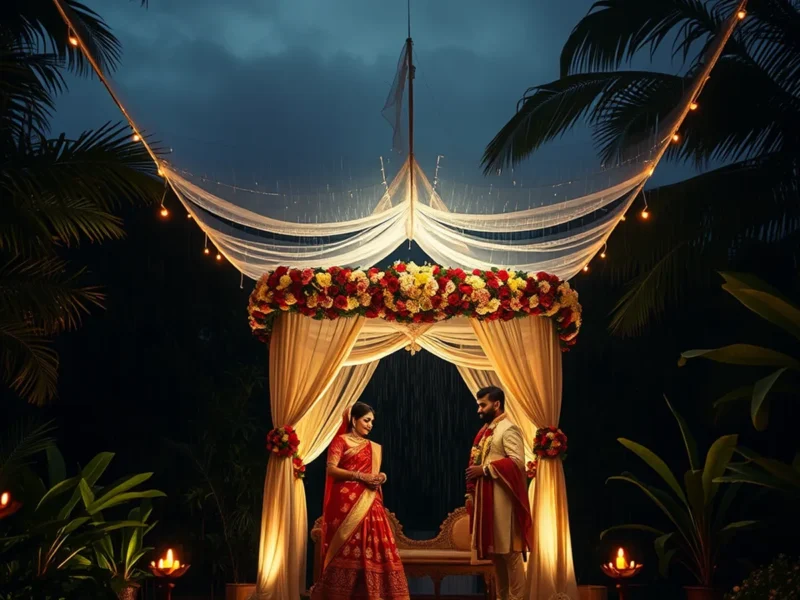
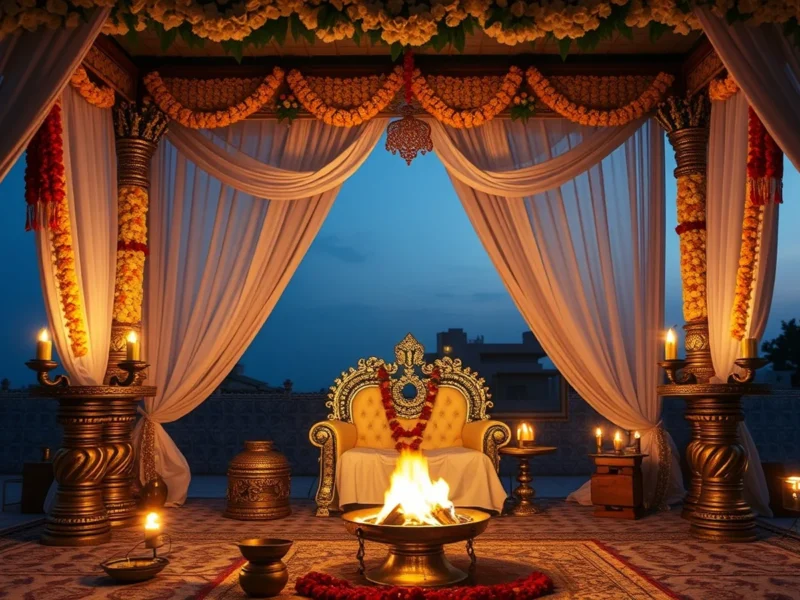
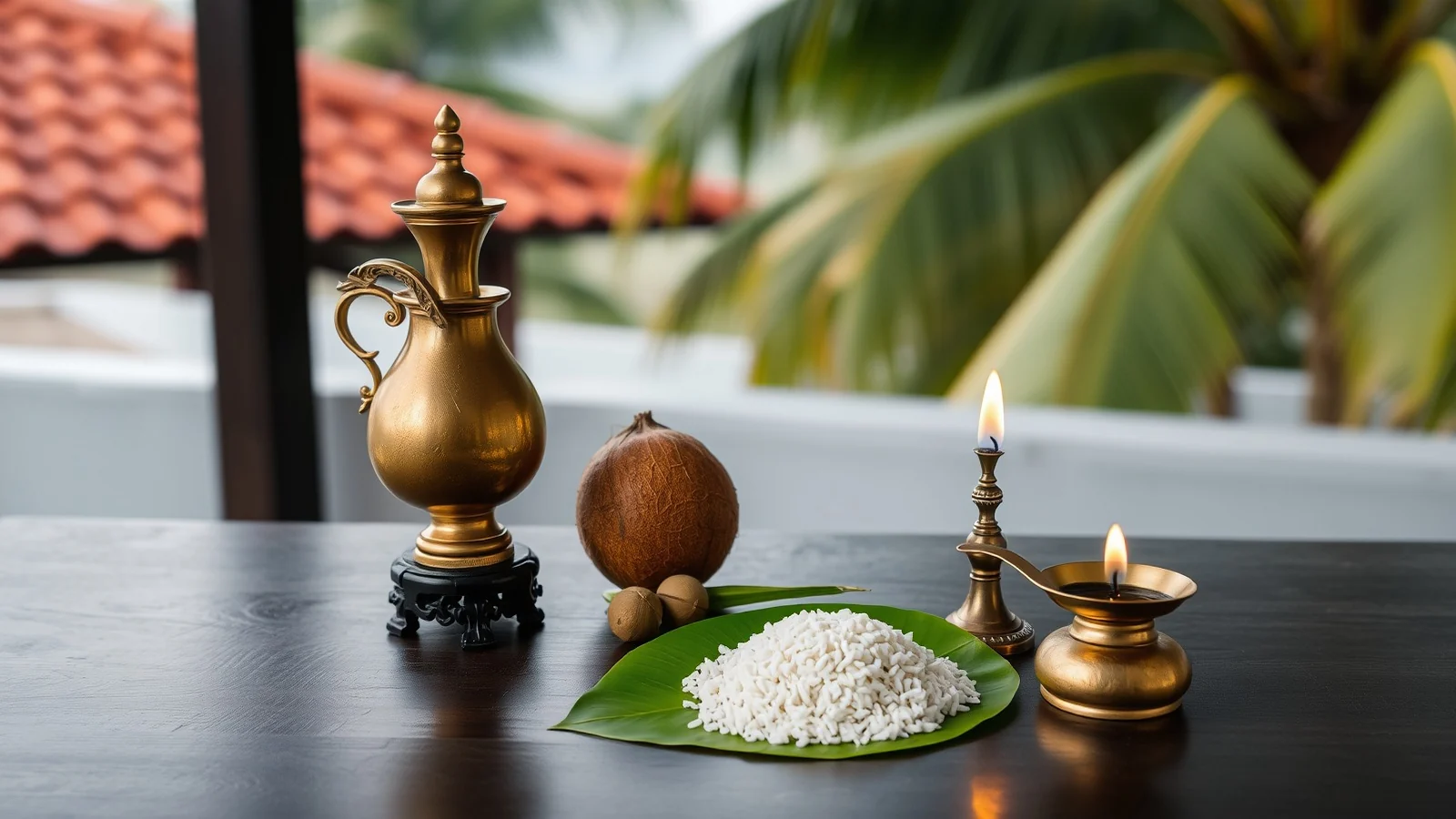
Dhare means the pouring, and the vessel is usually called the dhare gindi. The couple sit or stand at a decorated wooden platform or low pedestal known as the dhare mane, traditionally a carved seat kept in the family for generations and brought out for each wedding. The bride’s right hand is placed over the groom’s right hand, or in some family styles her hand rests in his palm, and a coconut is set on top of the joined hands with betel leaves and areca nut tucked around it.
Water, often mixed with a little milk, turmeric or sandal, is then poured slowly from the vessel so that it runs over the coconut, over the joined hands and down into a plate or the earth. The pouring is done by the bride’s guardian. In practice that is her maternal uncle, or her father, and in many families both take a turn, with the uncle pouring first because of his standing in the matrilineal system. Elders standing close by chant blessings in Tulu rather than Sanskrit in the older style.
The visual logic is unmistakable once you have seen it. Water poured over a gift is the classical Indian gesture of irrevocable giving, the same gesture that seals a land grant or a donation. Here the thing given is not the bride alone but the union itself, witnessed by the assembled kin of both baris. When the water stops, the couple are married. Everything before it is preparation and everything after it is celebration.
Two practical notes from running these. First, the pour must be slow and continuous, and the vessel should be filled well past what looks necessary, because a pour that runs dry mid ritual reads badly to elders. Second, put an absorbent mat and a wide brass plate under the dhare mane. Wet marble underfoot with a bride in a heavy kasavu or Mangalorean silk saree is the most common near miss at these weddings.
Why the dhare replaces kanyadaan, and what that changes on the day
In most Hindu ceremonies the father gives the daughter away. Our guide to kanyadaan sets out that logic: the father’s gift, the merit it earns him, the shift of guardianship from one household to another. The rite assumes a patrilineal family where the daughter leaves her line and joins her husband’s. Traditional Tulu society did not work that way, so the ceremony that expresses it never took root in the same form.
Under Aliyasantana, a woman never left her own lineage. Her children belonged to it. There was nothing to hand over. What the dhare does instead is publicly bind two people in the presence of both their clans, with the bride’s maternal uncle as the officiating elder because he, not the father, was the guardian figure in her line. Many Bunt families today do add a kanyadaan, a priest and a homa, especially in urban and inter community weddings, and that is a genuine modern layering rather than an ancient practice.
For a planner this changes the running order and the seating. The bride’s maternal uncle needs a defined position and a moment of his own, not a chair in the second row. Photographers who have shot mostly north Indian weddings will frame the father and miss him entirely. Brief them in writing. And if the family has chosen to include both kanyadaan and dhare, agree the sequence in advance with the elders, because the two rites compete for the same emotional peak.
Bari: the matrilineal clan rule that decides who may marry whom
Every Tulu person belongs to a bari, also written bali, inherited from the mother. There are many such clans, with names drawn from places, plants, animals and older lineage titles. A person’s bari never changes, and it does not pass from the father. A woman’s children carry her bari, her brother’s children carry his wife’s bari, and so the clan travels down the female line indefinitely.
The rule that follows is strict: two people of the same bari may not marry. They are treated as siblings regardless of how distant the actual blood relation is, and matches are checked against it before anything else, sometimes before horoscopes. This is genuinely unusual in Hindu India, where gotra exclusion is common but runs through the father. In Tulu Nadu the exclusion runs through the mother, which produces a completely different map of eligible partners within the same set of families.
It also means the first question in a Tulu match is not what caste or what star, but what bari. Families still ask it, including families who otherwise describe themselves as modern. Practice does vary: some households now treat it as advisory and some enforce it absolutely, and a few extend caution to the father’s bari as well. Where a couple share a bari and want to proceed anyway, expect a long negotiation with elders and plan for the possibility that some relatives will not attend.
Aliyasantana: how the matrilineal system worked and how much survives
Aliya means nephew, specifically the sister’s son. Aliyasantana was the system under which property and family authority in much of Tulu Nadu descended through women to their brothers and then to their sisters’ sons, rather than from father to son. The joint family estate, the guttu house, was held collectively, and the senior male manager was typically the eldest brother of the senior woman. The system is documented for Bunts and several other Tulu communities and has been recognised in Indian law, notably through the Madras Aliyasantana Act of 1949.
Legal change since then has steadily dismantled it. The Hindu Succession Act of 1956 and later state level reform moved inheritance towards individual, partible property, joint families were partitioned, and the guttu estates were broken up across generations. Very few families today transmit property by Aliyasantana rules. Anyone claiming it operates intact should be treated with scepticism, and any actual property question belongs with a lawyer in Mangalore, not with a wedding planner.
What survives is social rather than legal, and it survives strongly. The maternal uncle still carries ceremonial weight. The bride’s mother’s family is still the family that hosts and decides. Bari exclusion is still checked. Children still know their bari. In a wedding context you should assume the matrilineal frame is alive in etiquette even where it is dead in the revenue records, and address invitations, seating and ritual roles accordingly.
Nischaya tamboola: the betrothal that fixes the match
The formal engagement in Tulu households is usually called nischaya tamboola, and tamboola is the betel. Betel leaves and areca nut, both grown across the coast, are exchanged between the two families as the token that the agreement is binding. In the older form this was the whole ceremony: elders met, the bari question was settled, terms about the wedding and any gold were discussed openly, and the betel changed hands in front of witnesses.
Modern versions add a ring exchange, a photographer, a mandap style backdrop and a lunch for eighty to two hundred people. Families who want the ring element in a more familiar format often model it on the nischitartham style of the wider south. The Tulu core stays: the tamboola tray, the elders speaking, and the announcement of the wedding date once it has been checked.
Fix two things at the tamboola or you will pay for it later. One, the guest count split between the two families, since coastal weddings routinely run past a thousand and the catering scales brutally. Two, who pays for what. Our wedding planning cost guide sets out the usual Indian split, but coastal families often work to a different convention where the bride’s side hosts more of the daytime ritual and the groom’s side handles the reception, so write it down rather than assuming.
Muhurtha, the Aati month and the calendar traps of a coastal wedding
Dates are set by a local astrologer or the family purohit against the panchanga. The general south Indian principles apply and are covered in our muhurtham guide: auspicious months, favourable nakshatras, and a specific time window rather than a vague morning slot. Tulu weddings frequently place the dhare in the morning, with the feast at midday, which is very different from the late night muhurtams common in the north.
The distinctly Tulu constraint is Aati, the month that falls roughly from mid July to mid August. It sits at the height of the southwest monsoon, it is traditionally a lean and inauspicious period on the coast, and weddings are simply not held in it. Aati Amavasya, the new moon of that month, has its own observances involving medicinal kashaya. Do not try to argue a family into an Aati date because a venue is cheap.
The practical corollary is that the monsoon compresses the calendar. Coastal Karnataka takes very heavy rain from June through September, so the popular windows crowd into the cooler and drier months, and the good halls in Mangalore and Udupi are booked twelve to eighteen months ahead for those dates. Book venue and caterer before you finalise anything else, then build the rest of the plan around them.
Madarangi and the pre wedding nights
Madarangi is the Tulu word for henna, and the madarangi night is the community evening before the wedding. The bride’s hands and feet are decorated by female relatives and friends, the groom often receives a token application on his palm, and the two households sing, eat and stay up late. In many families the groom’s side has its own parallel evening on the same night rather than everyone gathering in one place.
The mechanics are the same as the henna nights described in our mehndi ceremony guide, but the mood is different. Tulu madarangi tends to be smaller, family heavy and less of a produced event than a north Indian mehndi, and the music is often local: Tulu folk songs, sometimes a Yakshagana influenced performance if the family is inclined that way. Sangeet in the Bollywood sense is an import, common now in Mumbai and Gulf weddings and optional at home.
A turmeric bathing rite is also performed in most families on the morning of, or the evening before, the wedding, with oil and turmeric applied by married women. It corresponds to the ritual described in our haldi ceremony guide, though the local name and the exact sequence vary from house to house. Plan for it in the schedule, because it routinely runs an hour over and pushes the bride’s dressing time straight into the muhurtha.
Planning the wedding these ceremonies belong to? We plan weddings across India and can take the schedule, the logistics and the coordination off your family entirely.
Bale muhurtha and the plantain in Tulu ritual
Bale is the Tulu word for plantain, and bale muhurtha is a pre wedding auspicious rite performed with plantain. Whole plantain plants complete with the stem and leaves are cut and fixed at the entrance of the house or the pandal, and the cutting and installing is done at a time fixed by the astrologer, with the family present. From that moment the household is formally in wedding mode.
Practice around this varies quite a lot between families and between Tulu communities, and you will hear the term used loosely for several different plantain related observances. Ask the family’s own elders what they do rather than importing a version from another household. The one constant is the plant itself. Plantain, coconut, betel and areca are the four coastal materials that appear at every stage of a Tulu wedding.
Source them fresh and locally. Plantain stems wilt fast in coastal humidity and a decorator who delivers them the previous afternoon will hand you brown, drooping leaves on the morning of the dhare. Same day cutting, kept shaded and wet at the base, is the only reliable method, and it costs very little compared with the visual difference it makes in the photographs.
Thali, kasarkana and the ornaments of a Bunt bride
The marriage thread and pendant is tied at or around the dhare in most families today. The ornament is broadly the thali of the south, and Tulu families use their own terms for the gold pieces, including kasarkana for the ornament worn by a married woman in some households. The specific design differs by community and by family goldsmith, so a Bunt thali will not look like a Tamil or Telugu one, and the meaning of the tying is the same one covered in our mangalsutra guide.
An honest point of history: the thali tying was not always the core of a Tulu wedding, because the dhare was. Its prominence has grown as coastal families have absorbed the wider south Indian and pan Hindu template. Older relatives will sometimes say plainly that the dhare is the marriage and the thali is an ornament. Both views will be in the room, and the ceremony can carry both without difficulty.
On dress, the bride typically wears a rich silk saree rather than a lehenga, often in the deep red and gold register, with substantial temple style gold. Groom’s dress is a white or cream dhoti with an angavastram and, in many families, a turban or a peta. The Mumbai and Gulf diaspora often add a lehenga for the reception and keep the saree for the dhare, which is a sensible compromise and worth suggesting early so the shopping is planned once.
The wedding feast: coastal food that people actually travel for
The Tulu wedding lunch is served on plantain leaf and it is a vegetarian meal in almost all cases. Even in communities that eat fish and meat daily, the wedding feast itself is usually pure vegetarian, with the non vegetarian coastal cooking appearing at the reception or at family meals around the wedding rather than at the ritual lunch. Ask, do not assume, because families differ.
The expected spread is specific: rice, sambar, several palya, a coconut heavy curry or two, sasive or menaskai style preparations, pickle, papad, and payasa to close. Coconut, red chilli, curry leaf and tamarind are the flavour base of the entire region, and a caterer from Bangalore or Hyderabad producing a generic south Indian menu will be noticed and discussed for years. Use a Mangalore or Udupi caterer, or fly one in.
Two logistical points. Plantain leaves must be laid correctly, tip to the left of the diner, and the serving order is fixed, so use servers who know the sequence. And build the seating in batches, called pankti, rather than assuming everyone eats at once. A thousand guest coastal wedding will typically feed in three or four sittings and the timing of those sittings is what determines whether the afternoon runs calmly or collapses.
Daiva, Bhuta Kola and the family shrine
Tulu Nadu has a living tradition of daiva or bhuta worship, performed publicly as Bhuta Kola. These are ritual performances in which a possessed performer embodies a local spirit deity and delivers judgements and blessings, and most old Tulu families are attached to a particular kuladaiva and its shrine. This is not folklore in the past tense. Kola are held annually across Dakshina Kannada and Udupi and families organise their year around them.
The wedding connection is direct. Many families will visit the family daivastana before the wedding to seek permission and blessing, and some will vow an offering or a kola after the wedding or after the birth of a first child. A Kola is not part of the wedding programme and should never be scheduled as entertainment for guests, which is an increasingly common and badly received mistake at diaspora weddings.
Alongside the daiva, most families also visit a temple, commonly Kollur Mookambika, Kateel Durgaparameshwari, Udupi Krishna or the family’s own kuladevata temple. Build the temple visit into the itinerary properly, since these are hours of travel from Mangalore and cannot be squeezed into a wedding morning.
How Bunt families run these weddings today, at home and abroad
In Mangalore and Udupi the standard shape is a two day event. Madarangi and the turmeric rite on day one, dhare and the plantain leaf lunch on the morning of day two, reception in the evening. Venues are typically a community kalyana mantapa, a beach resort along the Malpe or Someshwara stretch, or increasingly a private estate. Guest counts of eight hundred to two thousand are routine because the kin network is wide and invitations still go to the whole bari.
The Bunt diaspora is large and concentrated: Mumbai, Bangalore, and the Gulf, particularly Dubai, Sharjah, Muscat and Doha, where Bunt associations and hotel businesses have been established for generations. Those weddings compress. The dhare survives, usually performed in a hotel ballroom with the dhare mane shipped or rebuilt, with a sangeet added and the plantain leaf lunch replaced by a buffet. Many families still fly the bride’s maternal uncle in specifically for the pour.
Where families marry outside the community, the usual settlement is a layered ceremony, dhare plus whichever rites the other side needs, whether that is the saptapadi of a north Indian match or the sequence in our overview of South Indian wedding traditions. That works, but it doubles the ritual runtime. Agree a hard cap with both sets of elders at the planning stage, run it past the astrologer, and keep the dhare in the muhurtha window rather than letting it drift behind a longer homa.
Three things go wrong repeatedly. The dhare gets scheduled like a garland exchange, four minutes at the end of a priest led sequence that has already overrun, and the family’s central rite happens to a half empty hall. The maternal uncle is never briefed and improvises in front of everyone: walk him through the pour the previous evening, with actual water. And nobody translates. Many of these rituals are conducted in Tulu, so a short printed programme in English explaining the dhare, the bari and the uncle’s role changes how outside guests receive the whole day. Note too that the bride’s departure is handled far more quietly here than in the north, so brief the photography team not to chase a dramatic farewell the family has no intention of staging.
Planning a wedding that honours these traditions?
Team Velvet Knot plans weddings across every major Indian tradition, and we brief vendors on the rituals so nothing gets rushed, mistimed or quietly dropped from the running order. Tell us your dates and your community, and we will come back with an honest plan.
Frequently Asked Questions
What is the dhare ceremony in a Tulu wedding?
The dhare is the central marriage rite of Tulu Nadu. The couple stand or sit at the dhare mane, a decorated wooden pedestal, with the bride’s hand placed on the groom’s and a coconut with betel leaves resting on their joined hands. Water is poured from a vessel over the coconut and hands by the bride’s maternal uncle or father. When the pouring is done, the couple are married.
Is a Tulu Bunt wedding the same as a Kannada wedding?
No. Tulu speaking communities of Dakshina Kannada, Udupi and Kasaragod have a separate ritual tradition even though they live in Karnataka. The Kannada ceremony is built on kanyadaan, mangalya dharane and saptapadi around a fire. The Tulu ceremony is built on the dhare, historically without a priest or homa, and it uses matrilineal bari rules rather than paternal gotra to decide who may marry whom.
What is a bari and why does it matter for marriage?
A bari, also written bali, is a matrilineal clan inherited from your mother and never changed. Two people of the same bari are treated as siblings and cannot marry, however distant the actual relationship. Families check bari before horoscopes. Because it descends through the mother rather than the father, it excludes a very different set of relatives than gotra does in most Hindu communities.
Do Bunt families still follow the Aliyasantana system?
Not as a property system. Aliyasantana, under which inheritance passed through women to sisters’ sons, was recognised in law including the Madras Aliyasantana Act of 1949, but it has been largely dismantled by the Hindu Succession Act of 1956, later reform and generations of family partition. Socially it persists: the maternal uncle still holds ceremonial authority, the mother’s family still hosts, and bari is still checked.
Which months should be avoided for a Tulu wedding?
Aati, roughly mid July to mid August, is avoided entirely. It falls at the peak of the southwest monsoon and is traditionally a lean and inauspicious period on the coast, with its own observances at Aati Amavasya. Beyond that, the heavy monsoon from June to September makes outdoor coastal weddings impractical, so dates crowd into the drier months and good venues in Mangalore and Udupi book a year or more ahead.
Is the wedding feast vegetarian?
Usually yes. Even in Tulu families who eat fish and meat regularly, the ritual wedding lunch served on plantain leaf is almost always vegetarian, with coastal non vegetarian cooking appearing at the reception or family meals instead. The expected menu is specific to the region, heavy on coconut, curry leaf, red chilli and tamarind, and families notice immediately if a caterer from outside the coast serves a generic south Indian spread.
Sources and further reading
Begin Your Engagement
Want a real number for your wedding?
Tell us your city, guest count and dates. Team Velvet Knot will come back within 24 hours with an itemised budget.