Kodava (Coorgi) Wedding Traditions
- Who the Kodava are, and why their wedding is different
- Why there is no priest and no sacred fire
- Nishcaya Tamboola and Kanni Muhurtha: fixing the match
- Kombare Kettuvo: raising the mandap of green poles
- Murta: the turmeric and oil ceremony at both homes
- Ganga Puja and the worship at the Nellakki Nadubade
- Batte Toovo, the Pette procession, Sammanda Kodupo and Baale Birud
- Kupya Chele and the Kodagu saree: dressing the warrior and the bride
- The feast: pandi curry, kadambuttu, akki roti and noolputtu
- Martial heritage and the modern Coorg estate wedding
- Planning a Kodava wedding today
- Related post-wedding rituals
- Frequently Asked Questions
- Sources and further reading
Kodava (Coorgi) weddings from Kodagu, Karnataka are unlike any other Indian wedding: there is no Brahmin priest and no sacred fire. Respected elders officiate, ancestors are worshipped at the family hall, and the martial community feasts on pandi curry and kadambuttu.
Who the Kodava are, and why their wedding is different
The Kodava, often called Coorgi, are a distinct community native to Kodagu (Coorg), the misty coffee highlands of southern Karnataka. They are a small, martially proud, land holding people with their own language (Kodava thak), their own dress, and a social structure built around the okka, the patrilineal clan or extended family that traces itself back through a common ancestor. Understanding the okka is the key to understanding a Kodava wedding, because the whole ceremony is really a meeting and merging of two okkas rather than the joining of two individuals alone.
What startles visitors most is what is absent. There is no Brahmin priest reciting Sanskrit mantras, no homa or sacred fire, no saptapadi around the flames. In place of a priest, the community’s own married elders conduct every rite. In place of fire and Vedic mantra, the family worships its ancestors and its household deities. A Kodava marriage is validated not by a scriptural officiant but by the witness and blessing of the assembled elders and the okka. For couples coming from a mainstream Hindu wedding rituals background, or from the broader world of South Indian wedding traditions, this priestless form is the single most distinctive feature of the day.
Why there is no priest and no sacred fire
The absence of a priest is not a modern shortcut or a cost saving measure. It reflects the Kodava’s own origin and worldview. The community has historically stood a little apart from the temple centred, Brahmin mediated ritual world of the plains. Kodavas revere nature, weapons, and above all their ancestors, whom they call Karona (guru karona), the departed forebears of the okka. The living do not need a priestly intermediary to reach the divine, because the family elders and the ancestors are themselves the channel of blessing.
So the officiants are the respected married couples and senior members of the two families. At the heart of the house is the Nellakki Nadubade, the central hall or sacred space of the ancestral home where the family lamp burns and the ancestors are believed to preside. Key moments of the wedding happen here, before the lamp and before the Karona, rather than before a fire altar. When a couple bows, they bow first to the elders and to the ancestors. This is a marriage sealed by lineage and community consent, which is exactly why the Kodava form has survived intact even as it sits inside the larger Hindu fold.
Nishcaya Tamboola and Kanni Muhurtha: fixing the match
The formal engagement is the Nishcaya Tamboola, sometimes tied to the Kanni Muhurtha, the auspicious moment at which the two okkas commit to the alliance. Elders from both families meet, and the offering of tamboola, betel leaf and areca nut, seals the agreement. Betel and areca run through the whole wedding as the token of respect and invitation: it is offered to elders, to relatives, and to guests as a mark of honour.
At this stage the families agree the Muhurtha, the exact auspicious date and time for the marriage. Because there is no priest to consult scripture on the day itself, the timing and sequence are fixed and remembered by the elders in advance. The engagement is also where the two families begin to plan the reciprocal visits, the guest lists of relatives from each okka, and the division of ceremonies between the bride’s home and the groom’s home. Unlike a wedding where a priest choreographs the sequence, here the choreography lives in collective family memory.
Kombare Kettuvo: raising the mandap of green poles
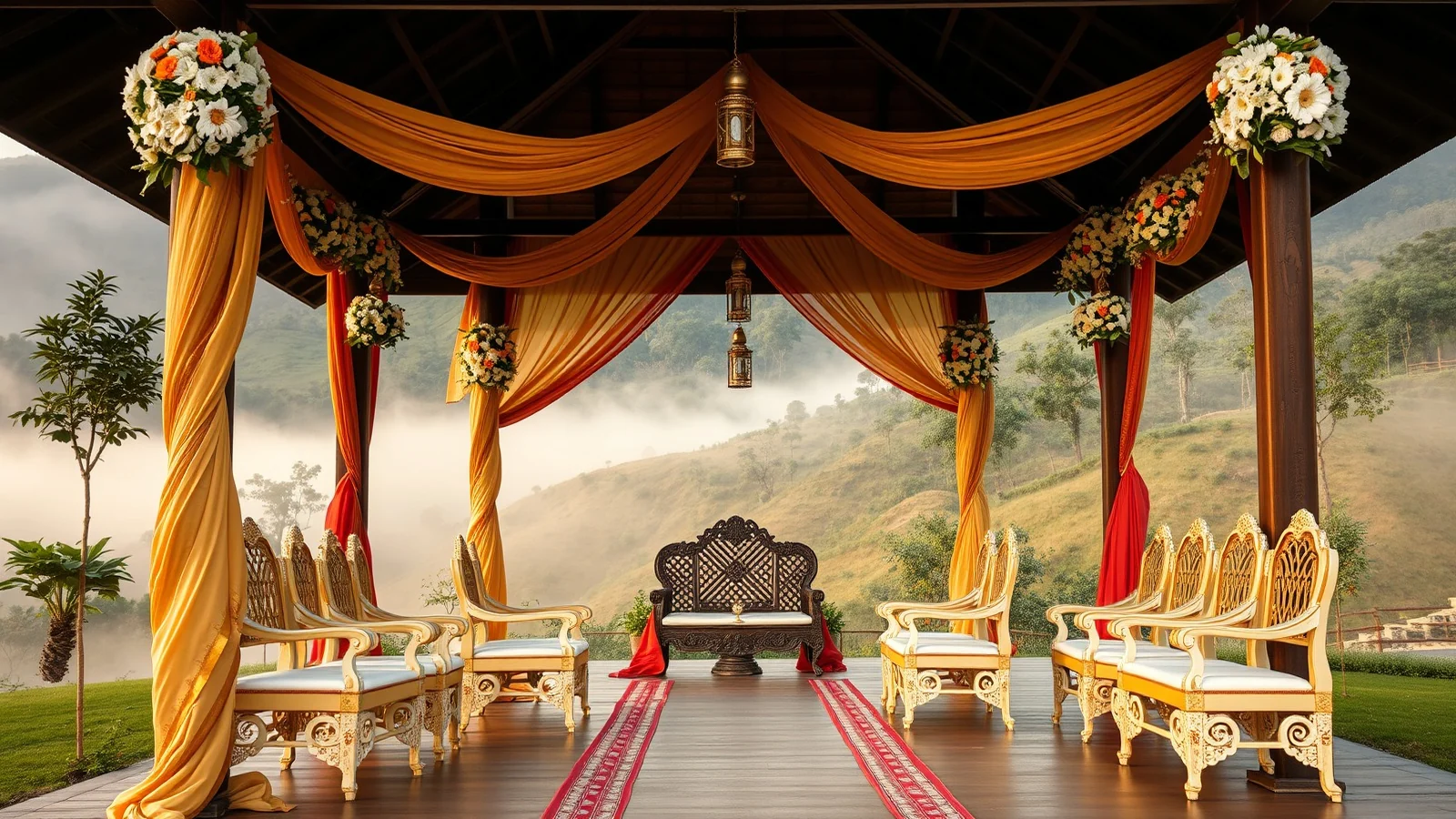
Before the celebrations, each family raises its own wedding pavilion. This is the Kombare Kettuvo, the tying and erecting of the Kombare, a mandap built from freshly cut green poles, banana stems, and foliage. Traditionally the frame is bamboo and green wood, decorated with plantain trunks, mango leaves, and flowers, set up in the courtyard of the ancestral home.
The Kombare is not mere decoration. Raising it marks the house as a wedding house and consecrates the space where the rites will unfold. In many families the cutting of the first pole is itself a small ceremony, done by the men of the okka, echoing the community’s forest and farming roots. Because Kodava homes sit amid coffee estates and paddy, the greenery of the Kombare literally comes from the family land, tying the marriage to the soil the okka has held for generations.
Murta: the turmeric and oil ceremony at both homes
The Murta is the Kodava turmeric and oil rite, close in spirit to the pan Indian haldi ceremony but with its own form. Crucially it is performed separately at the bride’s home and at the groom’s home, usually on the morning of the wedding day or the day before. The bride and groom are seated in their respective Kombare, and married women and elders apply a paste of turmeric and gingelly (sesame) oil to the head, shoulders, hands, and feet.
The Murta cleanses and blesses, softens and brightens the skin, and, in the community’s understanding, prepares and protects the young person for the change of status ahead. Water is often brought ceremonially, and the seniors of the okka take turns applying the paste and blessing the bride or groom. Because it happens in parallel at two houses, the Murta underlines a central truth of the Kodava wedding: each okka prepares its own child, and only later do the two families meet.
Ganga Puja and the worship at the Nellakki Nadubade
Two rites anchor the wedding to nature and to the ancestors. The Ganga Puja is the worship of water: family members, often the women, go ceremonially to fetch water from a well or stream, honouring the source of life before the marriage proper. It is a reminder that the Kodava wedding turns to the elements and to the household rather than to a temple deity for its sanctity.
Then comes the worship at the Nellakki Nadubade, the central sacred hall of the ancestral home. Here the couple and the families pay homage before the perpetual family lamp and to the Karona, the ancestors of the okka. This ancestor worship is the true religious core of the ceremony. The elders invoke the departed to witness and bless the union, and the bride and groom seek that blessing by bowing. Where a mainstream Hindu rite would centre the saptapadi and the seven vows taken around fire, the Kodava rite centres this bow to lineage. Consent of the living elders and blessing of the ancestral dead together do what the sacred fire does elsewhere.
Batte Toovo, the Pette procession, Sammanda Kodupo and Baale Birud
Several named rites carry the day forward. Batte Toovo is a rite of the path or the road, the ceremonial reception and honouring of the arriving party as it approaches the wedding house: the way is welcomed, greeted, and blessed before the guests enter the Kombare. The arrival itself is a Pette, a festive procession, in which the groom’s or bride’s party moves with music, drums, and dance toward the host home, kinsmen in full traditional dress.
The giving away is the Sammanda Kodupo, the establishing of the sammanda or the marriage bond and the formal handing of the bride into the new okka. It is the Kodava counterpart to kanyadaan, but framed as the joining of two clans rather than a scriptural gift. Elders of both families conduct it, and the couple bow to receive blessings from every senior present, one by one. A charming linked custom is the Baale Birud, the ceremonial cutting of a banana stem or plantain, a test and display in which a young man of the family severs the stem cleanly in a single stroke, a nod to the martial skill and precision the community prizes. Garlands are exchanged in the Kodava manner, echoing the wider jaimala garland exchange though without the fire and mantra that usually surround it.
Kupya Chele and the Kodagu saree: dressing the warrior and the bride
Kodava wedding dress is among the most striking in India and it broadcasts the community’s warrior heritage. The men wear the Kupya Chele, a long, wrap fronted, coat like robe (the kupya), usually white or dark, cinched at the waist by the Chele, a broad gold and crimson sash. Tucked into that sash is the odikathi, the ornate ceremonial dagger with its curved blade, often paired with the peeche kathi, a second silver hafted knife. A Kodava groom is dressed, in effect, as a soldier of his okka.
The bride wears the distinctive Kodagu saree, draped in the community’s own unmistakable style: the pleats are gathered and tucked at the back rather than the front, and the loose end, the pallu or vastra, is brought over the right shoulder and pinned, with a fold drawn over the head like a veil. She wears heavy traditional gold, the pathak and jomale necklaces and the kokkethathi pendant among them. The back pleated drape is practical, rooted in a hill and estate life of work and movement, and it instantly identifies a Kodava woman at any gathering. In place of a tied thread, married status and the union are marked in the community’s own idiom, distinct from the northern and coastal mangalsutra tradition.
The feast: pandi curry, kadambuttu, akki roti and noolputtu
Food is not a footnote at a Kodava wedding, it is a proud statement of identity. Kodavas are emphatically non vegetarian, and the wedding table centres on Pandi Curry, the celebrated Coorg pork curry, dark and tangy with kachampuli (a sour Coorg vinegar pressed from the kokum like Garcinia fruit), black pepper, and roasted spice. Pork is the festive meat of the community, and no major Kodava celebration is complete without it.
Around the pandi curry sit the region’s rice breads: kadambuttu, soft steamed rice dumplings shaped into balls; akki roti, a soft rice flatbread; and noolputtu (string hoppers), fine rice noodles steamed in nests. Chicken and mutton curries, bamboo shoot (baimbale) dishes, and local greens round out the spread, often finished with a sweet or with the community’s home brewed accompaniments. For a wedding planner, catering a Kodava wedding means sourcing genuine kachampuli and a cook who understands the pork, because guests will judge the pandi curry above all else. This centrality of meat, and of pork in particular, sets the Kodava feast firmly apart from the largely vegetarian wedding tables of many other South Indian communities.
Martial heritage and the modern Coorg estate wedding
The dagger in the sash and the banana stem cut with one stroke are not affectations. The Kodava are a historically martial people, long associated with soldiering and with a proud record in the Indian armed forces, and their rites preserve that memory. Weapons are respected, even worshipped, and the wedding openly celebrates strength, precision, and clan honour. This warrior thread, woven through dress and ritual, is part of why the community held on to its priestless, ancestor centred form rather than absorbing the temple model around it.
Today many Kodava couples marry on the family coffee estate itself, under the trees, with the green Kombare raised in the courtyard and the ancestral home’s Nellakki Nadubade at the heart of the day. Cool Coorg mornings, plantation backdrops, and the drama of the traditional dress make these among the most photogenic weddings in South India, and estate venues around Madikeri and Virajpet increasingly host them for the diaspora returning home to marry. Modern touches, sangeet evenings, curated decor, and destination logistics, layer easily over the old rites without displacing them.
Planning a Kodava wedding today
If you are planning a Kodava wedding, a few things shape the logistics from the start. First, there is no priest to book, but you do need to identify and honour the officiating elders of both okkas well in advance, and confirm the Muhurtha with them. Second, ceremonies split across two homes, the Murta especially, so timelines and travel between the bride’s and groom’s houses must be planned carefully. Third, the catering is non negotiable: authentic pandi curry, kadambuttu, akki roti, and noolputtu are what guests remember.
Dress, jewellery, and the odikathi should be arranged early, since heritage Kupya Chele and Kodagu drapes and the family gold often need specialist sourcing or careful transport. After the ceremonies, the bride’s departure to her new okka carries the same emotional weight as the vidaai in other traditions, a farewell softened by the fact that both families are now bound as one sammanda. Whether the wedding is at an ancestral home in Kodagu or a coffee estate resort, keeping the elders, the ancestors, and the feast at the centre is what makes it authentically Kodava.
Planning a wedding rooted in your traditions?
Tell us your community, dates and vision. Team Velvet Knot will honour every ritual and put together a tailored plan and an honest budget.
Related post-wedding rituals
Traditions in this region: read our full guide to Tulu and Bunt wedding traditions.
Frequently Asked Questions
Why is there no priest at a Kodava wedding?
The Kodava community historically stands apart from the temple and Brahmin centred ritual world of the plains. It reveres nature, weapons, and above all its ancestors (Karona). Marriage is validated by the witness and blessing of the family’s own married elders and the okka (clan), so no priestly intermediary is needed. Respected senior couples conduct every rite in place of a priest.
Is there really no sacred fire or saptapadi?
Correct. There is no homa or sacred fire and no seven steps around the flames. Instead the couple and families worship at the Nellakki Nadubade, the central hall of the ancestral home, before the family lamp and the ancestors. Bowing to elders and to the departed forebears does what the fire ritual does in mainstream Hindu weddings.
What is the traditional Kodava wedding dress?
Men wear the Kupya Chele, a long coat like robe with a gold and crimson sash holding the ceremonial odikathi dagger and often a peeche kathi knife, reflecting the community’s warrior heritage. Women wear the Kodagu saree, draped with the pleats gathered at the back and the pallu or vastra pinned over the right shoulder and drawn over the head, worn with heavy traditional gold.
What food is served at a Kodava wedding?
Kodavas are proudly non vegetarian, and the wedding feast centres on Pandi Curry, the famous Coorg pork curry made sour with kachampuli. It is served with rice breads: kadambuttu (steamed rice dumplings), akki roti (rice flatbread), and noolputtu (string hoppers), alongside chicken, mutton, and bamboo shoot dishes. The pandi curry is the dish guests judge the meal by.
What are the Murta and Kombare?
The Murta is the Kodava turmeric and oil ceremony, performed separately at the bride’s home and the groom’s home, in which elders apply turmeric and sesame oil paste to bless and prepare the bride or groom. The Kombare is the wedding mandap of fresh green poles, banana stems, and foliage (Kombare Kettuvo is its raising), set up in the courtyard of each family’s ancestral home.
How is the bride given away in a Kodava wedding?
The giving away is the Sammanda Kodupo, the establishing of the marriage bond (sammanda) and the joining of the two okkas, conducted by the elders of both families rather than a priest. The couple bow to receive blessings from every senior present. A linked custom is the Baale Birud, the ceremonial cutting of a banana stem in a single clean stroke, echoing the community’s martial precision.
Sources and further reading
Begin Your Engagement
Want a real number for your wedding?
Tell us your city, guest count and dates. Team Velvet Knot will come back within 24 hours with an itemised budget.