Mangala Snanam: The Dawn Bath That Opens a Telugu Wedding
- What mangala snanam is
- What actually happens
- What it means
- Where it sits in the Telugu wedding sequence
- Regional equivalents
- The sumangali convention, and how to handle it
- What the oils and turmeric actually do
- Scheduling the dawn sequence
- Practical notes
- Related South Indian rituals
- Frequently Asked Questions
- Sources and further reading
Mangala snanam is the auspicious ritual bath taken by the bride and groom at their own homes in the early hours of the wedding day. Married women apply turmeric and oils before the bath, which marks the formal beginning of the wedding day itself.
What mangala snanam is
Mangala means auspicious and snanam means bath. Mangala snanam is the ritual bath taken by the bride and the groom, separately and at their own homes, in the small hours of the wedding day, before any other ceremony begins.
It is a Telugu ritual, with close equivalents in Tamil and Kannada practice. In a Telugu wedding it falls immediately after the pellikuthuru ceremony for the bride and the pellikoduku ceremony for the groom, the rituals in which each is formally declared a bride and a bridegroom.
The timing is not arbitrary. South Indian weddings are frequently solemnised at muhurats in the early morning, sometimes before sunrise, and mangala snanam is scheduled to precede that. In practice this means families are awake and working at three or four in the morning, which is a fact worth knowing before you plan the previous evening.
What actually happens
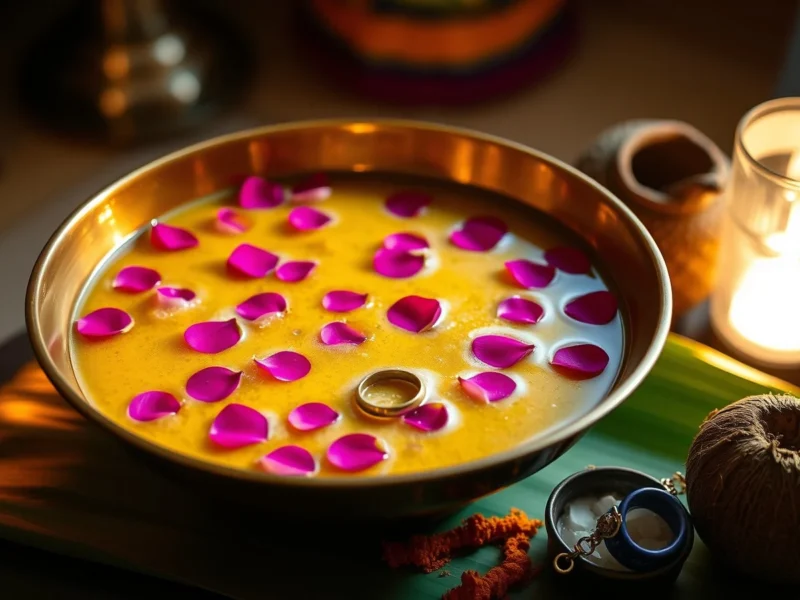
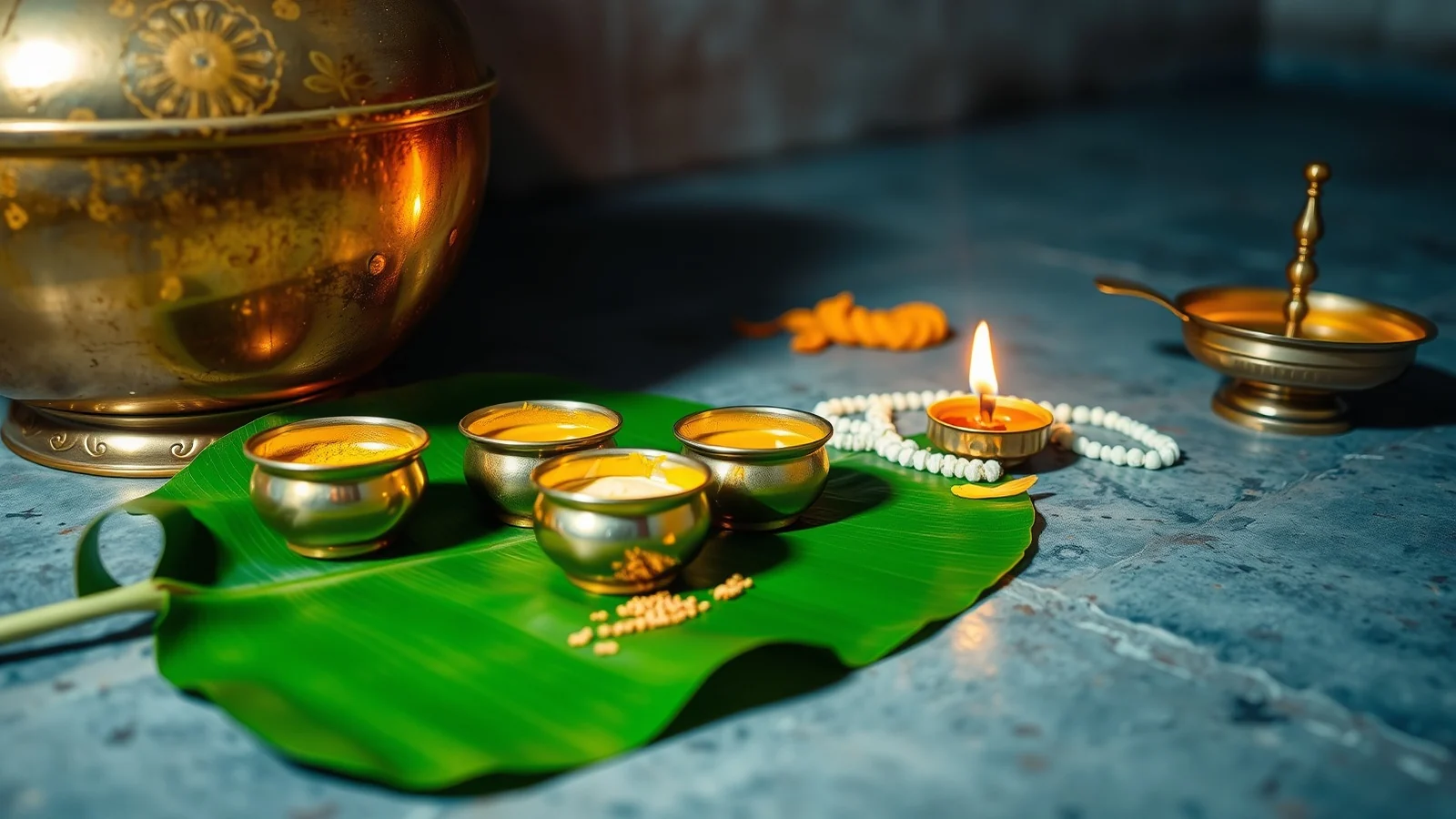
- The oils and paste. Married women of the family, the sumangalis, apply a mixture to the bride’s or groom’s head, shoulders, arms and feet. It typically includes gingelly or sesame oil, sometimes coconut oil, and turmeric paste, occasionally with a herbal powder such as shikakai or a green gram flour.
- The songs. Traditional songs are sung throughout, and the atmosphere is warm rather than solemn.
- The bath. The bath itself follows, often with water in which turmeric has been dissolved, and in some families with water brought from a specific source or blessed beforehand.
- New clothes. Afterwards, the bride and groom dress in new clothes given for the purpose, frequently by the maternal uncle.
- Aarti. A lamp is circled and the ritual closes, and the wedding day proper begins.
Only married women whose husbands are living traditionally perform the application. This is a widespread convention in South Indian ritual and is worth knowing in advance, because it determines who is asked and who is not, and unintended omissions cause real hurt.
What it means
The ritual works on three levels at once, and they reinforce each other.
Purification. The bath marks the transition from ordinary time into ritual time. Everything before it belongs to the preparations; everything after it belongs to the wedding. Bathing as a threshold between states is one of the oldest and most consistent gestures in Hindu practice.
Blessing by the married women. The sumangalis applying the oil are transferring something. The presence and touch of women in a long and living marriage is understood as auspicious in itself, and their participation is the blessing, not merely the mechanism of applying the paste.
Practical care. Turmeric is genuinely antiseptic and brightening, and oils condition skin and hair. A bride who is about to spend eighteen hours in heavy silk, full jewellery and stage lighting benefits from all of it. Like the haldi ceremony and like mehndi, this is folk medicine that has been given a ritual frame.
Where it sits in the Telugu wedding sequence
- Nischitartham. The formal engagement, at which the wedding date is fixed.
- Pellikuthuru and pellikoduku. The bride and groom are formally declared as such, at their own homes, usually the day before.
- Mangala snanam. The dawn ritual bath.
- Kashi Yatra. The groom’s staged departure. See our Kashi Yatra guide.
- Jeelakarra Bellam. The distinctive Telugu ritual in which the couple place a paste of cumin and jaggery on each other’s heads at the muhurat.
- Kanyadaanam. The giving of the bride. See kanyadaan.
- Mangalsutra and saptapadi. See the mangalsutra and saptapadi.
Mangala snanam is therefore the hinge between the preparatory rituals and the wedding itself. The full Telugu sequence is set out in our guide to Telugu wedding rituals.
Regional equivalents
- Telugu. Mangala snanam, tied to pellikuthuru and pellikoduku. See Telugu wedding rituals.
- Tamil. A ritual oil bath is performed on the wedding morning within a differently structured sequence. See Tamil Brahmin wedding rituals.
- Kannada. An equivalent auspicious bath is observed, with regional variation in the preparations used. See Kannada wedding traditions.
- Malayali. The Kerala sequence is structured differently and the pre-dawn ritual bath is not a standard element. See Malayali wedding traditions.
- North Indian. The nearest equivalent is the haldi ceremony, which shares the turmeric and the blessing by family, but is a daytime social function rather than a private dawn ritual. The difference in character is considerable, and inter-community families should not assume one substitutes for the other.
The sumangali convention, and how to handle it
The convention that only sumangalis, married women whose husbands are living, perform the oil application recurs throughout South Indian ritual, and it is the aspect of mangala snanam that most often causes real hurt.
The logic is that the blessing being transferred is one of a long and living marriage, and that it is carried by women who are themselves in one. Widows, and in stricter interpretations divorced and unmarried women, are traditionally excluded from performing the application, though not from being present.
Many families now find this indefensible, particularly when the excluded person is the bride’s own mother or grandmother. Others hold to it firmly. Both positions exist within the same extended families, which is precisely why it becomes difficult on the day.
The practical guidance is simple and it is worth following. Decide in advance, explicitly, who will be asked, and have the conversation before the wedding rather than in the room. If the family is relaxing the convention, say so clearly to the older generation beforehand so nobody is blindsided. If the family is keeping it, tell anyone affected privately and in advance, so they are not excluded in public at four in the morning in front of everyone. What causes lasting damage is not the convention itself but discovering it by being passed over without warning.
What the oils and turmeric actually do
The preparation used is not arbitrary, and each element has a function that predates its ritual meaning.
- Gingelly, or sesame oil. The traditional base across South India. It is warming, penetrates the skin well, and in Ayurvedic practice is the standard oil for a pre-bath massage, abhyanga.
- Coconut oil. Used more in Kerala and coastal areas, cooling rather than warming, and better suited to a hot climate.
- Turmeric. Antiseptic and mildly astringent, with genuine antimicrobial properties. It also brightens skin tone temporarily, which is part of why it persists in bridal use.
- Shikakai or green gram flour. Used as the cleansing agent, since the oil has to be removed and soap would strip the skin. Green gram flour in particular leaves skin soft rather than tight.
- Nalangu maavu. In some families a specific herbal powder blend is prepared at home for the purpose.
Two practical warnings. First, do not experiment on the wedding morning. Turmeric can stain fair skin visibly yellow for a day, and the correct quantity is a matter of experience. A trial run a week beforehand is sensible, and most families skip it. Second, coordinate with whoever is doing hair and makeup. Heavy oil applied at three in the morning has consequences for a hairstyle at six, and the two people involved have usually never spoken.
Scheduling the dawn sequence
The single most damaging error in a South Indian wedding is treating mangala snanam as an isolated item rather than as the start of a chain that runs to the muhurtham.
Work backwards from the muhurat, which is fixed and cannot move. A typical early-morning sequence looks roughly like this.
- Muhurtham at 5:30am. Fixed by the priest, non-negotiable.
- Couple seated and preliminary rituals from 4:30am. Kashi Yatra, garland exchange and oonjal may all sit inside this window depending on the family.
- Dressing, hair and jewellery from 3:00am. A bridal saree drape plus jewellery is ninety minutes minimum, and rushing it shows in every photograph.
- Mangala snanam at 2:00 to 2:30am. Oil application, bath, new clothes.
- Wake at 1:30am.
Which means the previous evening’s function has to end by nine or ten at the latest. A sangeet that runs to one in the morning followed by a two o’clock mangala snanam produces a bride who has not slept at all before the most photographed day of her life. This is the most common and most avoidable scheduling failure in South Indian weddings, and it is worth arguing about at the planning stage rather than living with on the day.
The full sequence and its timings are set out in our guide to Telugu wedding rituals.
Practical notes
- Work backwards from the muhurat. If the muhurat is at five in the morning, mangala snanam is at two or three. Confirm the exact time with the priest when the date is fixed, not the week before.
- Plan the previous evening around it. A sangeet that ends at one in the morning and a mangala snanam at three is a combination that ruins the wedding day for everyone involved. This is the single most common scheduling error in South Indian weddings.
- Check hot water and privacy at the venue. If the family is staying at a hotel rather than at home, confirm that a suitable room is available at that hour and that housekeeping knows.
- Agree the sumangalis in advance. Decide who is being asked to apply the oils, and tell them. Being overlooked at this ritual is remembered.
- Protect the hair plan. Oil applied at three in the morning and a hairstylist arriving at five need to have spoken to each other. They frequently have not.
- Keep it small. This is a private family ritual, not a photographed function, and it works best that way.
For the full order of a South Indian wedding day, see our guide to South Indian wedding traditions.
Planning a wedding that honours these traditions?
Team Velvet Knot plans weddings across every major Indian tradition, and we brief vendors on the rituals so nothing gets rushed, mistimed or quietly dropped from the running order. Tell us your dates and your community, and we will come back with an honest plan.
Related South Indian rituals
A related rite: read our full guide to kangna bandhana, the protective wrist thread.
Frequently Asked Questions
What is mangala snanam?
Mangala means auspicious and snanam means bath. It is the ritual bath taken by the bride and groom separately at their own homes in the early hours of the wedding day, after turmeric and oils are applied by the married women of the family. It marks the formal start of the wedding day.
Why is mangala snanam held before dawn?
Because South Indian weddings are frequently solemnised at muhurats in the early morning, sometimes before sunrise, and the bath must precede the ceremony. If the muhurat is at five, the bath is typically at two or three, which is worth knowing when planning the previous evening.
Who applies the oil and turmeric?
Married women of the family, the sumangalis, traditionally those whose husbands are living. Their participation is understood as the blessing itself rather than simply the means of applying the paste, so it is worth deciding in advance who is being asked.
What is used in the ritual bath?
Typically gingelly or sesame oil, sometimes coconut oil, together with turmeric paste and occasionally a herbal powder such as shikakai or green gram flour. The bath water often has turmeric dissolved in it, and new clothes, frequently given by the maternal uncle, are worn afterwards.
How is mangala snanam different from haldi?
They share turmeric and the idea of blessing by family, but they differ in character. Haldi is a daytime social function with music and guests. Mangala snanam is a private ritual performed before dawn by a small number of family members. Inter-community families should not treat one as a substitute for the other.
Is mangala snanam performed in all South Indian weddings?
It is standard in Telugu weddings and has close equivalents in Tamil and Kannada practice. Kerala weddings follow a different structure in which a pre-dawn ritual bath is not a standard element. Practice also varies by community within each region.
Sources and further reading
Begin Your Engagement
Want a real number for your wedding?
Tell us your city, guest count and dates. Team Velvet Knot will come back within 24 hours with an itemised budget.