Oonjal: The Swing Ceremony in South Indian Weddings
- What the oonjal is
- What happens during the ceremony
- What the ritual means
- Where oonjal sits in the sequence
- Regional variation
- The songs, and what they say
- The swing itself
- Who sits where, and the family roles
- Practical notes
- Related South Indian rituals
- Frequently Asked Questions
- Sources and further reading
In the oonjal ceremony the couple are seated on a decorated swing and gently rocked while women circle them with lamps and coloured rice. The swing’s motion stands for the instability of life, and the couple holding steady together is the point of the ritual.
What the oonjal is
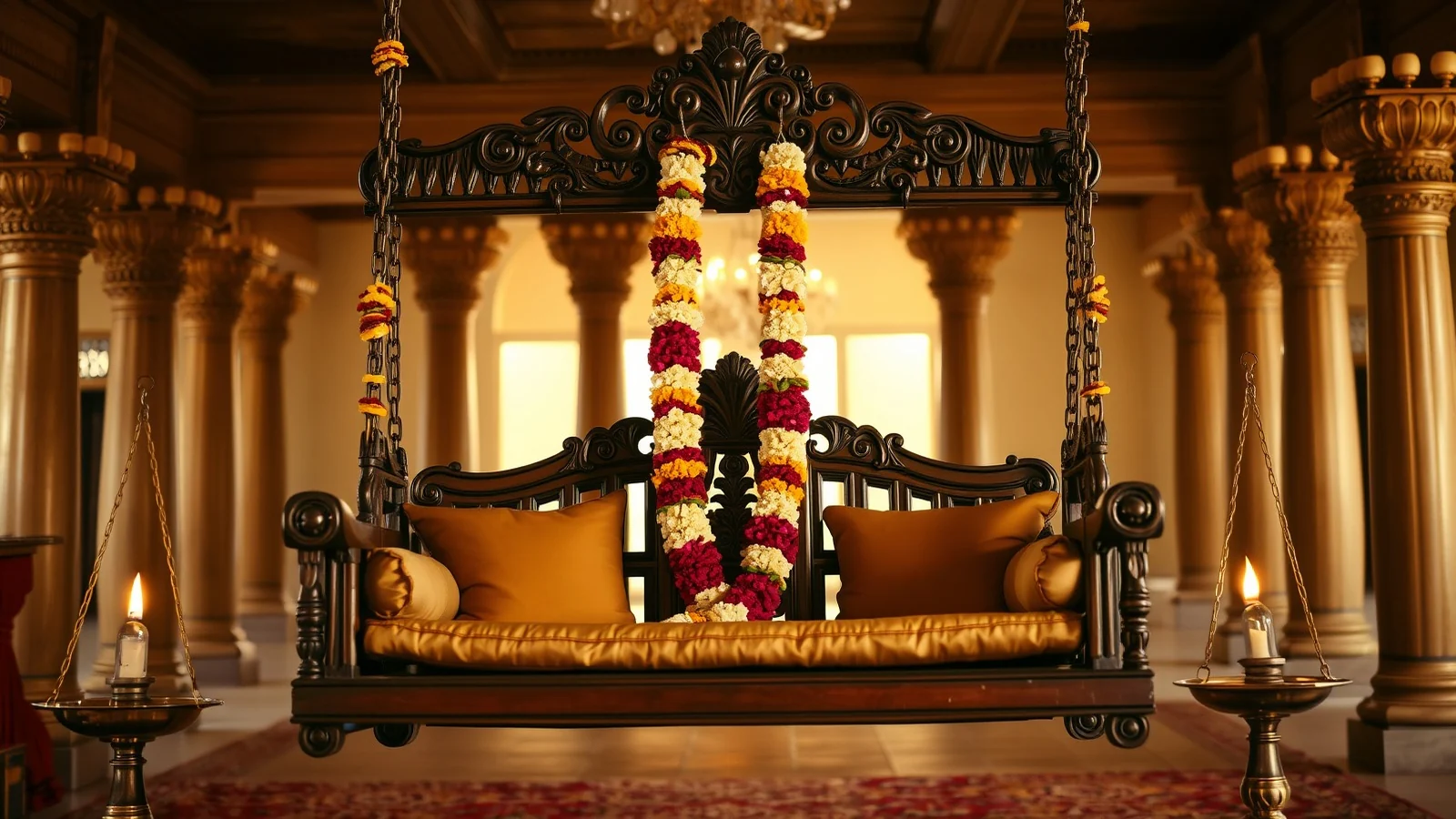
Oonjal is the Tamil word for a swing. The ceremony takes its name from the piece of furniture at the centre of it: an ornate wooden swing, suspended on chains or ropes, decorated with flowers, on which the couple are seated facing the assembled family.
In older households the oonjal was a fixed feature of the home, a heavy carved swing in the main hall, and the wedding ceremony used the family’s own. In hotel weddings it is brought in and dressed, and it is one of the few pieces of ritual furniture that families still commission properly rather than rent.
The ceremony is performed in Tamil, Telugu and Kannada weddings, with variations in the songs and the specific offerings. It comes after the exchange of garlands and before the kanyadaanam and the muhurtham, and it is the calm, slow point in a day that is otherwise tightly scheduled.
What happens during the ceremony
The structure is consistent even where the details differ.
- The seating. The couple are seated on the swing, the bride usually to the groom’s left.
- The songs. Married women of the family sing oonjal paatu, traditional songs specific to this ritual, which advise the couple and bless the marriage. In many families this is the only point in the wedding where the women’s singing carries the ceremony rather than the priest’s chanting.
- The rocking. The swing is moved gently. It is never swung hard; the motion is slow and deliberate.
- The circling. Women move around the couple carrying lamps and balls of rice coloured with turmeric and kumkum, circling them and then throwing the rice balls in the four directions.
- Milk and banana. The couple are fed a mixture of milk and banana, or given milk to drink, by the women of the family.
- Aarti. Lamps are circled before them to close the ritual.
The whole sequence takes twenty to thirty minutes, and it is the part of a South Indian wedding that guests remember as beautiful rather than as long.
What the ritual means
The central symbolism is the motion of the swing itself. A marriage will move through good fortune and bad, ease and difficulty, and the swing’s back-and-forth stands for exactly that. The couple sit on it together, steady, holding on, while it moves beneath them. The instruction embedded in the ritual is that the movement is expected and that stability comes from the two of them, not from the swing being still.
The coloured rice balls thrown in the four directions are an offering to ward off the evil eye and to appease the spirits of the directions, a common protective gesture at moments when a couple is conspicuous and, in traditional understanding, vulnerable. The same protective logic sits behind the groom’s sehra in North Indian weddings, though the form is entirely different.
The milk and banana are nourishment offered by the family, and the reading is straightforward: the couple are being fed and sustained by both households as they begin. The lamps are the standard Hindu marker of auspiciousness and the dispelling of darkness.
Where oonjal sits in the sequence
The placement is deliberate. Oonjal falls between the exchange of garlands and the binding rituals.
- Kashi Yatra. The groom’s staged departure and return. See our Kashi Yatra guide.
- Maalai Maatral. The garland exchange, three times. See the garland exchange.
- Oonjal. The swing ceremony.
- Kanyadaanam. The giving of the bride. See kanyadaan.
- Muhurtham. The tying of the thaali at the appointed time. See the mangalsutra.
- Saptapadi. The seven steps. See saptapadi.
Coming where it does, oonjal serves as the transition between the celebratory part of the morning and the formal, priest-led rituals that follow. The couple have met and exchanged garlands; they have not yet been married. The swing is the pause between.
Regional variation
- Tamil. Called oonjal, with oonjal paatu sung by the women, and the rice balls thrown in the four directions. See Tamil Brahmin wedding rituals.
- Telugu. A closely equivalent swing ritual is performed, and the sequence around it broadly matches. See Telugu wedding rituals.
- Kannada. Performed with regional song traditions and similar offerings. See Kannada wedding traditions.
- Malayali. Kerala wedding structure differs considerably and the swing ceremony is not a standard element. See Malayali wedding traditions.
- North Indian. No equivalent. The nearest thing in function, a shared moment of blessing before the binding rituals, is spread across several smaller customs rather than concentrated in one.
The songs, and what they say
Oonjal paatu is a genuine song tradition and one of the few points in a South Indian wedding where the ceremony is carried by the women of the family rather than by the priest.
The songs are sung in Tamil, Telugu or Kannada depending on the family, and they do several things at once. Some address the couple directly with advice about patience and partnership. Some are addressed to the bride, and are frankly about what she is leaving and what she is entering. Some are teasing, aimed at the groom or at his family. Several are old enough that the language has drifted, and the women singing them do not always agree on what a particular line means.
They are sung unaccompanied, or with simple rhythm kept by hand. There is no performance quality expected and none delivered; the point is participation, and a group of aunts singing slightly out of time is exactly what the ritual is supposed to sound like.
This repertoire is thinning fast. It was transmitted by being heard at family weddings, and as weddings professionalise and families disperse, fewer women learn it. Recording the singers in a family, at a wedding or simply at home, is one of the more valuable things anyone can do with a phone, and several families now play those recordings at later weddings when nobody present knows the songs.
The swing itself
The oonjal is a real piece of furniture with a long history in South Indian domestic architecture, and the wedding use is secondary to the household one.
Traditional swings were built of teak or rosewood, suspended from ceiling hooks on heavy iron chains, and installed in the main hall of the house. They were used daily, and in many older homes the oonjal was the seat of honour, where elders sat and where guests were received. Carved panels, brass fittings and chain work were points of craftsmanship, and a good swing was a family asset passed down rather than replaced.
Using the household swing for the wedding therefore carried a meaning that a hired one cannot fully reproduce: the couple were being seated in the seat of the family. Families that still own one usually insist on transporting it to the venue, and the effort is worth indulging.
For weddings in hotels, the practical alternatives are a rented decorated swing on a free-standing frame, or a purpose-built one commissioned for the wedding and kept afterwards. The second is more common than outsiders expect, and a well-made oonjal is one of the few wedding purchases that is still in use twenty years later.
Who sits where, and the family roles
The seating and the roles are more prescribed than they appear, and getting them wrong is the kind of thing an aunt will mention for a decade.
- The couple. Seated together on the swing, the bride conventionally to the groom’s left.
- The rockers. Usually the brothers or male cousins of the couple, one at each end, moving the swing gently and steadily. This is a real job, and doing it too enthusiastically is the most common failure.
- The circling women. Married women of both families, carrying lamps and the coloured rice. Convention in many families restricts this to sumangalis, women whose husbands are living, and it is worth knowing who is being asked and who is not before the moment arrives.
- The singers. Often the same group, often the older women, sometimes a designated few who know the repertoire.
- The feeders. Those who give the couple milk and banana, generally the mothers and aunts.
Families who assign these roles in advance, by name, have a noticeably smoother ceremony than families who work it out in the room. It takes one conversation a week before the wedding, and it also ensures nobody who expected a role is left standing at the back.
Practical notes
- Check the rigging. This is the one genuine safety item in a South Indian wedding. A decorated wooden swing carrying two adults in heavy silk and full jewellery needs proper suspension, and hotel ceilings are not always suitable. Free-standing frames are widely available and are the safer choice.
- Confirm who sings. Oonjal paatu is a real repertoire and fewer people know it each generation. Identify the singers in the family weeks ahead, or the ceremony proceeds in awkward silence.
- Prepare the rice balls in advance. Turmeric and kumkum coloured rice, rolled and ready, in enough quantity for everyone who wants to participate.
- Seat the elders where they can see. Oonjal is a ceremony the older generation particularly values, and it is often staged with the family behind the swing rather than in front of it.
- Allow thirty minutes. It runs longer than families plan, and rushing it is a poor trade.
For the full order of a South Indian wedding day, see our guide to South Indian wedding traditions.
Planning a wedding that honours these traditions?
Team Velvet Knot plans weddings across every major Indian tradition, and we brief vendors on the rituals so nothing gets rushed, mistimed or quietly dropped from the running order. Tell us your dates and your community, and we will come back with an honest plan.
Related South Indian rituals
Traditions in this region: read our full guide to Chettiar and Nagarathar wedding traditions.
Frequently Asked Questions
What is the oonjal ceremony?
Oonjal is the Tamil word for swing, and the ceremony seats the couple on a decorated swing while married women of the family sing traditional songs, circle them with lamps and coloured rice, and feed them milk and banana. It is performed in Tamil, Telugu and Kannada weddings.
What does the swing symbolise?
The movement of the swing stands for the ups and downs a marriage will pass through. The couple sitting steady together while it rocks beneath them is the instruction of the ritual: the motion is expected, and stability comes from the two of them rather than from the swing being still.
Why do women throw coloured rice balls?
The rice balls, coloured with turmeric and kumkum, are thrown in the four directions to ward off the evil eye and to appease the spirits of the directions. It is a protective gesture made at a moment when the couple are conspicuous and, in traditional understanding, exposed.
Why are the couple given milk and banana?
It is nourishment offered by the women of both families, and the meaning is direct: the couple are being fed and sustained by both households as they begin married life. In some families they drink milk; in others they are fed a mixture of milk and banana.
When does oonjal happen in the wedding?
After the exchange of garlands and before the kanyadaanam and the muhurtham. It functions as the transition between the celebratory part of the morning and the formal priest-led rituals that follow. The couple have met and garlanded each other but are not yet married.
Do we need a real wooden swing?
Traditionally yes, and many families still commission one. The practical point is safety: a decorated swing carrying two adults in heavy silk and full jewellery needs proper suspension, and hotel ceilings often are not suitable. Free-standing frames are widely available and are the safer option.
Sources and further reading
Begin Your Engagement
Want a real number for your wedding?
Tell us your city, guest count and dates. Team Velvet Knot will come back within 24 hours with an itemised budget.