Chettiar Wedding Traditions: Inside a Nagarathar Wedding in Chettinad, From Kovil Clan to Thali
- Why a Nagarathar Wedding Is Not a Tamil Brahmin Wedding
- The Chettinad Mansion as the Wedding Venue
- The Nine Clan Temples and Who May Marry Whom
- Betrothal: Parisam and the Tamboola Exchange
- Kaapu Kattal and the Building of the Panthal
- Muhurtham and Muhurtha Pathu: The Hour and the Provisioning
- The Thali, and What Makes the Nagarathar Form Distinct
- Oonjal, Nalangu and the Ceremonies Around the Core Rite
- The Brass, Bronze and Vessel Trousseau
- The Chettinad Wedding Feast
- The Achi: Who Actually Runs the Wedding
- Multi-Day Structure and How Families Run It Today
- The Departure and the Weeks After
- Frequently Asked Questions
- Sources and further reading
A Nagarathar Chettiar wedding is a multi-day event held in an ancestral Chettinad mansion, governed by the family’s clan temple, anchored by a betrothal with betel leaves, a panthal ceremony, the tying of a distinctive thali at the muhurtham hour, a vast brass and vessel trousseau, and a vegetarian Chettinad feast run by the senior women of both houses.
Why a Nagarathar Wedding Is Not a Tamil Brahmin Wedding
The single most common mistake we see is a vendor or venue treating a Nagarathar Chettiar wedding as a variant of the Brahmin ceremony with different food. It is not. The Nattukottai Chettiars, or Nagarathars, are a Saivite mercantile community from the Chettinad region of Sivaganga and Pudukkottai districts in Tamil Nadu, and their marriage rite grew out of community and temple authority rather than out of a priestly liturgy.
In practice the differences are structural. Where a Tamil Brahmin wedding is built around a fire altar, a purohit reciting Vedic mantra, and a sequence that runs through kanyadaan and the seven steps, the older Nagarathar form places the elders of both households at the centre. The tying of the thali is performed with the family and the clan witnessing it, and in many households a Brahmin priest is not required for the marriage to be complete.
Practice varies today. A great many Nagarathar families now engage a purohit and include a homam, and some incorporate saptapadi alongside the community rites, particularly in city weddings. That blending is legitimate and widespread. What a planner must not do is quietly substitute the Brahmin order of service, because the family’s own elders will notice within minutes and the correction is public and awkward.
The Chettinad Mansion as the Wedding Venue
The house is the venue, and the house was designed for this. Chettinad mansions were built by traders who had made money across South East Asia, and their plan is essentially a sequence of open courtyards running back from the street. The first courtyard, the valavu, is a large pillared hall with raised platforms along the sides. It exists so that a wedding party of several hundred can be seated, fed and watched over from one space.
The materials tell you the same story. Burma teak columns, Athangudi tiles laid by hand, Italian marble, Belgian mirrorwork and imported enamel were bought on trading routes and shipped home. The rear courtyards hold the kitchens, storerooms and the granary. A house of this type could historically host a thousand guests for several days without renting a single external item, because the vessels, the seating and the sleeping space were all built in.
When you plan in one of these houses today, the constraints are real. Load-bearing timber will not take heavy rigging. Athangudi tiles are lime-based and stain permanently from turmeric, oil and floral dye, so we lay coir matting under every haldi and food line. Power is usually the binding limit. Assume you are bringing in a silent generator and running dedicated cable for kitchen and lighting.
The Nine Clan Temples and Who May Marry Whom
Nagarathar identity is temple identity. The community is organised around nine ancestral Shiva temples, commonly called the nava kovils, which include Ilayathangudi, Mathur, Vairavan Kovil, Iraniyur, Pillaiyarpatti, Soorakudi, Velangudi, Iluppaikudi and Nemam. Every Nagarathar family belongs to one of them by descent through the father, and that temple, not a village or a surname, is the primary marker of who a person is within the community.
The rule that follows is exogamy. A person does not marry within their own temple group, because everyone sharing a kovil is treated as kin, and within each temple there are further subdivisions of lineage that also bar a match. The first question asked when a proposal is raised is almost never about horoscopes. It is which kovil, and then which lineage within that kovil.
This has planning consequences. Invitations, temple offerings and the announcement of the marriage often go to the family’s kovil, and some families make a formal visit to it before or after the wedding. If you are building the guest list, ask which temple each side belongs to, because seniority within the kovil determines seating and the order in which elders are honoured.
Betrothal: Parisam and the Tamboola Exchange
The betrothal is the binding moment socially, more so than in many other Tamil communities. It is usually called parisam, and the ceremony centres on the exchange of tamboolam, the tray of betel leaves, areca nut, turmeric, coconut, fruit and sweets. The groom’s family carries these trays to the bride’s house, the elders read out and confirm the terms of the marriage, and the two families formally accept each other.
What is announced at this stage typically includes the muhurtham date, the venue, and the outline of what each family will give. In older practice a written agreement, sometimes called the isaivu or the marriage agreement, was read aloud in front of witnesses. Some families still do this and it is treated seriously, so anything you as a planner want to change later should be raised before the reading, not after it.
Compared with a north Indian roka ceremony or a formal nischitartham, the Nagarathar parisam is less about rings and more about tray count, betel leaf count and the public statement of commitments. Ring exchange is common now but it is an addition, not the core. Budget for a photographer at parisam, because families frequently treat these images as the official engagement record.
Kaapu Kattal and the Building of the Panthal
Kaapu kattal opens the wedding proper. A turmeric-dyed thread is tied at the wrist of the bride and separately of the groom at their own homes, by elders and usually by the married women of the household, after an invocation to the family deity and to Ganesha for an obstacle-free ceremony, much as the Ganesh puja opens Hindu weddings generally. From that point the two are under ritual protection and are not expected to travel except for wedding purposes, so finish outfit trials, jewellery collection and any location portraits before kaapu is tied.
The panthal is the pavilion under which the marriage takes place, and its erection is itself a ceremony. Traditionally a set of poles, often of bamboo or of specified wood, is planted in the courtyard with an invocation, then dressed with mango leaves, plantain trunks, coconut fronds and cloth. The muhurtha kaal, the principal post, is worshipped first, and the whole structure is treated as consecrated ground for the days that follow.
In an ancestral house the panthal usually sits in the first courtyard so that the open sky above the courtyard forms its roof. This is the reason so many Chettinad weddings look the way they do in photographs. The light falls vertically into the hall, the guests sit on the raised side platforms, and the ceremony happens at the centre of the floor rather than on a raised stage.
The pitfall here is decor teams treating the panthal as a set. It is not. Families object strongly to the muhurtha kaal being wrapped, moved or replaced for visual reasons. Build your floral scheme around it and take a decision on the panthal design before the poles are planted, because after the invocation they will not be shifted.
Muhurtham and Muhurtha Pathu: The Hour and the Provisioning
The muhurtham is the fixed astrological window in which the thali is tied, and in Nagarathar weddings it is very often early morning, sometimes before sunrise. Everything else in the schedule is reverse-engineered from it. The family will normally have the hour set by a family astrologer or through the temple well before the invitations are printed.
The muhurtham is auspicious as a window, not as a moment, but in practice families want the thali knot tied within a narrow band of a few minutes. That means hair, jewellery and the bride’s arrival at the panthal must be finished with a buffer. Our working rule is that the bride is seated and ready thirty minutes ahead, because the single most common failure at Tamil weddings is jewellery running late and the family visibly panicking.
Season matters too. Nagarathar families avoid certain months for marriage, and the preferred dates cluster heavily, which is why the good Chettinad houses and the senior cooks are booked a year out. Our muhurtham guide covers how these windows are calculated and why two families can be given slightly different times for the same date.
Muhurtha pathu is the ceremonial provisioning that accompanies the hour. Families commonly describe it as a set of ten auspicious items, typically rice, pulses, jaggery, ghee, oil, turmeric, betel and areca, coconut, plantains and sweets, carried in vessels and arranged where guests pass them. The exact list varies by family and by kovil, so ask rather than assume. Treat it as a real logistics item: assign one coordinator to it and have a senior woman of the house sign off on the layout the night before.
The Thali, and What Makes the Nagarathar Form Distinct
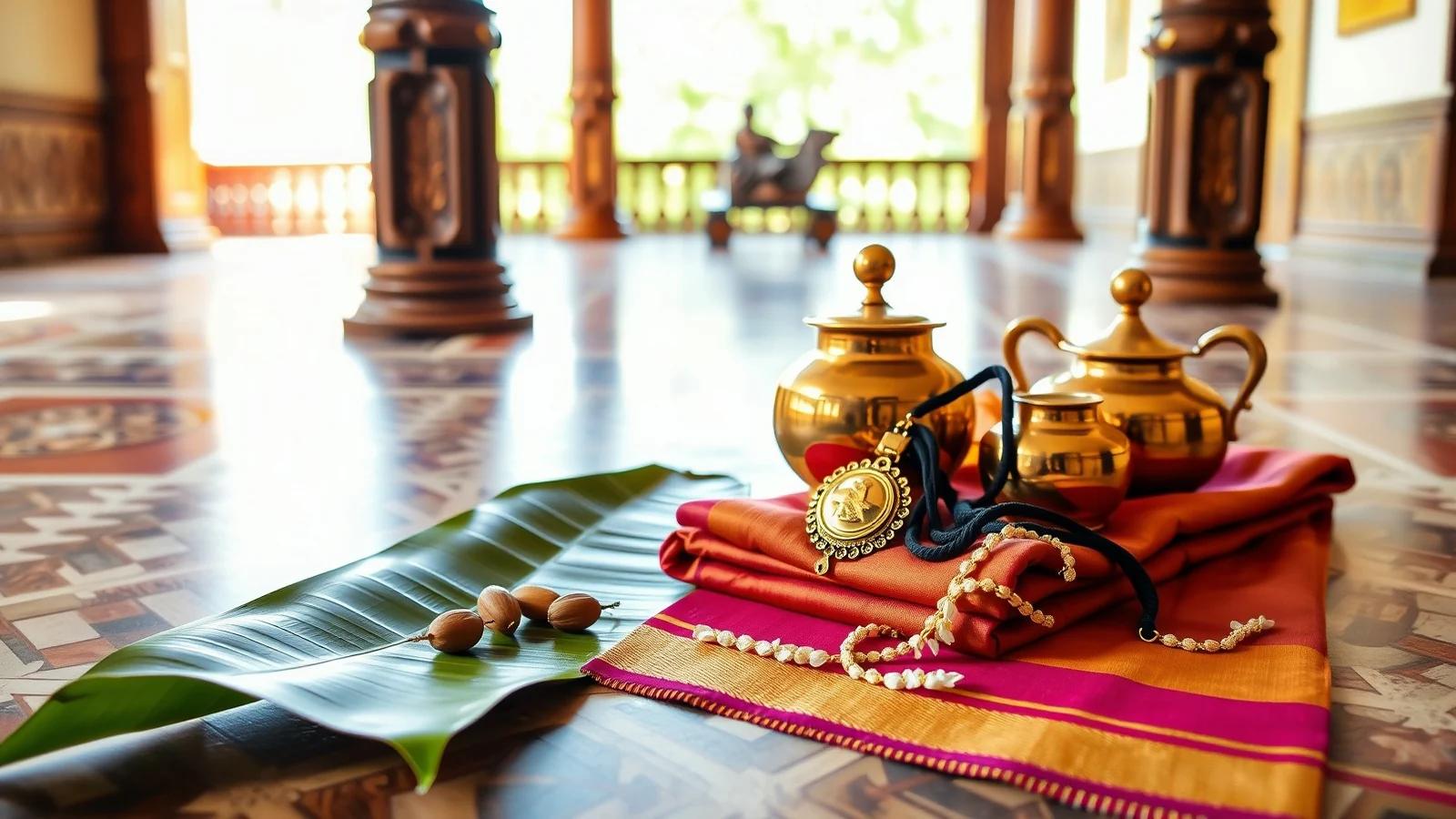
The thali is tied by the groom at the muhurtham hour and it is the act that makes the marriage. The Nagarathar thali is worn on a thick gold chain rather than only on a turmeric-dyed cord, and the pendant group is specific to the community, with the family and the kovil influencing the design. Many families have the thali made new for each bride from gold contributed by both households.
In most families the groom ties the first knot and the remaining knots are completed by his sister or another senior woman, with the elders standing immediately around the couple. Nadaswaram and thavil play at volume through this moment, in the older practice partly so that no inauspicious sound is heard. The photographers should be positioned and locked before the music starts, because there is no second take.
The thali carries the same meaning as the north Indian mangalsutra but the object, the metal weight and the way it is worn are different, and Nagarathar families are precise about it. If you are commissioning jewellery, work with a jeweller who has made this thali before, and get the chain length and pendant order confirmed by the bride’s grandmother, not by a catalogue.
Oonjal, Nalangu and the Ceremonies Around the Core Rite
Around the thali sit the ceremonies the guests actually enjoy. The oonjal, the swing ceremony, seats the couple on a wooden swing while the married women of the family circle them, wave lamps and coloured rice balls to ward off the evil eye, and sing traditional songs. In a Chettinad house the swing is often a permanent fixture of the hall, hung from the teak beams and old enough to have carried several generations.
The nalangu is the informal evening session where sandal paste and turmeric are applied, games are played between the couple, and the two families tease each other. This is where the Achis of the household run the room and where the best candid photography of the whole wedding usually happens. It is worth protecting an hour for it rather than compressing it.
Other elements shared with the wider South Indian wedding tradition may or may not appear. Some Nagarathar families include a kashi yatra performance, some do not, and the same is true of a formal kanyadaan. Ask the family which of these they keep, and put the answer in writing, because vendors will otherwise fill the gaps with generic Tamil wedding staging.
The Brass, Bronze and Vessel Trousseau
Nothing marks a Nagarathar wedding more distinctly than the vessels. The bride goes to her husband’s house with a full working kitchen: brass and bronze cooking pots, uruli, andas, water containers, lamps, plates, tumblers and serving ware, often in graduated sets running from very large down to very small. Many pieces are engraved with the family name or initials so that ownership is traceable across generations and across households that shared a mansion.
This is not decorative. The community’s men were absent for long periods in Burma, Ceylon and Malaya, and the wife ran an independent household. The vessels were her working capital and remained her property, alongside her gold. Older families still hold vessel sets that came in with a great-grandmother, and giving them at a wedding is a continuation of that, not a nostalgia exercise.
Practically, the vessels are displayed before the wedding for relatives to view, so build a lit display area with a stable surface. Metal polish takes days for a full set, insurance and inventory are genuine issues, and transport needs padded crates. We inventory every piece with a photograph before it leaves the bride’s house and again on arrival, because disputes over a missing lamp will outlive the wedding.
The Chettinad Wedding Feast
Chettinad food has a reputation for heat and meat, but the wedding meal is usually vegetarian. The muhurtham feast is served on plantain leaf and rests on rice, sambar, kuzhambu, poriyal, kootu, appalam and a set of sweets. Where the community’s cooking really shows is in the tiffin and sweet items: kandarappam, seeyam, athirasam, paal paniyaram, ukkarai and kavuni arisi, the dark black rice pudding that most guests will remember.
These items are made by specialist cooks, and in Chettinad the senior cook is booked before the venue in many families. The sweets are labour-intensive, several require jaggery worked to an exact thread consistency, and they cannot be produced at scale by a generic banquet kitchen. Non-vegetarian Chettinad cooking, if the family wants it, is normally served at a separate meal such as the reception, not at the muhurtham.
Service is the operational risk. Leaf meals are served in a fixed order by a team walking the rows, and a hall of six hundred needs enough servers to complete a round before the first item cools. Count servers against seated rows, not against total guests, and run the sweet items to a separate table so the main line does not stall.
The Achi: Who Actually Runs the Wedding
The Achi is the matriarch, and in a Nagarathar household her authority is not ceremonial. Achi is the community’s honorific for its women, and the senior Achis of both houses decide the vessel list, the menu, the seating of relatives, who performs which ritual role and what the bride wears at each stage. In the trading era, with the men overseas for years, the Achi ran the property, the household and the family’s local standing.
For a planner this changes the reporting line. The person who signs your contract may be the bride’s father, but the person whose approval prevents a problem on the day is almost always an Achi. We ask at the first meeting who that is, and we run the ritual schedule, the vessel display and the menu past her directly rather than through an intermediary.
The failure mode is predictable. A young couple books a decor scheme and a modernised order of service, the Achi sees it on the morning of the panthal, and the whole thing is rebuilt at short notice. Bring her into the design conversation early and most of that risk disappears.
Multi-Day Structure and How Families Run It Today
The classical structure runs across three to five days. Broadly it moves through the arrival and reception of the groom’s party, kaapu kattal and the panthal ceremony, an evening of nalangu and music, the muhurtham itself in the early hours, the feast, and then the departure of the bride to her husband’s house. Some families add a temple visit to their kovil and a homecoming reception afterwards.
The complication now is that most ancestral houses are no longer lived in. Families are settled in Chennai, Bengaluru, Singapore or Kuala Lumpur, and the mansion is opened for weddings and for a few festivals. That means water, wiring, plumbing, pest treatment and cleaning have to be commissioned weeks ahead, and guest accommodation is spread across several family houses in the same village or across heritage hotels in Karaikudi and Kanadukathan.
A common compromise is a two-centre wedding: the ceremonies in Chettinad for the ritual and the photographs, and the reception in the city where most guests live. That works, but it doubles the vendor bill and the transport plan, so decide it early. Our wedding planning cost guide sets out how the two-centre model changes the budget, and the general Hindu wedding rituals guide is useful for family members from other communities who want to follow along.
The Departure and the Weeks After
The departure is quieter than in north Indian weddings and is generally not staged as a set piece. The bride leaves with her vessels, her jewellery and her attendants, is received at the threshold of her husband’s house with a lamp, and enters on an auspicious foot. Families who feel the vidaai emotionally will build it up, but the older Nagarathar handling is restrained.
The arrival carries more weight than the leaving. The first entry, the lighting of the lamp and the first meal cooked in the new vessels are what elders comment on, which is why the griha pravesh stage should be scheduled and staffed rather than treated as an afterthought. In the following weeks there is usually a return visit to the bride’s family, reciprocal meals between the households, and in some families a formal presentation of the couple at their kovil. Ask about these at the planning stage, because they affect travel dates.
Planning a wedding that honours these traditions?
Team Velvet Knot plans weddings across every major Indian tradition, and we brief vendors on the rituals so nothing gets rushed, mistimed or quietly dropped from the running order. Tell us your dates and your community, and we will come back with an honest plan.
Frequently Asked Questions
What is the difference between a Chettiar wedding and a Tamil Brahmin wedding?
They are separate traditions. A Nagarathar Chettiar wedding is centred on the community’s elders and the family’s clan temple, and in its older form it does not require a Brahmin priest or a Vedic fire ritual for the marriage to be valid. The thali tying at the muhurtham hour is the binding act. A Tamil Brahmin wedding is built around a purohit, a homam and a fixed Vedic sequence. Many Nagarathar families today include priestly elements as well, but the two orders of service are not interchangeable and should never be substituted for each other by a vendor.
What are the nine Chettiar clan temples and why do they matter for marriage?
The Nagarathars are organised around nine ancestral Shiva temples, commonly listed as Ilayathangudi, Mathur, Vairavan Kovil, Iraniyur, Pillaiyarpatti, Soorakudi, Velangudi, Iluppaikudi and Nemam. Membership passes through the father. Because everyone in a temple group is treated as kin, marriage within the same kovil is not permitted, and there are further lineage subdivisions inside each temple that also rule out a match. This is why the first question in a proposal is which kovil each family belongs to, before horoscopes are even discussed. The kovil also shapes invitations, offerings and the honouring of elders.
Why do Chettiar brides receive so many brass and bronze vessels?
Because the vessels were the bride’s independent working capital, not decoration. Nagarathar men spent long stretches trading and financing in Burma, Ceylon, Malaya and elsewhere in South East Asia, and the wife ran the household and its economy alone. She arrived with a complete kitchen in brass, bronze and copper, frequently engraved with the family name so pieces stayed identifiable in a shared mansion and across generations. Families still give graduated sets today, still display them for relatives before the wedding, and still treat them as heritable property rather than as a gift that gets used once.
Is the Chettinad wedding feast vegetarian?
The muhurtham meal usually is. It is served on plantain leaf with rice, sambar, kuzhambu, poriyal, kootu and appalam, and the distinctive part is the sweet and tiffin range: kandarappam, seeyam, athirasam, paal paniyaram, ukkarai and kavuni arisi. Chettinad’s well known non-vegetarian cooking, if a family wants it, is generally served at a separate meal such as the reception rather than at the wedding ceremony itself. Practice varies between families, so confirm early, because these sweets need specialist cooks who are booked months ahead and cannot be improvised by a standard banquet kitchen.
How many days does a Nagarathar Chettiar wedding run?
Traditionally three to five days. The sequence broadly covers the arrival and reception of the groom’s party, kaapu kattal and the raising of the panthal, an evening of nalangu, music and family games, the muhurtham with the thali tying in the early hours, the leaf feast, and then the bride’s departure. Some families add a visit to their clan temple and a homecoming reception. City weddings often compress this to two days, and a common modern format splits the wedding between Chettinad for the ceremonies and a metro city for the reception.
Can a Chettiar wedding still be held in an ancestral house that nobody lives in?
Yes, and most are. The houses were designed to host exactly this, with a large pillared first courtyard, raised seating platforms, rear kitchens and storerooms. What has changed is that the family lives elsewhere, so the property needs to be commissioned rather than simply opened. Plan for cleaning, pest treatment, plumbing, water tankers, temporary wiring and a silent generator, and expect to protect the Athangudi tile floors from turmeric and oil, which stain them permanently. Guest accommodation is normally spread across other family houses in the village and heritage hotels around Karaikudi and Kanadukathan.
Sources and further reading
Begin Your Engagement
Want a real number for your wedding?
Tell us your city, guest count and dates. Team Velvet Knot will come back within 24 hours with an itemised budget.