The Wedding Welcome Dinner: Planning the Night Before Everything Starts
- What a welcome dinner actually is
- Welcome dinner versus sangeet versus cocktail night
- The scheduling problem, which is the real work
- Venue and format options, with honest trade-offs
- Who is actually invited, and how to say so
- Menu: comfort over ambition, and the 4am problem
- Programme: what should and should not happen
- Decor and cost positioning: the function to under-spend on
- Failure modes a planner watches for
- Frequently Asked Questions
- Sources and further reading
A wedding welcome dinner is the arrival-night function that feeds guests as they land and lets two families meet before the formal ceremonies. Plan it as a rolling three to four hour buffet, not a timed sit-down, invite outstation guests and immediate family only, serve regional comfort food, and keep it to roughly three to six percent of budget.
What a welcome dinner actually is
At almost every hotel or destination wedding in India now, there is a function on the calendar that nobody in the family can quite define. It appears on the itinerary as the welcome dinner, the welcome lunch, the arrival night, or under some version of mehmaan nawazi. It is the meal held on the evening guests arrive, before the first formal function of the wedding.
Its job is narrow and worth stating plainly. It absorbs guests who are landing across an entire day, feeds people who have travelled, and gives two extended families a low-pressure hour or two together before anyone is on stage. That is the whole brief. It is not a performance, it is not a party, and it is not a preview of the sangeet.
The reason it has quietly become standard is structural. Once a wedding moves out of the home city and into a hotel, resort or palace property, guests stop arriving in the evening and start arriving whenever their flight or train allows. A family that books 60 rooms at a Udaipur or Goa property has effectively signed up to feed those people on arrival day whether or not anyone calls it a function. The welcome dinner is simply the honest, planned version of a meal that will happen anyway.
The most common planning error is treating it as a fourth headline event. Families budget for it like a sangeet, decorate it like a reception, and then spend the actual evening watching half the guest list trickle in exhausted while a stage sits unused. The welcome dinner should be the least ambitious and most functional night of the wedding. Every rupee you move from here into the sangeet or the reception is a rupee better spent.
If you are still deciding which functions to hold at all, the sequencing question belongs in your planning timeline and the money question in the wedding budget calculator. This page is about how to run the night itself.
Welcome dinner versus sangeet versus cocktail night
Families conflate these three constantly, and the conflation is expensive. Each has a different purpose, a different guest list and a different tone, and merging them produces a function that does none of the three jobs well.
The sangeet is a performance evening. It exists so that the two families can dance, roast each other affectionately and burn off nerves, and it carries real production cost: stage, sound, choreography rehearsals, lighting design and often a longer bar. For what that actually runs, see the sangeet night cost guide, which breaks down the production line items properly.
The cocktail night is a social evening, usually skewed younger, usually later, usually a shorter guest list of friends and cousins. It has a bar programme, a DJ and no obligation to feed anybody a full meal.
The welcome dinner is neither. It is a hospitality function. Its success metric is that every arriving guest ate something warm, found their room, met a few people from the other side and went to sleep at a reasonable hour.
| Element | Welcome dinner | Sangeet | Cocktail night |
|---|---|---|---|
| Purpose | Feed arrivals, introduce families | Performances, family showcase | Social drinks, younger crowd |
| Guest list | Outstation and international guests plus immediate family | Full or near-full wedding list | Friends, cousins, close circle |
| Typical size at a 400-guest wedding | 80 to 150 | 350 to 400 | 60 to 120 |
| Tone | Relaxed, informal, conversational | High energy, staged, photographed | Late, loud, informal |
| Format | Rolling buffet or live stations | Seated viewing then dinner | Standing, passed food |
| Typical duration | 3 to 4 hours, open arrival | 4 to 5 hours, fixed start | 3 hours, late start |
| Relative budget share | Lowest of the three | Highest of the three | Middle |
| Decor investment | Minimal, lighting and linen | Full stage and set design | Moderate, bar-led |
| Alcohol | Optional, light | Usually yes | Central to the function |
If your budget is tight and you must lose one of the three, lose the cocktail night and keep the welcome dinner. Guests will forgive a missing bar. They will not forgive landing at 10pm after a delayed flight and finding nothing to eat.
The scheduling problem, which is the real work
Here is the operational heart of the post. On arrival day, your guests will land across a window of roughly twelve hours. A Delhi family drives in by noon. The Bengaluru cousins take an afternoon flight. The NRI contingent from Dubai, London or New Jersey clears immigration in the morning, sleeps four hours and surfaces at nine. Somebody’s train is late. Somebody’s connection through a fogbound North Indian airport in December simply does not happen.
Against that reality, families still plan a fixed 8pm sit-down dinner. It fails in a specific and predictable way. At 8pm perhaps 40 percent of the expected count is in the room. The hosts wait. By 9pm they give in and start service. By 9.45pm the largest single wave arrives, straight from the airport, into a room where the food has been sitting for an hour and the staff have started clearing. The family that arrived earliest is now three hours in and visibly bored. Nobody has a good time and the catering bill is identical to the one you would have paid for a well-run evening.
Plan an open format, not an event start time
The fix is to stop treating it as an event with a start time and treat it as a service window. Open food at, say, 7.30pm and hold it live until 11pm. A rolling buffet or a set of live stations replaces a served, seated, timed dinner. Nothing on this night should require a guest to have arrived on time, because a meaningful share of them will not have.
Practically, that means:
- A three and a half to four hour continuous service window rather than a ninety minute dinner service.
- Food replenished in small, frequent batches rather than laid out once in full. A buffet loaded to capacity at 7.30pm is cold and picked over by 9.15pm, which is exactly when your biggest wave walks in.
- Live counters as the backbone, because a chaat counter, a dosa or appam station, a kebab grill or a pasta and noodle counter produces food to order and looks abundant even when only twelve people are standing at it.
- Seating for roughly 50 to 60 percent of the expected headcount, not 100 percent. People arrive, eat, sit for a while and go up to their rooms. Full seating for a rolling function looks empty all evening.
- A small hot holding option for very late arrivals, so a guest landing at 11.30pm can still get a hot plate sent to the room. Agree this with the hotel in writing, since late room service in a wedding week is often the first thing to break.
What this does to catering and staffing
An open format is not free. It costs you in two places. First, staffing hours: you are paying service and kitchen crew for four hours of live counter operation instead of a compressed ninety minute push, and live counters carry their own chef per station. Second, wastage risk: batch production over a long window is harder to forecast than a single service, and a cautious kitchen will over-produce.
Discuss this with your caterer or the hotel banquet team at contracting stage, not on the day. The two clauses that matter are the guaranteed minimum count and the service window length, because in-house hotel catering is typically quoted per plate against a fixed service duration and any extension is chargeable. The pricing mechanics of all of this are covered in the wedding catering cost guide, and the per-plate maths, including how guaranteed minimums actually work, in wedding cost per plate in India.
One useful negotiating point: because the welcome dinner draws a fraction of the full wedding list, you have room to trade. Ask for the longer service window on this function in exchange for the volume you are giving the property across the sangeet, muhurtham and reception. Properties running a full room block for you are usually willing.
Venue and format options, with honest trade-offs
Four options come up repeatedly. Each works at a specific guest count and fails outside it.
The hotel’s own restaurant or a private dining room
Works well up to about 40 to 60 guests. The kitchen is metres away, service is already staffed, and late arrivals are handled without drama. The trade-off is that you are inside a working restaurant with other hotel guests, so noise, seating flexibility and any decor are limited. A private dining room solves the noise issue but usually caps at 25 to 40 and can feel closed-in for two families meeting for the first time.
Poolside or terrace
The default at most resort weddings, and rightly so, at roughly 60 to 150 guests. It reads as informal, the lighting does most of the design work, and people naturally circulate rather than lock into seats. The trade-offs are real: pool decks are hard-surfaced and loud, they are a genuine safety issue if children are running around at 10pm, and in coastal or hill properties an unseasonal shower ends the function. Never take a poolside welcome dinner without a contracted indoor backup room held for the same evening.
Lawn, garden or courtyard
Best for 100 to 250 guests, and the strongest option if your welcome dinner is genuinely large. Space to circulate, room for four or five live counters spread out so no queue forms, and enough acoustic room that conversation works. The trade-offs are power and lighting rigging cost, insects during monsoon and post-monsoon months, and the fact that a large open lawn feels desolate until roughly half the guests have arrived. Cluster the setup into one corner rather than spreading across the whole lawn.
An offsite local venue
A heritage haveli in Udaipur, a beach shack in Goa, a courtyard restaurant in Hyderabad’s old city. It is the most memorable option and the one that most often goes wrong on arrival night, because it adds a transfer to a day that is already all transfers. Only consider it if the venue is within fifteen to twenty minutes of the hotel and you can run a shuttle loop rather than a single departure. For anything further, save the offsite idea for a later function when everybody is already in town. Transfer costing sits in the hospitality cost guide.
Whichever you choose, the choice is downstream of where your guests are sleeping. Sort the hotel room block first, then pick the welcome dinner space, because a function fifteen minutes from a guest’s bed is a completely different proposition from one fifty minutes away.
Who is actually invited, and how to say so
This is where families get nervous. The welcome dinner is not for the full wedding list. It is for people who have travelled and have nowhere else to be: outstation guests, international guests, and immediate family on both sides. At a 400-guest wedding that is typically 80 to 150 people.
The logic is not exclusion, it is function. Local guests are at home, will eat at home, and will attend the sangeet and the reception. Inviting them to arrival night doubles your headcount, doubles the cost, and swamps the exact conversation the evening exists for, which is the tired traveller from Chennai meeting the groom’s uncle from Ludhiana without a stage between them.
How to communicate it without offence
- Put it on the itinerary card that goes to travelling guests only, not on the main invitation. Two different printed pieces solve most of the problem quietly. The main card carries the ceremonies, the itinerary card carries the arrival night.
- Word it as logistics rather than invitation. Something in the register of, dinner will be served at the poolside from 7.30pm for guests arriving on the 14th, reads as hospitality, not as a guest list.
- Brief the family on one consistent line so nobody improvises a different explanation. The line is that arrival night is for guests who are staying at the hotel.
- Expect and accept a handful of local family members who will come anyway. Build 10 to 15 percent headroom into the count rather than fighting it.
Getting the underlying list right in the first place is a separate exercise, and a harder one. Work through the wedding guest list guide for the method, and outstation guest planning for how to track who is arriving when, which is the data this entire function depends on. If your guests are flying in from abroad, the destination wedding guest guide covers what they need to be told and when.
Menu: comfort over ambition, and the 4am problem
The menu principle for arrival night is the opposite of every other function. Everywhere else you are trying to impress. Here you are trying to comfort. Your guests have been in a car, an aircraft or a train for anywhere from four to twenty hours. Several of them are elderly. Some are on medication schedules that have been disrupted. A few have small children who last ate at an airport.
What that means in practice:
- Serve the region’s food. This is the single best decision available to you and it costs nothing extra. If you are marrying in Hyderabad, this is the night for Hyderabadi biryani, haleem in season, mirchi ka salan and double ka meetha. In Kerala, appam and stew, a Malabar fish preparation, banana chips. In Rajasthan, dal baati churma and laal maas. Guests who have flown across the country to attend want the place to taste like itself, and no later function will have room for it once you are into standardised banquet menus.
- Include genuinely light options. Khichdi, curd rice, a clear soup, idli, plain dal and rice, fruit. Every welcome dinner needs food that a 74-year-old with a sensitive stomach after a flight can actually eat. This is the item families forget and the one guests remember.
- Keep the count of dishes low and the quality high. Eight to twelve well-executed items beat a 30-dish spread that goes cold. A long buffet on a rolling service is a wastage machine.
- Go easy on the chillies and the fried food. A punishing menu the night before a physically demanding wedding day is a planning mistake, not a flex.
- Plan for dietary needs properly. Jain, vegan, no-onion-no-garlic and gluten-free counts should have been collected on the RSVP. On arrival night, when guests are tired and not inclined to hunt, label everything clearly and keep the pure vegetarian section physically separate from the rest.
The 4am muhurtham consideration
In South Indian weddings especially, this matters more than anywhere else. If the muhurtham falls in a pre-dawn window, guests will be dressed and seated by 4.30am or 5am the following morning. That means they are getting up at 3.30am. A heavy, rich, late welcome dinner that ends at midnight leaves you with a hall of people running on three hours of sleep and an upset stomach at the most important ceremony of the wedding.
When the muhurtham is early, close the welcome dinner service at 10.30pm rather than 11pm, lighten the menu deliberately, and say so on the itinerary card. Guests behave sensibly when they are told the reason. The auspicious-timing mechanics are explained in the South Indian wedding muhurtham guide, and the knock-on effects on the following day sit in the wedding day timeline.
Programme: what should and should not happen
The welcome dinner does not need a programme. It needs a shape. The temptation is to fill the evening because it feels empty on paper, and every item you add makes the function worse.
What should happen
- A greeting at the entrance, not a receiving line. Two or three family members from each side near the entry, welcoming people as they come in over the whole evening. A formal receiving line requires everybody to be present at once, which is precisely what will not happen.
- Name tags, if the two families have genuinely never met. Families resist this and then find it works. Name plus a one-word relationship, such as bride’s mother’s sister, does more for cross-family conversation than any icebreaker.
- Two or three designated introducers. Give a confident cousin from each side the explicit job of walking people across the room and making introductions. This is the highest-value unpaid role at the entire wedding.
- Background music at conversational volume. A single instrumentalist or a low playlist. If two people three feet apart have to raise their voices, the music is too loud and the function has failed at its only job.
- A visible hospitality desk. Room keys, itinerary cards, welcome hampers, luggage queries and the wifi password all land here. This is where welcome hampers are handed over or confirmed as delivered to rooms.
What should not happen
- No speeches, or at most one, from the bride’s father or the host, under ninety seconds, delivered once the room is reasonably full. Speeches to a half-empty room get repeated, and repeated speeches are worse than no speeches.
- No choreographed performances. That is the sangeet. Rehearsed dances on arrival night cannibalise the sangeet and exhaust the performers a day early.
- No DJ set. The moment a dance floor opens, arrival night becomes the main party, guests stay until 1am, and the next morning is a write-off.
- No formal seating chart. Assigned seating on a rolling arrival function creates empty tables and stranded guests. Save it for the reception, where seating design genuinely matters.
- No long photo or video call sheet. A single photographer covering candids for two hours is enough. Nobody wants a full crew on them after a flight.
Decor and cost positioning: the function to under-spend on
Be blunt about this with your decorator. The welcome dinner is the function to under-spend on relative to the sangeet and the reception, and there is a clear reason. Decor buys photographs and atmosphere. On arrival night, you will get very few usable photographs, because half the room is in travel clothes and the light is being carried by whatever the venue already has. Atmosphere on this night comes from warm lighting and good food, both of which are cheap relative to floral and set design.
What is worth paying for:
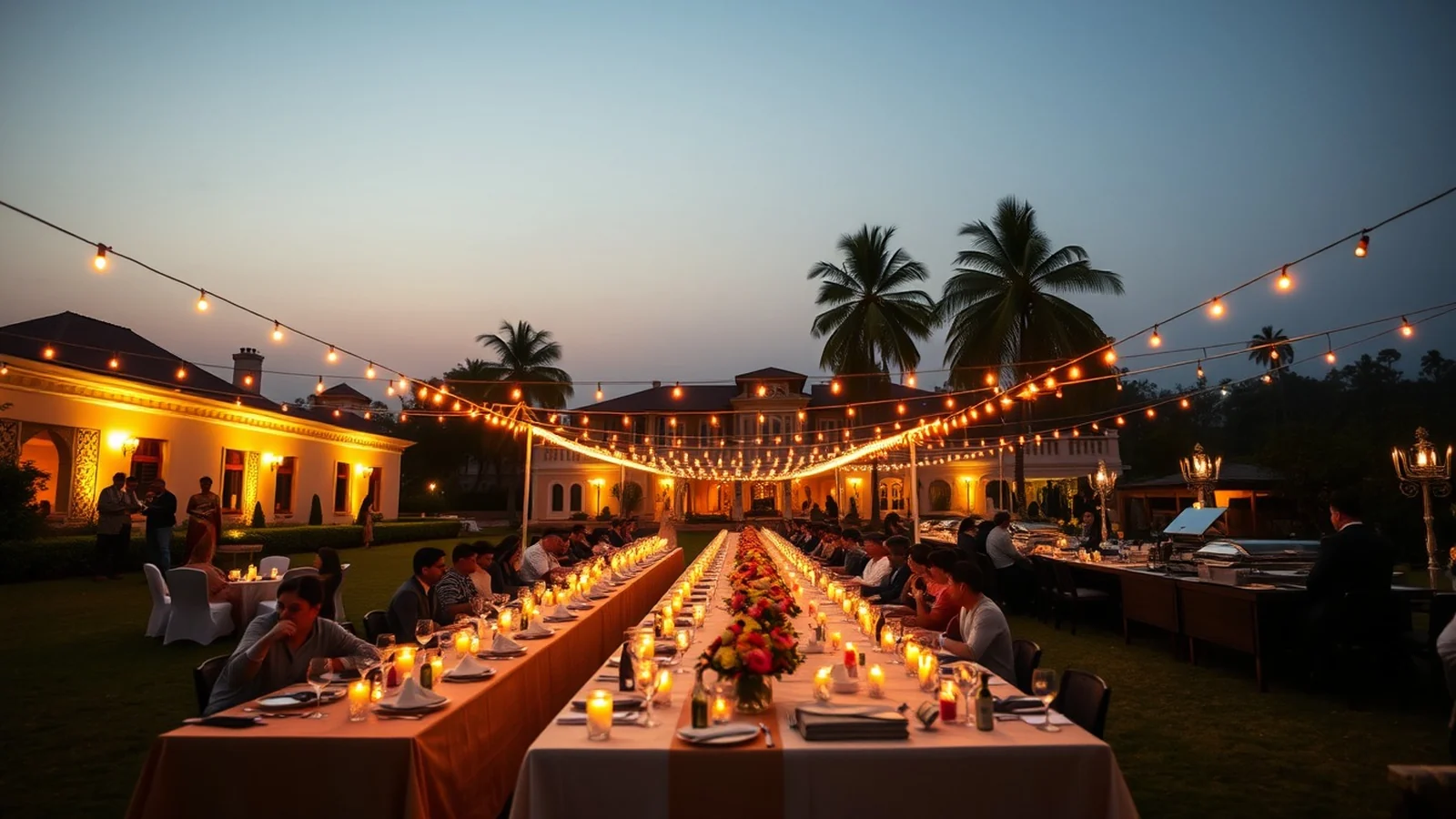
- Lighting. String lights, uplighters, lanterns, candles on tables. This is the entire look on a poolside or lawn and it is a fraction of the cost of a built set.
- Linen and table dressing. It photographs, it is inexpensive, and it makes a hotel lawn stop looking like a hotel lawn.
- Signage and wayfinding. Guests who have never been to the property need to find the function. Three clear signs are worth more than three flower arrangements.
- Ambient sound and one genuinely good live counter.
What is not worth paying for: a stage, a built backdrop, heavy floral installations, entrance gates, or anything that requires a rigging crew.
As an indicative planning share, treat the welcome dinner as roughly three to six percent of total wedding spend at the Rs 50 lakh to Rs 2 crore band, against something like twelve to twenty percent for a sangeet and a comparable or higher figure for the reception. Those percentages are indicative planning anchors, not quotes. They shift with guest count, city, whether the property allows outside catering and whether alcohol is served. Run your own numbers through the wedding budget calculator, and if you are working destination, cross-check against the destination wedding cost guide, where multi-day food and beverage is usually the largest single line after venue.
One counterintuitive point on spend: the cheapest welcome dinner is not the one with the smallest decor budget, it is the one with the most accurate headcount. Guaranteed minimums, over-catering for a wave that never lands, and a stretched service window are what actually inflate this function.
Failure modes a planner watches for
Five things go wrong on arrival night with enough regularity that they should be designed against rather than reacted to.
Flight delays that move the centre of gravity
Winter fog in North India and monsoon disruption on the west coast routinely push a large block of arrivals three to five hours late. Mitigation: hold the service window open, keep at least two live counters running to the end, and pre-agree hot food to rooms after close. Track the four or five largest arriving groups by name, not just as a number, and know their flight status through the evening.
No-shows against the catering guarantee
Families consistently over-declare the welcome dinner count because they include local relatives who will not come. You then pay per plate for people who never arrived. Mitigation: confirm the count against actual room block occupancy and confirmed arrivals, then add the 10 to 15 percent headroom, rather than working off the wedding list.
The buffet running out at hour three
The classic failure. Production is planned for the declared count but consumed unevenly, and by 10pm the two most popular items are gone exactly as the late wave arrives. Mitigation: instruct the kitchen to hold back roughly a quarter of the biryani, the main non-vegetarian dish and the most popular dessert for the last hour, and put it in the contract if you are working with an external caterer.
Guests treating it as the main party
Give people a bar and a dance floor and they will treat arrival night as the wedding. Mitigation: no DJ, close service at a stated time, and put an explicit note on the itinerary card about the next morning’s start time. The single most useful sentence you can print is the time the first function begins.
The hospitality desk collapsing under check-in
The welcome dinner and hotel check-in peak at the same time, and one under-staffed desk cannot do both. Mitigation: separate the two functions physically and staff them separately. Room keys and luggage at the hotel lobby desk, itinerary, hampers and family queries at a second desk near the dinner space. Two staff members on each, minimum, for a 100-plus arrival evening.
Everything in this list is a planning decision made weeks earlier, not a problem solved on the night. That is the honest argument for treating the welcome dinner as a real function with a real run sheet, even though it is the one you should spend the least money on.
Planning for a lot of guests?
Tell us your guest count, how many are travelling in, and your venue. Team Velvet Knot will map the hospitality, transport and run sheet, and tell you honestly what it will cost.
Frequently Asked Questions
Is a welcome dinner necessary at an Indian wedding?
It is necessary whenever a meaningful number of guests are staying at a hotel or resort for the wedding. Those guests have to eat on arrival day and will otherwise be scattered across restaurants and room service at your expense anyway. If your wedding is entirely local and guests sleep at home, you can skip it. For destination and hotel weddings, treat it as standard.
How is a welcome dinner different from a sangeet?
The sangeet is a performance evening with a stage, choreography, a full guest list and significant production cost. The welcome dinner is a hospitality function with no stage, a shorter guest list of travelling guests, informal food service and minimal decor. Running them as one event usually means the sangeet gets diluted and tired guests underperform. Costs for the sangeet are covered in the sangeet night cost guide.
Who should be invited to the welcome dinner?
Outstation and international guests, plus immediate family from both sides. At a 400-guest wedding that usually lands between 80 and 150 people. Local guests who are sleeping at home are generally not invited, and this is communicated through the itinerary card sent to travelling guests rather than on the main invitation.
What time should a welcome dinner start and end?
Open food service around 7.30pm and hold it live until about 11pm, or 10.30pm if the next morning has an early muhurtham. Do not set a formal start time that guests must meet. Arrivals spread across a twelve-hour window, so a service window works and a fixed sit-down does not.
How much should a welcome dinner cost?
As an indicative planning anchor, roughly three to six percent of total wedding spend in the Rs 50 lakh to Rs 2 crore band, which is materially less than the sangeet or the reception. Actual cost is driven by headcount, per-plate rate, service window length and whether alcohol is served. See wedding cost per plate for the per-head maths and hospitality costs for the surrounding guest-services spend.
Should we serve alcohol at the welcome dinner?
Optional and, if served, kept light: beer, wine and one or two spirits rather than a full bar. A large bar programme turns arrival night into the main party, and guests then face the first formal function on very little sleep. Keep the bar spend for the sangeet or the cocktail night, where it belongs.
Sources and further reading
Begin Your Engagement
Want a real number for your wedding?
Tell us your city, guest count and dates. Team Velvet Knot will come back within 24 hours with an itemised budget.