Outstation Wedding Guests: Moving 200 People Without Losing Any of Them
- What 180 outstation guests actually look like on the ground
- Collect arrival data at RSVP or you are planning blind
- The arrivals manifest, the desk and the 2am landing
- Building the shuttle system: loops beat on-demand cars
- The number everyone underestimates: real journey time
- Multi-hotel logistics when one property cannot hold everyone
- The guest-liaison team and the WhatsApp structure that works
- Special-care guests are core planning, not an afterthought
- Departures: the half of the plan every family gets wrong
- Fleet, liaison and desk staffing by guest band
- Parking and security
- Guests travelling from abroad
- Frequently Asked Questions
- Sources and further reading
Outstation guest planning is a movement operation, not a courtesy. Collect flight and train details at RSVP, build an arrivals manifest sorted by time, staff an airport desk, run fixed shuttle loops instead of on-demand cars, appoint one liaison per 25 to 40 guests, and plan departures as carefully as arrivals.
What 180 outstation guests actually look like on the ground
Take a real shape: a 300-guest wedding in Hyderabad or Udaipur where 180 of those guests are flying or training in. They arrive across a window that opens around 6am on Thursday and does not close until midnight. They sleep in three hotels because no single property could hold the block. There are five functions across three days, held at two different venues. And every one of those 180 people needs to be somewhere specific, five times, without being told twice.
That is a movement operation. It has an arrival curve, a fleet, a staffing roster and a failure rate. Most Indian families run it on a WhatsApp group and adrenaline, and it mostly works, because Indian families are extraordinarily good at improvising. But the cost of improvising shows up in very specific places: the mehendi starts fifty minutes late because the second shuttle never left, an eighty-year-old grandaunt waits ninety minutes at the airport arrivals gate because nobody was tracking her flight, and the bride’s own cousins miss the baraat because they were told the wrong hotel lobby.
None of those are catering failures or decor failures. They are logistics failures, and they are the ones guests remember and talk about. This guide is purely about the operation: arrivals, ground movement, and the human team that runs it. For what any of it costs, hand off to wedding transport costs in India and wedding hospitality costs. This page assumes you have a budget and now need a plan.
The first decision is honest scoping. Count your outstation number early, not late. If your guest list is 300 and 60 are outstation, you are running a hospitality courtesy. If 180 are outstation, you are running a small conference with a wedding attached, and you should staff it that way from six months out.
Collect arrival data at RSVP or you are planning blind
Every downstream decision depends on one dataset: who arrives when, by what, and leaves when. If you do not capture it at the RSVP stage you will spend the last fortnight chasing it by phone, and you will still be missing forty entries on the day the fleet has to be booked.
Build the ask into the RSVP itself. When you set up your RSVP and save-the-date flow, the form should capture, per travelling party: names and headcount, arriving city, mode (flight, train, or self-drive), flight or train number, arrival date and time, terminal or station, departure date and time with return flight or train number, hotel preference or family grouping, and any mobility, medical or dietary need. Ten fields. Not optional.
Why the flight number matters more than the time
A guest who tells you ‘landing Thursday evening’ has given you nothing. A guest who gives you 6E 2143 has given you a live object you can track: you know the scheduled arrival, and on the day you know the actual arrival forty minutes before it happens. Delays are not a surprise if you have the number. They are only a surprise if you have a vague sentence.
The two-stage collection that actually works
Bookings are not final at invitation stage. Ask twice. Stage one at RSVP, roughly ninety days out, captures intent and approximate dates so you can size the room block and the fleet. Stage two, at fourteen days out, captures the confirmed flight and train numbers. Send stage two as a short individual message, not a group blast, because group blasts get read by everyone and answered by nobody.
Expect about eighty percent compliance on stage two. The remaining twenty percent are the guests who will call you from an airport taxi rank. Budget for them: keep two vehicles and one liaison genuinely unassigned on every arrival day for exactly this reason.
Special note for NRI arrivals
Long-haul guests arrive tired, often at inconvenient hours, and frequently a day or two earlier than domestic guests because they are combining the wedding with a longer India trip. Capture their full India itinerary, not just the wedding legs. If a large share of your list is flying in from abroad, the date choice itself is a logistics variable worth reading up on in the best time for an NRI wedding in India, and the guest-facing preparation is covered in the destination wedding guest guide.
The arrivals manifest, the desk and the 2am landing
Once you have the data, turn it into one document: the arrivals manifest. It is a single sheet, sorted by arrival time, not by family name. That sorting choice is the whole point. A list sorted by family tells you who is coming. A list sorted by time tells you what your day looks like.
Each row carries: arrival time, flight or train number, terminal or platform, party size, number of bags expected, assigned hotel, assigned vehicle, assigned liaison, and a status column that the desk updates in real time (landed, collected, in transit, checked in). One sheet, shared live, editable by four people and readable by twenty.
Plan for the curve, not the average
This is the rule that separates a working plan from a spreadsheet. If 180 guests arrive over twelve hours, the average is fifteen guests an hour, and fifteen guests an hour needs almost no fleet at all. The average is a lie. Indian domestic arrival banks cluster. You will typically find sixty of your guests landing between 9am and 11.30am, another forty between 6pm and 9pm, and a thin scatter across the rest of the day.
So plot the manifest as a curve, hour by hour, and size the fleet and the desk against the two peaks, not the mean. The peak hour is the only hour that can break you. If your worst hour is fifty-five arrivals, you need vehicles and greeters for fifty-five arrivals, and for the other ten hours most of that capacity sits idle. That idle capacity is not waste. It is the plan.
Staffing the airport or station desk
For a large arrival day, put a physical desk at the airport. Not a person wandering with a phone, a desk: a folding table where permitted, or an agreed fixed point outside arrivals with clear signage, staffed continuously through the arrival window. Two people minimum during peak, one during the tail. They hold the manifest, a phone with the shuttle drivers on speed dial, a printed vehicle roster, water, and a small cash float.
Signage should carry the couple’s names in large type and nothing clever. A guest who has flown seven hours should be able to identify your desk from thirty feet away without reading a monogram. At major airports, the arrivals concourse is crowded and the pickup bays are a walk away, so tell each guest at the desk exactly where the vehicle is and, ideally, walk them to it.
The 2am landing and the delayed flight
Two scenarios will happen. Someone lands at 2am, and someone’s 7pm flight becomes an 11.40pm flight. Decide the policy in advance rather than in the moment.
- Night arrivals: anything landing between midnight and 5am gets a pre-booked single vehicle with a named driver and a phone number sent to the guest by message the previous evening. No shuttle, no desk. Confirm the hotel front desk is expecting a late check-in and that the room is genuinely held, which is a room-block detail worth nailing early in your hotel room block negotiation.
- Delays: a delayed flight must never delay a shuttle that is already loaded. The rule is that the loop runs on time and the delayed party is picked up separately. Families break this rule constantly, holding a full tempo traveller for one cousin, and it is how twelve people become late instead of two.
- Missed connections: keep one liaison on call overnight through the arrival window with the manifest open. Rotate this duty. Do not give it to the same exhausted person two nights running.
Building the shuttle system: loops beat on-demand cars
There are two distinct transport jobs and families routinely confuse them. Job one is airport or station to hotel: point to point, unpredictable timing, driven by the manifest. Job two is hotel to venue and back: repeating, predictable, driven by the function schedule. Job one wants individual vehicles. Job two wants a loop.
Why a fixed loop wins at scale
On-demand transfers feel more hospitable. At 40 guests, they are. At 180 guests they collapse, because every request creates a dispatch decision, every dispatch decision creates a phone call, and one person cannot field ninety phone calls in ninety minutes while also loading vehicles.
A published loop removes the decisions. Print it: a coach leaves Hotel A at 6.00pm, 6.30pm, 7.00pm and 7.30pm, and leaves the venue at 11.00pm, 11.45pm and 12.30am. Put the times on the welcome card in the room, on a printed A5 slip in every welcome hamper, on a notice at the hotel front desk, and in the WhatsApp broadcast. Then run it exactly to those times.
The loop also gives you an honest capacity model. If your loop is a 35-seat coach doing a 25-minute round trip, you move roughly 70 people an hour per coach, and 180 guests need three coaches or a longer window. That is arithmetic you can defend to a hotel and a fleet operator.
Realistic vehicle capacities
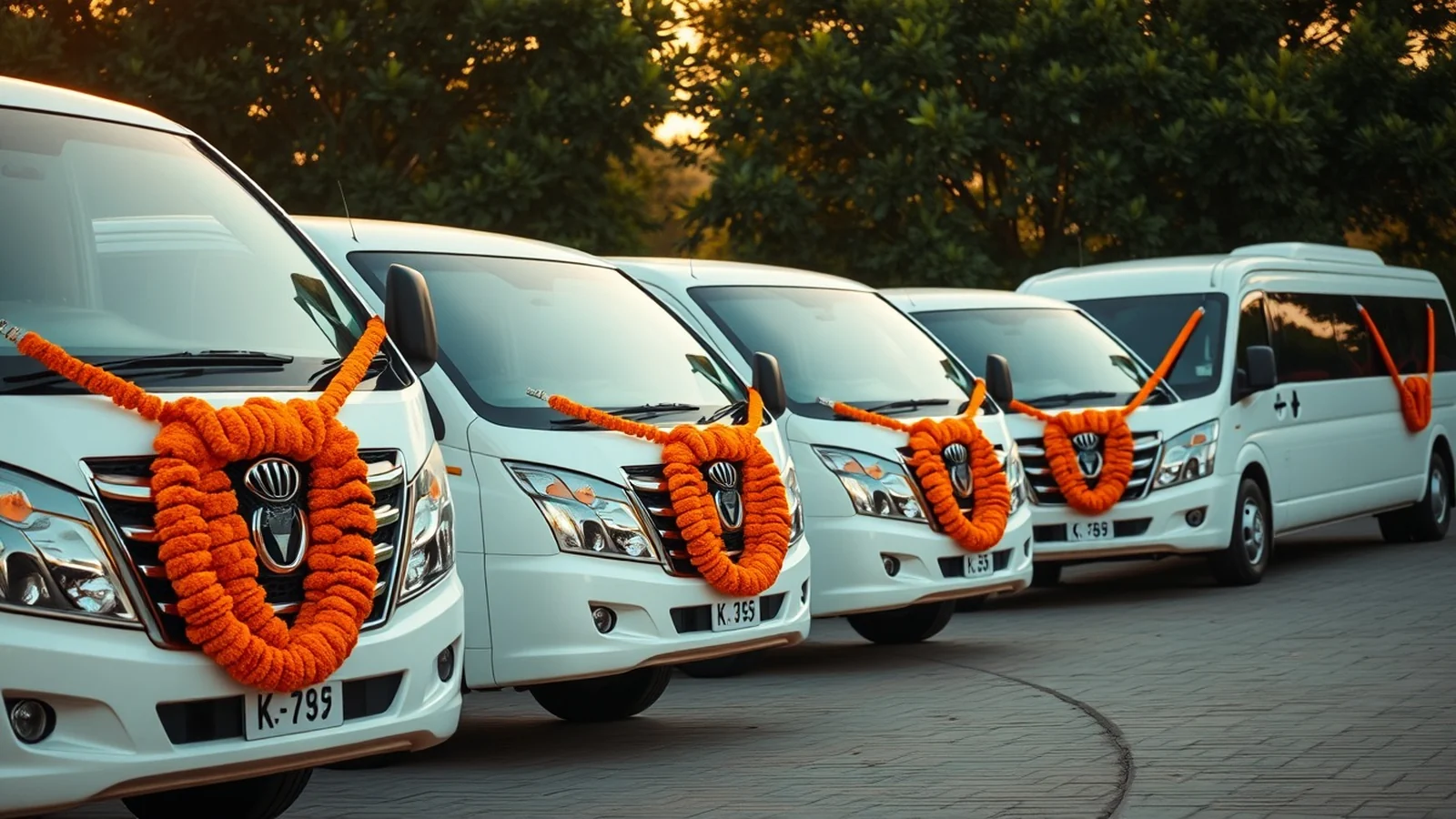
Book against real, comfortable, luggage-inclusive capacity, not the number on the registration certificate. A tempo traveller sold as a thirteen-seater carries roughly nine adults comfortably once suitcases and a saree bag per person are on board.
- Sedan: 3 adults with light bags, or 2 adults with full luggage. Use for elderly couples, VIP arrivals and late-night singles.
- SUV, Innova class: 5 to 6 adults, 4 with full luggage. The workhorse of Indian wedding transport and the most forgiving vehicle on narrow venue approaches.
- Tempo traveller: 9 to 12 adults depending on trim, 8 to 9 with airport luggage. Good for family groups arriving together.
- Mini coach: 18 to 25 seats. Good for hotel-to-venue loops in cities with reasonable roads.
- Full coach: 35 to 49 seats. Highest people-per-rupee, worst manoeuvrability. Verify it can physically reach the venue gate before you book it.
Sizing the fleet from a headcount
Work backwards from the peak hour, not the total. Take the largest single simultaneous movement, usually the main function departure from the hotels, and divide by comfortable capacity. Then add a buffer of fifteen to twenty percent, or a minimum of two spare vehicles, whichever is larger. The buffer is not luxury: it absorbs the breakdown, the late family, the guest who needs to leave early, and the sudden run to a pharmacy.
Parking, turning circles and heritage venues
The single most common physical failure is a coach that cannot turn. Palace and heritage venues in Rajasthan, old Hyderabad properties, Kerala backwater resorts and hill-station venues frequently have gates built for horses and Ambassadors, not for 12-metre coaches. Do a physical recce with the actual vehicle class you intend to book, at the hour you intend to use it. Ask three questions on site: can the vehicle enter, can it turn without a reverse manoeuvre in the dark, and where does it wait for four hours while the function runs. If the answer to any of those is uncertain, downgrade to mini coaches or Innova-class vehicles and accept the higher trip count. Also confirm the drop point is not a two-hundred-metre walk from the mandap, because for a section of your guest list it may as well be two kilometres.
The number everyone underestimates: real journey time
Ask a family how far the hotel is from the venue and they will tell you twenty minutes. That number came from a maps app, at 3pm on a weekday, for one car, door to door. It is not the number you should plan with.
Here is what actually happens to that twenty minutes when 200 people move together. Loading a full coach with guests in heavy outfits takes twelve to eighteen minutes, not three. The convoy travels at the speed of its slowest vehicle. The wedding is at a wedding hour, which in most Indian cities means peak evening traffic. The venue has one gate, and vehicles queue single file to drop at the porch. If a baraat is moving on the approach road, the road is functionally closed. And at the far end, unloading and walking to the lawn adds another eight minutes.
The twenty-minute transfer is a fifty-five-minute operation. Plan the run sheet against the fifty-five. This is the single most valuable correction you can make to a wedding schedule, and it is why the transport plan and the wedding day timeline must be built in the same room, by the same people, on the same afternoon.
How to get a real number
- Drive the route yourself, in the vehicle class you will use, on the same weekday and at the same hour, ideally in the same season.
- Time it door to door including the porch queue, then add ten minutes for loading and eight for unloading.
- Ask the venue how many vehicles can be at the porch simultaneously. If the answer is two, and you have eight vehicles, your last guest arrives roughly thirty minutes after your first.
- Check for local closures: temple processions, political rallies, exam days and monsoon waterlogging points all change the number.
Then publish shuttle departure times that are built on this real number and hold to them. A shuttle that leaves on time and arrives forty minutes later is fine. A shuttle that leaves twenty minutes late because you were waiting for one family is a compounding error that ruins the whole evening.
Multi-hotel logistics when one property cannot hold everyone
Above roughly 120 outstation guests in most Indian cities, one property will not hold the block at a sane rate, and you will be running two or three hotels. This is normal. It is also where most guest complaints originate, because guests read hotel assignment as a statement about their standing in the family.
Group by family, never split a family
The rule is absolute: one household, one hotel. Splitting a family of six across two properties for room-inventory reasons will cost you more goodwill than the rate difference is worth, and it doubles the coordination burden on the day. Group instead by natural clusters: the bride’s paternal side in one property, the groom’s travelling party in another, the friend group in the third.
Give each hotel a legible identity rather than an implied hierarchy. If one property is genuinely more expensive, use it for the oldest guests and those with mobility needs, which is defensible to everyone, rather than for whoever asked first. Do the negotiation properly, including cut-off dates and attrition clauses, using the room block guide.
Running parallel loops
Each hotel gets its own shuttle loop, its own posted times, its own liaison and its own notice board. Do not run a single loop that collects from three hotels in sequence. It looks efficient on paper and it is miserable in practice: the last hotel’s guests sit in a vehicle for forty minutes before reaching the venue, and one delay at hotel one pushes everything behind it.
Stagger the loops so that the three streams do not all hit the venue porch in the same six minutes. If your venue can handle two vehicles at the porch, stagger the departures by ten to twelve minutes. Also stagger the return loops, because the end-of-night rush is worse than the arrival rush: everyone wants to leave at once, and nobody wants to wait.
The information problem
Three hotels means three sets of information, and guests will confidently follow the wrong one. Print hotel-specific cards. Hotel A’s card carries only Hotel A’s times. Never hand a guest a master schedule with all three loops on it, because they will read the wrong row and blame you when they miss a vehicle.
The guest-liaison team and the WhatsApp structure that works
Every large outstation wedding needs named humans owning named groups of guests. The workable ratio is one liaison per 25 to 40 guests, closer to 25 when the group skews elderly or includes first-time visitors to India, closer to 40 when the group is young, mobile and self-sufficient.
A liaison can be a cousin, a family friend, or a professional from your planning team. Whoever they are, they must be someone whose phone the guests will actually answer and who is not also expected to participate fully in the rituals. A liaison who is also a wedding-party member is not a liaison, they are a person who will vanish at the exact moment they are needed. If you are hiring this out, check that it is explicitly scoped in the planner services list, because guest management is often assumed rather than contracted.
What each liaison carries
- The printed list of their assigned guests, with hotel, room number, phone number and any special-care flag.
- The printed function itinerary with shuttle times for their hotel, plus ten spare copies to hand out.
- A cash float of a few thousand rupees for parking, tips, a chemist run or an emergency auto.
- A contact tree card: their escalation contact, the transport controller, the hotel duty manager and the venue coordinator. Names and numbers, not roles.
- A fully charged power bank. Every liaison’s phone dies by 9pm on the main day.
The WhatsApp structure
The default family instinct is one giant group with 200 people in it. By day two it has 600 messages, forty of them useful, and guests have muted it. Structure it instead:
- One broadcast group: everyone is in it, only three admins can post. Use it for schedule, dress code, shuttle times and changes. Two or three messages a day, maximum.
- Small logistics groups: one per liaison, 25 to 40 guests each, open conversation. This is where ‘where is the car’ gets answered.
- One core operations group: the liaisons, the transport controller, the planner and one family decision-maker. Ten to fifteen people. This group runs the wedding.
The escalation path should be one line long and everyone should know it: guest to liaison, liaison to operations group, operations group to the single decision-maker. Nobody calls the bride’s mother. That is the entire purpose of the structure, and it is worth saying out loud at the briefing.
Brief the team properly
Hold a real briefing the evening before the first arrivals: forty-five minutes, everyone in one room, walk the manifest, walk the loops, hand out the packs, and rehearse the two most likely failures (a delayed flight and a missing guest). It is the highest-return forty-five minutes in the entire wedding.
Special-care guests are core planning, not an afterthought
In a 180-person outstation group, expect roughly fifteen to twenty-five people who need something specific. Identify them at RSVP, flag them on the manifest, and assign them to a named liaison rather than to the general pool.
Elderly guests
Assign a dedicated vehicle rather than a shuttle seat wherever possible, because a sedan with a known driver is worth more than any hamper. Book their rooms on lower floors, near lifts, and confirm the hotel has a working lift, not one that is under maintenance that fortnight. At the venue, reserve seating with backs and with shade, close to a washroom and away from the loudest speaker stack. Check ritual timings against their day: a 4am muhurtham is manageable for a fit forty-year-old and punishing for an eighty-year-old who arrived from Chennai at midnight.
Mobility and wheelchair needs
Ask the airport for wheelchair assistance at booking, and confirm it forty-eight hours before, because it is requested through the airline, not arranged on arrival. Then check the ground truth at your venue: heritage properties in Rajasthan and older temples across South India have steps, gravel, uneven stone and no ramps. Walk the exact route the guest will take, from vehicle drop to seat to washroom, and if it does not work, change the drop point or arrange staff to assist. Do this on the recce, not on the day.
Children
Children under six drive their parents’ entire schedule. Provide a quiet room near the function with a mat, water and a fan, list which hotels can supply cots and high chairs, and be explicit about which functions are late enough that children should not attend. Late-night functions with 110-decibel sound are not for infants, and saying so plainly in advance is kinder than everyone pretending otherwise.
Medical and dietary
Keep a single confidential sheet held by the planner and one family member: conditions that matter in an emergency, regular medication, and the nearest hospital with an emergency department, with the route and drive time already checked. Keep a basic first-aid kit and an oral rehydration supply at each hotel desk and at the venue. On dietary needs, collect Jain, vegan, no-onion-no-garlic, diabetic and allergy requirements at RSVP and pass them to catering as a named list, not a headcount, so a plate can be handed to a specific person rather than left on a buffet nobody points out.
Guests unfamiliar with the customs
Overseas friends and colleagues often do not know what any of it means or what to wear. A one-page primer in the welcome pack solves ninety percent of it, and you can point them to what to wear to an Indian wedding and Indian wedding guest etiquette rather than writing it yourself.
Departures: the half of the plan every family gets wrong
Families plan arrivals with real care and then treat departures as something that will sort itself out. It does not. Departures are harder than arrivals, because they are compressed, they collide with hotel checkout policy, and they happen when the entire family is exhausted.
Time checkout against the last function, not against the hotel’s clock
The standard noon checkout is almost always wrong for a wedding. If your reception ends at 1am, a noon checkout gives your guests seven hours of sleep and a scramble. Negotiate late checkout for the block as part of the original room-block deal, not as a favour requested at 11am on the day. A 4pm or 6pm checkout for a defined subset of rooms is a very common concession when you are holding thirty or more rooms, and it costs far less than an extra night for everyone.
Staged departure shuttles
Build a departure manifest exactly like the arrivals manifest, sorted by flight or train time. Then group departures into waves and publish an airport shuttle schedule: for example 5am, 8am, 11am, 2pm and 6pm on the final day. Each guest is assigned to a wave based on their departure time minus a real buffer.
Use a working buffer of three hours before a domestic flight and four before an international one, measured from hotel lobby departure, and add the real journey time you measured earlier rather than the maps estimate. For trains, use ninety minutes to the station, because Indian stations at peak require a walk, a foot overbridge and platform hunting.
The 6am flight after a 1am reception
Someone always has this itinerary. Handle it explicitly: identify these guests two days ahead, offer them a dedicated vehicle rather than a wave shuttle, arrange express or pre-paid checkout the previous evening so they are not standing at a front desk at 3.30am, ask the hotel to hold their luggage from the evening before, and pack a boxed breakfast because no kitchen is serving at 3am. Then have a liaison awake and confirming the driver at the appointed time, because this is the single most likely booking in the entire wedding to be missed.
Return gifts and the goodbye
Departure is also when return gifts are handed over, and the practical answer is to give them at the last function or leave them in the room with the checkout note, not to chase people in a lobby at dawn. What to actually give is a separate question, covered in return gifts. Finally, assign one person to a lost-property sweep: after every large wedding, three phones, a dozen chargers, two sets of jewellery and somebody’s passport are sitting in hotel rooms and venue chairs.
Fleet, liaison and desk staffing by guest band
Use the table below as a starting scaffold, then correct it against your own arrival curve, the number of hotels and the venue’s porch capacity. It assumes a typical three-day, five-function Indian wedding with one main venue. The vehicle mix is for the peak simultaneous movement, not for the total headcount, and it excludes family and vendor vehicles.
| Outstation guests | Suggested vehicle mix (peak movement) | Buffer vehicles | Liaison headcount | Arrival desk staffing |
|---|---|---|---|---|
| Up to 50 | 2 SUVs plus 2 tempo travellers | 1 | 2 | 1 person, peak hours only |
| 50 to 100 | 3 SUVs, 3 tempo travellers, 1 mini coach | 2 | 3 to 4 | 1 to 2, full arrival window |
| 100 to 180 | 4 SUVs, 4 tempo travellers, 2 mini coaches | 2 to 3 | 4 to 6 | 2 at peak, 1 on tail |
| 180 to 250 | 5 SUVs, 5 tempo travellers, 2 full coaches | 3 | 6 to 8 | 2 to 3, plus night cover |
| 250 plus | 6 plus SUVs, 6 tempo travellers, 3 to 4 full coaches | 4 plus | 8 plus, split by hotel | 3 plus, two shifts, night cover |
Two notes on reading this table. First, if your venue cannot take full coaches, replace each coach with two mini coaches or three tempo travellers and add thirty percent to your movement window. Second, the liaison count assumes liaisons are not also core wedding-party members. If they are, increase the count.
For what this fleet costs in 2026 rupees, including per-day vehicle rates, driver allowances and night charges, see wedding transport costs in India. For rooms, welcome desk staffing and hamper budgets, see wedding hospitality costs. And if you want the arrival day to end with something other than a key card, the welcome dinner is the function that does the most work for outstation guests, because it converts a hotel corridor full of strangers into a wedding.
Planning for a lot of guests?
Tell us your guest count, how many are travelling in, and your venue. Team Velvet Knot will map the hospitality, transport and run sheet, and tell you honestly what it will cost.
Parking and security
Guests travelling from abroad
Frequently Asked Questions
How many guest liaisons do I need for 200 outstation guests?
Plan on one named liaison for every 25 to 40 guests, which puts a 200-guest outstation group at six to eight liaisons. Move toward the 25 end when the group includes many elderly guests, wheelchair users, young children or first-time visitors to India, and toward 40 when it is a young, mobile group staying in one hotel. Liaisons should not also be core wedding-party members, because they will be unavailable exactly when they are needed.
Should I book on-demand cars or run fixed shuttles?
Below about 50 outstation guests, on-demand transfers are workable and feel more personal. Above roughly 80, switch to a published shuttle loop with fixed departure times from each hotel. The loop removes hundreds of individual dispatch decisions, gives every guest one clear instruction, and lets you calculate real capacity. Keep two or three individual vehicles unassigned for late arrivals, early departures and emergencies.
How much time should I allow between the hotel and the venue?
Take the maps estimate and roughly double or triple it. A 20-minute drive typically becomes a 55-minute operation once you add 12 to 18 minutes of loading a coach with guests in heavy outfits, convoy speed, evening wedding-hour traffic, a single-file queue at the venue porch and the walk from drop point to lawn. Drive the route yourself in the same vehicle class, on the same weekday, at the same hour, and plan against that measured number.
What details should I collect from outstation guests at RSVP?
Ten fields per travelling party: names and headcount, origin city, mode of travel, flight or train number, arrival date and time, terminal or station, departure date and time with return service number, hotel or family grouping, and any mobility, medical or dietary need. Collect intent at about 90 days out and confirmed flight and train numbers again at 14 days out, sent as individual messages rather than a group blast.
How do I handle guests spread across three hotels?
Group by natural family clusters and never split one household across two properties. Give each hotel its own shuttle loop, its own posted times, its own liaison and its own printed information card carrying only that hotel’s schedule. Stagger the loop departures by 10 to 12 minutes so all three streams do not arrive at the venue porch simultaneously, and stagger the return loops too, since the end-of-night rush is heavier than the arrival rush.
What is the right way to plan departures?
Build a departure manifest sorted by flight or train time, negotiate late checkout for the block as part of the original room-block contract rather than as a day-of favour, and run staged departure shuttles in waves. Allow three hours before a domestic flight and four before an international one, measured from the hotel lobby, plus your real measured journey time. Guests with pre-dawn flights after a late reception get a dedicated vehicle, express checkout arranged the previous evening, a boxed breakfast and a liaison awake to confirm the driver.
Sources and further reading
Begin Your Engagement
Want a real number for your wedding?
Tell us your city, guest count and dates. Team Velvet Knot will come back within 24 hours with an itemised budget.