Wedding Valet Parking Cost in India 2026: Parking 300 Cars Without Chaos
- What wedding valet parking actually costs in India in 2026
- Valet and parking cost tiers by event scale
- The arrival curve: the number families always get wrong
- What drives the price up
- Hidden extras the first quote leaves out
- When you genuinely need managed valet
- How to save on valet without the gate jamming
- Frequently Asked Questions
- Sources and further reading
Wedding valet and parking management in India costs roughly Rs 15,000 to Rs 40,000 for a small setup, Rs 50,000 to Rs 1.5 lakh for a few hundred guests, and Rs 2 lakh to Rs 6 lakh for a full valet-and-traffic operation at a large or destination wedding across function days. Figures are indicative 2026 ranges.
What wedding valet parking actually costs in India in 2026
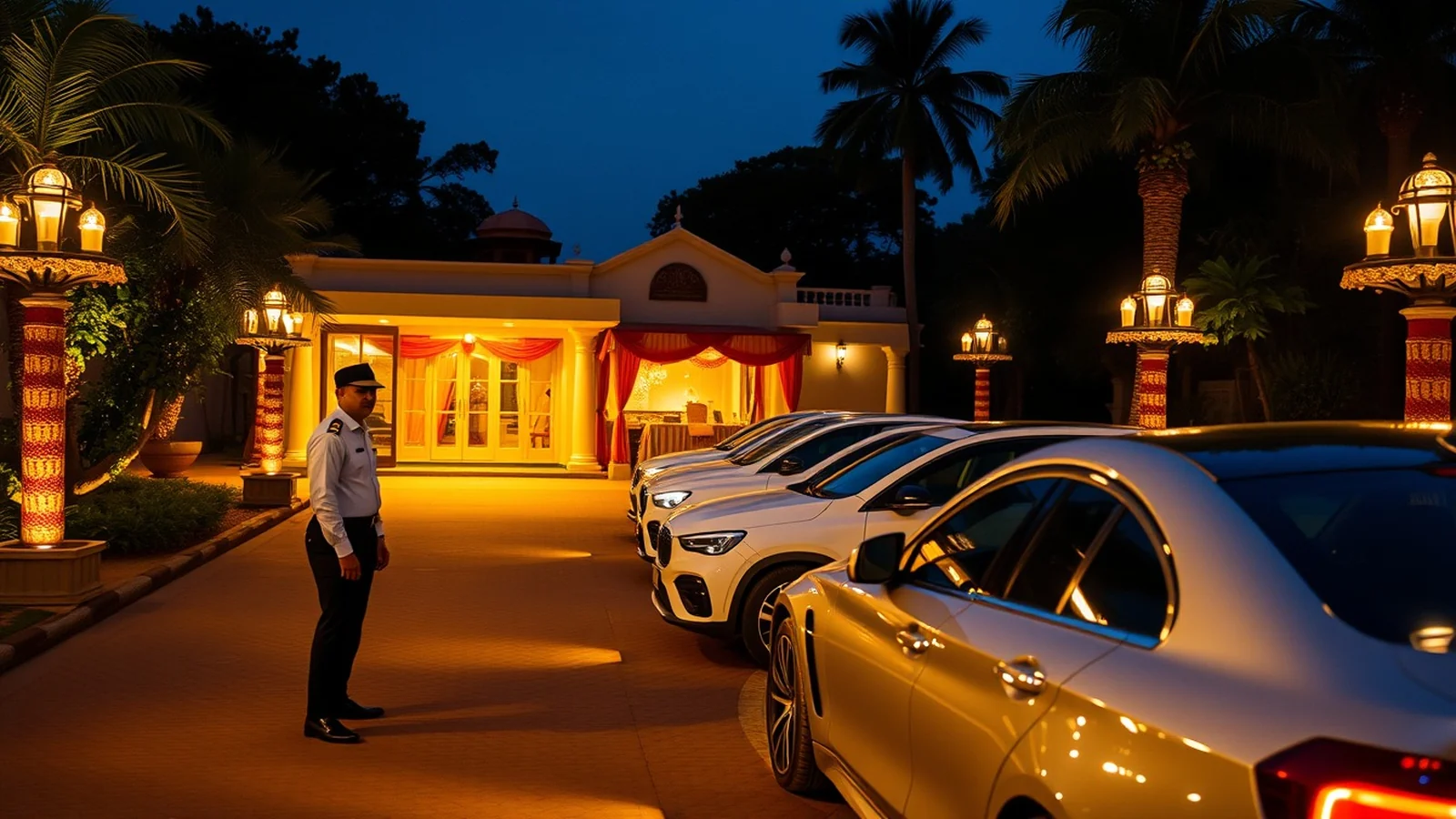
Valet and parking management is one of the quietest line items on an Indian wedding budget and one of the first things guests judge you on. Nobody remembers who parked their car smoothly. Everybody remembers the forty-minute crawl to the gate, the argument over a scratched bumper, and the aunt who walked 300 metres in heels because the lot was a field behind the venue. This is a logistics purchase, not a luxury, and it is priced by how many cars arrive in the same fifteen minutes, not by how grand the wedding is.
As an indicative 2026 guide, a small valet setup for an intimate function runs about Rs 15,000 to Rs 40,000 per event. A mid operation handling a few hundred guests sits at Rs 50,000 to Rs 1.5 lakh. A full valet-and-traffic operation for a large city wedding or a destination property runs Rs 2 lakh to Rs 6 lakh across the function days. Where you land inside those bands depends almost entirely on the arrival curve, which we break down below, and on how far guests have to walk from car to gate.
These numbers are market ranges, not quotes. A valet vendor prices your specific site: how many entry points, how far the lot is, whether the road outside needs marshals, how many function days, and whether outstation guests leave cars overnight. Treat the tiers as a planning anchor and get a walkthrough quote once your venue and guest count are locked. If you are still building the overall number, our wedding budget calculator and the cost by guest count guide put valet in context against the rest of the spend.
Valet and parking cost tiers by event scale
The table below maps event scale to the crew and extras you actually need. The car counts assume a typical Indian wedding where a large share of guests arrive by private car rather than shared transport. If you are running guest transport and shuttles, your parking load drops sharply, because a single hired bus removes twenty to thirty cars from the lot.
| Event scale | Cars at peak | Valet attendants | Typical extras | Indicative range (per event) |
|---|---|---|---|---|
| Small / intimate function | 30 to 60 | 3 to 5 | Ticketing, 1 marshal | Rs 15,000 to Rs 40,000 |
| Mid city wedding | 100 to 200 | 8 to 14 | Marshals, barricades, lot lighting | Rs 50,000 to Rs 1.5 lakh |
| Large wedding | 250 to 400 | 15 to 25 | Traffic team, buggies, insurance | Rs 1.5 lakh to Rs 3.5 lakh |
| Destination / heritage venue | 200 to 400 across days | 18 to 30 across days | Shuttle buggies, overnight parking, road marshals | Rs 2.5 lakh to Rs 6 lakh |
Notice that attendant count does not scale one-to-one with cars. It scales with the peak. A 400-car wedding where guests trickle in over three hours needs fewer hands than a 200-car wedding where everyone lands in the same half hour after the muhurat. That single fact is why so many families overpay for the wrong thing and underpay for the thing that actually matters. The next section explains it.
The arrival curve: the number families always get wrong
Here is the mistake almost every family makes. They see 300 confirmed guests, assume roughly 150 cars, and ask the valet vendor to quote for 150 cars. The vendor quotes low, the family is happy, and on the night the gate jams because 150 cars did not arrive across the evening. They arrived in a 30 to 45 minute window right before the ceremony, because Indian guests time their entry to the muhurat, not to the invitation start time.
Crew size is set by the arrival curve, not the total car count. A useful rule of thumb: one attendant can receive, park and return roughly one car every two to three minutes once you account for walking back to the gate. So a single attendant clears around 20 to 25 cars an hour at a steady pace. If 200 cars land in 45 minutes, that is a peak rate of over 260 cars an hour. Divide by the 20 to 25 an attendant handles and you need roughly 10 to 13 people just receiving cars, before you add runners, marshals and a supervisor.
The planner-side rule most vendors use is one attendant per 15 to 25 cars at peak. Size for the lower end (one per 15) when the lot is far from the gate, when it rains, or when cars are large SUVs that are slow to manoeuvre. Size for the higher end (one per 25) when the lot is right at the entrance and the surface is smooth. If you quote for the average arrival rate instead of the peak, you will be short-staffed for the exact 40 minutes that decide whether your entrance feels premium or chaotic.
Two levers flatten the curve and cut the crew you need. First, stagger the programme so not every guest needs to be seated at the same minute; a realistic wedding day timeline with a soft-start window spreads arrivals. Second, move a block of guests onto shared transport. If your outstation contingent is large, coordinated shuttles from the hotel room block take dozens of cars off the peak entirely. Plan that alongside your outstation guest logistics rather than treating parking as a night-of problem.
What drives the price up
Once the peak crew is set, the rest of the quote is built from these drivers. Read them before you compare vendors, because a cheap quote usually means one of these has been left out and will reappear as a night-of surcharge.
- Number of function days. A three-day wedding with haldi, sangeet and the main event is three separate parking operations, often at different venues. Vendors price per event or offer a multi-day package. Bundling the same crew across days is usually cheaper than three standalone bookings.
- Distance from lot to gate. If parking is a field or a lot 300 metres away, you now need runners and, on a large site, shuttle buggies or golf carts to move guests. Every extra 100 metres slows each attendant’s cycle time, which quietly raises the crew count.
- Traffic marshals for the public road. A narrow approach road, common at farmhouse and heritage venues, needs marshals and barricades outside the gate so cars do not back up onto the main road. This is a safety line, not a nicety, and it is the item most often missing from a low quote.
- Ticketing and tagging systems. Printed valet tickets, key-tag boards and a claim counter cost more than a paper-chit setup but prevent the wrong car going to the wrong guest. For 200-plus cars, a proper system is worth it.
- Liability and insurance. A professional valet company carries insurance for damage while a guest’s car is in their custody. Uninsured local labour is cheaper and leaves you personally exposed if a car is dented. This is the single biggest reason to hire a real vendor over the venue’s casual staff.
- Night lighting and overnight parking. An evening lot needs lighting for safety and for the guest experience. Outstation guests often leave cars overnight, which means a secured, lit lot and sometimes a night watchman, overlapping with your security and bouncer arrangement.
Coordinate all of this with your venue’s own parking rules early. Many banquet halls and hotels mandate their empanelled valet vendor or charge a fee to bring your own. Factor that into your hospitality budget so it does not surprise you at contract stage.
Hidden extras the first quote leaves out
The opening valet quote is almost always the bare crew for one event. These are the extras that turn a Rs 50,000 line into Rs 1.2 lakh, and every one of them is legitimate. Ask for them itemised up front so you can decide what to keep.
- Liability insurance for guest vehicles. Damage cover while cars are in the valet’s custody. Non-negotiable for a large fleet of expensive cars; ask to see the policy, not just a verbal assurance.
- Buggy or golf-cart rental. For a sprawling farmhouse, palace lawn or resort, guests will not walk from a distant lot. Buggy rental with a driver is charged per unit per day and is a common destination-wedding add-on.
- Road marshals and barricades. Crowd and traffic control on the public road outside, plus the physical barricades to channel cars. Essential when a baraat procession blocks the approach and cars keep arriving behind it.
- Lot lighting. Portable tower lights or festoon lighting for a night lot, which overlaps with your event lighting vendor. Decide who owns this line so it is not double-charged or forgotten.
- Supervisor and coordination. A dedicated valet supervisor who liaises with the venue, the security team and your planner. On a big night this person is the difference between a system and a scramble.
- Overtime. Indian weddings run late. Confirm the crew’s hours and the per-hour overtime rate in writing, because a reception that ends at 1am on a crew booked till 11pm is a bill you will get after the fact.
When you genuinely need managed valet
Not every wedding needs a full valet operation. A 120-guest lunch at a hotel with its own basement parking does not. You need managed valet and traffic when the geometry works against you. Spend on it when any of these are true.
- 150-plus cars at peak. Above this, self-parking jams the gate no matter how big the lot is, because the bottleneck is the entrance, not the space.
- Limited or distant parking. A venue whose lot is small, offsite, or a field means guests need directing and often shuttling. Without a crew, the overflow ends up on the road.
- A heritage or farmhouse venue on a narrow road. Palace, fort and farmhouse venues frequently sit on single-lane approach roads. One stalled car blocks everyone. Marshals outside the gate are what keep the road moving.
- A baraat that blocks the approach. The groom’s procession can occupy the approach road and gate for 30 to 60 minutes while cars are still arriving. Only a managed crew with marshals prevents a total gridlock during that window.
- A destination or multi-day event. Guests unfamiliar with the property, multiple venues, and overnight cars all point to a managed operation across the function days.
If none of these apply and you are running a compact engagement or a small cocktail night, a marshal or two directing self-parking is usually enough. Match the spend to the geometry, not to the guest count on the card.
How to save on valet without the gate jamming
Valet is easy to cut badly, which shows on the night, and easy to cut smartly, which nobody notices. Here is where the smart cuts are.
- Use the venue’s own parking staff for the base. Many hotels and banquet halls include a parking crew in the package. Use them for the steady flow and hire an external team only for the peak function, rather than paying an outside vendor for the whole event.
- Valet only the peak function. Book full managed valet for the main ceremony and reception where arrivals spike, and run cheaper self-park-with-marshals for the smaller side functions like haldi and mehendi where guests trickle in.
- Self-park with marshals for smaller events. For any function under about 100 cars on an easy site, two or three marshals directing traffic cost a fraction of a valet crew and are perfectly adequate.
- Shrink the peak with transport. Every shared bus or coordinated shuttle removes twenty-plus cars from the lot. Money moved from valet into guest transport often nets out cheaper and smoother.
- Bundle multi-day crews. Book one vendor across all function days for a package rate instead of three separate single-event bookings.
- Lock hours and overtime in writing. Padding the booked window by an hour up front is cheaper than paying open-ended overtime after a late reception.
Where you should not cut: liability insurance and road marshals. A saved Rs 20,000 on insurance is meaningless the moment a guest’s car is damaged in your custody. Keep those two lines and trim the crew size and the side-function coverage instead. For the bigger picture on staging costs across the whole event, see the hospitality cost guide and the budget planning walkthrough, and talk to our team about a parking plan sized to your venue.
Want a realistic quote for your wedding?
Tell us your guest count, city and which functions you are planning. Team Velvet Knot will build you an honest, itemised budget.
Frequently Asked Questions
How much does valet parking cost for a wedding in India?
As an indicative 2026 range, a small valet setup costs about Rs 15,000 to Rs 40,000 per event, a mid operation for a few hundred guests Rs 50,000 to Rs 1.5 lakh, and a full valet-and-traffic operation for a large or destination wedding Rs 2 lakh to Rs 6 lakh across the function days. The final figure depends on your peak arrival rate and how far the lot is from the gate.
How many valet attendants do I need for a wedding?
Size the crew to peak arrivals, not total cars. The working rule is one attendant per 15 to 25 cars at peak. If 200 cars arrive in a 45-minute muhurat window, you need roughly 10 to 13 people receiving cars plus runners, marshals and a supervisor. Use the lower ratio (one per 15) when the lot is far or it rains.
Why is the arrival curve more important than guest count?
Because Indian guests arrive in a tight 30 to 45 minute window before the muhurat, not evenly across the evening. Crew size is set by cars per minute at that peak, not by the total. Quoting for the average arrival rate leaves you short-staffed for the exact window that decides whether your entrance feels smooth or chaotic.
Does valet insurance cover damage to guest cars?
A professional valet company carries liability insurance covering damage while a car is in their custody. Uninsured local labour is cheaper but leaves you personally exposed if a car is dented or scratched. Ask to see the actual policy, not just a verbal assurance. This is the main reason to hire a real vendor over the venue’s casual staff.
When do I actually need managed valet rather than self-parking?
You need managed valet and traffic control when any of these apply: more than about 150 cars at peak, a small or distant lot, a heritage or farmhouse venue on a narrow approach road, a baraat that blocks the gate while cars arrive, or a multi-day destination event. Below that, two or three marshals directing self-parking is usually enough.
How can I reduce valet parking costs without causing chaos?
Use the venue’s own parking staff for the steady flow and hire an external crew only for the peak function. Run self-park-with-marshals for smaller side events. Move a block of guests onto shared transport to shrink the peak. Bundle a single crew across function days. Do not cut liability insurance or road marshals; trim crew size and side-function coverage instead.
Sources and further reading
Begin Your Engagement
Want a real number for your wedding?
Tell us your city, guest count and dates. Team Velvet Knot will come back within 24 hours with an itemised budget.