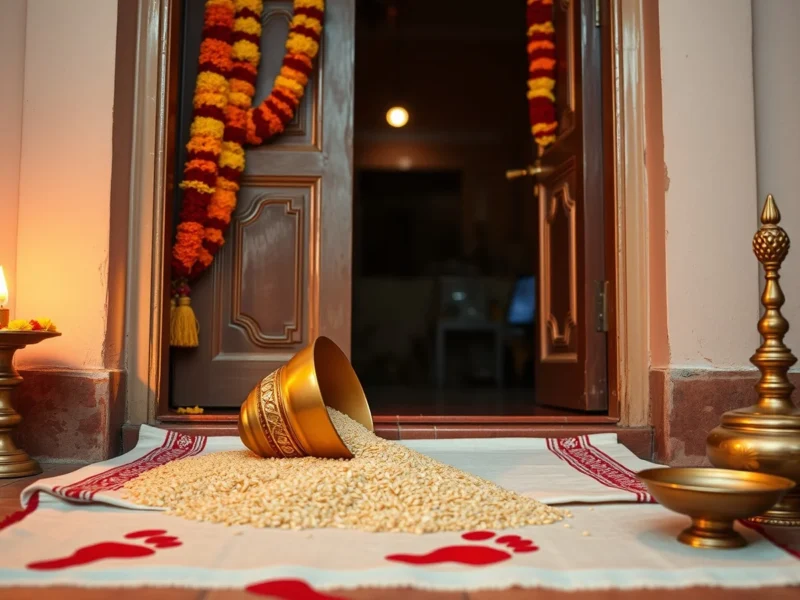
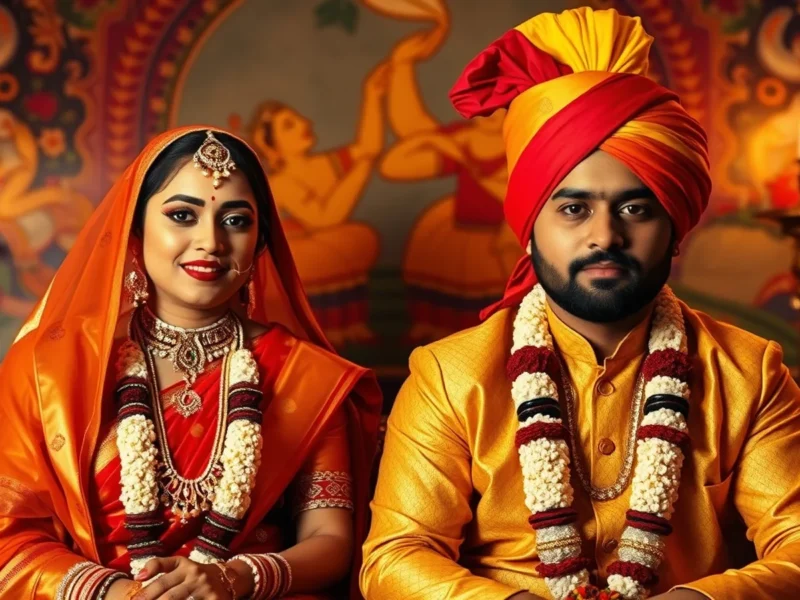
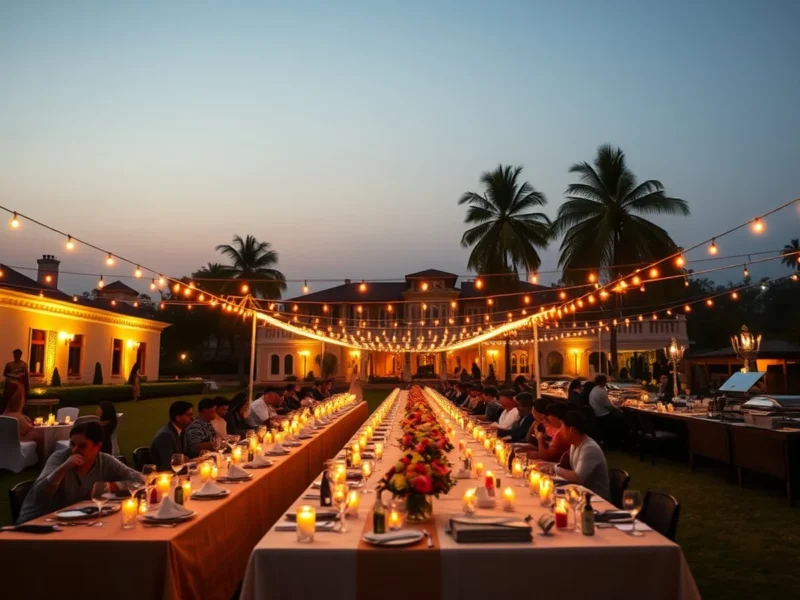
Roka Ceremony Guide: Meaning, Rituals, and How to Plan It
- What the Roka actually is
- Regional variations of the Roka
- The Roka ritual sequence (typical Punjabi/Marwari format)
- Who attends the Roka
- What to gift at a Roka
- Roka vs Sagai vs Mangni vs Engagement
- How to plan a Roka ceremony
- Sample Roka budget (2026)
- Choosing the wedding date
- What tilak and roka cost
- Related pre-wedding rituals
- The Roka at a glance
- Roka names and customs across communities
- A combined Roka and Sagai: how the day usually runs
- Frequently Asked Questions
- Related ceremonies on Velvet Knot
- Sources and further reading
The Roka is the first formal ceremony in a North Indian Hindu, Punjabi, or Sikh wedding. Held typically 3-9 months before the wedding day, the Roka publicly locks in the alliance between two families and signals that the wedding is being planned. It is smaller than the engagement (Sagai or Mangni) but functionally more important: “Roka” means “to stop”, as in, neither side stops looking elsewhere because the marriage is now formal.
What the Roka actually is
The Roka is a pre-engagement ceremony with formal religious and family significance in Punjabi, Marwari, Bihari, Gujarati, and many other North Indian Hindu wedding traditions. The Hindi word roka literally means “to stop”, referring to the moment both families publicly stop considering other matches and commit to the alliance.
The ceremony is smaller than the Sagai (formal engagement) and the wedding itself. Typical Roka guest count is 20-80, drawn from immediate family and closest extended relatives. Most Rokas run 2-4 hours, are held at one family’s home or a small banquet space, and conclude with a meal.
The Roka happens early in the wedding planning calendar, typically 3-9 months before the wedding date. This is the moment after which save-the-dates can be sent, the venue can be locked in, and the formal wedding planning begins.
Regional variations of the Roka
Punjabi Roka
The most-photographed and most-celebrated version. Typically held at the bride’s home (or a Gurudwara in some Sikh families). The bride’s family applies tilak to the groom, the groom’s family presents the bride with a set of gifts (clothes, jewellery, sweets), and an Ardas (Sikh prayer) or short puja is performed by a priest. Music and family celebration follow, often with dhol players for an hour or two.
Marwari Roka (also called Tilak in some Marwari families)
The Marwari version is more structured. The groom’s family arrives at the bride’s home with a formal procession of gifts called the Sagun. Tilak is applied to the groom by the bride’s father or eldest brother. A pandit conducts a short Vedic ritual (Ganesh Puja + Mangal Path). The bride’s family presents the groom with clothes, gold ornaments, and the formal Sagun thali. Coconut and rice are exchanged. The ceremony concludes with the elders’ blessings and a meal.
Bihari Roka (also called Chhekka)
Common in Bihari, Bhojpuri, and Eastern UP families. The ceremony is called Chhekka (literally “to mark”) and involves a small puja, the exchange of sweets, and the formal commitment to the alliance. Typically held at the bride’s home.
Gujarati Roka (called Gor Dhana or Chandlo Matli)
Gujarati families call this the Gor Dhana (literally “the meeting”) or Chandlo Matli (the marking ceremony). The groom’s family arrives with a basket of fruits, sweets, and gifts. A short puja is performed and the formal alliance is announced.
Sindhi Berana
The Sindhi pre-engagement ceremony. The groom’s family visits the bride’s home with gifts. A formal exchange ritual is performed. Often combined with a Mehndi-style cultural celebration.
Planning the wedding these rituals belong to?
Velvet Knot plans luxury Indian weddings end to end, from every ceremony and its decor to the venue, vendors and guest hospitality. Share your dates for a tailored plan.
The Roka ritual sequence (typical Punjabi/Marwari format)
- Family arrival. The groom’s family arrives at the bride’s home (or the chosen venue). The bride’s family receives them with sweets and a welcome arati. Music plays (typically dhol for Punjabi, Shehnai for Marwari).
- Ganesh puja. A small Vedic puja is performed by the family pandit (or in Sikh families, an Ardas by a Granthi). This formally invokes blessings for the alliance.
- Tilak application. The bride’s father (or eldest male relative) applies a tilak to the groom’s forehead. This is the moment the alliance becomes formal.
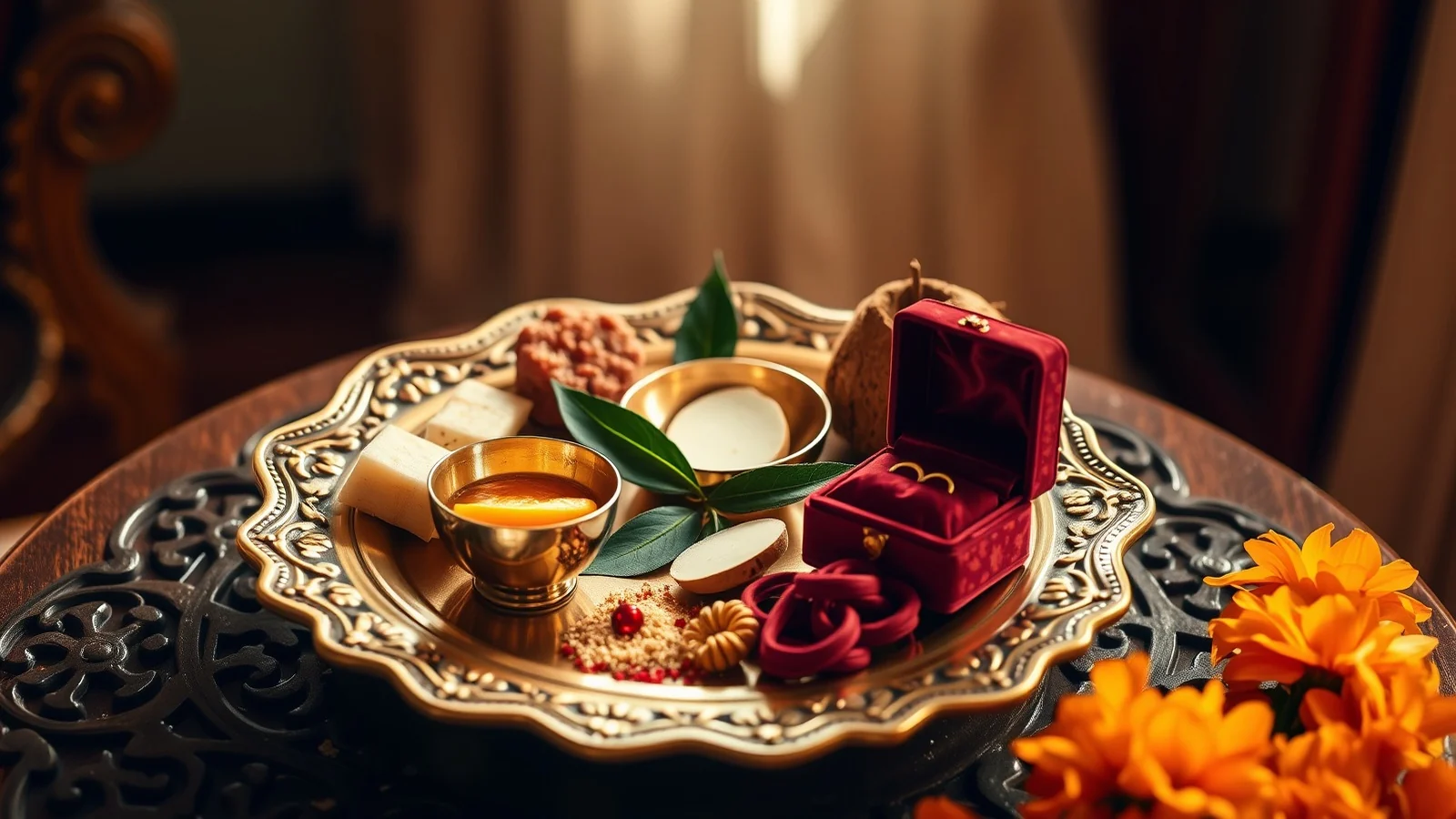
- Sagun exchange. The groom’s family presents the bride with the Sagun thali: a tray containing clothes, jewellery, sweets, dry fruits, and a fixed sum of cash. The bride’s family reciprocates with gifts for the groom and his immediate family.
- Elders’ blessings. The bride and groom (if both present, which is increasingly common in modern Rokas) take blessings from all the elders present. Family photographs follow.
- Meal. The ceremony concludes with a meal hosted by the bride’s family. Often a buffet for the 30-80 guests typical to a Roka. The meal extends 2-3 hours and is where extended family socialises.
Who attends the Roka
The Roka guest list is deliberately smaller than the wedding. Standard attendees:
- Bride’s immediate family (parents, siblings, grandparents if living)
- Bride’s close extended family (paternal and maternal uncles and aunts with spouses, first cousins)
- Groom’s immediate family
- Groom’s close extended family (smaller group than groom’s full wedding party, typically 6-15 people travel for the Roka)
- 1-2 family priests / Granthis
- 1-2 close family friends from each side (optional)
The bride and groom themselves are increasingly present at modern Rokas, particularly in urban families and inter-city couples. Traditional Marwari and conservative Punjabi families occasionally hold the Roka without the bride or groom present, with the families representing them. Both formats are valid.
What to gift at a Roka
Gift conventions for the groom’s family to the bride:
- A traditional outfit (Punjabi suit, Marwari lehenga set, or saree depending on community)
- Bridal-set jewellery (Tikka, earrings, sometimes a kada)
- A box of dry fruits or premium sweets (the Sagun thali)
- A symbolic cash amount (called Shagun), typically a number ending in 1, like Rs 1,001, Rs 2,101, Rs 5,101, or higher in wealthier families
Gift conventions for the bride’s family to the groom:
- A traditional sherwani, suit, or kurta-pyjama (depending on community formality)
- A wristwatch or ring
- Sweets and dry fruits in reciprocation
- A reciprocating Shagun amount
Roka vs Sagai vs Mangni vs Engagement
The terminology gets confusing. Here is how the major North Indian pre-wedding rites typically sequence:
- Roka: the first formal alliance-locking ceremony. Small, family-only. 3-9 months before the wedding.
- Tilak / Chhekka / Gor Dhana: regional variants of the same ceremony as Roka, OR a separate second ceremony in some Marwari and Bihari families.
- Sagai or Mangni (engagement): the formal ring exchange. Larger than the Roka (often 100-300 guests). Held 1-6 months before the wedding. Some families merge the Sagai with the Roka into a single combined ceremony.
- Engagement (Western-style): a Western-influenced ring exchange. Increasingly common in urban couples. Sometimes replaces the traditional Sagai entirely; sometimes layered on top.
Many modern families now combine the Roka and Sagai into a single ceremony for logistics simplicity. Both functions are achieved in one event with 80-200 guests. This is the most-common format we plan in 2026.
How to plan a Roka ceremony
- Fix the date. The Roka date is typically picked through a family purohit using a short muhurta consultation. Some families prefer a Tuesday (associated with Ganesha) or a Thursday (Brihaspati / Guru) for the auspicious window.
- Lock the venue. The bride’s home is the traditional choice. Modern urban families often book a small banquet hall, hotel suite, or restaurant private dining room for 30-100 guests. Budget Rs 50,000-3 lakh for the venue.
- Brief the pandit / Granthi. The family priest needs the bride’s and groom’s full names, gotra (for Hindu families), and the date confirmed. A short Ganesh puja + Mangal Path runs 45-90 minutes.
- Source the Sagun. The Sagun thali, clothes, jewellery, and Shagun cash need to be ready a week before. Most families assign this to one designated aunt who has done this before.
- Catering. A buffet for 30-80 guests at Rs 1,200-2,800 per plate is the standard. Total catering cost: Rs 50,000-3 lakh.
- Photography. A 3-4 hour photographer (and ideally a videographer) for Rs 35,000-1.5 lakh. The Roka is a major photo moment and is often the first formal family portrait of the bride and groom together.
- Decor and flowers. Light decor only: a marigold setup at the entrance, a small floral arch where the ceremony happens, table arrangements. Budget Rs 40,000-2 lakh.
- Music. A dhol player or a Shehnai musician for an hour or two. Rs 15,000-75,000.
Sample Roka budget (2026)
| Item | Cost range (Rs ) |
|---|---|
| Venue (private dining room or small banquet) | 50,000 to 3,00,000 |
| Catering (50 guests) | 60,000 to 2,00,000 |
| Decor + flowers | 40,000 to 2,00,000 |
| Photography + video | 35,000 to 1,50,000 |
| Music (dhol / shehnai) | 15,000 to 75,000 |
| Pandit / Granthi | 5,000 to 25,000 |
| Sagun (clothes, jewellery, sweets) | 50,000 to 5,00,000+ |
| Shagun cash (symbolic) | 1,001 to 51,000+ |
| Total (excluding heirloom items) | 2,55,000 to 14,50,000+ |
Choosing the wedding date
What tilak and roka cost
Related pre-wedding rituals
- the mehndi ceremony explained
- the chooda and kalire ceremony
- the sagai engagement ceremony
- chunni chadhana explained
The Roka at a glance
| Item | What is typical |
|---|---|
| When | Three to nine months before the wedding |
| Guests | About 20 to 80, from the immediate family and closest relatives |
| Length | Two to four hours, ending with a meal |
| Venue | The bride’s home, a small banquet space, or a Gurudwara in some Sikh families |
| Led by | The family pandit, or a Granthi reciting the Ardas in Sikh families |
| Core rites | Ganesh puja or Ardas, tilak for the groom, the Sagun exchange, elders’ blessings |
| Gifts | The Sagun thali, an outfit, jewellery and a Shagun amount ending in 1 |
| The couple | Increasingly present, though some families hold it without them, and both are valid |
Roka names and customs across communities
| Community | Name | Usually held at | What stands out |
|---|---|---|---|
| Punjabi | Roka | The bride’s home, or a Gurudwara in some Sikh families | Tilak for the groom, gifts for the bride, an Ardas or short puja, then dhol |
| Marwari | Roka, called Tilak in some families | The bride’s home | A formal Sagun procession, tilak by the bride’s father or eldest brother, Ganesh Puja and Mangal Path, and an exchange of coconut and rice |
| Bihari, Bhojpuri and Eastern UP | Chhekka | The bride’s home | A small puja, sweets exchanged and the alliance formally committed |
| Gujarati | Gor Dhana or Chandlo Matli | The bride’s family home | The groom’s family brings fruit, sweets and gifts, and the alliance is announced after a short puja |
| Sindhi | Berana | The bride’s home | The groom’s family visits with gifts, often alongside a mehndi-style celebration |
A combined Roka and Sagai: how the day usually runs
Most families we plan for in 2026 combine the Roka and the engagement into one event for 80 to 200 guests. The order below is a common shape rather than a fixed rule. The family priest sets the auspicious window, and everything else fits around it.
| Stage | What happens | Planning note |
|---|---|---|
| Arrival and welcome | The groom’s family is received with sweets and aarti, to dhol or shehnai | Seat the elders before the first car arrives |
| Puja or Ardas | Ganesh puja by the pandit, or the Ardas in Sikh families | Timed to the muhurta, so it is the one fixed point in the day |
| Tilak and Sagun | Tilak for the groom, then the Sagun thali and gifts | Set the gift display on a table in good light for the photographs |
| Ring exchange | The engagement rings, now usually in front of every guest | A low platform lets the back rows see |
| Blessings and portraits | The couple take the elders’ blessings, then family photographs | Keep a list of family groupings so no branch is missed |
| Meal | Hosted by the bride’s family and often running two to three hours | Confirm a firm headcount with the caterer a few days ahead |
A combined event is bigger than a traditional Roka, so it usually moves out of the home into a banquet space or a hotel, and it needs a caterer and a photographer rather than a family arrangement. Plan and budget it as a small function, not a family visit.
Also on Velvet Knot: engagement wishes and quotes.
Frequently Asked Questions
Is the Roka mandatory for a Hindu wedding?
No, it is a tradition, not a religious or legal requirement. Many South Indian Hindu families, Bengali Hindu families, and Tamil/Telugu families do not hold a Roka in the North Indian format. North Indian, Punjabi, Marwari, Bihari, and Gujarati families typically do.
Can the Roka and engagement be combined?
Yes, and this is increasingly the standard format. A combined Roka-and-Sagai runs 3-4 hours with 80-200 guests and incorporates the tilak ritual, the formal alliance announcement, the ring exchange, and the elders’ blessings into one event. Most urban Marwari and Punjabi families use this format in 2026.
Who pays for the Roka?
The bride’s family hosts the Roka and pays for the venue, catering, decor, photography, and music. The groom’s family brings the Sagun (gifts for the bride) and their own travel costs. The bride’s family reciprocates with gifts for the groom.
How many guests should we invite to the Roka?
Traditional Roka: 30-80 guests. Modern combined Roka-Sagai: 80-200 guests. Keep it deliberately smaller than the wedding so the ceremony retains its intimate, family-only character.
Can the bride and groom be present at the Roka?
Yes, and this is the modern norm. Traditional Marwari and conservative Punjabi families sometimes hold the Roka without the bride and groom present (with the families representing them), but most 2026 Rokas have both attending.
How long before the wedding should the Roka happen?
3-9 months is the typical window. Any earlier and the wedding planning calendar feels stretched. Any later and the Roka becomes redundant with the wedding itself. Most of our 2026 portfolio runs the Roka at the 4-6 month mark.
What is the Roka called in Bihari and Gujarati families?
Bihari, Bhojpuri and Eastern UP families call it Chhekka. Gujarati families call it Gor Dhana or Chandlo Matli, and the Sindhi equivalent is the Berana.
Related ceremonies on Velvet Knot
For the next ceremonies in the sequence, read our Wedding Sangeet planning guide, the Haldi ceremony guide, and the Saptapadi (seven vows) guide. For full community ritual sequences, see the Punjabi, Marwari, and Hindu wedding rituals guides. To plan your Roka with Velvet Knot, request a quote.
Sources and further reading
- Hindu Marriage Act, 1955 (text on India Code): Government of India
- Hindu wedding overview: Encyclopaedia Britannica
Begin Your Engagement
Want a real number for your wedding?
Tell us your city, guest count and dates. Team Velvet Knot will come back within 24 hours with an itemised budget.