Wedding Videographer Cost in India 2026: Cinematic Film Pricing
- What cinematic wedding film actually delivers
- Cinematic production tiers (2026)
- What’s included at each tier
- The five deliverables that move the price
- City coverage and travel logistics
- Sample budget: Couture cinematic film for 3-day luxury wedding (2026)
- What’s NOT in most videographer quotes (the gotchas)
- How Velvet Knot coordinates film + photo teams
- Streaming and aerial add-ons
- Deliverables, and when you actually receive them
- The two things that ruin wedding films, and neither is the camera
- How the film team and the photo team actually get along
- Frequently Asked Questions
- Sources and further reading
A cinematic wedding videographer in India in 2026 costs Rs 2.5 lakh to Rs 35 lakh+ depending on the production tier, crew size, deliverable complexity, and team’s portfolio. Premium cinematic film houses (Stories by Joseph Radhik, The Wedding Filmer, House on the Clouds, 7Vachan films) start at Rs 6-12 lakh for a 2-day wedding with full crew and deliverables. Boutique cinematographer-led teams sit at Rs 2.5-6 lakh. This guide is about cinematic film-making for weddings, distinct from still wedding photography.
What cinematic wedding film actually delivers
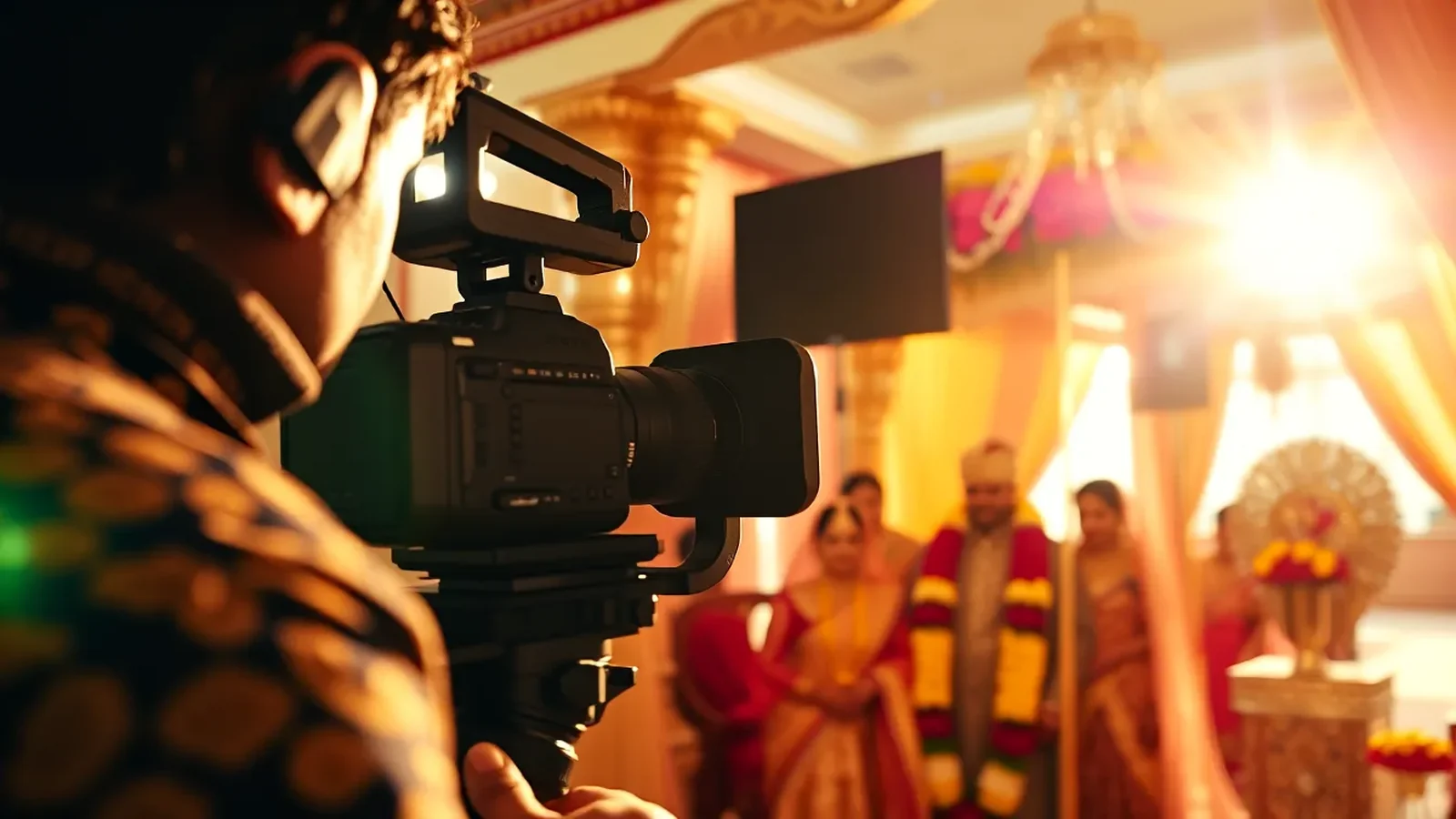
A cinematic wedding videographer is fundamentally different from a wedding photographer with a video camera. Cinematography is film-making: narrative structure, story arc, multi-camera coverage, professional audio engineering, colour-grading workflow, and editing as a craft discipline. The deliverable isn’t documentation; it’s a film of the wedding, typically 6-12 minutes for the highlight reel and 30-90 minutes for the full feature.
This guide focuses specifically on cinematic film-making teams. If you’re looking at still-image pricing, see our wedding photographer cost guide instead. Most luxury weddings hire both teams: separate, parallel, often coordinated.
Cinematic production tiers (2026)
Tier 1: Couture cinematic film houses (Rs 8-35 lakh)
The most senior wedding film studios in India. Multi-camera crews of 6-12, full audio engineering, drone and gimbal coverage, post-production over 8-16 weeks, narrative cinematography.
- Stories by Joseph Radhik: Wedding films Rs 10-25 lakh. Considered the benchmark for narrative wedding cinematography in India. Joseph Radhik.
- The Wedding Filmer (Vishal Punjabi): Rs 8-20 lakh. Pioneering wedding film studio.
- House on the Clouds: Rs 6-15 lakh. Cinematic storytelling with documentary instinct.
- 7Vachan Films: Rs 6-15 lakh. South India-strong production house.
- The Picture Patch: Rs 5-12 lakh.
- Lighthouse Productions: Rs 5-10 lakh.
Tier 2: Premium cinematographer teams (Rs 4-8 lakh)
Strong portfolio cinematographers operating 4-6 crew. Cinematic quality, focused on the bride-and-groom story rather than full-event documentation. Most commonly chosen by luxury couples balancing cinematic film with still photography budgets.
- Knot for All: Rs 4-8 lakh.
- Sweet Memories Wedding Cinema: Rs 3.5-7 lakh.
- Wedding Storytellers India: Rs 4-9 lakh.
- BluePixel Studio: Rs 3-7 lakh.
Tier 3: Boutique cinematographers (Rs 2.5-5 lakh)
Solo cinematographer or 2-3 crew. Strong individual portfolios. Good fit for intimate weddings (under 200 guests) where a smaller team can capture intimacy that larger crews cannot.
Tier 4: Documentary-style coverage (Rs 1.5-3 lakh)
Single videographer, single-day coverage, minimal post-production. This tier produces footage rather than a film: useful if you want raw documentation alongside your still photography but don’t need cinematic editing.
What’s included at each tier
Couture cinematic tier (Rs 8-35 lakh) typically includes
- Director-led production: pre-wedding consultation, shot list, story arc development
- Multi-camera crew: 4-8 cinematographers + drone operator + audio engineer + DOP
- Equipment: cinema-grade cameras (Sony Venice, ARRI, RED), professional gimbals, drones, lighting kit, full audio
- Coverage across all events: typically 3-4 days, 10-14 hours per day
- Deliverables: 6-12 minute highlight film, 30-60 minute full feature, optional 90-second teaser, raw footage on request
- Post-production: 8-16 week edit cycle, colour grading by specialist colourist, professional sound design
- Output: 4K master, social-media optimised cuts, Vimeo/private streaming
Premium tier (Rs 4-8 lakh) typically includes
- 3-5 person crew
- Coverage across 2 days, key events only
- Cinema-grade cameras, drone, gimbal
- Deliverables: 5-8 minute highlight, 20-30 minute feature
- Post-production: 4-8 week edit cycle
The five deliverables that move the price
Highlight reel length and pacing
A 5-minute highlight needs 20-30 hours of edit work. A 10-minute narrative film with multiple story arcs needs 50-80 hours. Same footage, different post-production investment.
Drone and aerial cinematography
Drone coverage adds Rs 40,000-1.5 lakh depending on whether you have a dedicated drone operator (cinematic shots) vs an occasional drone deployment by the cinematographer. Heritage palaces and beach venues benefit most.
Audio engineering
Lapel mics on the priest, couple, and parents during ceremonies are non-negotiable for cinematic sound. A dedicated audio engineer (separate from the camera operators) adds Rs 30,000-1.5 lakh but transforms the final film.
Colour grading
Tier 1 studios use professional colourists who spend 8-15 hours on the final grade. Boutique tiers do in-house colour: faster, less refined. Visible difference in film texture.
Same-day-edit (SDE)
A 90-second teaser edited and screened at the reception same night. Adds Rs 1-3 lakh; cinematically powerful moment, logistically demanding.
City coverage and travel logistics
Top cinematic studios are concentrated in Mumbai (Joseph Radhik, Wedding Filmer, House on the Clouds), Bangalore (7Vachan), and Delhi. Out-of-city travel adds Rs 50,000-3 lakh depending on crew size, duration, and equipment shipping. Destination weddings at palaces (Jaipur palaces, Udaipur palaces) or beach (Goa) almost always pull from the Mumbai pool.
Sample budget: Couture cinematic film for 3-day luxury wedding (2026)
| Line item | Range |
|---|---|
| Cinematic studio package (Joseph Radhik / Wedding Filmer tier) | Rs 10-22 lakh |
| Drone operator and aerial coverage | Rs 60,000-2 lakh |
| Same-day-edit teaser | Rs 1.2-3 lakh |
| Out-of-city travel (Mumbai team to Udaipur) | Rs 1-3 lakh |
| Equipment shipping and insurance | Rs 40,000-1.5 lakh |
| Raw footage hand-over (additional) | Rs 50,000-2 lakh |
| Total | Rs 14-34 lakh |
What’s NOT in most videographer quotes (the gotchas)
- Raw footage hand-over: Most studios retain raw footage; if you want it, Rs 50,000-3 lakh extra
- Reception-day extra crew: If your reception extends beyond contracted hours, Rs 40,000-1.5 lakh per extra hour
- Additional edit revisions: Tier 1 studios typically allow 2 revision rounds; further rounds Rs 20,000-80,000 each
- Soundtrack licensing: Most studios use stock-licensed music; popular Bollywood track licensing for film use Rs 50,000-3 lakh
- Multi-format deliverables: If you need 4K, vertical social cuts, and 90-second teasers all separately, add Rs 40,000-1.5 lakh
- Coordination with photography team: Better when planner-managed; otherwise the two teams clash for shot positions
How Velvet Knot coordinates film + photo teams
For luxury weddings, we run cinematic film and still photography as a single coordinated workstream: shot-list alignment, timeline coordination on the wedding day, equipment positioning, and deliverable scheduling. Request a quote.
Streaming and aerial add-ons
Deliverables, and when you actually receive them
Almost every dispute with a wedding film team is about timing rather than money. The
quote lists what you get; it rarely says when. Agree the delivery window in writing at the
same time as the fee, and agree what happens if it slips.
| Deliverable | Typical length | Usual delivery window | What delays it |
|---|---|---|---|
| Teaser or social reel | Under a minute | Days after the wedding | Rarely delayed. It is the team’s own marketing, so it is prioritised |
| Highlight film | A few minutes | Weeks | Music licensing, and the edit queue behind other weddings in peak season |
| Feature or documentary cut | Substantially longer | Months | The volume of footage, and how many rounds of changes you are entitled to |
| Full ceremony edit | Runs to the length of the rites | Months | Usually the last thing delivered, and the one most often forgotten in the contract |
| Same-day edit | A few minutes, shown at the reception | The same evening | Nothing, but it needs a dedicated editor on site, which is a separate line item |
| Raw footage | Everything shot | On request, if agreed | Many teams do not hand it over at all. Ask before signing, not after |
Two clauses are worth insisting on. How many rounds of revisions are included, because
“unlimited” is never true and the second round is where families start disagreeing. And how
long the team retains your footage, because a hard drive failure two years later is a
question of their archive policy, not your luck.
The two things that ruin wedding films, and neither is the camera
Couples compare showreels and camera bodies. The two failures that actually spoil a
wedding film are elsewhere.
Audio. A beautiful shot of the vows is worthless if you cannot hear
them. Good teams put a lapel microphone on the groom and on the officiant, and take a feed
from the sound desk for speeches. Cheaper coverage records everything from the camera at
the back of the room, which means you hear the room and not the ceremony. Ask directly how
audio is captured at the ceremony and at the speeches, and treat a vague answer as an
answer.
Drone rules. Aerial shots are quoted casually and are the most
regulated part of the day. In India drones must be registered and are flown under the civil
aviation rules through the national digital platform, airspace is zoned, and flying near an
airport or over a restricted area needs clearance rather than confidence. Many heritage
properties and protected sites prohibit drones outright regardless of national rules. Before
paying for aerial coverage, confirm three things in writing: that the operator is properly
authorised, that your specific venue permits it, and what happens to that line item if
permission is refused on the day.
How the film team and the photo team actually get along
Photography and film are quoted separately and then have to occupy the same three square
metres at the most important moments of the day. Whether that works is a planning question,
not a talent question.
- One team or two. Booking both from the same studio removes the
negotiation entirely: they have worked out who stands where. Booking separately gets you
the best of each discipline and a coordination problem you own. - Agree the pecking order for three moments. The garland exchange, the
solemnising rite and the vidaai. At each, one discipline gets the primary angle and the
other works around it. Decide in advance, in the run-of-show, not by elbow on the day. - Lighting is the real flashpoint. Film needs continuous light,
photography uses flash, and each ruins the other’s frame. This is settled at the venue
recce with both teams present, which is a meeting couples rarely schedule and always
should. - Brief both on the rites, not the schedule. A team that does not know
the solemnising moment is coming will miss it. In South Indian ceremonies it can be over in
seconds and it is often before dawn. - Feed them and give them a base. A twelve-hour day with heavy kit and
no room to change batteries produces worse footage after hour eight. This costs almost
nothing and is visible in the final film.
If you take one thing from this section: put the photo lead and the film lead on the same
call before the wedding week. It is a twenty-minute conversation that prevents the most
common cause of disappointing coverage.
One last item that surprises couples. The music under your highlight film is licensed,
and the popular track you had in mind usually cannot be cleared. Teams work from licensed
libraries for exactly this reason, and a film scored to a chart song is one that can be
muted or taken down when it is posted. Ask early what the team can legally use, and if a
specific song genuinely matters to you, say so at the briefing rather than at the first
edit, when changing it means rebuilding the cut around a different tempo.
Frequently Asked Questions
What is the difference between a wedding videographer and a cinematic wedding film-maker?
Videographer documents the event; cinematic film-maker tells a story from the event. Different production approach, different equipment, different post-production craft, different price tier. Most luxury weddings hire the cinematic tier for the wedding day and a documentary videographer for less-important events.
Should we hire the same studio for both photography and videography?
Some studios offer both (Stories by Joseph Radhik, 7Vachan), and bundling can save 15-25%. Others specialise in one or the other and excel at it. The trade-off is convenience vs picking the strongest specialist per discipline.
How many cameras do we need for a luxury wedding film?
Minimum 3 cameras for ceremony coverage (wide, mid, close), 4-6 cameras for reception with stage and audience coverage. Tier 1 studios deploy 6-12 cameras across the wedding day for narrative cinematography.
How long does post-production take?
Couture tier: 12-20 weeks for full delivery. Premium tier: 8-12 weeks. Boutique: 4-8 weeks. Same-day-edit teaser turnaround is 3-6 hours during the wedding itself.
Sources and further reading
Begin Your Engagement
Want a real number for your wedding?
Tell us your city, guest count and dates. Team Velvet Knot will come back within 24 hours with an itemised budget.